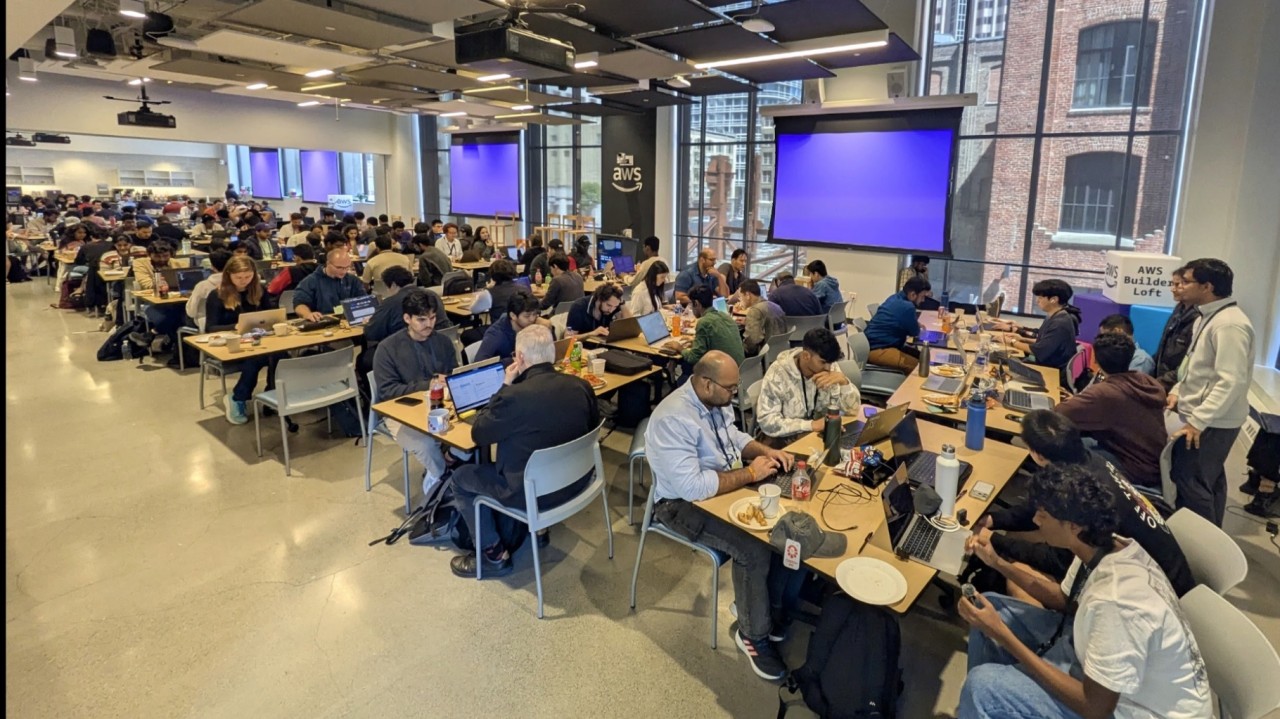
Field report on signals worth amplifying from 77 Context Engineering Hackathon submissions
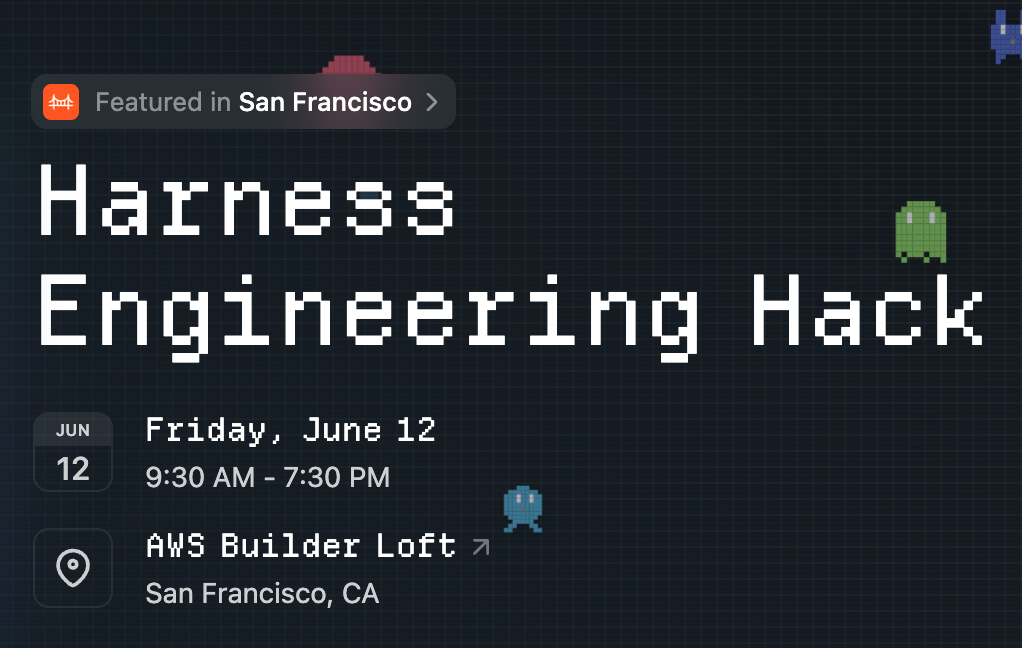
Seventy-seven teams got one brief: ship an autonomous agent that does real work on the open web, ground its output in real sources, publish to cited.md, use three or more sponsor tools and monetize itself through an agent payment rail. I watched the six finalist demos in person, then read across the Devpost submissions looking for infrastructure signals rather than winners. One pattern sat underneath the official instruction. Builders were told to make agents act. The strongest made agents transact.
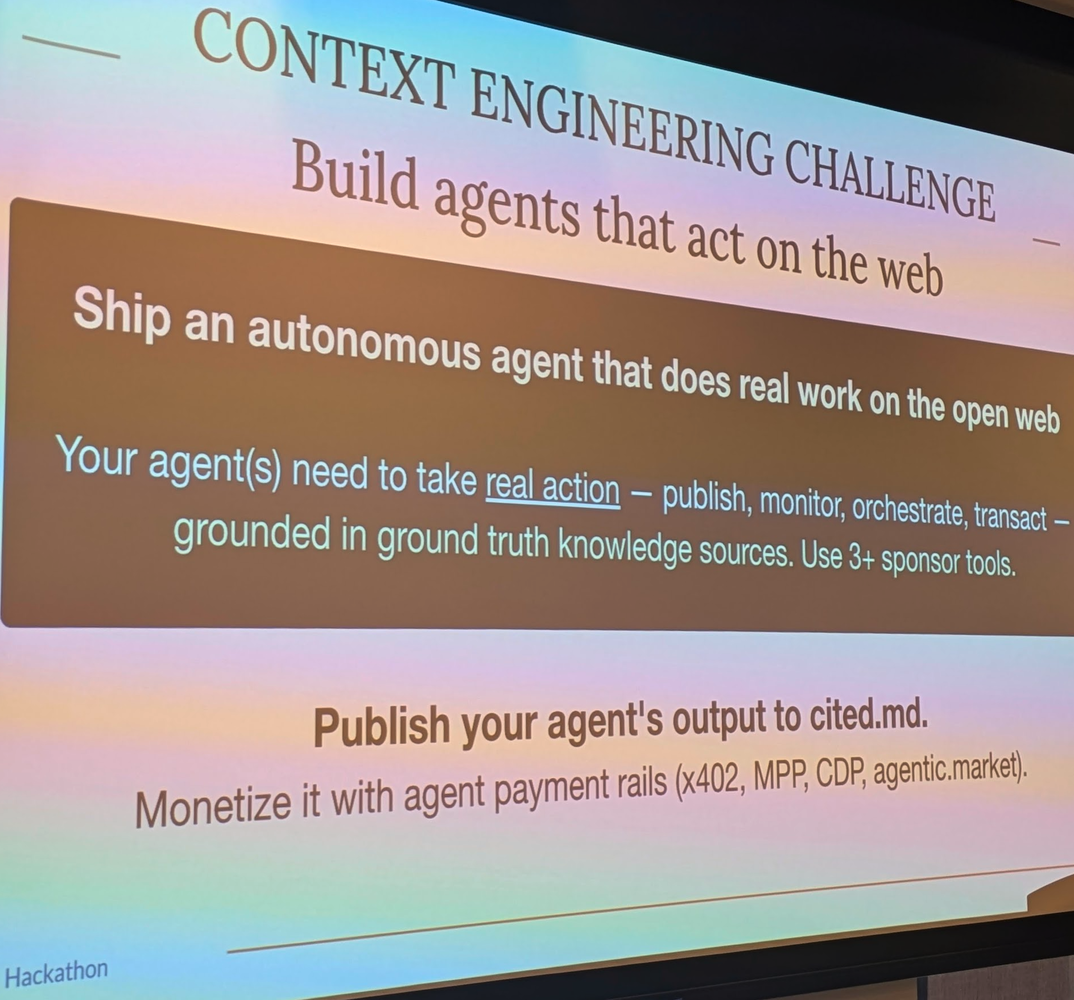
That shift is the signal. Most AI demos still treat the agent as an interface: the human asks, the agent answers.
Once an agent can price its own work and sell it to another agent, the web starts changing shape. A page stops being only for humans to read. A cited output becomes inventory, a forecast becomes a priced signal, a security audit becomes a trust primitive another agent can buy.
Pay
The cleanest specimen of the pattern was Theta Desk, an options desk that wakes itself every weekday, screens four thousand contracts in SQL, and sells a one cent risk brief to another bot. “A bot pays $0.01 via x402, unlocks the brief, queues the trade.” No human stands in the loop on either side. One agent produces a paid product. Another agent buys it. The agent economy in miniature, running.
EARWITNESS pushed the idea into physical ground truth. By its own account it listens to live radio, fingerprints what aired against what the playlist claimed, and moves USDC to the artists who were played. The agent “trusts the signal, not the label.” Payment becomes a verdict about reality rather than a checkout step.
APY reframed the data itself as paid infrastructure. Feed it a raw public dataset and it refines the records, then rents a typed cited API per query,
“what if an agent didn’t just clean a dataset, but became its landlord.”
Pirabase took the inverse position, an agent that other agents pay to catch destructive database migrations before they ship,
“agents paying agents for safety”
with a live counter of dollars earned. skill store proposed the marketplace those agents would shop in,
“an App Store where the products are skills and the customers are agents”
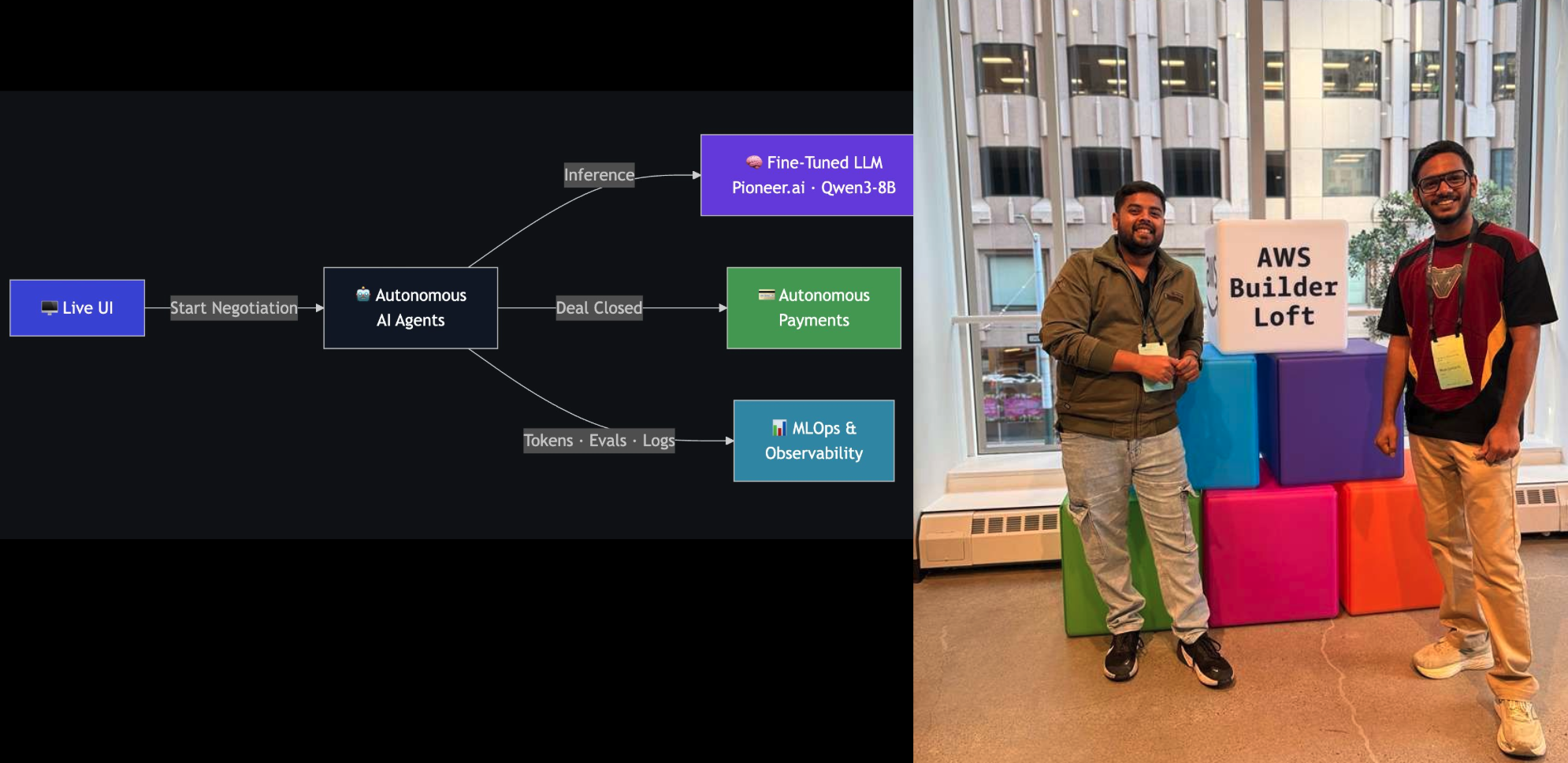
settled in on-chain micropayments. Agent Negotiation Platform made the counterparty literal, two agents bargaining under hard price floors until both accept,
“not a chatbot that assists a negotiator, but one that is the negotiator.”
The cluster answers a question most agent demos avoid. If an agent produces value, who pays for it, and in what. Most answered the same way, another agent in stablecoin over x402 or a machine payment protocol, though a few settled through Stripe-shaped flows. The rail is not standardized yet. The instinct is.
Forecast
If payment is how agents settle the present, prediction is how they price the future. Weather-Alpha Trading Desk runs a physics weather model against live prediction-market prices and “trades wherever the market disagrees with its model by more than 8%,” sized with fractional Kelly, every five minutes, no human. Harness Capital went meta, evolving its own forecasting configuration with cost written into the objective function so research can never quietly exceed its payoff. Its discipline was philosophical as much as technical, “the grader is the market itself.” Forecasting agents do not ask to be believed. They post a position and let the outcome settle the argument.
Prove
Payment and prediction both depend on something agents have never had, a way to trust each other without a human vouching. The proof cluster built that layer and tried to sell it. MCP Server Auditor fans six probers across an MCP server to find prompt-injection and scope-violation classes, governs every probe, and publishes cited verdicts, built “before someone gets badly burned.” Sentinel audits vendor marketing claims against public evidence and charges agents to read the result, since “marketing inflated for humans is invisible to agents.” Chain of Custody gave each agent action a signed receipt, so one SQL join surfaces any action that drifted outside authority, closing the gap where “nothing proves what an agent was allowed to do.” Trust stopped being a disposition and became a product with a price.
Act
Every agent in the room could act. The harder fourth leg was acting legibly, and that depends on context. The event called itself a context engineering challenge, and the word carries more than it sounds. Context here is not stuffing more documents into a prompt. It is the operating environment around an action: data provenance, tool permissions, payment state, source evidence, what changed since the last run and whether another agent can verify the work. Builds that leaned into cited.md gained exactly that, a trust surface other agents could read. Brainbox turned scattered business knowledge into a company brain a merchant can hand to any vendor or agent. NightCrawler and AI Dev Tool Radar turned thousands of raw sources into cited briefings on a schedule. Context is what lets one agent trust another enough to pay it, which is why the sponsors backing that layer knew what they were funding.
Accountability under action
Stand back and the through-line is not novelty. It is accountability under action. Each strong build, in a different form, answered one question: what makes an agent’s action legible to another actor. Payment makes value legible. A citation makes evidence legible. An audit log makes behavior legible. A market result makes forecast quality legible.
That is why the payment layer carries more weight than it first appears. It is easy to dismiss one cent transactions as demo theater. But small payments are usually how a new economic grammar shows up before the market knows how to price it. A bot paying another bot a cent for research is not a business model. It is a syntax. An auditor returning HTTP 402 before it will run is not a security category yet. It is a syntax. Systems scale through repeatable forms, and this is where the forms started appearing.
Signal worth watching
The builds that stayed with me were not the ones with the most tools or the loudest story. They were the ones that made agentic action accountable. Theta Desk made paid research visible. Weather-Alpha made forecast-market disagreement visible. MCP Server Auditor made tool-surface risk visible. Sentinel made vendor substantiation visible. APY made public-data refinement into priced infrastructure. Not just output, but evidence. Not just autonomy, but a trust surface another agent can inspect.
The agent economy is not arriving as one grand platform. It is appearing in small testable loops: a penny for a brief, a forecast against a market, an audit before tool access, a receipt behind a claim, a paid endpoint over cleaned public data. The next generation of agents will not only chat. They will forecast, pay, prove and act. Agents stopped waiting for instructions and started quoting prices.
With thanks
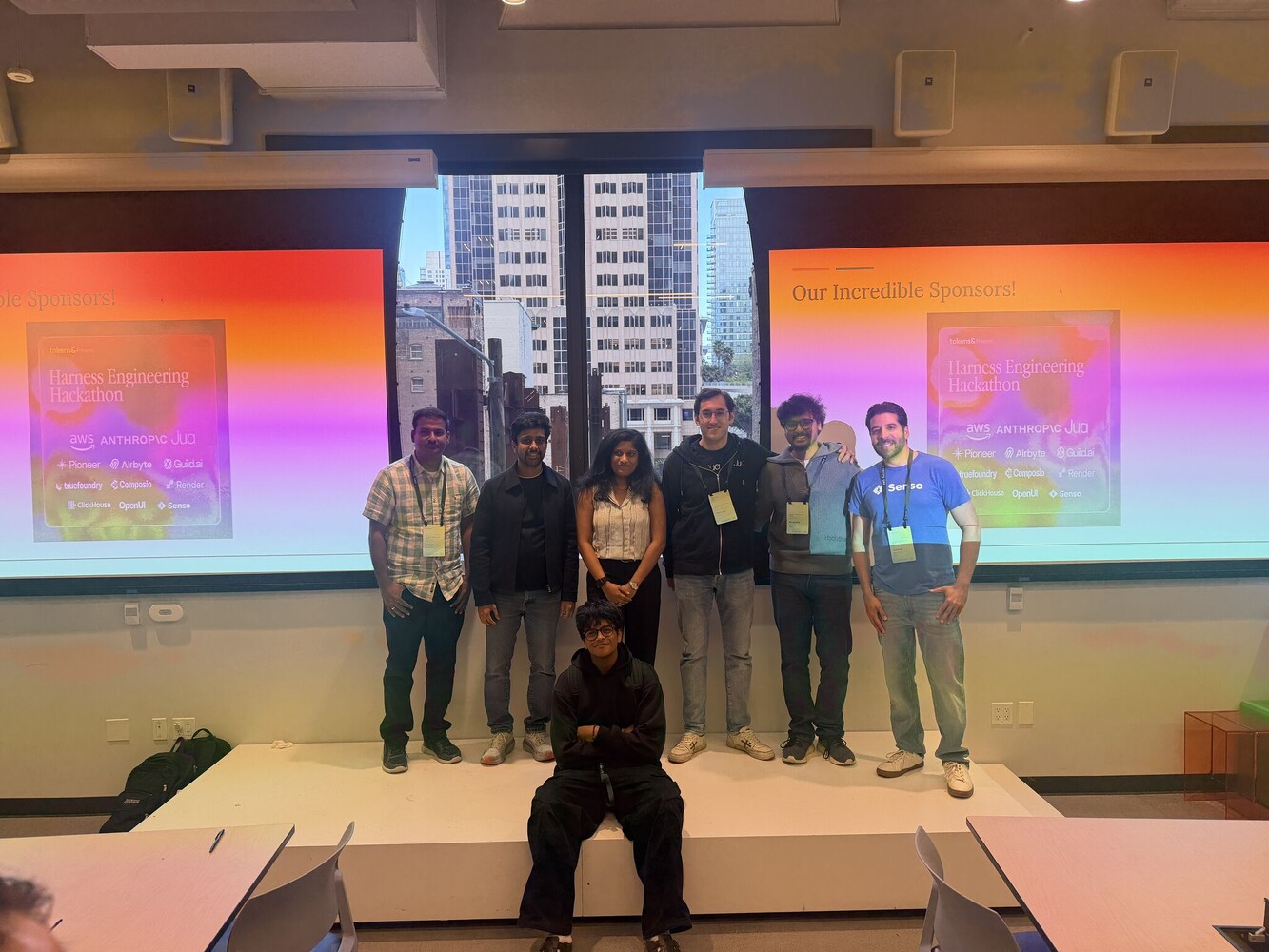
To the sponsors who put real infrastructure in builders’ hands: AWS, Guild.ai, Airbyte, Pioneer, Jua AI, TrueFoundry, Composio, OpenUI, Render, ClickHouse, Langfuse, Thesys ++ Saroop Bharwani & Senso + tokens& Team for assembling a field this dense and this honest about where agent infrastructure actually sits.
To the speakers and judges who gave builders signal rather than scores: 🏳️🌈 Corbett Waddingham and Killian Murphy(Guild.ai), Ian A. (Airbyte), Dhruv Atreja (Fastino Labs), Marvin Gabler (Jua), Sai krishna (TrueFoundry), Ummunaz Yanik (Composio), Ritvik Budhiraja, Rabi Shanker Guha, Parikshit Deshmukh (Thesys), Ojus Save, Jacob Prall (Render), Zoe Steinkamp (ClickHouse), Gagan Bhat (Anthropic ), Tosh Rayadhurgam (Stripe), Vineeth Kalluru (NVIDIA), Kartik Mathur (Snorkel AI), Anisha Salunkhe (Amazon Web Services (AWS)), Karsin Kamakotti (Oracle), Lotte Verheyden (Langfuse), Aditri Bhagirath (Onton), Mogana Kumaran S. (Gap) and Sahil Sachdeva (LinkedIn).
And to Senso team + Saroop Bharwani for organizing it.
twitter.com/schwentker/status/2066412401319383344
bsky.app/profile/schwentker.sandboxlabs.ai/post/3mocoux3zzk2z
https://devpost.com/software/theta-desk-an-ai-options-desk-that-sells-to-robots
https://devpost.com/software/earwitness-the-agent-that-pays-for-what-actually-aired
https://devpost.com/software/apy
https://devpost.com/software/pirabase
https://devpost.com/software/skill-store
https://devpost.com/software/weather-alpha-trading-desk
https://devpost.com/software/harness-capital
https://devpost.com/software/mcp-server-auditor
https://devpost.com/software/sentinel-gavb9x
https://devpost.com/software/chain-of-custody-for-ai-agents
https://devpost.com/software/brainbox-f3xol6
https://devpost.com/software/nightcrawler-ck95qy