A Meetup, A Map & Question About What Agents Might Instill
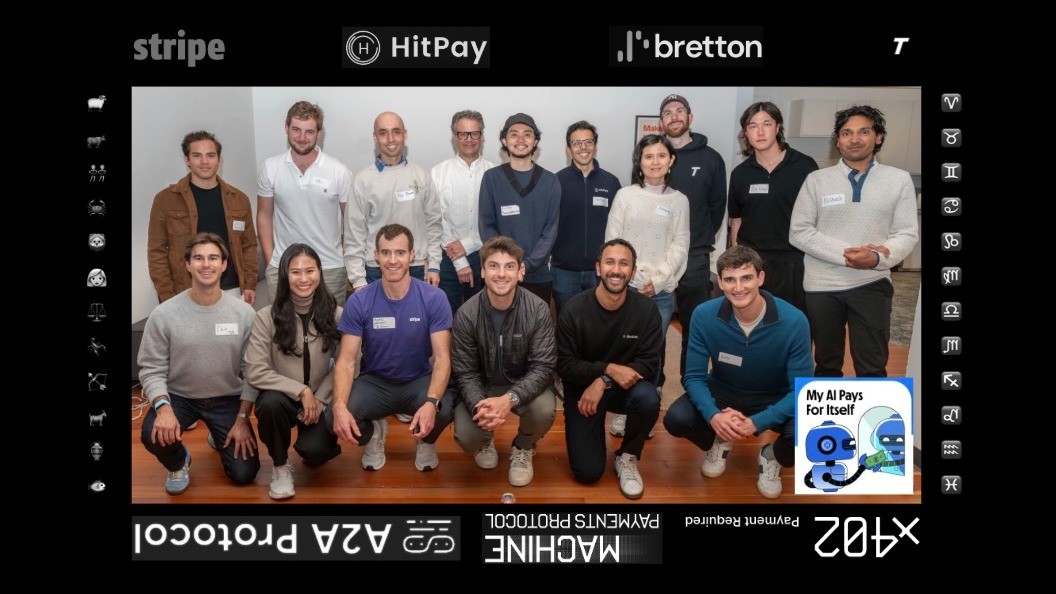
The Meetup
Stripe Sessions 2026 had just wrapped when a handful of builders gathered at Bretton AI HQ in San Francisco, demoing a gestalt-ish spectrum of agentic commerce apps built across MPP, x402, link wallets, stablecoins, A2A, and UCP. In the room were the Stripe experimental projects team, the MPP protocol lead, and the founders of Bretton and HitPay. My demo slotted into the unapologetically avant garde category.
Artiji.xyz * What?
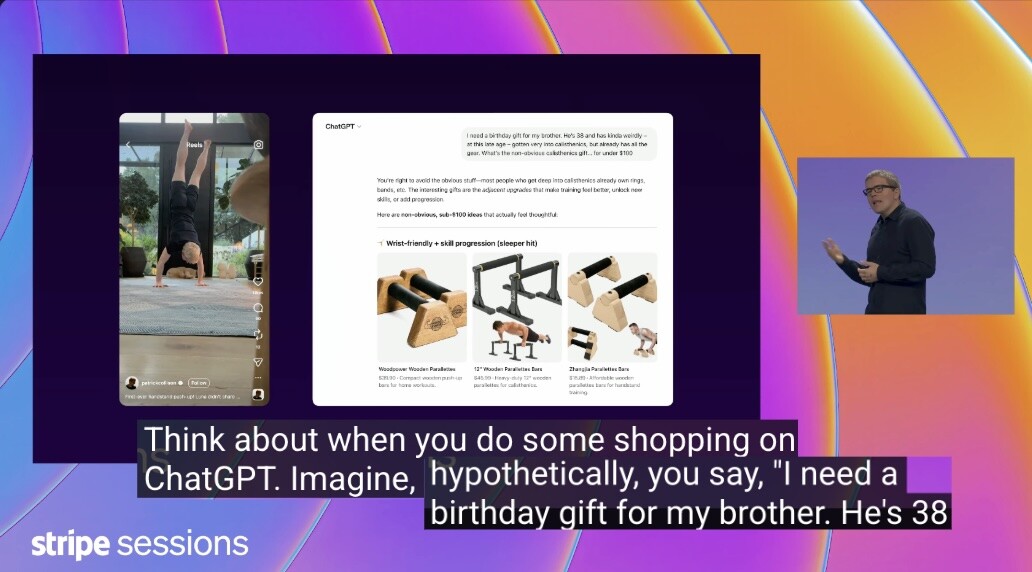
A week earlier, in a Stripe keynote, John Collison told a small story about trying to figure out what to send Patrick Collison. He landed somewhere around a hundred dollars. A normal founder problem. What do you give the person who has, you know, Stripe.
I had been sketching a side project to compare ancient prediction systems with modern recommendation systems. Same question, really: given a person, given a moment, what might a pattern suggest? The keynote nudged the sketch sideways into a thought experiment.
What if the gift was a built map, not a guessed one? Not jewelry, not a book, not another piece of merch. A symbolic intelligence map of the recipient, with a timing meter that says where they are in their own arc. Not a prediction. A mirror with rhythm.
That sketch is now a site called Artiji. It is less than a week old. Soft launching it here.
Calling Artiji an astrology site is technically true and almost completely misleading, the way calling a celestial navigation system “looking at stars” is technically true. Yes, the inputs are astronomical. The output is closer to a personal coordinate system: a chart that tries to describe how someone moves through the world, and what season of that movement they are currently in.
I am aware this lands awkwardly in a feed that mostly talks about distributed systems.
The interesting claim is not “the planets decide.” The interesting claim is that humans organize their lives through more than optimization. Timing matters. Symbolism matters. Memory and relationship and meaning matter. If you have ever waited until the right hour to send a message, or felt that a launch had a wrong week to it, you already use a folk version of this. Artiji is an attempt to build a more honest version, as infrastructure, not as oracle.
The site currently will sell two things to humans: a short reading at $25, a long reading at $100. The site also says “Agents Only” in a few places, which is a small joke about where this is going.
The Sessions
Here is where it gets fun for the protocol people.
The demo I ran at the meetup was a primitive command line client pretending to be an agent. Imagine a near future where someone tells Claude or GPT or Gemini, “find an astrology gift for a friend,” and the model has to figure out the rest.
Step one, the agent fetches llms.txt from artiji.xyz. It learns what the site is, what it sells, how to talk to it. It then looks at agent.md, which spells out endpoints, integrations, payment flow. Catalog, SKUs, pricing, methods.
Step two, the agent tries to buy. The site responds with an x402 challenge, a polite “pay to proceed.” The agent picks an item, a horoscope, and the system creates a payment link. Twenty five dollars in the demo, payable via HitPay sandbox today, with the longer term ambition of stablecoin payment on Tempo. The flow uses a shared payment token (SPT) rather than a Stripe token, which is the small but real distinction that makes machine to machine commerce different from human checkout.
Step three, the agent passes a small humane test. Before delivery, it has to do something only an actual agent would bother with: a birth time rectification for Joan of Arc, using significant life events to triangulate her rising sign. Half puzzle, half proof of agency. A receipt then goes to the agent’s inbox. The gift goes to the recipient.
None of this is fully production today. No chatbot can yet autonomously order a reading. The protocols are not mature. Human ordering comes first. But the scaffolding is there, and the gap is closing faster than many may realize.
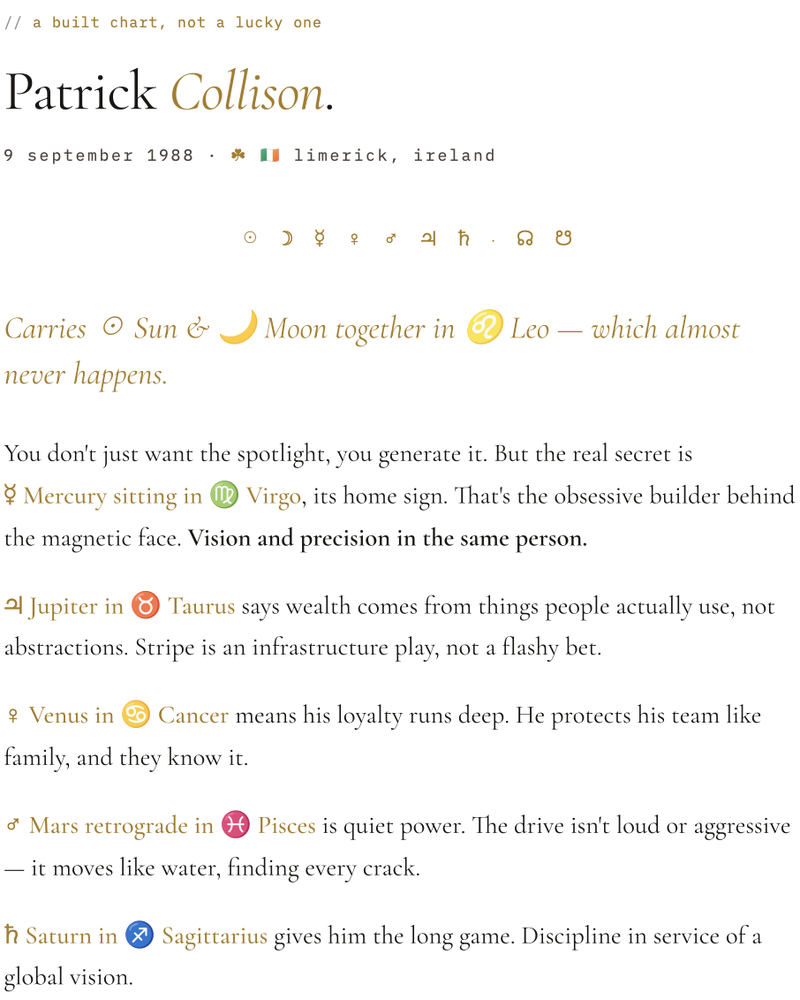
Because the original prompt was ‘what do you buy the founder who built Stripe,’ the demo card ended up being Patrick’s - born in Limerick, Ireland. September 1988. Without descending into the technical vocabulary, here is what the map says, translated into language a builder would recognize.
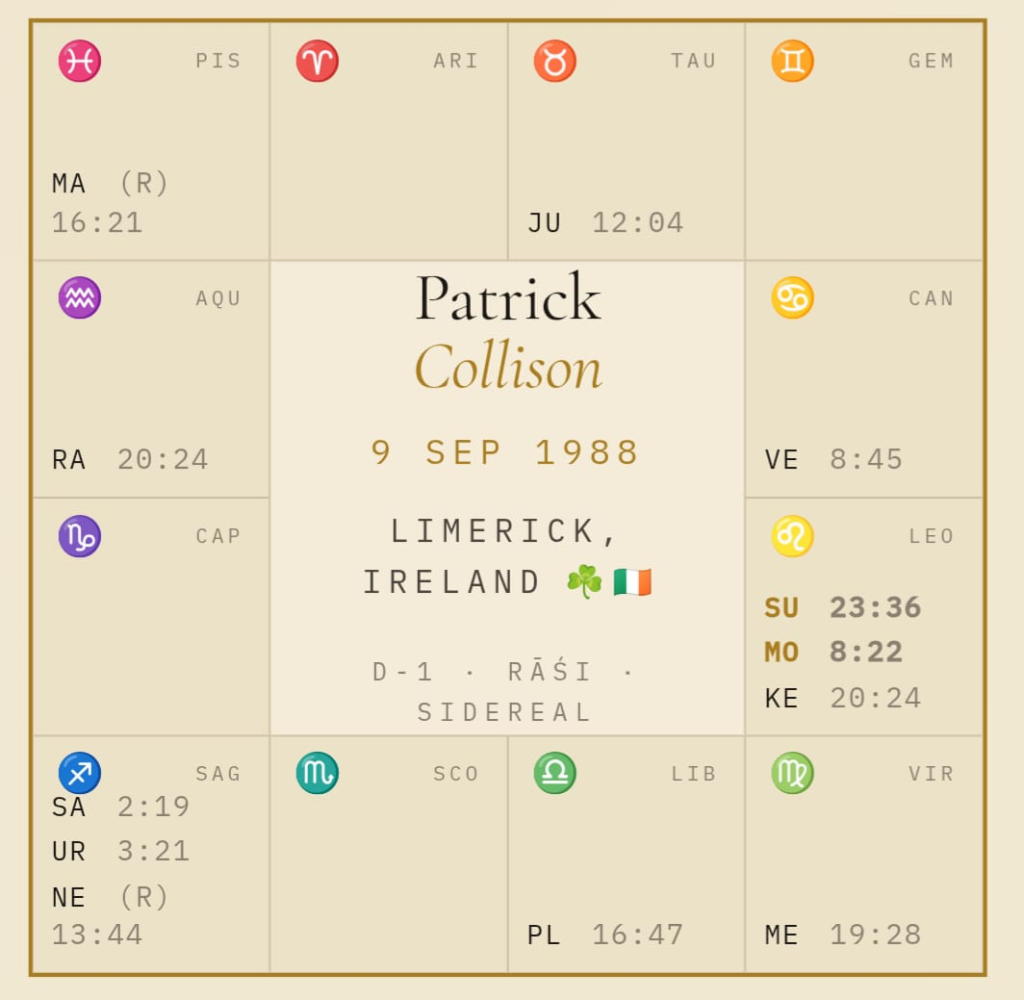
He carries an unusually concentrated signature: vision, identity, and expansion clustered in the same region. Companies with that kind of coherence tend to feel larger than their headcount. Stripe has always had that quality.
The signal tied to cognition and craft sits in its strongest possible position. Precision is not layered on top of the vision; it is the vision. If you have ever read Stripe’s docs, you can feel it immediately.
Another major signal points toward utility over spectacle. Infrastructure instead of theater. Wealth through systems people quietly depend on.
Elsewhere, the pattern suggests unusual loyalty, long-horizon discipline, and a style of movement that behaves less like force and more like fluid dynamics: finding openings, reducing friction, compounding over time.
You can decide for yourself whether this is post hoc storytelling or pattern recognition. I find that question more interesting than its answer.
The card ends as limericks, because the site has a sense of humor about itself:
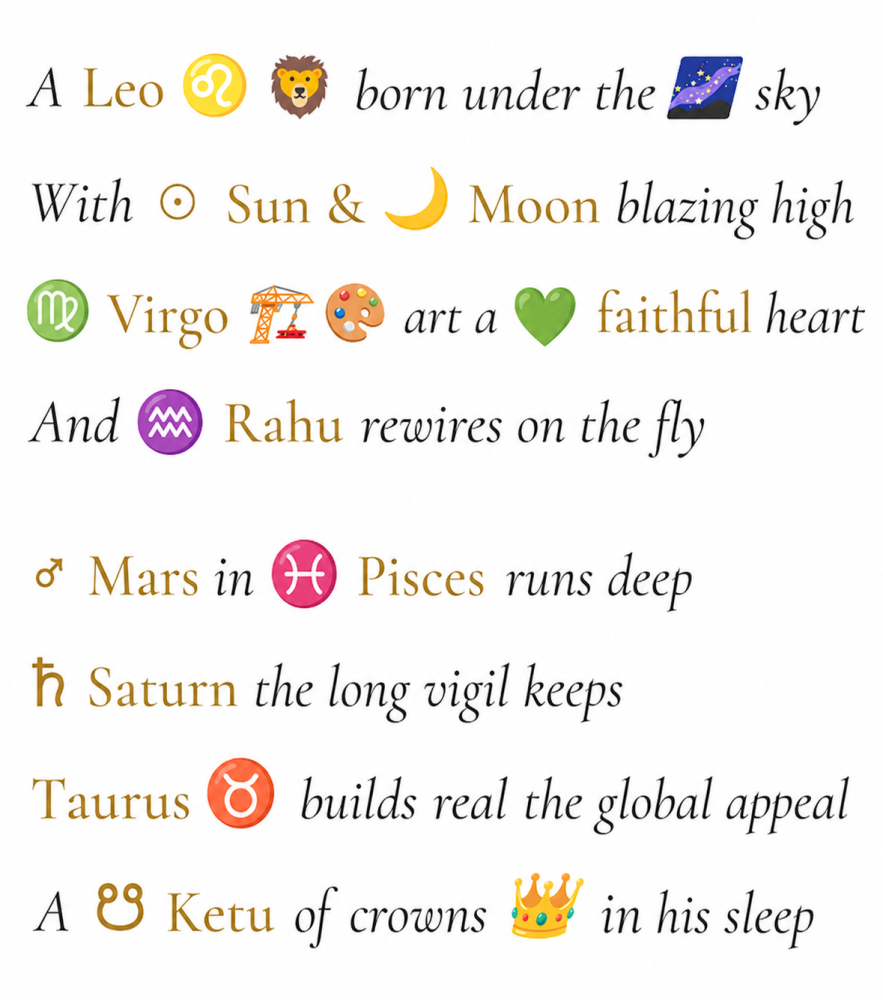
A Leo born under a sky with sun and moon blazing high, Virgo art, a faithful heart, and Rahu rewires on the fly. Mars in Pisces runs deep, Saturn the long vigil keeps, And Ketu, node of the moon, crowns him in sleep.
Why Cosmic Intel, Now
Out of curiosity, I ran Artiji itself through the same kind of map. A cosmic DNA chart for the project. A soul.md, a brand.md, a manifesto.md. Worth underscoring: this is a tool, not a religion. Founders also have charts. Companies have charts. Whether you believe the inputs are causal or merely correlative, the outputs are useful as a Rorschach for the team.
Artiji’s chart describes tensions I did not write into the brief: strong fire, deep water. A systems builder with a philosopher’s nervous system. A pull toward public contribution. And one line I love savoring: can reflective intelligence survive optimization culture?
If you are a founder reading this, you can probably feel which axis your own company sits on. You also probably know when it shifted, and what shifted it. There is a version of this that becomes useful diagnostic infrastructure for early teams: launch timing, board dynamics, founder compatibility, organizational pacing. We in Silicon Valley have commenced the journey to spend a decade building agents that negotiate identity, memory, payment, coordination, recommendation, and context on our behalf. Most of the energy is going, correctly, into making those agents efficient, safe, and verifiable. x402, MPP, MCP, AT Protocol lexicons, cryptographic receipts. This is good and necessary work, and the people in that room last week are doing it extremely well.
But efficiency is not the only thing humans need accompanying them. We also navigate by season, by relationship, by symbol, by the felt sense that this is the wrong week to send the email. Artiji is an early sketch of: reflective infra for agents moving observatory rather than oracle pattern mirror rather than prediction machine timing interface rather than certainty engine
So the question I left the meetup with:
Artiji is live, quietly, at artiji.xyz. Humans first. Agents soon.
Many thanks for event organizers, Stripe, Tempo, HitPay, Bretton AI teams including Shi Tong Tan (Steph) Brendan Ryan Mark Moriarty Chip Specker Aditya Haripurkar Will Lawrence & Kofi Dodi <– man behind the shutter! 📸