Stripe Sessions 2026: Field Notes
Two days at Moscone, where infrastructure for non-human buyers got built and almost nobody on stage called it crypto.
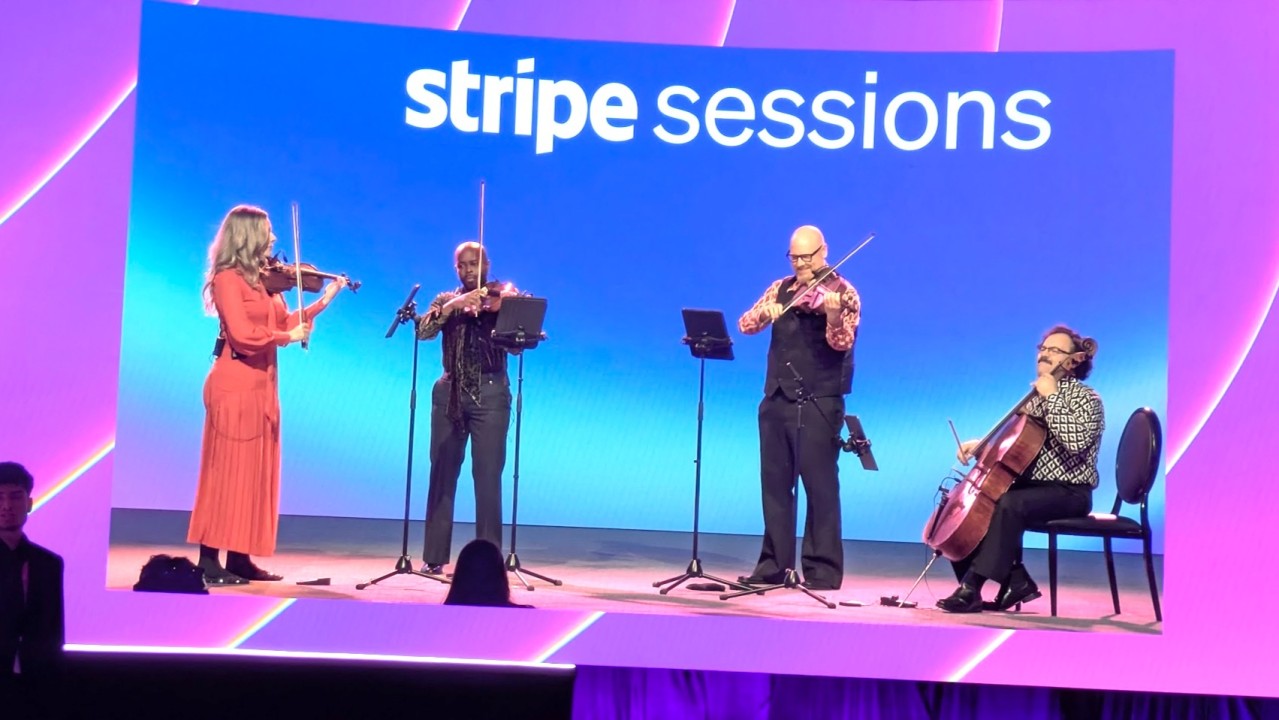
PUBLIQuartet played the Bridgerton theme song at 8:43 a.m. on Day 2 of Stripe Sessions 2026, and half the room hadn’t found a seat yet. A four-piece string ensemble warming a hall built for product launches: Stripe’s tell that cultural register matters. Twenty minutes later John Collison would project a chart of Solow’s productivity paradox over their stillness. Hundred-year-old electricity story. Familiar shape. Different stakes.
Collison’s keynote laid down a series of ambitious bets on how rapidly the internet economy will actually digest this new intelligence. Two days at Moscone meant testing those bets against what Stripe, Shopify, Meta, OpenAI and the new stablecoin teams put on stage. The questions were practical. Whether merchants are actually building for agent buyers, or still hedging. Whether stablecoin rails have stopped being religious and started being architectural. Whether the new fraud surface is what’s quietly driving PSP migrations among AI-native merchants. Whether enterprise teams are roadmapping payments-as-policy for 2026, or still waiting for someone else to go first. Each answer arrived in a different room.
Day 1 Keynote
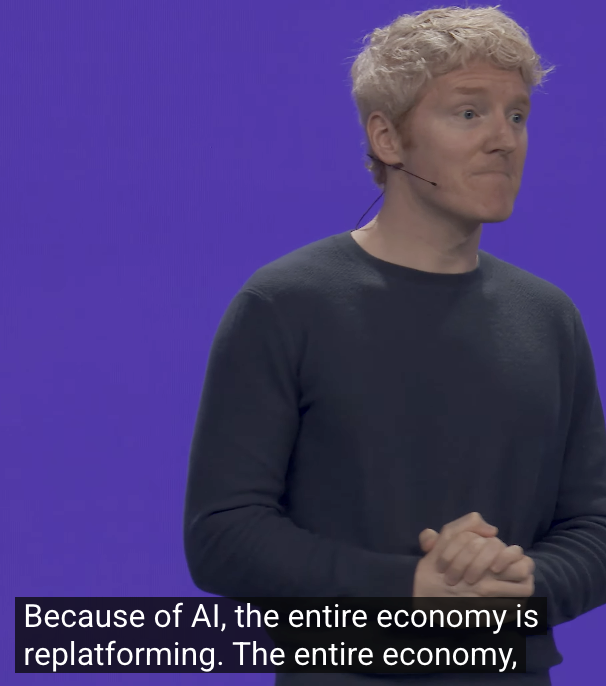
Patrick Collison opened with the line that became the conference’s spine: “the entire economy is replatforming.” A new-business-formation chart curved vertical from January. The line is a joke until it isn’t. Stripe processes nearly 2% of global GDP. When that platform reframes its product surface, the reframing is itself an economic event.
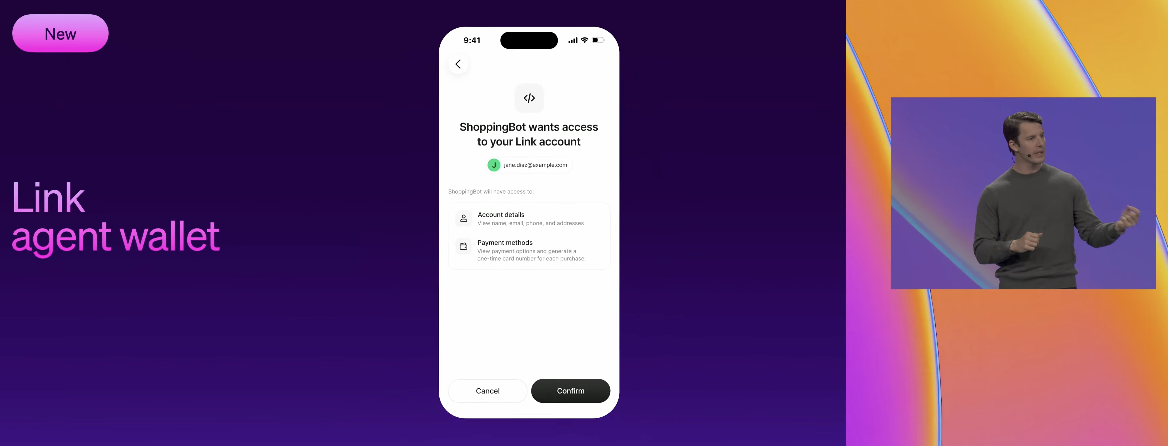
William Gaybrick the stage and ran a live agent-to-agent payment. One Claude instance deployed an API review service via Stripe Projects. A separate Codex instance discovered it, parsed the Machine Payments Protocol headers, requested a $2 review, got routed to Link’s new wallet for agents, got human approval via fingerprint, and the payment settled. On stage. With the demo gods cooperating.
The merchant question got answered in that demo. Watching two LLMs transact autonomously without either of them being told about MPP or Link in the prompt is the difference between a protocol that exists and a protocol that’s already absorbed into the agent harness layer. “Agents are autonomous economic actors” was Gabbrick’s framing, and the demo earned it.
Numbers followed. Anthropic, OpenAI, Cursor on Radar. ClawHub showing six-figure cumulative downloads of payment-related skills inside twelve weeks. Less experimental than that sounds. The agent harness is being treated as a deployment target.
Worth pausing on Link Wallet for Agents specifically. Watched as a checkout flow, it looks like one more wallet integration. Watched as a control surface, it is something different: programmable spend rules, agent-tagged credentials, per-transaction approval, budget caps that route through the human only when policy demands it. This is the primitive that makes Ginger Baker’s framing from later in the day operational. Payments stop being a moment. They start being a policy.
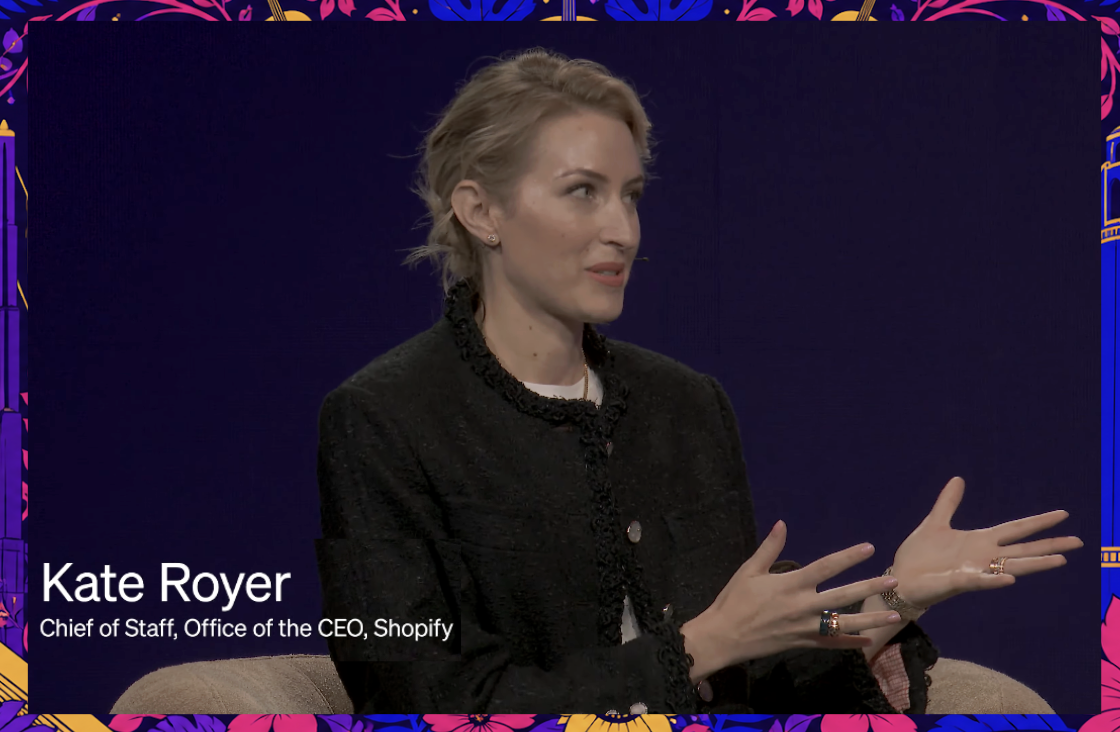
Kate Royer came on later to confirm the protocol picture. Shopify becomes the preferred catalog provider for the Agentic Commerce suite. Then she dropped the slide that mattered: “Meta, Amazon, Salesforce and Microsoft are joining UCP.” Universal Commerce Protocol now has the four hyperscalers Stripe was trying to align. Whatever fragmentation the agentic-commerce stack threatened to create has just been short-circuited at the protocol layer by the four companies most able to fragment it.
Half the room understood what they had just watched. The other half clapped politely. That gap, between what’s already operational at the substrate and what the room can metabolize, is the actual subject of the conference. The infrastructure is ahead of the comprehension. By a lot.
For enterprise advisors: the question to retire is whether clients should accept agent payments. The question to surface is which catalog format, which protocol commitments and which wallet integrations get committed to in Q3 of this year, before peers commit and supplier terms harden.

Sam Altman, Closing Day 1
Sam Altman took the closing fireside slot on Day 1. The slot was originally Greg Brockman’s. The substitution is itself a small data point: AI org calendars are too volatile for stable lineups, and Sessions adapted in real time.
Patrick asked why coding models suddenly clicked late last year. Altman hedged, then offered something more useful: a thesis on what OpenAI wants to be.
“I would like us to be an infrastructure provider.”
Forever-low-margin, huge, growing fast. A token meter for the world.
The largest AI lab is publicly choosing the utility model. Not the platform-eats-the-stack model. Not the everything-app model. Utility. Explicit alignment between how big the customer gets and how much OpenAI charges them. Stripe’s posture, projected onto the inference layer.
This is the answer to the consolidation question from the supply side. Concentration onto a few infrastructure providers (Stripe at the payments layer, OpenAI at the inference layer, the new stablecoin L1s at the rails layer) is happening because the providers themselves are choosing it. They are not trying to capture the next layer up. They are trying to be deeper utilities than the customer can replace. Lanes remain wide open above the substrate. Identity, fraud, vertical orchestration, regulated workflows. Just not at the rails themselves.
Altman noted that he is now thinking about the management transition into a “third phase” at OpenAI: from research org to product company to mega-scale token utility. He was candid that his own management style does not naturally fit that third phase. The implication for any large enterprise standing up an agentic stack: this is not a CTO problem to solve once. The org chart that supports a research effort, the org chart that supports a product surface, and the org chart that supports a programmable utility are three different shapes. Most enterprises are still on the first.
Patrick mentioned Tempo in passing. The team built a single Slack channel where agents handle most operational work: pull requests, deployments, log analysis. He was honest that it does not transpose to Stripe-scale orgs yet. But the experiment is the early indicator. Small companies running fully agentic ops today are the prototype for what middle-tier enterprise will run in eighteen months. The interface gap, as he put it, is the missing layer. That gap is where the work is.

Day 2 Morning, John Collison
PUBLIQuartet wrapped the second movement and the lights came up. John Collison opened the economic data session. The brother who runs charts.
The trend chart everyone was retweeting by lunchtime: solopreneurs scaling to seven figures in volume that did not exist three years ago. Emily Sands joined him on stage with the receipts. Top 100 AI startups on Stripe: median earns most of revenue internationally and sells into 55 countries within first year. “You launch globally on day one. You keep headcount very lean and you automate aggressively.” The shape of the modern AI-native firm.
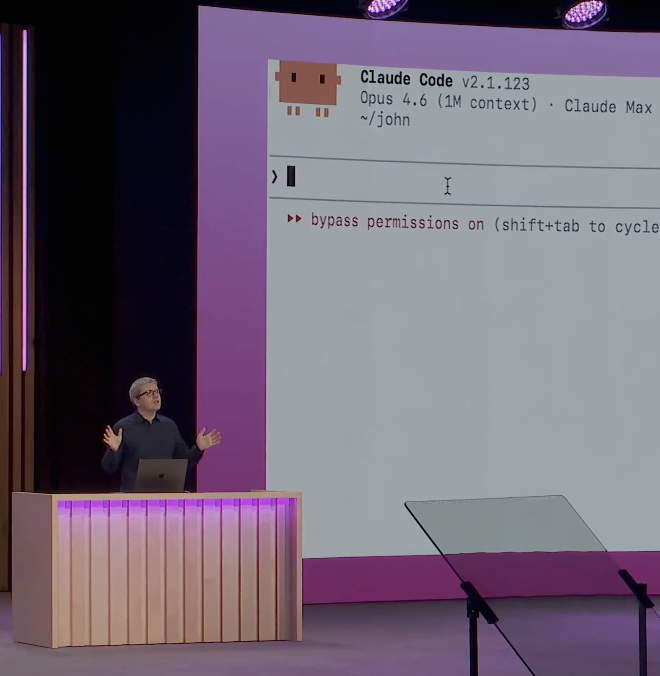
Then Collison ran a demo that did the actual work of the talk. He asked Claude to research how AI demand affects commodity prices. Claude found an Alpha Vantage paid endpoint, requested it, the agent’s budget approved four cents, and the data flowed in. The transaction happened over Tempo via the agent’s stablecoin wallet.
This is the rails question made concrete. For four-cent purchases, fiat does not work. Card networks have minimum economics. ACH has settlement delays. Stablecoins on a payments-purposed chain do work. Not because crypto won. Because the cost structure of card networks was never designed for sub-cent transactions and the cost structure of stablecoin rails was. The reframe enterprise teams should be running internally: stablecoins are now a payment method for token-denominated AI businesses, not an asset class with a roadmap.
Collison closed with the Solow paradox. Electrification took thirty years to show up in productivity statistics because factories had to be redesigned around it. “Transformative technology looks for a long time like it’s not doing much.” The wager Collison left the room with: AI’s lag will be shorter, and the businesses being built right now are the productivity story rather than a footnote to it.
For advisors: the K-shaped economy narrative does not match what Stripe sees in actual spend data. The replatforming narrative does. Calibrate client conversations accordingly.
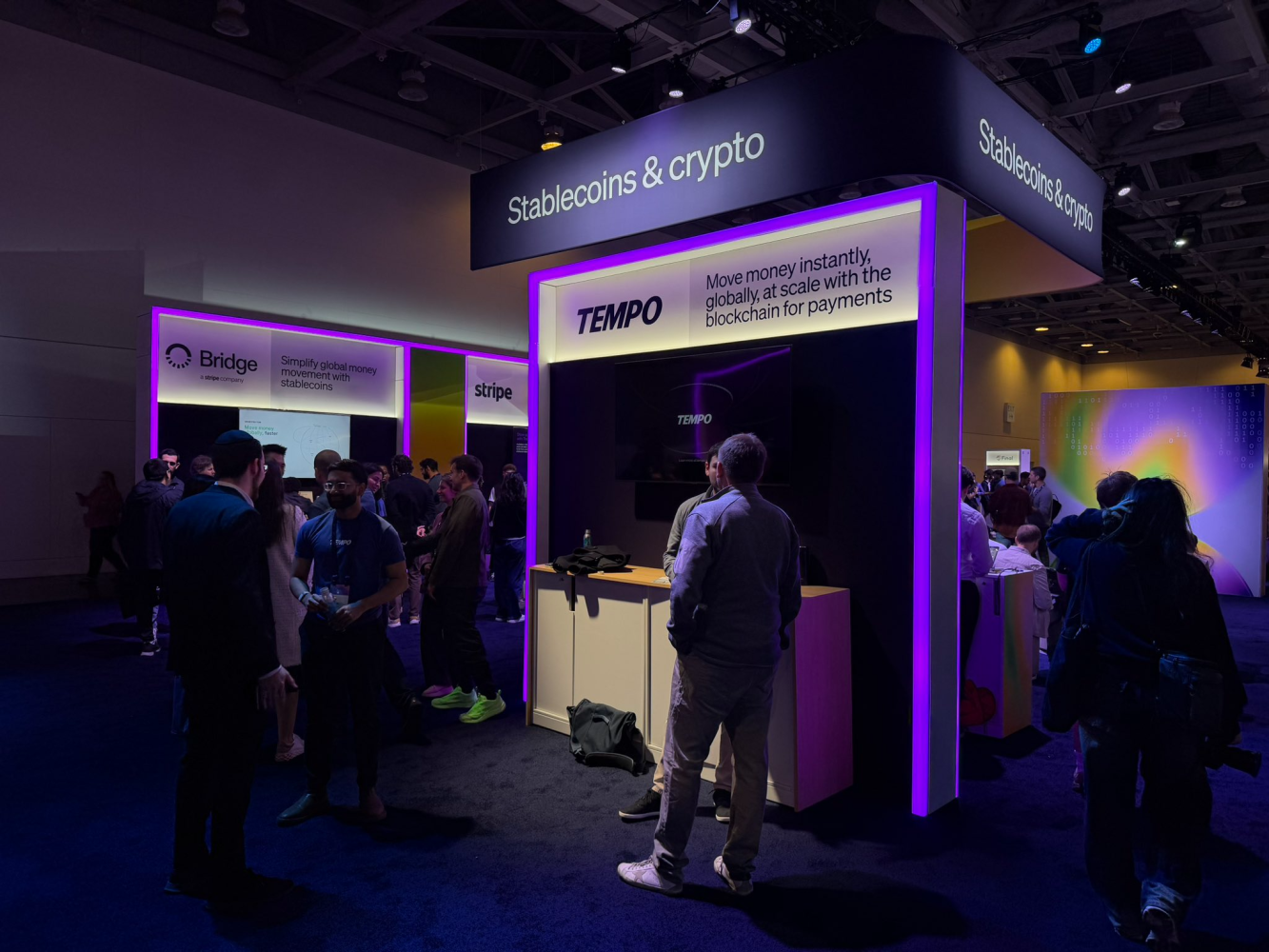
Expo Hall, After The MPP Session
The most useful conversation of two days happened in the Expo Hall after the MPP session. Brendan Ryan, lead MPP maintainer at Tempo, walked through the architecture without a slide deck. Single Layer 1, not Layer 2s on top. Sub-cent micropayments at sub-half-second blocks. Bandwidth-guaranteed lanes so payment traffic cannot get drowned out by other transactions. Privacy primitives that let merchants run private state on top of the chain while preserving regulator auditability.
Most surprising part: the explicit non-goals. Identity. Fraud. Risk. Left to specialists. Best protocols stay narrow, was the framing. The team writes the most-common DEX and recurring-payment patterns into the chain itself in Rust. Solidity stays available for the long tail.
Here is the inversion most coverage has missed. The most consequential new rails for commerce are intentionally incomplete. The teams building them are not trying to absorb the financial stack. They are racing to be excellent plumbing and consciously refusing the upsell. Enterprise architecture reads this exactly backwards: it assumes “complete” is the goal and treats narrowness as a maturity gap. It is not a gap. It is a strategy. The completeness has to come from the layer above, assembled by the merchant or the platform from specialists. Identity from one team. Fraud from Stripe Radar or a competitor. Compliance from another. Risk scoring from a fourth. The rails team gets out of the way on purpose.
That refusal is the thing to brief enterprise clients on this quarter. The agentic-commerce stack will not be sold as a single integrated platform. The rails are committing to incompleteness. Procurement and architecture functions need to staff up for a more modular world than the one their PSPs sold them in 2022.

Synthesis
The conference settled most of what it was asked.
Merchants are not waiting for agent buyers. The largest AI labs are deploying payment skills at scale and Shopify catalog is being prepared for agent discovery. The serious question for any merchant doing meaningful volume is no longer whether to support agent commerce but which protocol commitments to harden in the next two quarters.
Stablecoin rails have stopped being a religious choice and become an architectural one. They are the only payment rail with cost structure compatible with sub-cent agent micropayments. DoorDash, Visa and Meta payouts already running on Tempo. The crypto framing has fallen away from the conversation almost completely.
Consolidation is happening at the substrate. Not because Stripe is winning, but because Stripe and OpenAI and the new L1s are choosing utility positioning. That choice creates lanes above the substrate for specialists in identity, fraud, vertical orchestration and regulated workflows. The strategic question for advisors is no longer “consolidation or specialists” but “which lane above which substrate.”

PSP-switching among AI-native merchants is real and largely about fraud tooling. Multi-account abuse, free-trial abuse, token theft, pay-as-you-go non-payment. The Radar numbers were specific enough that any client whose PSP cannot break out exposure in those four categories should treat the gap as silently absorbed risk.
Payments-as-policy is the biggest organizational shift coming. The Link wallet for agents shipped this week makes it operational. What it forces inside the enterprise is a re-allocation of authority. Treasury defines the spend rules. Security defines the credential boundary. Product defines what an agent is allowed to do on a customer’s behalf. CFOs who used to authorize transactions one at a time now authorize policies that authorize transactions. That is a different job. Architecture teams that are not roadmapping for it in 2026 are losing the twelve months in which the policies, the audit trails and the override semantics are being settled by competitors.
The deeper point underneath all five answers is the one most coverage of the conference is missing. The largest replatforming of commerce in twenty years is happening under the branding of incremental improvement. No one on the Sessions stage said “rebuild.” The protocols got named. The wallets got demoed. The rails got reframed as boring infrastructure. That choice of register is itself the strategy. The replatforming is moving fastest where it is hardest to see.
Close
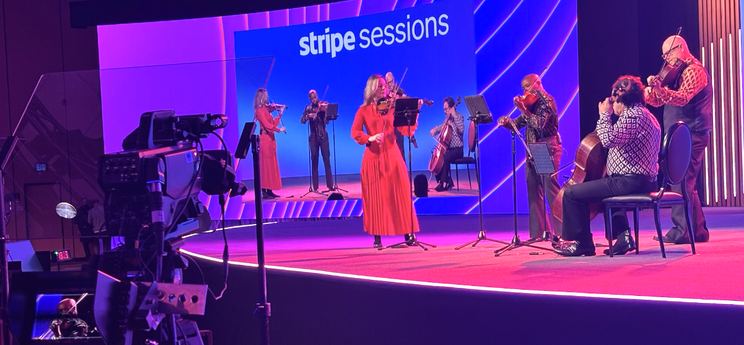
Walking out at the end of Day 2, PUBLIQuartet was already breaking down their stands. Just across the hall, two builders were locked in a heated debate over whether MPP would eventually eat x402 or vice versa. The developers didn’t notice the musicians. They didn’t notice their own volume, either.
Both scenes captured the true essence of Stripe Sessions 2026. Many attendees who had shown up purely to log the latest infrastructure updates found themselves quietly pulled into a deeper, more creative register by the quartet. Drifting seamlessly from modern compositions to reinterpreted classics and remarkably sophisticated pop covers, it was music nobody expected to hear in a payments hall.
That intersection was exactly the point. It felt like an audio edition of Stipes Works in Progress: a cultural anchor running parallel to the unrefereed protocol fights spilling into the corridors.
Agentic commerce won’t arrive with a grand, formal announcement. It will turn out to have already happened, slipping in quietly, somewhere between the second movement and the third.
Appendix: Sources
-
Stripe Sessions 2026 | Day 1 Keynote | youtube.com/watch?v=e13-s0p1tfE&t=1983s
-
Sam Altman in Conversation with Patrick Collison | Stripe Sessions 2026 | youtube.com/watch?v=1ySBxK7viNs
-
Indexing the Economy: John Collison on Economic Trends & the AI Replatform | Stripe Sessions 2026 | youtube.com/watch?v=-vRY2dtD7iQ&t=5s
-
Stripe Sessions 2026 (event hub) stripesessions.com
-
Link Wallet for Agents link.com/agents
-
Tempo Agentic Agents tempo.xyz/agentic-payments
-
Tempo Decentralized Exchange (DEX) docs.tempo.xyz/protocol/exchange
-
PUBLIQuartet | publiquartet.com