The astrologer had the royal ear. The jester had the truth.
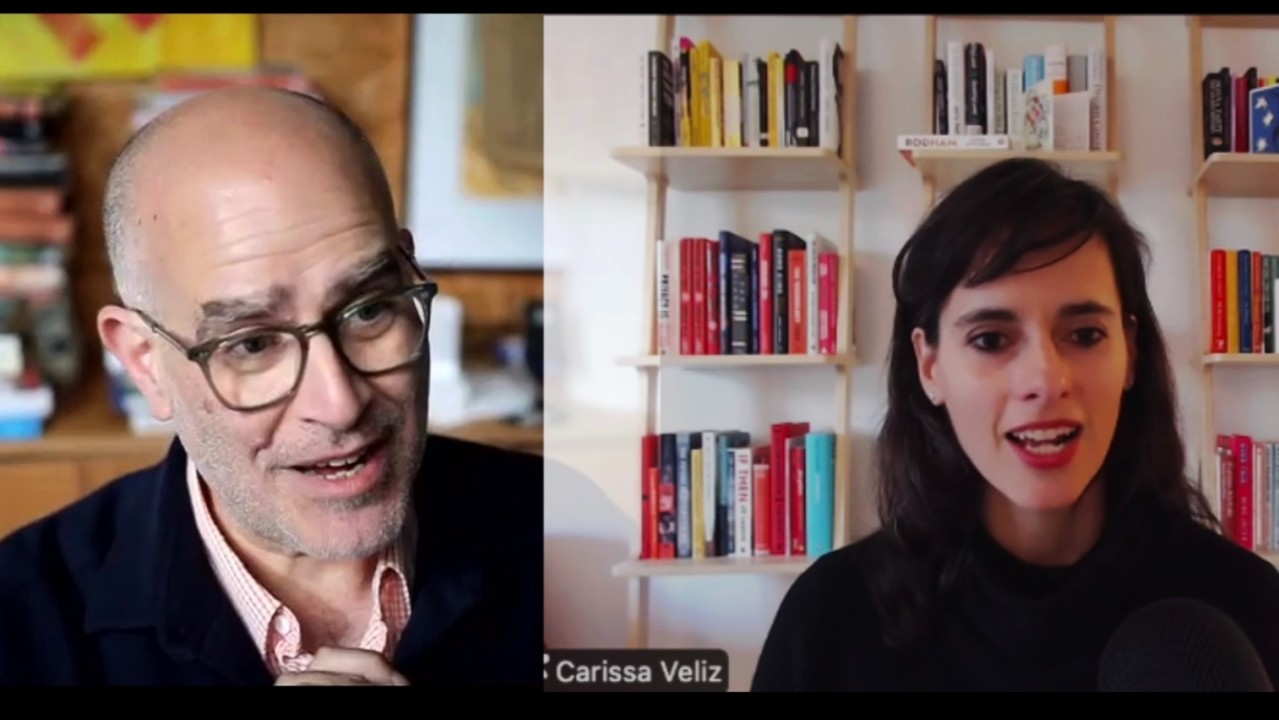
I attended today’s Bloomberg Beta book talk with Carissa Véliz and Roy E. Bahat on her new book Prophecy: Prediction, Power, and the Fight for the Future.
I came in with a specific lens: I work at the intersection of ancient prediction systems & modern AI. I practice Jyotish Vedic astrology, roughly 5,000 years old, and I build with LLMs. My working hypothesis is that both systems are doing something structurally similar: pattern recognition dressed as prophecy. Today’s conversation sharpened that considerably.
Roy opened by admitting what most in his position won’t: “What’s going to happen with the AI bubble? I have no idea.” That honesty set the tone.
In Rome, the emperor Tiberius tested astrologers by asking them to read his intentions – and had the wrong ones thrown off a cliff. The one who survived, Thrasyllus, didn’t survive by being accurate. He survived by understanding what the game actually was. As Carissa writes: “Thrasyllus had shown Tiberius that he understood that predictions are not about knowledge but power.” Two thousand years later, the cliff is optional. The dynamic is not.
Carissa’s central argument is that predictions aren’t descriptions of the world. They’re speech acts, closer to commands or verdicts than reports. “Predictions are the arena where fights over the future take place.” As Hobbes wrote and Carissa invokes, our urge to look into the future is rooted in perpetual fear. And as Carissa cited Toni Morrison on a psychic: “His business was dread.” The oracle was never in the knowledge business. It was always in the certainty business.
She traced the historical line cleanly: oracle → astrologer → statistician → economist → tech exec. Each generation, the prophet gets closer to the throne. The methods change. The political role, asserting the future to bring leaders into alignment, stays identical. Sam Altman and Elon Musk sharing drinks with presidents and prime ministers is, in her framing, structurally reminiscent of Rasputin counseling Nicholas II. The technology is different. The dynamic is not. And the Oracle at Delphi was always a commercial enterprise - prediction has been a business for three thousand years. The question was never whether the oracle knew the future. It was who was paying for the answer.
Because oracles are built to consolidate power, they are inherently backward-looking. They cannot predict what has never existed. On creativity, Carissa used Seinfeld vs. House of Cards. Netflix greenlit House of Cards because the data said political drama works. One NBC exec greenlit Seinfeld despite the data saying nobody wanted it. “An algorithm would have never selected it; there is no database about the future.” Benjamin Jackson put the structural problem cleanly in the chat: the people most likely to disrupt a prediction are the least likely to show up in the sample that generated it.
Her unexpected antidote wasn’t policy or regulation. It was comedy. Specifically the jester. If you walk into a king’s court and want to know what’s actually true - you don’t ask the astrologer. You ask the jester. The only one with no position to protect. She pointed to Milan Kundera’s The Joke as the novel that understood this earliest: in an authoritarian system, you can’t even make a joke because it can cost you your life. And on AI: “there’s no one there laughing. It’s not funny because it’s not a person challenging power.”
I work on this question from both ends. Jyotish, like LLMs, is a formalized system for reading patterns and generating forecasts - both map historical data to probabilistic futures. Both are only as trustworthy as the questions you ask of them. Both have been used by those in power to assert inevitability. And neither has ever been able to tell a joke.
My question for Carissa, which I didn’t get to ask: if you want the truth about the king’s court, you ask the jester. Who plays that role when the king builds the AI?
Prophecy publishes April 21. Pre-order it! Buy a copy for the person in your life who needs to laugh at the oracle before they believe it : ))
The Joke, Milan Kundera, original publication 1967
wikipedia.org/wiki/The_Joke_(novel)
🧵 bsky.app/profile/schwentker.sandboxlabs.ai/post/3miwjdlqgzk2t
🧵 twitter.com/schwentker/status/2041600864461451383
Appendix: Note on Launch Date
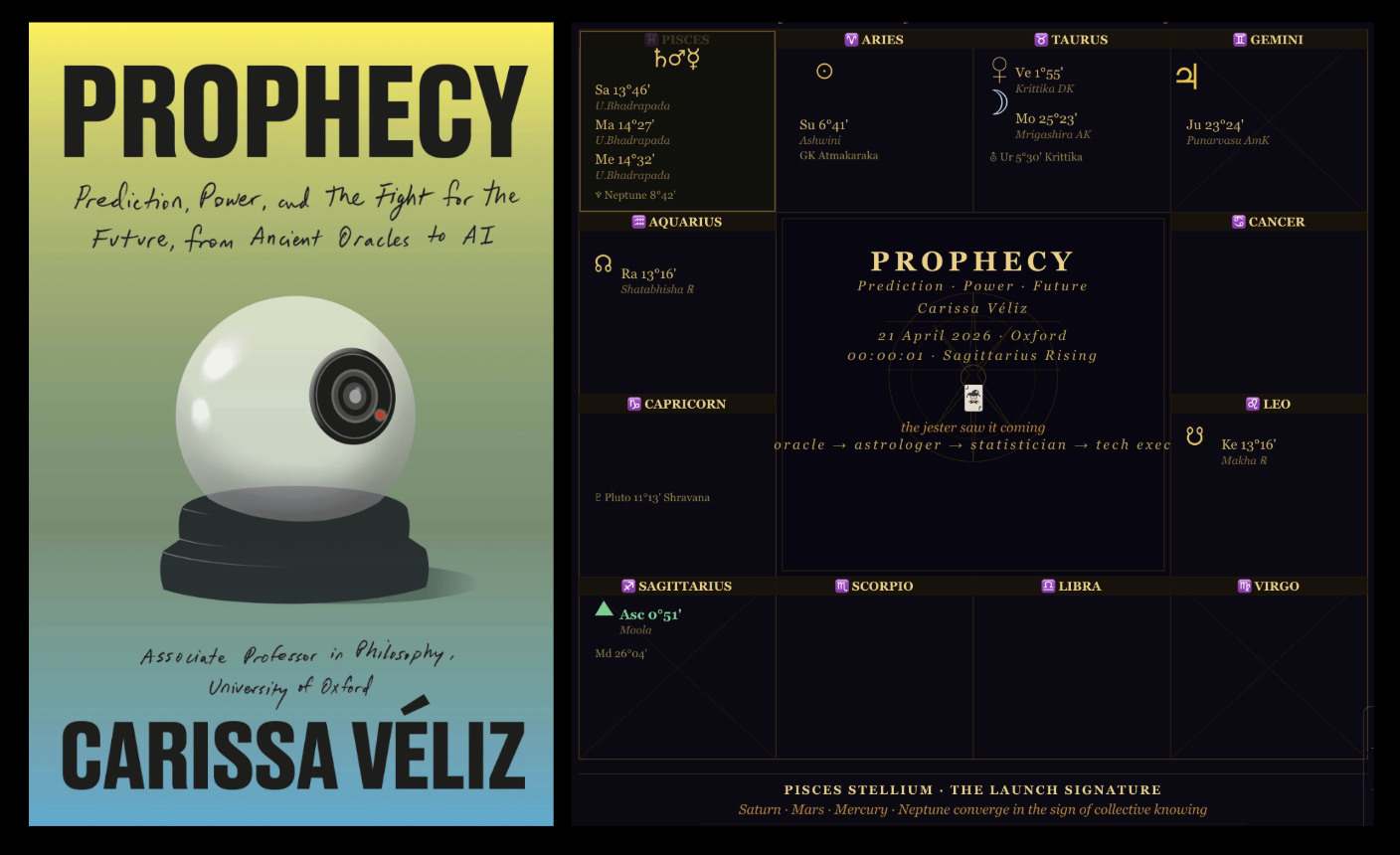
Prophecy publishes April 21, 2026. Out of curiosity, the chart for that date was examined through a Jyotish lens. What follows is not a review of the book’s merit. It is an observation about timing.
TL;DR: Prediction systems – from Delphi to LLMs – have always been proxies for power, not knowledge. The jester was the only one in the court who couldn’t be bought; the question is who plays that role now.
3 planets cluster in Pisces at launch: Mars, Saturn, and Neptune, with Mercury nearby. In Jyotish, Pisces governs collective knowing, spiritual transmission, and the dissolution of boundaries btw seer & seen. A stellium here @ the moment a book about prophecy enters the world is, at minimum, an interesting coincidence. Mars contributes the courage to say uncomfortable things plainly. Saturn gives the message structural endurance – not a news cycle book, but one designed to persist. Neptune dissolves the line between author & reader. The concentration suggests content that feels received rather than merely composed.
The Sun sits in early Aries, in the lunar mansion of Ashwini – associated in Vedic tradition with divine physicians and rapid healing thru revelation. The book’s identity, in this reading, is initiatory: the first of its kind, arriving fast, carrying something corrective.
The Moon at 25 degrees Taurus, in Mrigashira – the seeker’s star – gives the emotional core of the launch a quality of restless, grounded curiosity. Taurus Moon also suggests lasting commercial resonance. This is not a flash reading.
Jupiter in Gemini – wisdom in the sign of communication & dual audiences – favors teaching, publishing, and crossing between communities that do not normally read the same books. Skeptics & seekers both have a🚪door in.
Venus in early Taurus in Krittika, the blade star: beautiful presentation with a cutting edge. Krittika purifies through fire. The book’s aesthetic will attract; the content will burn away something.
Rahu, the moon’s north node, in Aquarius amplifies distribution thru networks & technology. Ketu, the moon’s south node, in Leo asks readers to release personal mythology in service of the collective argument.
No chart proves anything. But for a book whose central argument is that prediction systems have always served the powerful – and that the pattern persists from Delphi to Silicon Valley – the celestial pattern at launch is, to use Carissa Véliz’s own framework, unusually coherent. Whether that coherence is meaningful or merely noticed is, as the book might put it, a question only you can answer.