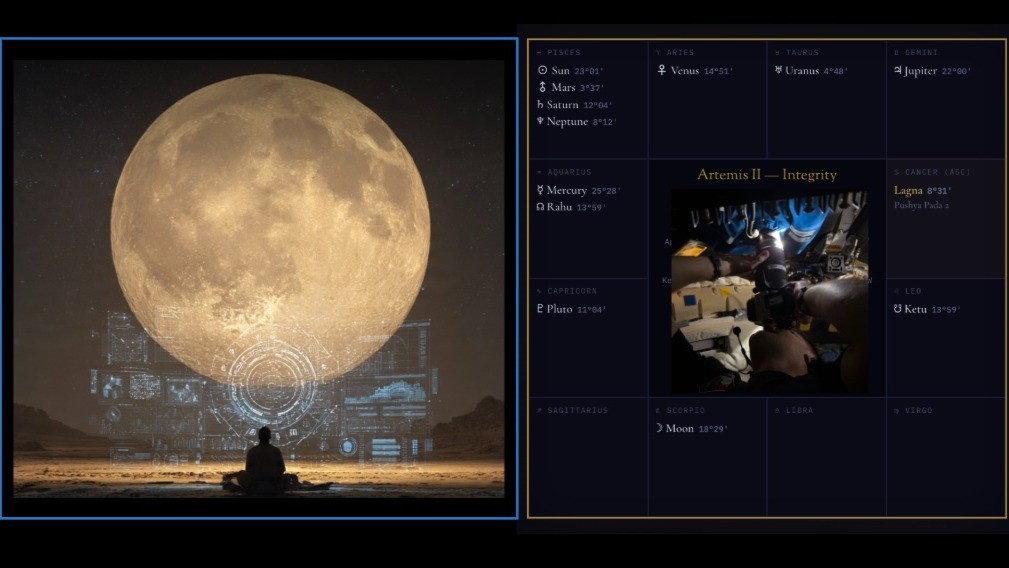
Part 3: What Convergence Looks Like
At 252,756 miles from Earth, the farthest any human has ever been, Commander Reid Wiseman called down to Houston and proposed naming an unnamed lunar crater for his late wife. A bright spot near Glushko, on the boundary between the Moon’s near side and far side. He spelled it out: C-A-R-R-O-L-L.
His two daughters were watching from the viewing gallery in Mission Control.
I cast a Vedic astrology chart for this moment. In that chart, Mars — the significator of the spouse in the Chara Karaka system — sits in Uttara Bhadrapada, a lunar mansion whose presiding deity is the serpent of the cosmic deep and whose territory is the passage between worlds.
I also ran the 10-hour mission transcript through a language-model-based thematic extraction pipeline. The system flagged a 90-second spike in grief and memorial language, densely concentrated around the same transmission. It could not explain why the emotional weight was so high. Only that it was.
I did not arrange either of these. Two systems with incompatible epistemologies, pointed at the same ten hours. Thematically proximate outputs.
That proximity is what this piece is about. Not as proof of anything. As a discomfort I cannot explain away, and that I have come to believe is itself the finding.
This is Part 3 of a series. Part 1 argued that the impulse to split pattern from meaning is recent and culturally specific. Part 2 built a working bridge between symbolic and computational reading. Part 3 is what happened when I pointed both at the same event.
What I Am and Am Not Claiming
A disclosure before we go further, because the framing matters more than the data.
I am not claiming scientific equivalence between Vedic astrology and computational thematic extraction. They are different kinds of rigor. Computational methods are anchored by mathematical falsifiability: holdout data, precision and recall, confidence intervals. Jyotish is anchored by archetypal resonance and five thousand years of tradition-internal accountability: coherence, not prediction.
I am also not claiming parity of authorship. Jyotish is an inherited system whose rules I learned. The extraction pipeline is a system I built, whose clusters I named. Calling them “two systems” at the level of architecture is honest. Calling them two systems at the level of authorship is not. One I received. The other I made. My hand is in both readings, but the hand is deeper in the second.
What I am claiming is narrower and, I think, more interesting: both are high-dimensional interpretive systems, both require a trained operator to produce meaning from raw output, and when applied to the same ten-hour event they produced thematically convergent readings on four of five dominant themes. The gap on the fifth is part of the argument, not an embarrassment to it.
The astrology chart was cast for 17:57 UTC, April 6, 2026, using Kennedy Space Center as the terrestrial reference point (28.57°N, 80.65°W). Swiss Ephemeris for the ascendant, sidereal zodiac, Lahiri ayanamsa. Planetary positions verified against published ephemeris data.
The transcript was a 10-hour NASA broadcast covering the full lunar flyby — roughly 60,000 words of crew communications, Capcom exchanges, science sitreps, and real-time commentary. I processed it through an LLM-based extraction pipeline that produced semantic density maps, co-occurrence weights, and thematic clusters. I named the clusters. The system does not title its own outputs “Boundary Dissolution.” I do. This distinction is load-bearing and I will return to it.
System 1: The Chart Speaks
Four mappings. Not the full reading, that is the appendix, for practitioners who want the house-by-house analysis, including material from the post-flight press conference that corroborates the in-flight linguistic patterns. Four mappings here, each the same structure: symbolic position, real event, where they touch.
1. The Crab Carries Its House. The ascendant at the record moment is Cancer — the crab, the sign of home, nurture, the shoreline. Cancer’s symbol is the creature that carries its shell on its back. Its nakshatra (lunar mansion) is Pushya, which means “the nourisher”: sustenance, bloom, the udder of the cow. Cancer is ruled by the Moon.
At 252,756 miles from Earth, the crew lived inside 330 cubic feet of habitable volume — about the size of two minivans. Recycled air. Rehydratable food. Reclaimed water. A life-support system keeping four bodies alive inside a shell hurtling through vacuum. The nourisher, rising. The crab carrying home on its back through the dark.
2. Home at Its Weakest. The Moon sits at 18°29’ Scorpio in Jyeshta, the nakshatra of “the eldest” or “the chief.” Its deity is Indra, king of the gods. Its symbol is a protective talisman. Scorpio is the Moon’s sign of debilitation — its weakest possible placement. In this chart the Moon also carries the role of Matrikaraka: the significator of the mother, the homeland, the emotional root.
The home-significator at its weakest dignity, at the moment home was farther away than it has ever been for any human being.
Debilitation does not mean absence. It means operating under strain. In the 5th house of creativity, the debilitated Moon produced the crew’s most vivid language. Victor Glover described the Terminator as having “islands of light” surrounded by darkness. Christina Koch compared bright craters to “a lampshade with tiny pinprick holes and the light shining through.” Jeremy Hansen said the far side looked like “frozen choppy water.” The Moon in fall, pushed beyond its capacity, generated language of extraordinary precision. Jyeshta’s signature: authority earned through endurance.
3. The Empty Circle. Rahu, the north lunar node, sits at 13°59’ Aquarius in Shatabhisha, the nakshatra of “a hundred healers.” Its symbol is an empty circle. Its deity Varuna governs cosmic order and hidden truth. Rahu occupies the 8th house: the unseen, what lies beyond the veil.
During the flyby, the crew flew behind the Moon for 40 minutes. Complete loss of signal. No communication with anyone on Earth. The first time in over 50 years that humans were entirely unreachable.
Inside that void, they saw impact flashes on the lunar surface. They watched Saturn set behind the Moon. They observed the solar corona. They ate maple cookies together. They kept recording science observations no one could hear. Shatabhisha’s empty circle, rendered literal. The void that was operationally full.
4. The Beloved Named at the Threshold. Mars sits at 3°37’ Pisces in Uttara Bhadrapada, the nakshatra of “the latter blessed feet.” Its deity Ahir Budhnya is the serpent of the cosmic deep, associated with the passage between worlds - the crossing from seen to unseen. In this chart’s Chara Karaka system, Mars serves as Darakaraka: significator of the spouse.
At the moment the distance record fell, Wiseman called down and named a crater near Glushko - on the boundary between what Earth can see and what it cannot. Carroll. A bright spot, he said. Visible from home at certain librations.
The spouse-significator, in the star of passage between worlds, at the moment the farthest threshold was crossed. I did not arrange this. The chart did.
System 2: What the Extraction Found
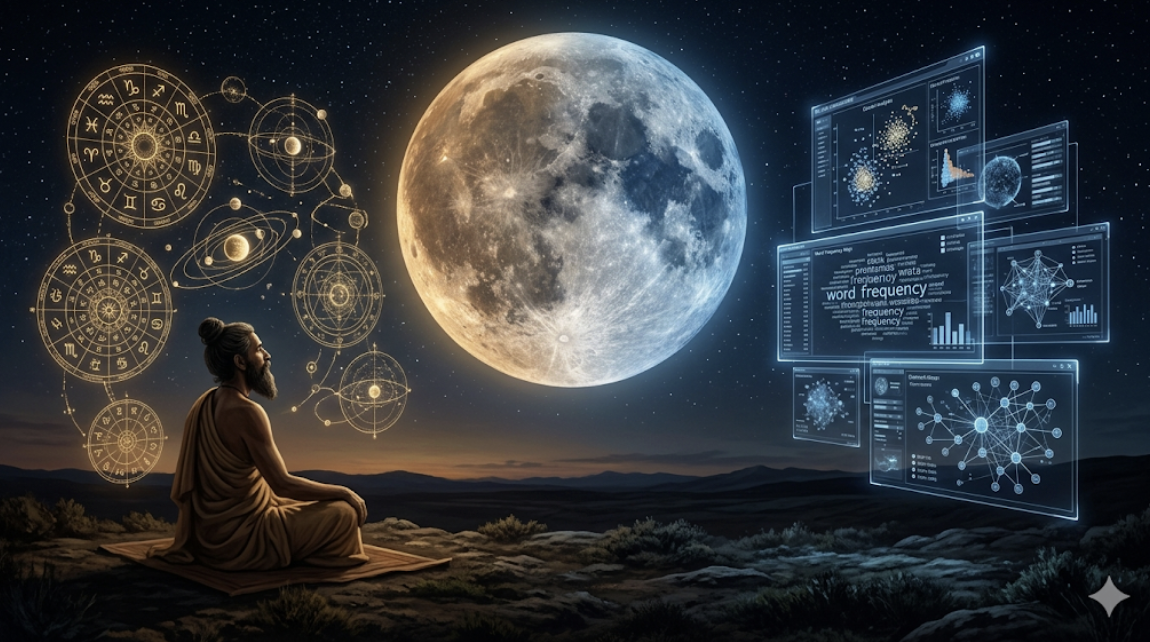
I processed the same 10-hour transcript through an LLM-based thematic extraction pipeline. The system produced semantic density maps, cluster weights, and co-occurrence data. What follows are the five dominant thematic concentrations it surfaced. The statistical structure is the system’s. The labels are mine.
Cluster 1: Boundary Dissolution. Unusually high density of language around thresholds, transitions, liminal states. Near-side/far-side. Light/dark. Communication/silence. The Terminator, the literal day-night boundary on the Moon, was the crew’s most frequently described and emotionally weighted feature. The system identified “boundary” as the event’s dominant semantic field.
Cluster 2: Communication as Survival Infrastructure. The Deep Space Network, the Capcom protocol, science sitreps, and the PCD recordings weighted as structurally central, not peripheral. Communication was not a feature of the mission. It was the mission’s load-bearing architecture. The loss-of-signal period was flagged as a structural anomaly: a 40-minute gap in an otherwise continuous data stream, during which the crew’s behavioral pattern, continued observation, continued recording, remained unchanged. The protocol persisted through the void.
Cluster 3: Naming as Consecration. A spike in emotional and ceremonial language at two moments: the record passage itself, and the crater-naming sequence. The system flagged that the naming of Carroll carried significantly higher emotional weight than the naming of Integrity, despite both occurring in the same transmission. It could not explain why. Only that the linguistic markers of grief, love, and memorial were densely concentrated in a 90-second window.
Cluster 4: Return Encoded in Departure. A recurring structural motif: the Translunar Injection burn that sent the crew toward the Moon also committed them to splashdown. Multiple crew members and Mission Control referenced this. The system flagged it as a thematic invariant - every statement about going farther contained an implicit statement about coming home. Departure and return were not sequential but simultaneous.
Cluster 5: Physiological Adaptation Under Observation. A persistent thread of language around the body adjusting to an environment it was not built for. Eye adaptation between the bright lunar surface and the dark cabin. The fluid shift affecting Glover’s vision. The physical strain of switching between cameras, PCDs, and windows. The crew’s repeated mentions of needing time for their eyes to “settle.” Weighted lower than the four above but statistically present. The chart has no obvious analogue. This matters, and I will come back to it.
Where They Touch
I want to be precise about what I am not saying.
I am not saying that System 1 predicted System 2’s outputs. I am not saying that planetary positions caused the crew to behave in certain ways. I am not saying that pattern extraction validates astrology, or that astrology validates pattern extraction.
I am saying this:
Two systems with no shared epistemology, no shared methodology, no shared vocabulary, and no shared history were pointed at the same 10-hour event. Both identified the same four thematic concentrations:
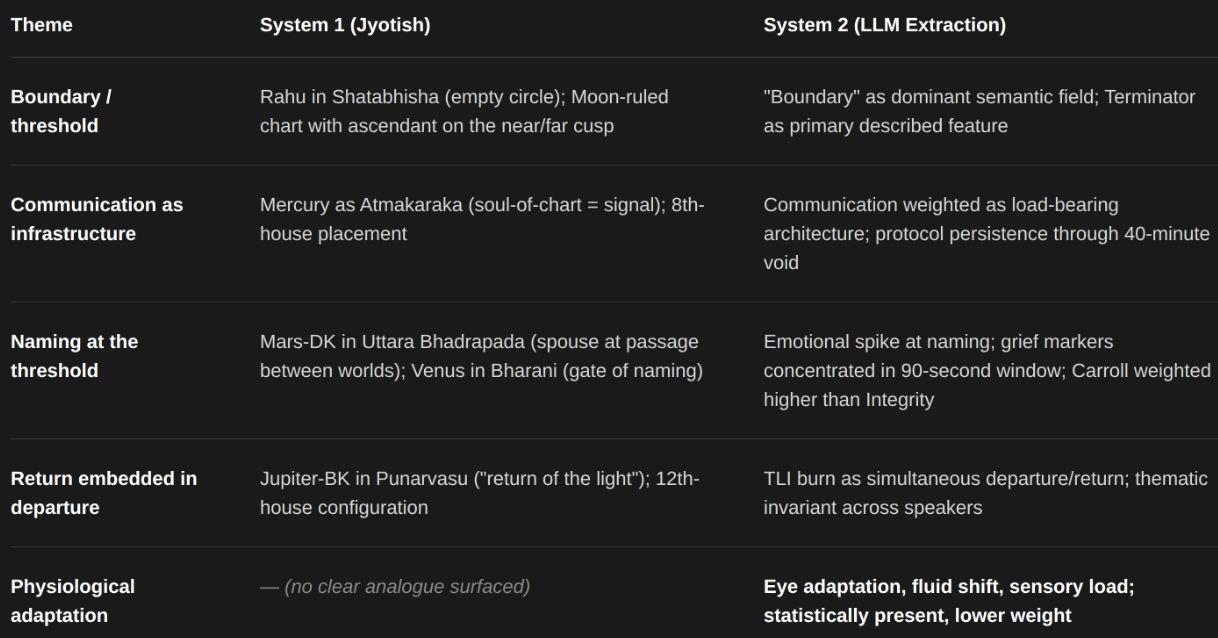
And then there is Cluster 5: the body adapting. System 2 found it. System 1 did not surface it. I mention this because convergence that is total is not convergence. It is projection. The gap matters as much as the overlap.
The convergence is not total. It is not necessary.
It is also not random.
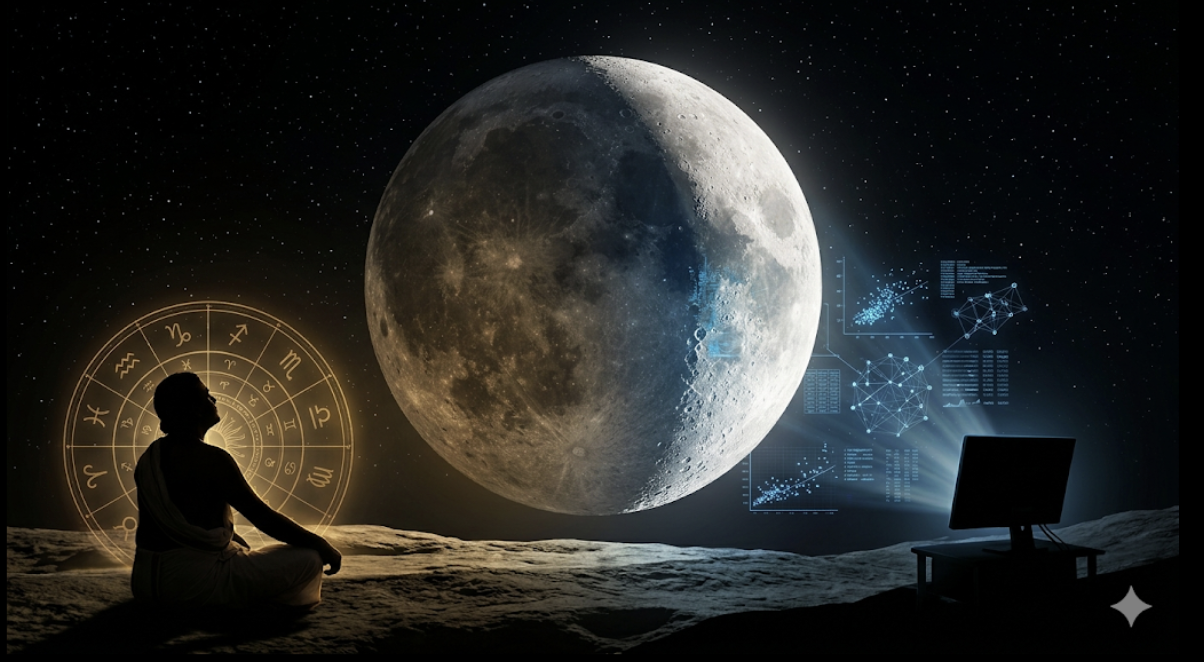
The Interpreter Is the Variable
Here is the claim the piece has been building toward, and it is the one I am most confident about.
Convergence in interpretive systems is a property of the interpreter more than of the systems.
Both Jyotish and LLM-based thematic extraction are pattern-recognition engines operating on high-dimensional data. Neither produces meaning without an operator. When I labeled a statistical word-grouping “Naming as Consecration,” I made the same interpretive move as when I read Mars-DK in Uttara Bhadrapada and said “the spouse-significator at the passage between worlds.” Neither output arrived pre-labeled. Both required a trained eye to decode. Both required me.
The systems have different accountability structures — falsifiability versus coherence — and those structures do real work. They are not interchangeable. But at the decisive moment, the moment where raw output becomes legible meaning, the operator is the common variable.
This is not a debunking. It is not “astrology is just pattern-matching” or “AI is just astrology with statistics.” Both of those are lazy. It is something harder: the fact that two incompatible systems can be made to converge on the same themes by a single trained operator tells us something about how interpretation works, and it applies to every interpretive act — literary criticism, medical diagnosis, intelligence analysis, historical reading. The operator is never neutral, and the rigor of a system is partly a discipline for noticing where the operator’s hand rests.
The question I started this series asking was not are these systems equivalent. It was: what does it mean that the oldest and newest pattern-recognition systems available to humans can be brought into thematic agreement when a trained operator points them at the same data?
I do not have a clean answer. I have proximity. I have coherence on four themes. I have one cluster that did not converge, which I am glad of. And I have the discomfort of recognizing my own hand in both readings.
And I have Christina Koch’s words, called down at 252,000 miles after 40 minutes of silence behind the Moon:
“With this burn, we do not leave Earth. We choose it. We will explore, we will build. We will build ships. We will visit again. But ultimately we will always choose Earth. We will always choose each other.”
Two systems. One Moon. The interpreter in between.
I am not sure what to do with this yet. I am not sure anyone is. But I am certain the discomfort is the signal, and that the work now is to stay with it rather than resolve it in either direction.
Part 3 of 3. Part 1 explored the cultural history of splitting pattern from meaning. Part 2 built the methodological bridge. Part 3 is what it looks like when you stop asking which system is right and start asking what the operator is accountable for.
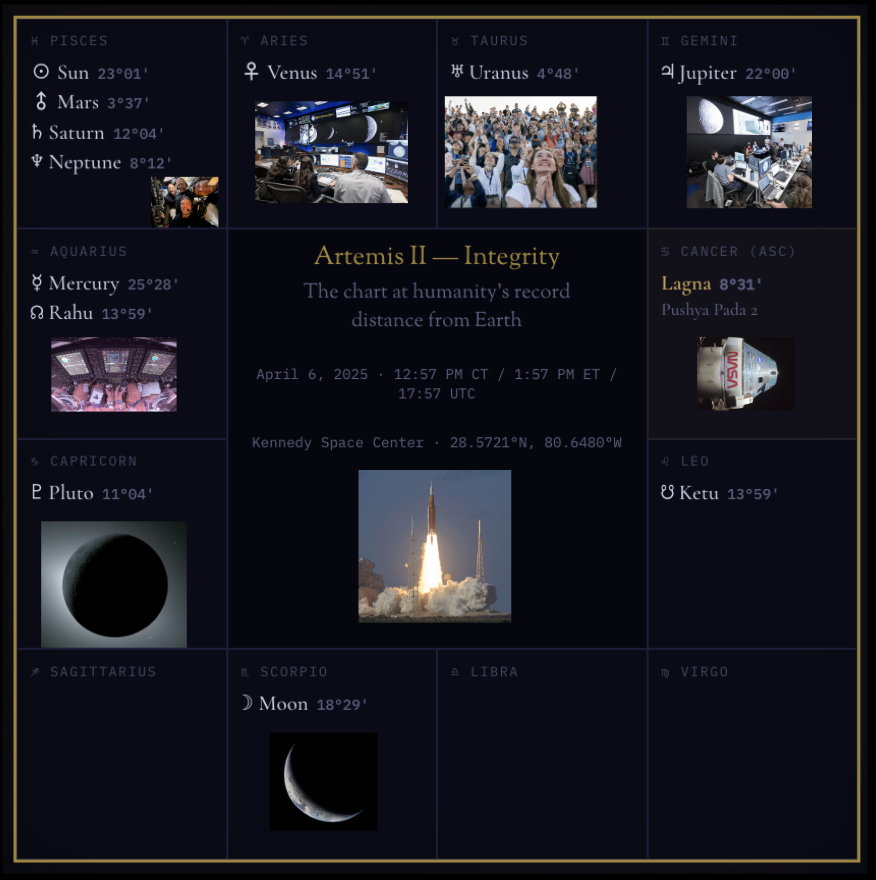
Full Vedic chart (South Indian format) and complete house-by-house reading — including post-flight press conference corroboration — available as a companion appendix for practitioners.
Appendix 1: Glossary of Vedic Astrology Terms
Jyotish — The Sanskrit name for Vedic astrology, meaning “science of light.” One of the six classical disciplines of Vedic scholarship, dating back approximately 5,000 years.
Sidereal zodiac — A zodiac system anchored to the fixed stars, as opposed to the tropical zodiac used in Western astrology, which is anchored to the seasons. The two systems have drifted apart by approximately 24 degrees (called the ayanamsa), meaning the same moment produces different sign placements in each system.
Rashi — A zodiac sign. There are twelve, corresponding to the same constellations as Western astrology but offset by the ayanamsa.
Nakshatra — A lunar mansion. There are 27, each spanning 13°20’ of the ecliptic. Each has its own deity, symbol, and interpretive associations. Every planet sits in both a rashi and a nakshatra simultaneously, creating a layered positional address. Nakshatras provide much of the interpretive precision in Vedic astrology.
Graha — Literally “that which grasps.” The Vedic term for a celestial body that exerts influence. The nine traditional grahas are: Sun, Moon, Mars, Mercury, Jupiter, Venus, Saturn, Rahu (north lunar node), and Ketu (south lunar node). Uranus, Neptune, and Pluto are modern additions not part of the classical system.
Lagna — The ascendant, the sign rising on the eastern horizon at the moment the chart is cast. It sets the frame for the entire chart.
Debilitation (Neecha) — A planet’s weakest zodiacal position. The Moon is debilitated in Scorpio. Debilitation does not mean absence of effect. It means the planet operates under strain, far from its natural comfort. This sometimes produces depth precisely because nothing comes easily.
Rahu and Ketu — The north and south lunar nodes, the points where the Moon’s orbit crosses the ecliptic. In Vedic astrology, they are treated as shadow planets with powerful interpretive significance. Rahu represents obsessive desire, boundary-crossing, and the unknown. Ketu represents detachment, dissolution of ego, and spiritual insight.
D-1 (Rashi chart) — The primary birth chart or event chart showing planetary positions across the twelve signs. The foundation of all Vedic astrological interpretation.
Chara Karaka: The Planetary Family
In Vedic astrology, each planet takes on a specific role in your chart, much like characters in a family drama. Their positions determine who plays which part.
AK Atmakaraka: The Soul of the Story. The planet with the highest degree. It represents your core self, your essential nature, the protagonist driving the narrative.
AmK Amatya Karaka: The Purpose-Keeper. Second-highest degree. This planet shows your life’s direction, your calling, the quest that organizes everything else.
BK Bhratri Karaka: The Crew. Third-highest degree. Significator of siblings, companions, allies, the supporting cast who stand beside you. In group endeavors, this is the team itself.
DK Dara Karaka: The Beloved. Fourth-highest degree. Significator of spouse, partner, the one you choose and who chooses you. Also represents your capacity for intimacy and commitment.
PK Putra Karaka: The Creator. Fifth-highest degree. Significator of children, creativity, what you produce and leave behind. Everything you birth into the world.
GK Gnati Karaka: The Obstacle. Sixth-highest degree. Significator of adversity, illness, the antagonist. What you must overcome to grow.
MK Matri Karaka: The Roots. Seventh-highest degree. Significator of mother, homeland, your emotional foundation. Where you come from and what grounds you.
Appendix 2: Full Reading
A note for readers new to astrology: Vedic astrology (Jyotish) reads a chart as a snapshot of the sky at a specific moment. Each planet sits in a sign (there are 12) and also in a finer subdivision called a nakshatra (there are 27). Each nakshatra has a symbol, a deity, and a meaning. Certain planets are also assigned temporary roles in the Chara Karaka system: significators of soul, siblings, spouse, mother, and so on, based on the degrees they occupy. What follows reads this chart the way a literary critic reads a poem, looking for resonance between symbol and event, not prediction.
♓️Pisces Stellium: The Ocean Above
Four planets cluster in ♓️Pisces at this moment: ☉ Sun, ♂️ Mars, 🪐 Saturn, ♆ Neptune. ♓️Pisces is the zodiac’s final sign, the cosmic ocean, the place where separate streams dissolve into one water. The post-splashdown press conference kept returning to this same image. Reid Wiseman describing the crew as “bonded forever… the closest four humans can be and not be a family.” Christina Koch saying “we took your hearts with us and your hearts lifted our hearts.” ♓️Pisces is that dissolution of edges between self and other.
The ☉ Sun at 23° ♓️Pisces sits in Revati⭐️, the final nakshatra of the zodiac. Revati⭐️’s deity is Pushan, shepherd-god who guides travelers home. Its symbol is a fish in the cosmic ocean, or a drum marking time. Revati⭐️ means “the wealthy one” — wealth here being distance itself, the abundance of separation that deepens the bond to origin. Koch’s post-flight reflection makes this literal: “I cannot overstress that we did this together… we took your hearts with us.” The farthest point from Earth produced the strongest sense of belonging to it.
♂️ Mars (3°37’), 🪐 Saturn (12°04’), ♆ Neptune (8°12’) all sit in Uttara Bhadrapada⭐️, whose deity is Ahir Budhnya, the serpent of the cosmic deep. Its symbol is the back legs of a funeral cot—the passage between worlds.
♂️ Mars here carries the role of DK (Darakaraka), significator of spouse and partnerships. Wiseman chose the record moment to name a crater for his late wife Carroll, a bright spot on the near-side/far-side boundary, visible from Earth only at certain librations. The spouse-indicator, in the star of passage between worlds, at the moment the farthest threshold was crossed. In the press conference, Wiseman described breaking down crying when the Navy chaplain came aboard the recovery ship: “I’m not a religious person, but there was just no other avenue for me to explain anything or to experience anything.” Uttara Bhadrapada⭐️’s territory precisely: the threshold where ordinary frameworks fail.
🪐 Saturn as GK (Gnatikaraka), significator of obstacles, marks the 55-year gap. Apollo 13 set the prior distance record in crisis, not triumph. Saturn-as-obstacle was the record, a marker of human limitation that held for over half a century.
☽ Moon Debilitated: Home at Its Weakest
The ☽ Moon at 18°29’ ♏️ Scorpio sits in Jyeshta⭐️ (“the eldest”), whose deity is Indra, king of the gods, and whose symbol is a protective talisman. The ☽ Moon carries the role of MK (Matrikaraka), significator of mother, homeland, emotional root.
♏️ Scorpio is the ☽ Moon’s sign of debilitation: its weakest placement. The home-significator at its weakest dignity, at the moment home was farther away than it has ever been for any human. Debilitation doesn’t mean absence; it means the planet works under strain. In the post-flight conference, Jeremy Hansen described seeing “depth to the galaxy… that same feeling, small and powerless, but yet powerful together.” The debilitated ☽ Moon doesn’t break. It deepens.
Jyeshta⭐️ confers authority earned through endurance: the right to speak from experience no one else has. Victor Glover: “To all of you down there on Earth and around Earth, we love you from the Moon.” That is the eldest’s voice. Koch’s observation that the Moon is “a real place… not just a poster in the sky that goes by” is also Jyeshta⭐️: the elder correcting a younger culture’s assumptions.
☿ Mercury as Soul: Communication as Infrastructure
☿ Mercury at 25°28’ ♒️ Aquarius in Purva Bhadrapada⭐️ is Atmakaraka (AK): the highest-degree planet, the soul-indicator of the chart itself. This means the deepest meaning of this event is a ☿ Mercury process: signal, exchange, protocol, narration.
The press conference made this visible in ways the in-flight commentary couldn’t. Wiseman on the crew’s communication discipline: “if you have a bad night of sleep or if something is angering you… just talking about that to the other three crew members.” Koch: “everything we did up there was a four person activity minimum.” Hansen on the lesson for future crews: “ask more questions.” The record was not broken by thrust alone but by the slow accumulation of signal: between crew members, between crew and Capcom, between the vehicle and the Deep Space Network.
Purva Bhadrapada⭐️’s deity is Aja Ekapada, the one-footed unborn one, associated with cosmic fire. ☿ Mercury-as-soul at such late degrees signals a cycle closing: the final ☿ Mercury exam of a long institutional conversation about whether this machinery could carry four humans safely to the Moon and back.
☊ Rahu in the Empty Circle: The Void That Speaks
☊ Rahu at 13°59’ ♒️ Aquarius sits in Shatabhisha⭐️, “the hundred healers.” Its deity Varuna governs cosmic order and hidden truth. Its symbol is an empty circle: a void, a zero.
The 40-minute loss-of-signal behind the Moon was this symbol made literal. Complete unreachability. No Earth on the line. In that void, the crew observed impact flashes, watched ♄ Saturn set behind the Moon, ate maple cookies, kept recording science observations no one could hear.
The press conference confirmed what the in-flight data only suggested: the void produced language the Moon itself couldn’t. Wiseman on the eclipse moment: “I don’t think humanity has evolved to the point of being able to comprehend what we were looking at.” Hansen on the far side: it kept “grabbing my attention… this depth to the galaxy that I just had never experienced before.” Shatabhisha⭐️’s healers work through what cannot be seen. The void was operationally full.
♃ Jupiter’s Promise: Return Encoded in Departure
♃ Jupiter at 22° ♊️ Gemini in Punarvasu⭐️ is BK (Bhratrikaraka), significator of siblings, comrades, crew. Punarvasu⭐️ means “return of the light” or “the good again.” Its deity is Aditi, boundless mother of the gods. Its symbol is a quiver of arrows: weapons that return.
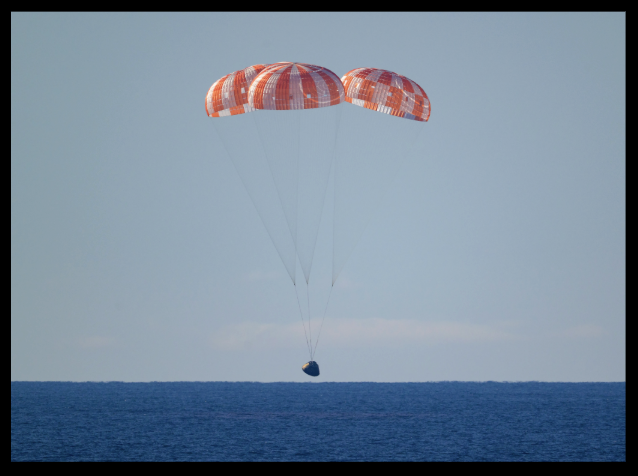
This is the chart’s guarantee of safe splashdown. The Translunar Injection burn that sent them Moonward also committed them to Pacific splashdown. No option to stay. Wiseman at the press conference kept returning to this structure: “we launched as friends and we came back as best friends.” Departure and return were the same act, witnessed from opposite shores.
♃ Jupiter-as-crew in the star of homecoming. Koch: “the benefits that compound when you support those around you and they support you back are just immeasurable.” The arrows return to the quiver because they were made to.
♀ Venus in Bharani: The Gate of Naming
♀ Venus at 14°51’ ♈️ Aries in Bharani⭐️ is PK (Putrakaraka), significator of children, creativity, what is produced. Bharani⭐️’s deity is Yama, lord of death and dharmic judgment. Its symbol is the yoni, the gate of birth. Bharani⭐️ means “she who bears.”
What was produced at the farthest point was not discovery but naming. Two craters given names at the threshold: Integrity (the spacecraft, the ethos) and Carroll (the beloved, departed). Wiseman’s reflection on the crew’s own name for the vehicle: “there were moments on this mission where I was out of integrity… and it was amazing to watch the other three pull them back in.” This confirms Bharani⭐️’s gate-work. Naming is not labeling. It is consecration: choosing what a thing will be held accountable to.
♀ Venus in ♂️ Mars-ruled ♈️ Aries, at the gate Yama watches: the creative act that honors both the living vessel and the departed person. Two names. One moment. Both weighted.
☋ Ketu in Purva Phalguni: The Self Emptied Out
☋ Ketu at 13°59’ ♌️ Leo sits in Purva Phalguni⭐️, the star of rest, pleasure, the marriage bed. ☋ Ketu strips worldly attachment. In ♌️ Leo—sign of the self, the individual ego—☋ Ketu dissolves personal identity into something larger.
The press conference made this explicit in ways the livestream couldn’t. Hansen: “you guys did, and we just don’t not see it that way. We should be rewording that question to what we did.” Koch deflecting her own recognition: “we’re very intentionally not trying to take individual photo credit for things.” Wiseman on the crew as unit: “we just went up and did what we were going to do.” ☋ Ketu in Purva Phalguni⭐️: the royal comfort of individual achievement dissolved, the self emptied out by distance, what remains is crew. The four would not let the interviewer’s framing stand.
Synthesis: The Farthest Point as Naming Ceremony
The chart concentrates in ♓️ Pisces and water nakshatras: dissolution, transcendence, the erosion of boundaries between self and cosmos. Four planets in the zodiac’s final sign create a weight of endings that are also seeds.
The ☽ Moon debilitated in ♏️ Scorpio is the literal condition: emotional body stretched to its greatest distance from origin. Jyeshta⭐️ confers authority through that endurance.
☿ Mercury as Atmakaraka makes the event’s soul a communications process. The press conference confirms this as the crew’s own reading: Koch, Wiseman, Hansen, Glover all returned to communication, questions, team, protocol. Not “what we saw” but “how we stayed a crew while seeing it.”
♃ Jupiter in Punarvasu⭐️ carried the return inside the departure. ♀ Venus in Bharani⭐️ held the gate where naming happened.
And at the center, the chart’s most precise signature: ♂️ Mars as Darakaraka, in the serpent-star of passage between worlds, at the moment the farthest threshold was crossed: the moment Wiseman called down a woman’s name.
The press conference closed with Koch answering a question about being the first woman to walk on the Moon: “when the world tries to make the accomplishment something different than what it really is, which is a team accomplishment, you will know.” That is the chart’s final instruction. The farthest point was not a summit. It was a gate. What passed through it was named.
“The moon really is its own unique body in the universe. It’s not just a poster in the sky that goes by. It is a real place. And when we have that perspective and we compare it to our home of the earth, it just reminds us how much we have in common. Everything we need, the earth provides. And that in and of itself is somewhat of a miracle, and one that you can’t truly know until you’ve had the perspective of the other.”
Christina Koch, Mission Specialist
Chart cast for 7:07 PM EDT, April 6, 2026.
-
Maximum Earth distance.
-
Launch: April 1, 2026, Kennedy Space Center.
-
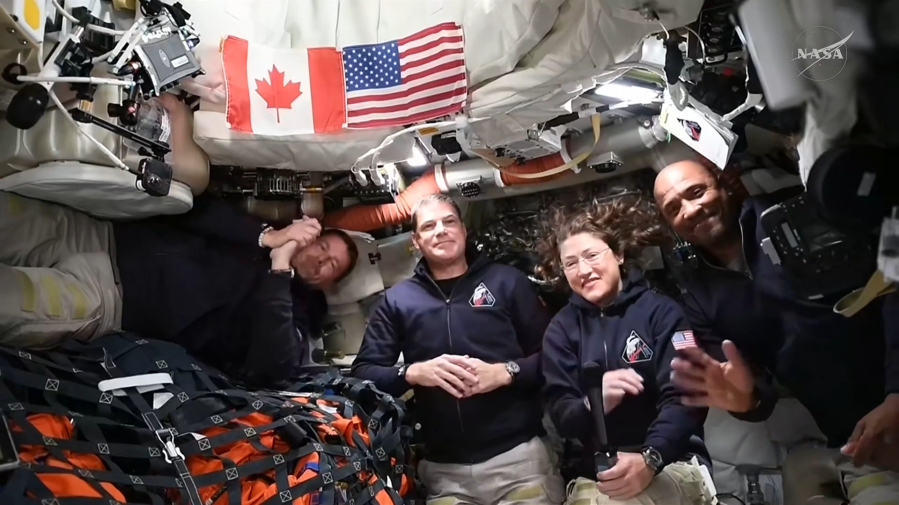
Crew: Reid Wiseman (CDR), Victor Glover (PLT), Christina Koch (MS), Jeremy Hansen (MS, CSA).
-
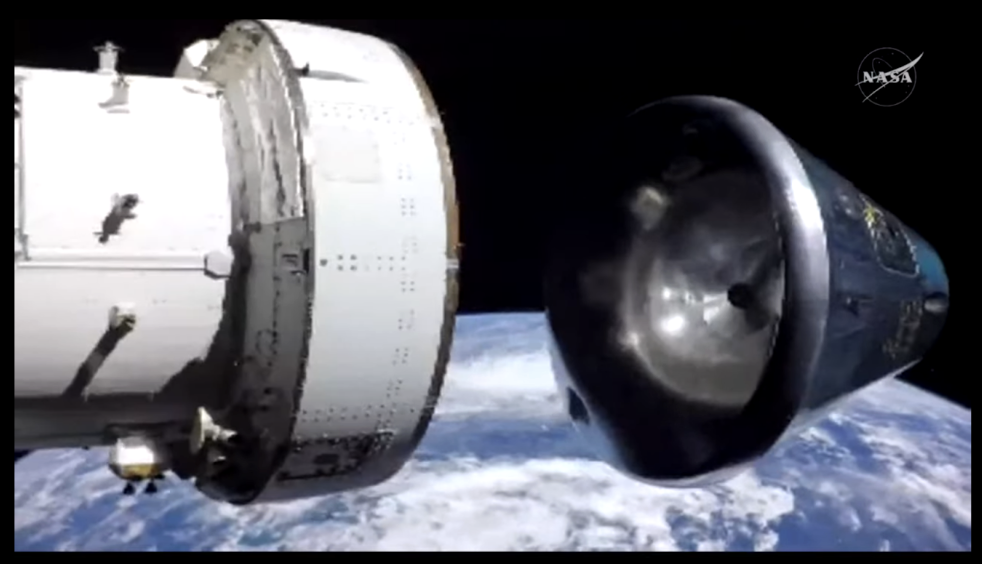
Spacecraft: Orion, named “Integrity.”
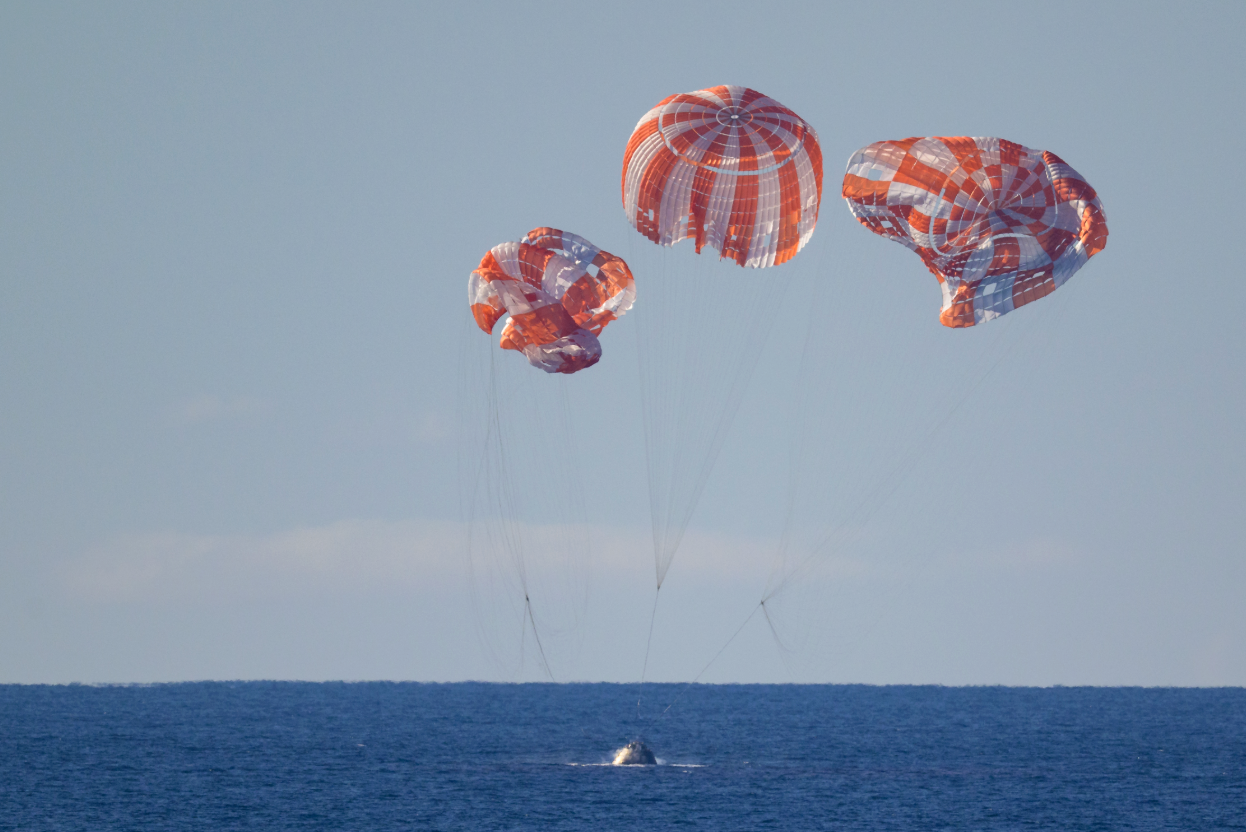
Splashdown: April 10, 2026, Pacific Ocean.
Bluesky: bsky.app/profile/schwentker.sandboxlabs.ai/post/3mjvuiwssas2z