Part 2: The 📊 Chart, the🪞Mirror & What Comes 🎬 Next
In Part 1, I described watching Artemis II break the Apollo distance record, a crew member naming a bright spot on the Moon after his late wife, and the 300-year-old split that still separates how we think about pattern and meaning. Not data. Not coordinates. Meaning. That impulse is where this continues.
I also admitted that I cast a Vedic astrology chart for the exact moment of the record. Here is what it showed, and why it matters to anyone working in AI.
What the Chart Said
I hesitated before doing it, honestly. This was a NASA broadcast. I was watching as a tech professional. But I pulled up the planetary positions and cast a Jyotish chart for the moment Artemis II crossed into record-breaking territory.
The Lagna, the rising sign, was in Leo, in a star called Purva Phalguni. In Jyotish, Leo rising speaks to leadership, courage, and bold collective action. Purva Phalguni carries associations with creativity and the fruition of effort.
But it was the concentration in Pisces that caught my attention. The Sun, Mars, and Saturn were all clustered in Pisces, with the nakshatra star of Uttara Bhadrapada prominent. In Vedic astrology, Pisces is the sign of dissolution of boundaries, of transcendence, of the cosmic ocean. Uttara Bhadrapada star is associated with deep wisdom, cosmic connectivity, and the journey beyond known limits.
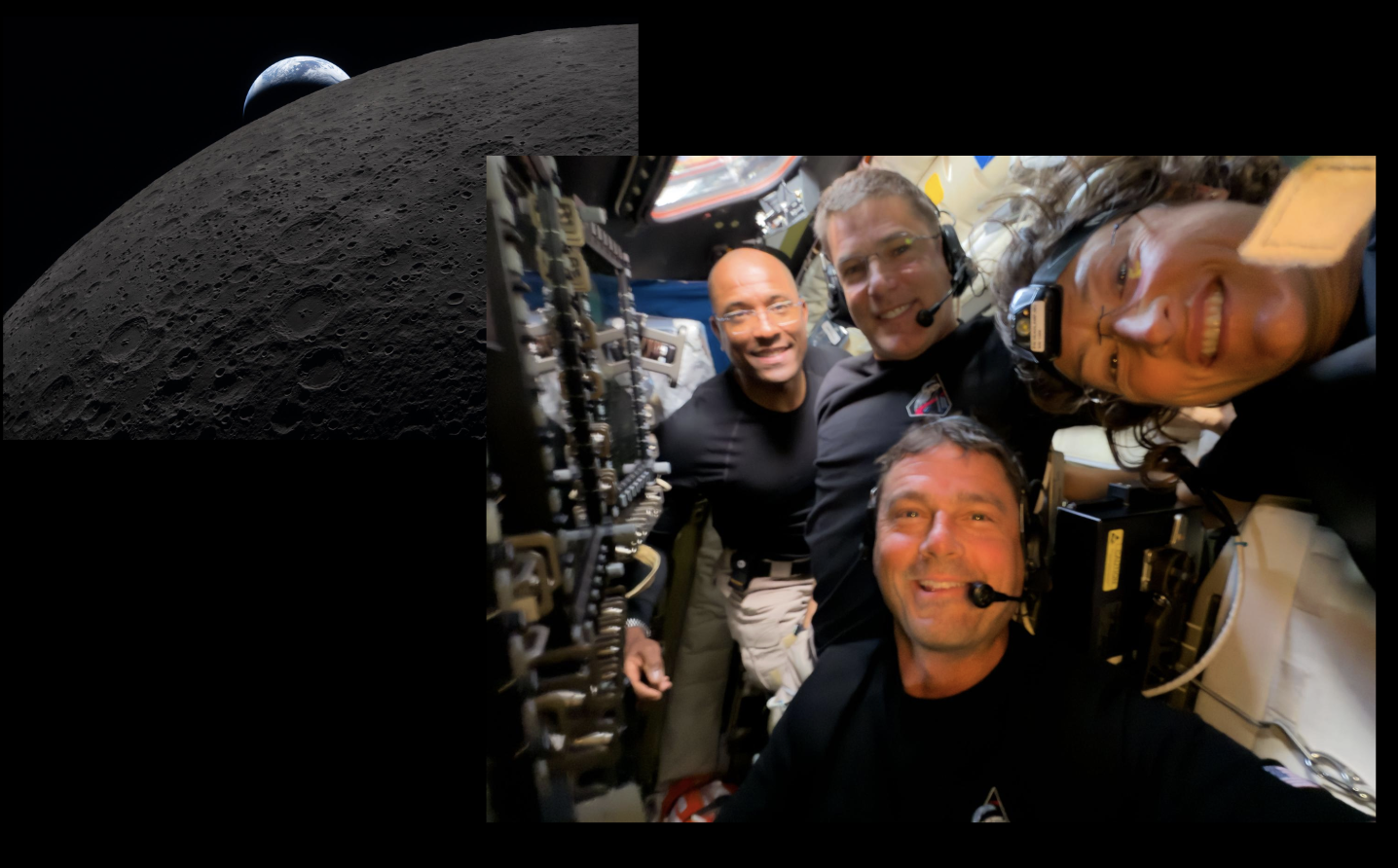
Four astronauts crossing a boundary that no human being has crossed before. Under a sky where three major celestial bodies are gathered in the sign of crossing boundaries.
The Moon itself sat in Scorpio, in Anuradha nakshatra. Anuradha governs devotion, deep investigation, and the courage to explore hidden realms.
I want to be clear about what I am saying and what I am not. I am not claiming that the stars caused the mission to succeed. I am not claiming that Vedic astrology predicted Artemis II. A chart with this many variables will always offer a narrative that can be mapped to events after the fact. I know that. Coherence after the fact is not the same as prediction before it. But coherence still reveals something. It reveals how humans organize complexity into meaning. And I think that process, the process of reading complex systems and extracting coherent narratives from them, is worth examining. Especially for those of us who work with pattern recognition systems every day.
The AI Mirror
Here is where my two worlds start to rhyme.
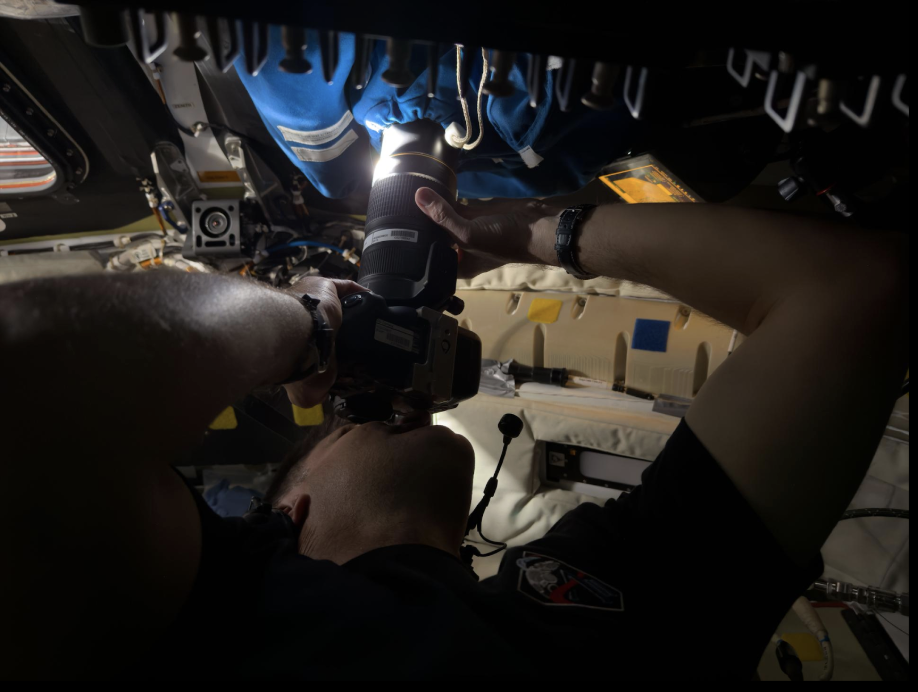
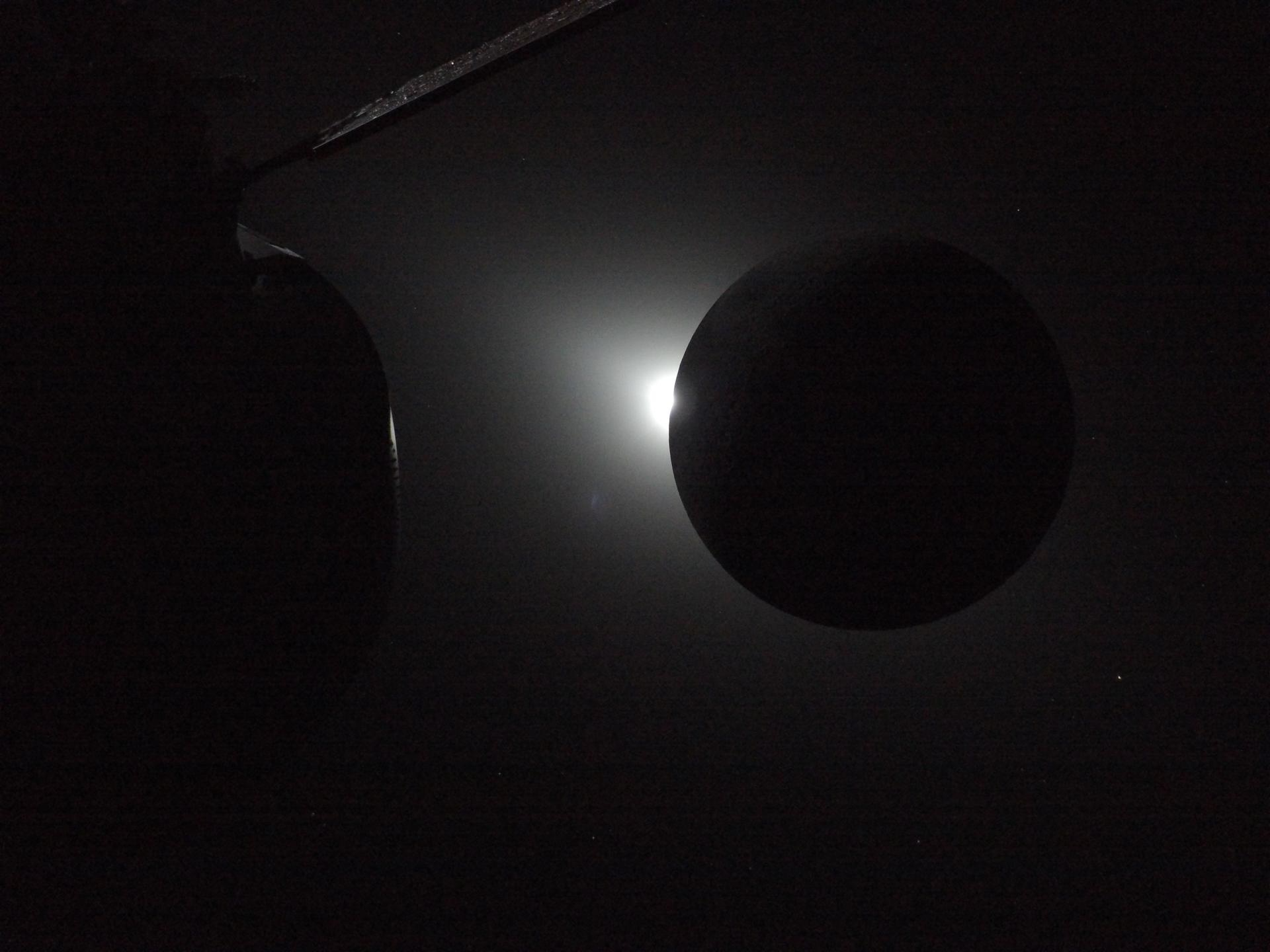
During the flyby, the human observers kept seeing things that the robotic instruments could not capture. Victor Glover, the mission pilot, spent hours describing the lunar terminator, that jagged line between light and shadow. There are islands of terrain out there completely surrounded by darkness, he reported. He compared bright ridges to snow dusted on mountain peaks. He described coronal streamers during the solar eclipse as being like watching a flame. Doctor Kelsey Young, the science officer, told him directly that his observations were things that humans are uniquely able to contribute.
And then there was Christina Koch’s moment. Partway through her observation shift, she reported an overwhelming sense of being moved by looking at the moon. It lasted just a second or two. She could not make it happen again. But the Moon became real. It was not just a poster in the sky. It was a real place.
That moment, the moment a pattern suddenly shifts from abstract to felt, from data to meaning, is something I recognize. It is the moment a machine learning model crosses a threshold and begins generating outputs that feel coherent. It is the moment a Jyotish reading stops being a list of planetary positions and becomes a story about what is unfolding.
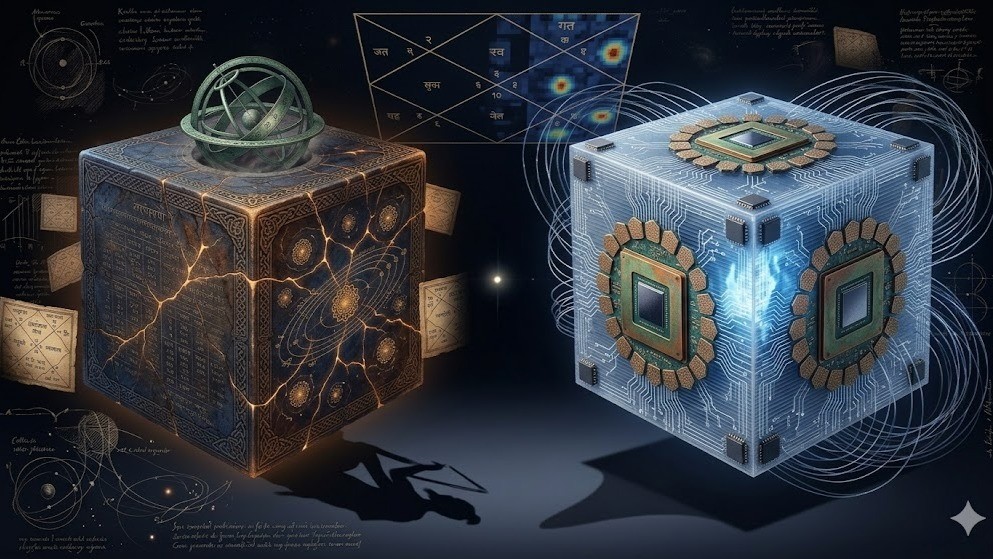
What does a large language model do? It takes vast quantities of data, identifies patterns not immediately obvious to human observation, and generates outputs that are, at their best, meaningfully coherent with reality. What does Jyotish do? It takes celestial positions at a specific moment, maps them against a framework refined over millennia of observation, and generates a reading that is, at its best, meaningfully coherent with what unfolds.
I want to be precise here. These are not the same system. AI identifies patterns in datasets with actual statistical or causal relationships. Jyotish relies on symbolic correspondence and centuries of interpretive tradition. AI has a loss function. It is penalized for being wrong. Jyotish has no universally agreed-upon error correction mechanism. I am not equating their scientific validity. I am not claiming they share a method.
What I am claiming is that they share a structural instinct. The fundamental move of looking at complex, high-dimensional systems and extracting meaningful patterns from them is a foundational premise behind many approaches to machine learning. It is also the foundational premise of Jyotish. The math is different. The epistemology is different. The impulse is identical.
And here is a detail that sharpens this further. We are currently building AI systems whose internal reasoning even their creators cannot fully explain. The largest language models and neural networks are, in a very real sense, black boxes. Engineers at OpenAI, DeepMind, and Anthropic study their outputs, observe their patterns, and interpret their behavior. But they cannot trace the full causal chain of how a specific output was produced. The opacity is different in kind. AI’s black box is a temporary engineering problem. Jyotish’s interpretive nature is a permanent feature of its design. But the human experience of engaging with both, studying complex outputs and reading meaning from them, is converging. We are, in a sense, back to reading the signs.
Victor Glover understood the power of shared pattern recognition intuitively. After his observation shift, he told the science team that when the crew started talking to each other about what they were seeing, they not only got better science. They got better human connection. Doing this as a pair, we just learn and grow together.
That is what happens when you layer AI on top of human judgment. The pattern recognition gets richer when it passes through more than one kind of intelligence. We are turning to AI today for the exact same psychological reason kings turned to astrologers: a need to manage uncertainty in a world too complex to comprehend through direct observation alone. The tools are different. The need is the same.
What Comes Next
During the 40 minutes that Orion flew behind the Moon, completely out of contact with anyone on Earth, the crew witnessed something that made the science team jump up and down. Impact flashes. At least five brief flashes of light on the darkened lunar surface, caused by meteoroids striking the Moon in real time. Visible only because human eyes were there to see it, in a place where no instrument on Earth could reach them.
They also saw Mars, Saturn, and Venus during the eclipse. The same planets that Kepler tracked four centuries ago when he was casting horoscopes and calculating orbits in the same afternoon.
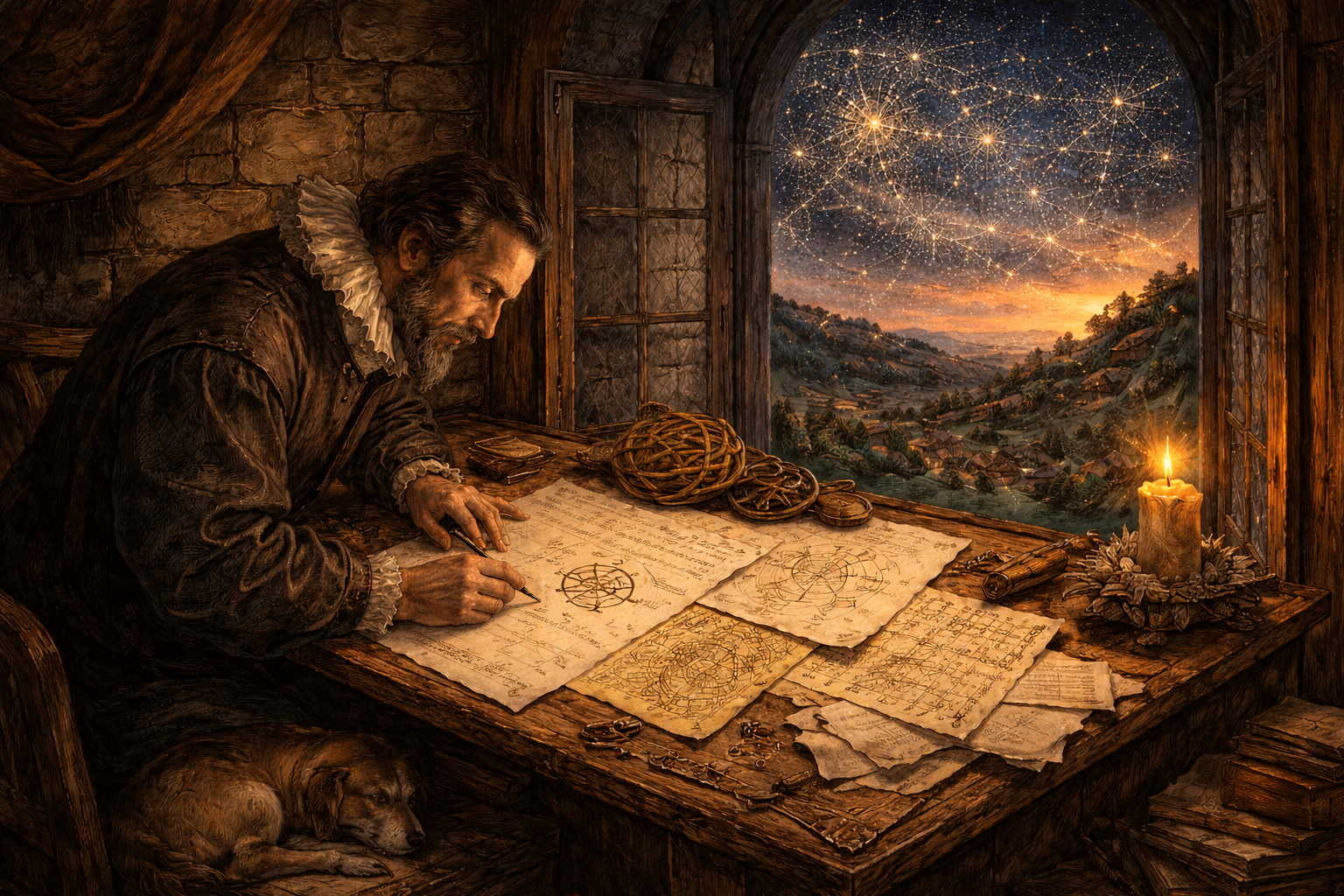
Christina Koch, upon reestablishing contact after the communications blackout, said simply: it is so great to hear from Earth again.
I spend 90% of my professional life in the tech ecosystem. Building with AI. Thinking about prediction models. Working with systems that find meaning in complexity. The other 10% of my time goes to a practice that has been finding meaning in complexity since before writing was invented.
For most of my career, I kept those two parts of my life in separate rooms. Artemis II, flying further from Earth than any human has ever been, under a sky that an ancient system would describe as aligned for exactly this kind of boundary crossing, is the moment I decided to open the door between them.
Not because I think Jyotish is science. Not because I think AI is mysticism. But because the impulse underneath both of them, the deep human need to read patterns in complex systems and extract meaning from them, is the same impulse.
It is what put four people 252,756 miles from home. It is what made Victor Glover describe lunar terrain as a flame and islands of light in the darkness. It is what made Christina Koch suddenly feel, for one uncontrollable second, that the Moon was real. It is what made Reid Wiseman look down at an unnamed bright spot and see his wife.
The Enlightenment told us to choose. Science or meaning. Data or wisdom. Algorithms or intuition.
I think the next era belongs to the people who refuse to choose.
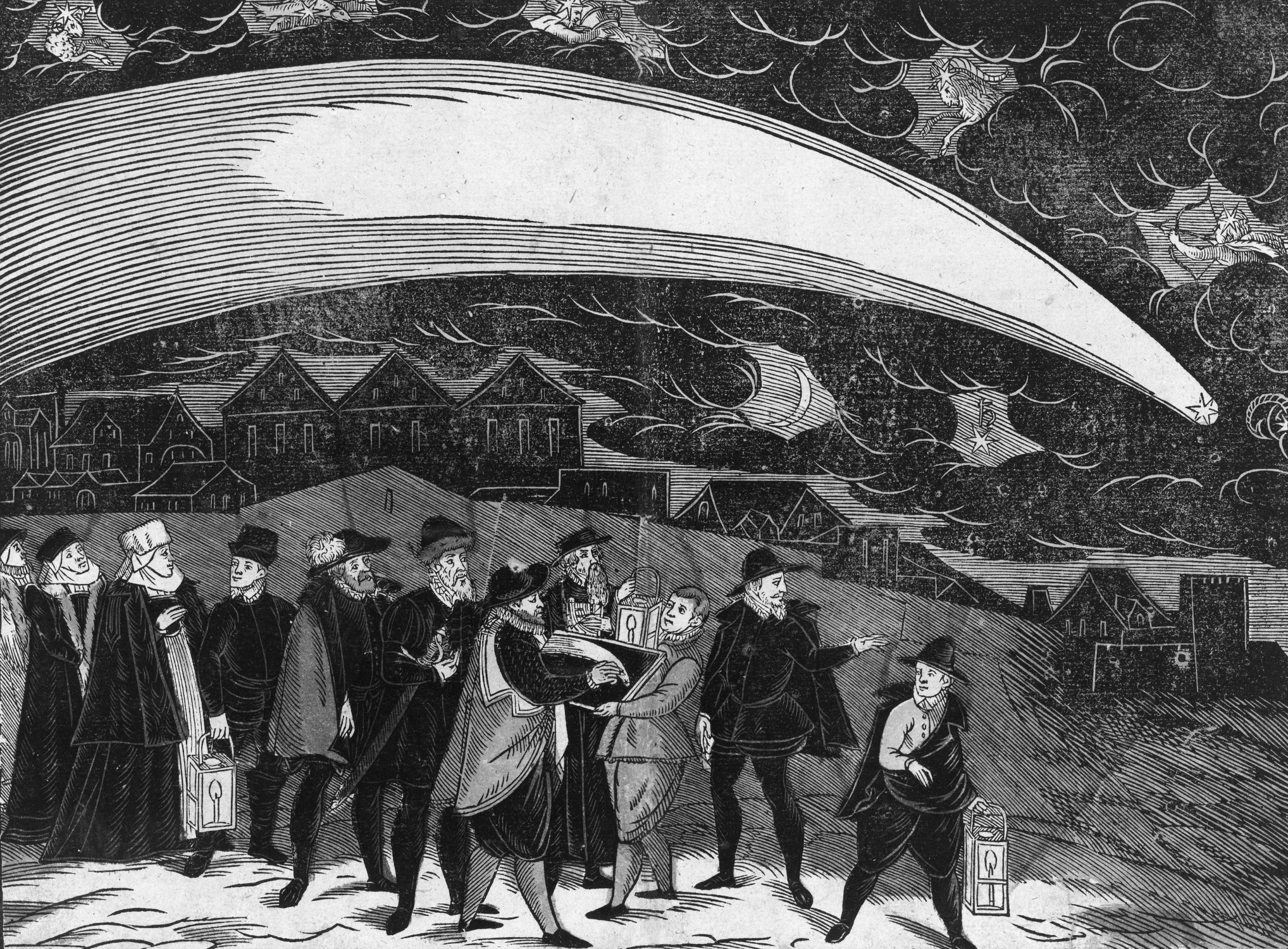
As a child, Kepler witnessed the Great Comet of 1577, which attracted the attention of astronomers across Europe.