When the enterprise interface disappears, what remains is architecture
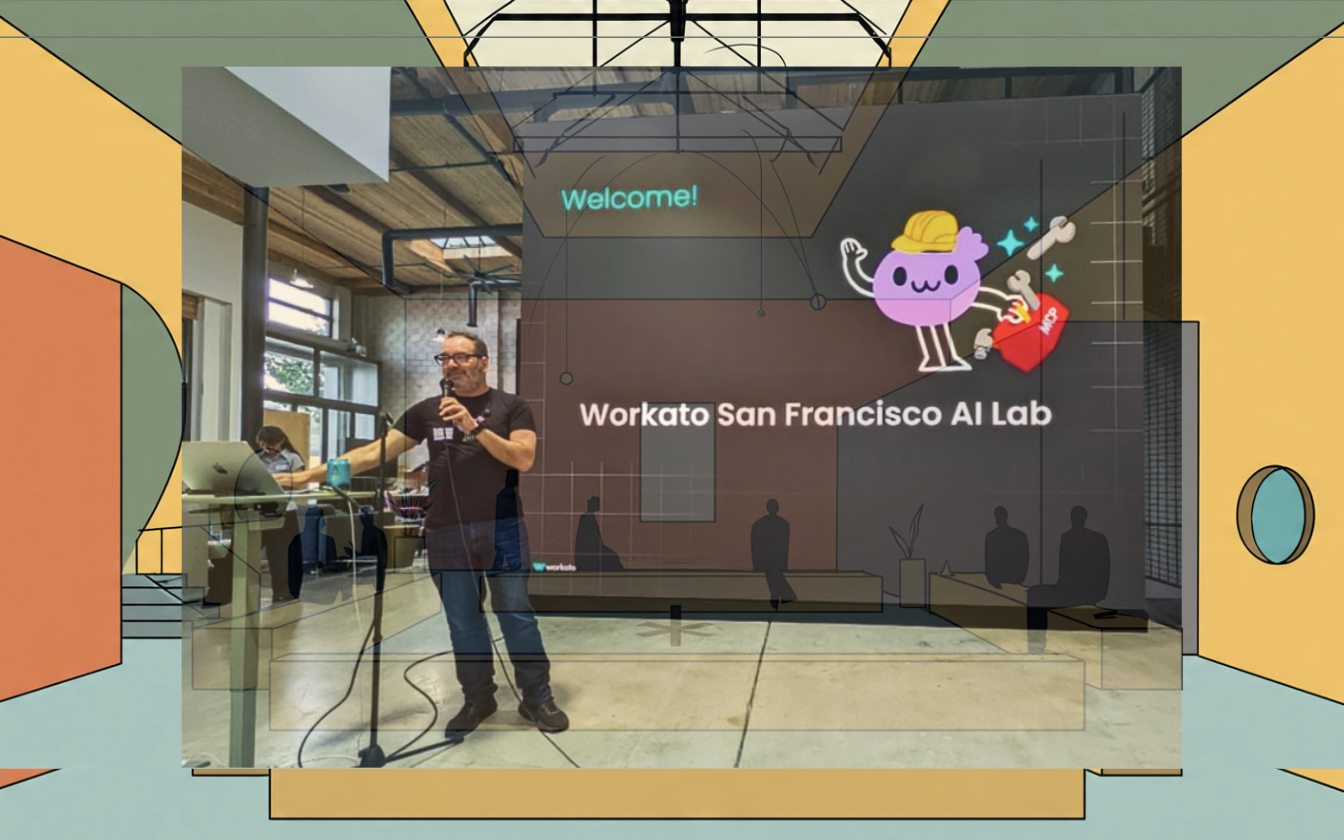
Field report from Workato’s Agentic AI in Action: MCP Happy Hour, March 26th, San Francisco AI Lab
Twelve days before Workday goes live on April 6th, the people operations team at Workato accepted a constraint that would have been unthinkable in any prior enterprise systems rollout. No user guide. Not a condensed one. Not a video walkthrough. None.
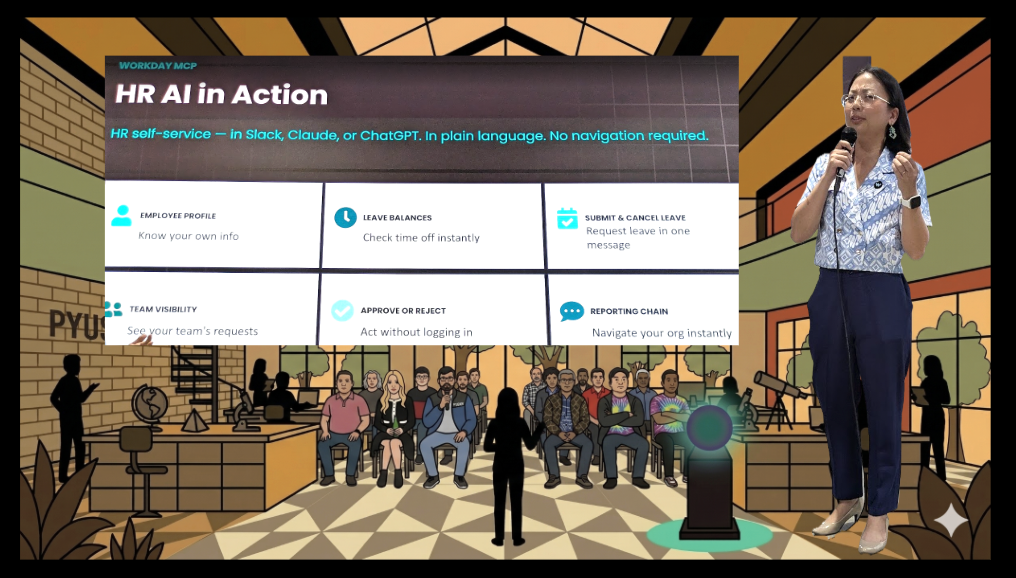
Choon Yen KHOO, IHRP-SP, Workato’s Director of Global People Operations & Technology, explained the logic with the kind of calm that comes from having led implementations for over a decade. The CEO and CIO had posed a challenge: what if employees never have to look into Workday at all? Not how to avoid the investment. Not how to skip the system. How to make the system invisible while preserving every layer of integrity and auditability underneath.
The answer is MCP, an open protocol that standardizes how AI models access enterprise systems and take action across them.
Employees will check time-off balances, apply for vacation, and manage approvals through whatever LLM they already prefer, whether Claude, ChatGPT, or Slack. The request enters the system. The system processes it. The employee never opens a tab. Managers ask for pending approvals in natural language. The approved leave flows to a shared calendar, updates the on-call roster, and ensures coverage continues without a single manual handoff. A people ops workflow that once required training decks and office hours now requires 🔇 nothing but a sentence.
The ambition does not stop at PTO. Greenhouse MCP for end-to-end recruiting. A performance management genie to rethink quarterly and annual reviews. The pattern is consistent: build the MCP skills first, expose them to users through familiar interfaces, let adoption happen where attention already lives.
CIO as Builder
Carter Busse, Workato’s CIO and a Bay Area ORBIE Award winner who was the first IT leader hired at Salesforce, opened his portion of the evening with a provocation aimed at every IT executive in the room. This is our moment. If IT leaders do not seize the opportunity to define the control layer before someone else defines it for them, the window closes. The chief AI officer. The chief transformation officer. Or, as Busse put it with a grin, someone’s nephew who is really good with AI.
The provocation landed because Busse is not theorizing. Over 35 years in IT, mainly at Bay Area SaaS companies, and right now more hands-on than at any prior point in the career. Building MCP servers. Building agents. Vibe coding. The challenge to the room: if not spending 30 to 60 minutes every day hands-on with the technology, start today. Someone else will.
The honesty about what failed matters as much as what worked. In 2023, Workato connected business processes to OpenAI. Game-changing. Well-adopted. In 2024, the team built agents using Workato’s Denim framework. Despite the geniuses being purpose-built for sales, customer success, and engineering, they were not adopted. The reps did not use them. The frustration was real. Then the company bought Claude and ChatGPT licenses for everyone. Adoption remained flat, despite capability, distribution, and executive sponsorship.
The breakthrough came last summer when Workato’s engineering team shipped MCP server support in the Jetpack platform. Busse described the moment with the kind of specificity that signals genuine inflection: a Friday afternoon, standing with BJ (who runs data infrastructure), connecting an MCP to a data warehouse with an existing API endpoint. They started asking about customer data through ChatGPT. Predicting churn. The CEO walked over and stayed for an hour and a half.
Token Killers & FOMO Architecture
Adoption driven by performance, not enablement
What followed is an adoption curve that enterprise software vendors would study if they understood what caused it.
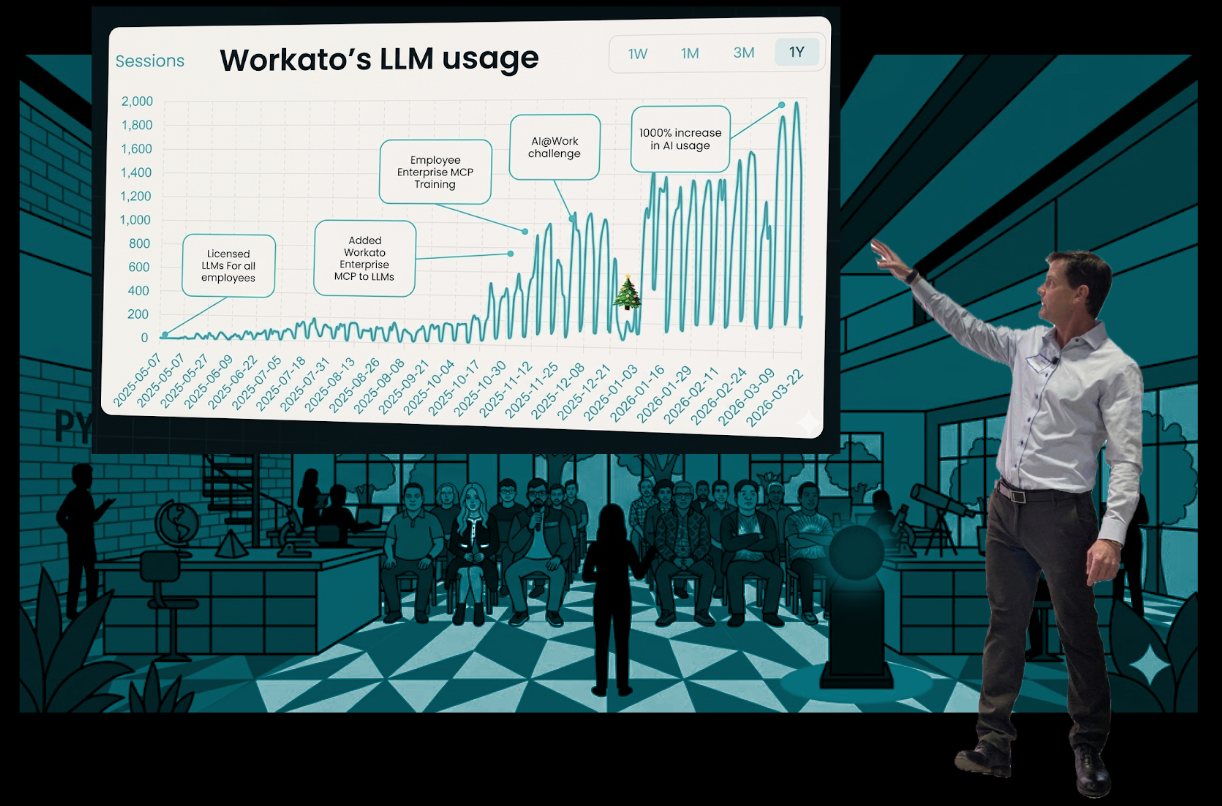
Six MCP servers deployed in the summer and fall. Exposed to the entire company with training and all-hands meetings. Adoption climbed. Then a hackathon over the holidays. Adoption climbed further. And then the sales kickoff, where top-performing reps demonstrated MCP-powered workflows on stage. The rest of the sales team watched. FOMO did 🚀 what enablement could not.
Busse’s team tracked adoption through token consumption and discovered something the genie-era agents never revealed: the employees consuming the most tokens were also producing the most revenue. Kate Waters, a six-month sales rep, was killing tokens and killing her number simultaneously. Jonathan, a general counsel running 600 accounts across 15 reps, was bringing in more deals by reading buying signals from usage data and proof-of-concept activity. Richie in customer success. Another colleague in engineering. The pattern held across functions.
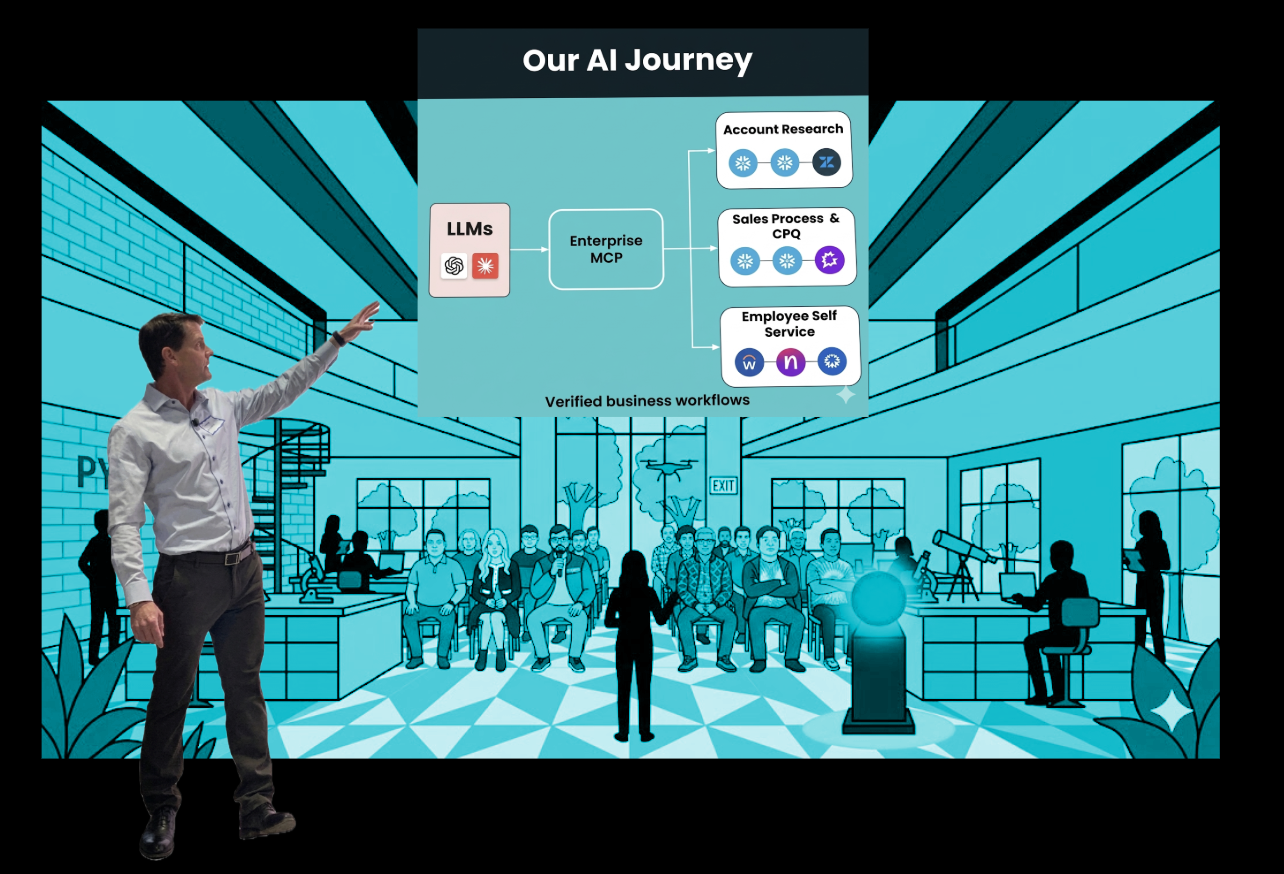
The strategic inversion is worth sitting with. Workato did not build agents and push them to employees. The company connected LLMs to enterprise data, found the employees who independently invented the most creative uses, and then built agents around those workflows. Workflow discovery precedes automation design. Heroes first. Agents second. Not the other way around.
Carter’s team published the data for the first time at this event: a conservative estimate of one million dollars in contributed revenue for Q4 alone. The mechanism was not capability alone. Agents brought in more pipeline by surfacing deals that reps would have otherwise missed. Managers got better data in Salesforce because agents listened to Gong calls, followed the sales methodology, and populated the right fields. Deals moved faster. QBRs that took Jonathan ten hours now take ten minutes.
Demo as Proof: From Sentiment to Signed Quote
The live demonstration made the architecture tangible. Busse asked the same question of two configurations side by side. ChatGPT connected to two MCP servers (Gmail and Slack) returned surface-level public information about a customer with some confidence that the account existed based on email and Slack mentions. Useful. Limited.
Claude Desktop connected to fifteen MCP servers (Snowflake, Gong, Salesforce, Gmail, calendar, directory, Highspot, and others) returned a full account intelligence profile from a single prompt. Current ARR, renewal state, overconsumption alerts, risk profile from Gong call sentiment, rep assignment, upsell opportunities flagged from call transcripts. One question produced what previously required hours of manual aggregation across six or seven systems.
The demo then escalated into action. Generate a renewal quote. Select the opportunity in Salesforce. Listen to recent calls to identify what the customer wants. Add an upsell product. Set terms at 24 months. Apply a discount (the agent recommended 7%, noted that a longer term might justify 8%, and accepted Carter’s decision to hold at 7%). Verify product codes. Create the quote. Submit for approval through Salesforce workflows. Check Jira for open tickets. Route to Ironclad for contract management. Draft the email. Place it in the Gmail drafts folder, not sent.
That last detail matters. Control is designed, not assumed. The MCP server was built to place emails in drafts, not send them. Busse emphasized the principle: MCP servers define the boundary of what actions an agent can take in each system. The organization slowly opens that boundary as trust develops. Sales reps request new capabilities. The team evaluates whether the action is safe and deterministic. The door opens incrementally.
Finance Builds Before Vendor Does
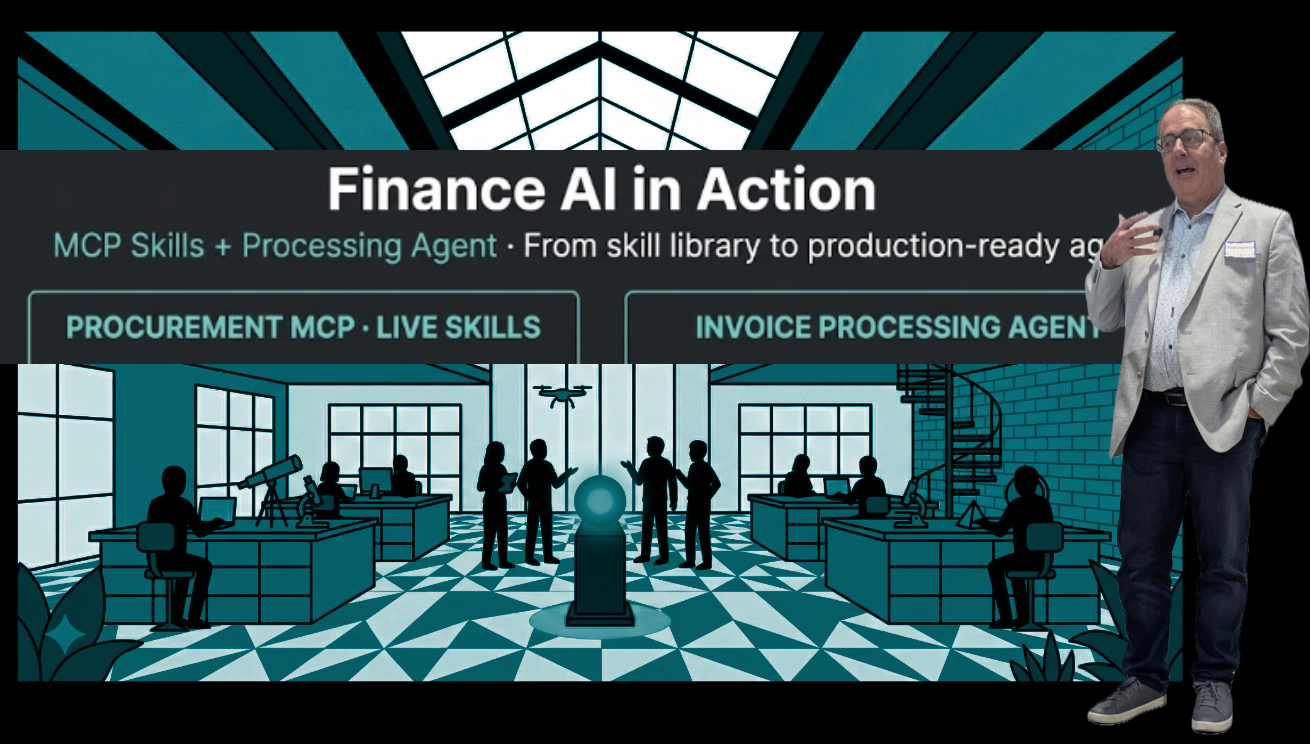
Michael Harrington ☁ brought the finance and accounting perspective with a detail that places the urgency in present tense: more procure-to-pay use cases have landed since the calendar flipped on 2026 than any other finance category. His team is simultaneously building a Coupa procurement MCP server exposing eight skills and an invoice processing genie whose foundation rests entirely on those same MCP skills. The invoice genie monitors an inbox, processes invoices using AI, validates through three-way matching, and orchestrates downstream actions.
The detail that quietly rewrites vendor dynamics: Coupa does not yet offer its own MCP server. Workato is building it and feeding the inputs back to Coupa so they can potentially offer one as well. Protocol adoption is inverting traditional vendor roadmaps. The customer is leading the vendor on enterprise protocol design. The MCP server gives finance users immediate value through dashboards and data access. The genie built on top of those skills gets tested against the same foundation. Value delivered quickly through the MCP, trust built incrementally through the genie. A strategy that 🏗️ provides returns at each layer while the next one matures.
Invisible Architecture
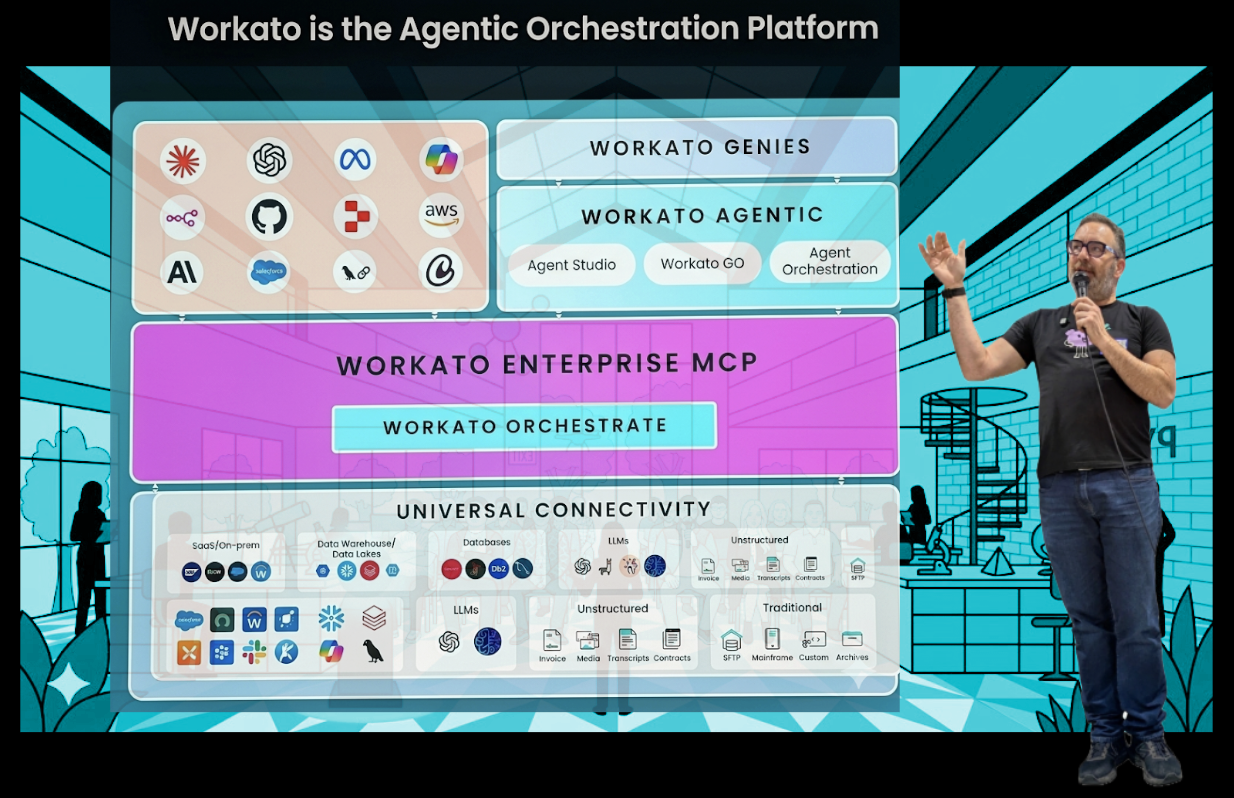
Adam Seligman, Workato’s CTO (formerly VP of Developer Experience at AWS), framed the evening by placing MCP in the context of twelve years of integration and orchestration. The pitch was direct: every vendor within a hundred miles has an agent platform to sell. The question is not which agent framework to choose. The question is what sits between where an organization is today and where agents need to go. That intermediate layer is the control plane for agent behavior. Without clarity on it, agents will not succeed, and outcomes will not be deterministic.
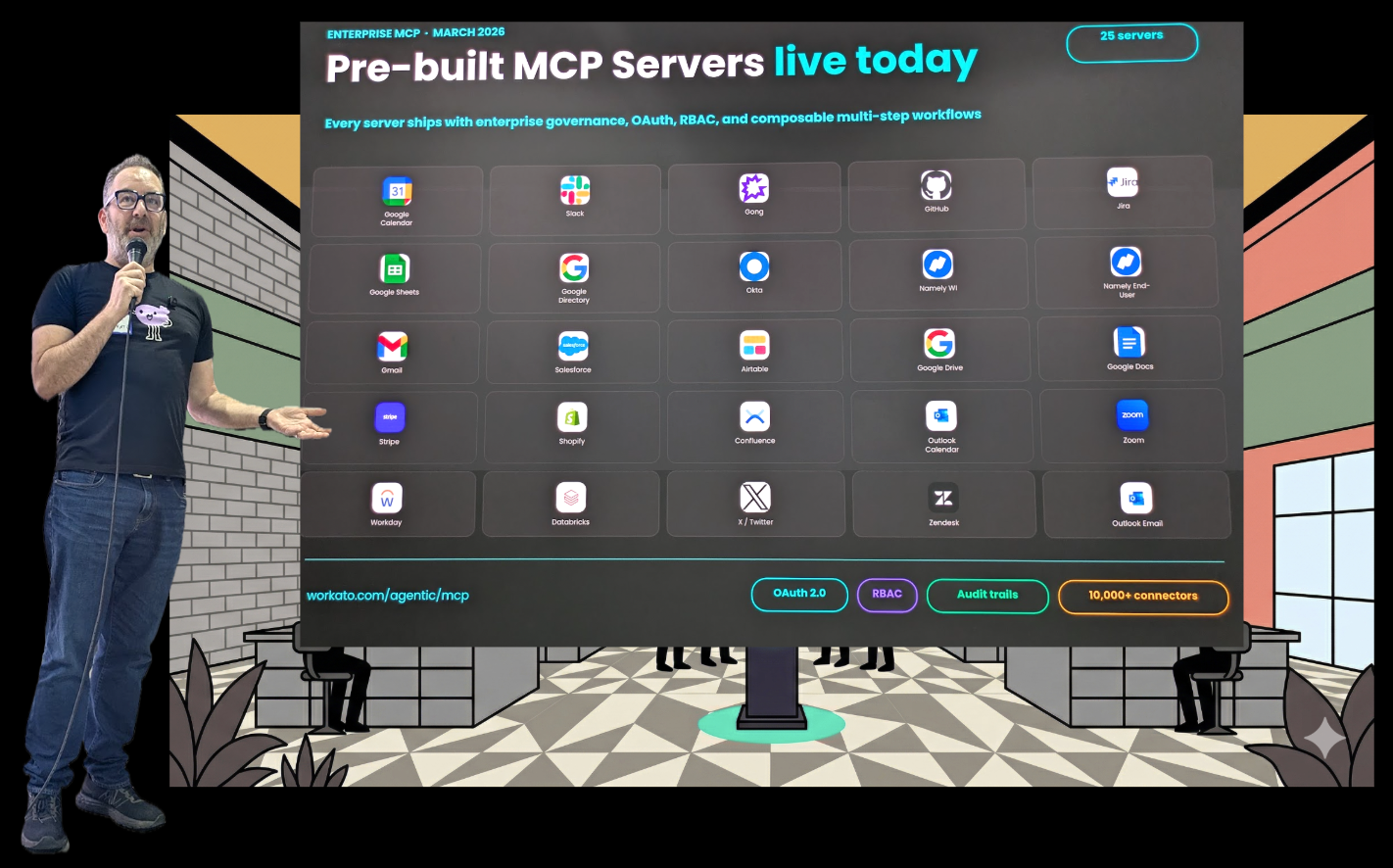
Workato has 25 MCP servers available today in the Jetpack platform, with plans to reach 100 within six months covering top enterprise applications. The servers are ready to connect. The recommendation: start small. Open a few. Get them running. But get them running, because the enablement effect on an entire company is substantial.
On security, Seligman described the MCP server as the control point. The RBAC architecture handles role-based access control through verified user connections that swap in a token for the specific user at the enterprise MCP layer. Agents never see what the human is not allowed to see. The fine-grained access controls of the underlying system are respected, not bypassed.
On hallucination, Seligman pointed to context precision. Two failure modes produce hallucinations: missing context, where no MCP connection exists to the needed source and the model improvises, and overloaded context, where too many tokens saturate the window and the model loses fidelity. The solution is purpose-built MCP tools that extract the right signal deterministically and pass only the relevant tokens to the LLM.
Pattern Recognition
Three departments arrived at the same architectural conclusion from different starting points. People operations needed to make a system invisible. Sales needed to make data actionable without manual aggregation. Finance needed to build procurement intelligence before the vendor did. Each converged on MCP as the protocol layer that makes the interface disappear while governance becomes more visible, not less.
The adoption story underneath is not about technology preference. Workato tried pure LLM access. Tried purpose-built agents. Tried universal licenses. None produced the adoption curve that MCP servers connected to real business data generated in a matter of weeks. The binding constraint was never capability. The constraint was context: giving models access to the right data through the right controls at the moment the employee is already working.
For CIOs, the signal reframes IT from service layer to strategic control layer. The question is no longer which tools to support but which protocol governs how every tool gets accessed. For CTOs, the shift moves architecture from systems design to protocol design, where the orchestration layer between agents and enterprise data becomes the most consequential surface in the stack. For both, the system that wins is the one that disappears.
The adoption that sticks is the one driven by FOMO among top performers, not by training decks in a conference room. Find the token killers. Celebrate them. Build around what they discovered. That is a community-driven adoption loop, not a deployment plan.
Workato built the room. Filled it with customers, partners, and practitioners. Asked the right people to show their work, not describe it. The questions that emerged, unfiltered and real, are the kind of signal that cannot be manufactured in a product roadmap meeting. The organizations that feed that signal back into what they build next are running a live feedback loop between practitioners and platform. The room itself becomes infrastructure for learning what to build.
This is the second in a series of field reports from Workato’s AI Hub in San Francisco. Part 1, “The Room Where Agents Go to Production,” maps the architecture, evaluation, and absorption layers of enterprise agent deployment.
For a deeper look at what happens when token-scale infrastructure meets a single engineer running 30 agents, see “Five Billion Tokens, Thirty Agents, One Engineer.”