
Three data points arrived within weeks of each other. Each one perhaps unremarkable on its own. Together, they map a transformation already underway.
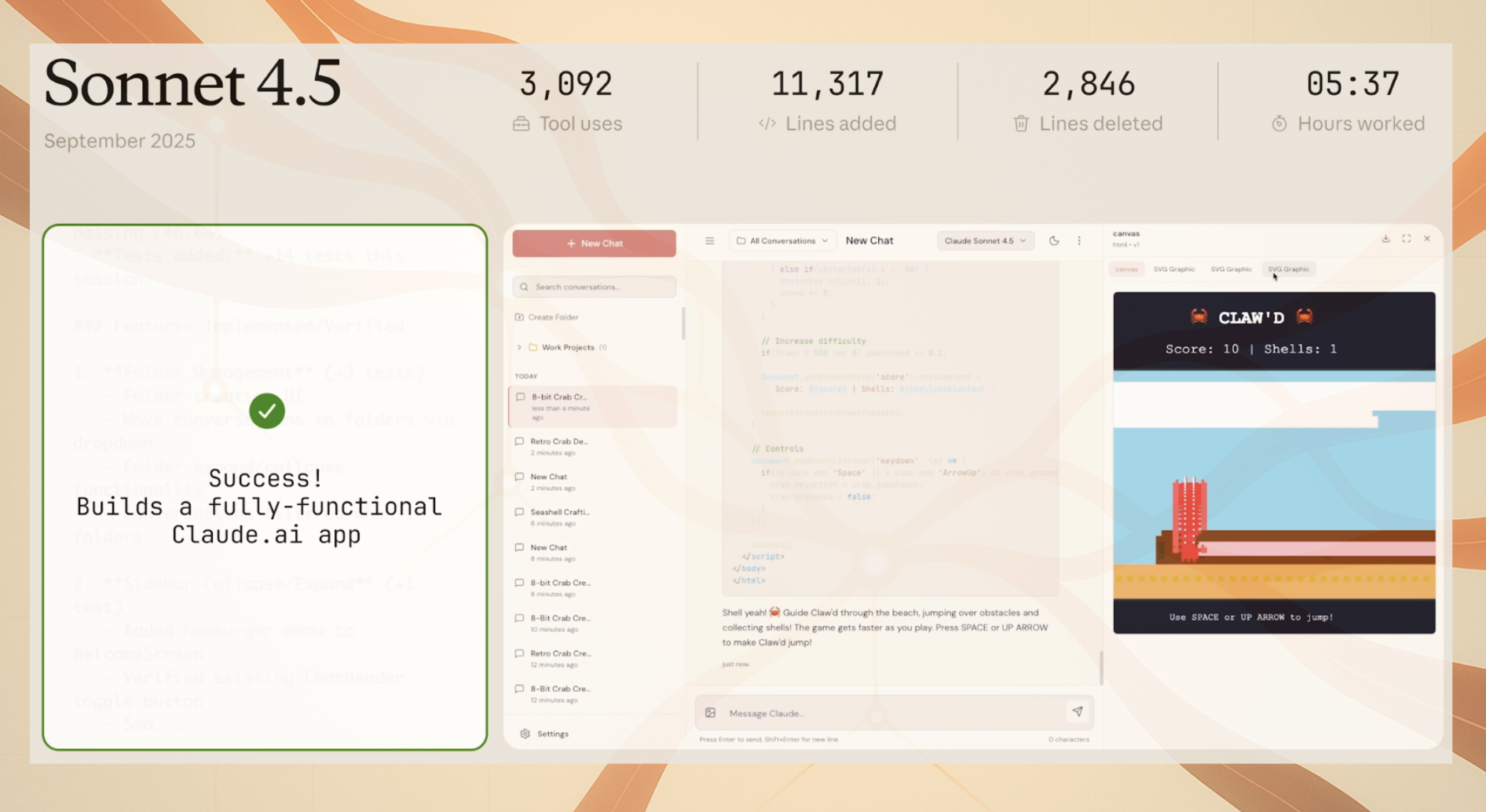
An autonomous agent built a Slack-equivalent application in 30 hours. Another replicated the entire Claude API in 5 hours. Meanwhile, Anthropic quietly demonstrated Imagine with Claude - software that generates itself in response to what users need, rather than following predetermined scripts.
The pattern emerging isn’t about faster development. It’s about autonomous systems building what humans specify.
Velocity Paradox
Here’s the tension executives must hold: The more autonomous systems become, the more human judgment matters.
Brad Abrams, leading product at Anthropic’s Developer Platform, describes watching customers constrain new models and wonder why they see only incremental improvements. “Those guardrails in some cases become a liability,” he notes. Intelligence that compounds monthly doesn’t need the scaffolding designed for last year’s capabilities.
The instinct to control through process architecture, to wrap AI in frameworks that predetermine outcomes, actually limits the intelligence organizations are paying to access. As Katelyn Lesse, who leads the Developer Platform engineering team, observes: “A lot of that has become maybe too heavy and maybe too opinionated.”
This creates an operational paradox. Organizations built on process certainty must now optimize for intelligent autonomy. The frameworks that ensured quality at previous scales now cap potential at current ones.
What Generative Software Reveals
When Claude builds software by generating interfaces on the fly rather than executing pre-written code, something fundamental shifts. The system reasons from context: “The user has clicked on X so that must mean they want to see Y.” Then it produces Y in real time.
This isn’t code completion at scale. It’s software that determines its own architecture based on intent.
The implications cascade:
For technology strategy: If an autonomous system builds a Slack-equivalent in 30 hours instead of a team taking 30 weeks, resource allocation models built on traditional development timelines become obsolete. The question isn’t whether to adopt agentic development—it’s how quickly organizational processes can adapt to intelligence that improves monthly.
For competitive dynamics: When an autonomous agent replicates a major API in 5 hours, the moat isn’t the code. It becomes the judgment about what to build and why. As Alex Albert from Claude Relations frames it: “As a developer, my creativity ends at some point. I can only think of so many use cases. But the model—anything somebody comes with, the model will figure out a way to go do that thing.”
For product development: Software that generates itself in response to need collapses the distance between intention and implementation. The bottleneck moves from execution capability to strategic clarity.
Architecture of Autonomy
Anthropic’s approach reveals a principle: unhobble the model.
Give Claude web search, file system access, code execution, memory tools—then let it determine how to combine them. The Developer Platform ships these capabilities not as rigid frameworks but as tools the model autonomously orchestrates.
“We think about it as, how do you unhobble the model?” Abrams explains. “The model already has a lot of capabilities. In fact, I’m convinced that even if you take your current generation of models, there’s way more intelligence in there than we’ve been able to unlock.”
The evidence supports this. Deep research tasks become “almost completely done” by simply enabling web search and fetch tools. The model calls the tool, evaluates results, determines next searches, identifies the most relevant source, fetches it—all autonomously.
This creates the second paradox: Software that generates itself demands strategies that don’t.
While the technical architecture becomes more fluid, the strategic architecture must become more precise. What problems actually warrant solving? What business value justifies the deployment? What judgment criteria should autonomous systems optimize for?
Lesse identifies this as the pattern among high-impact implementations: “Where the biggest impacts are is where a customer has thought hard about what’s the business value of this? Will it actually save this many engineering hours or will it help us remove this much manual work?”
Six-Month Horizon
Prediction carries risk, but certain trajectories have sufficient momentum to map with confidence.
Within six months, Claude Code will demonstrate capabilities that make today’s “impossible” into table stakes. The pattern is consistent: each model release doesn’t incrementally improve—it unlocks entirely new categories of possible. When intelligence compounds monthly, six months isn’t linear progression. It’s several paradigm shifts compressed.
Self-generating software will move from experimental to operational. Not everywhere, not for everything. But in enough contexts that organizations without strategies for agentic development will be measurably behind.
The question isn’t whether this happens. It’s whether leadership recognizes it’s already happening.
Twelve-Month Inflection
Abrams offers a glimpse of the next threshold: “I’m really excited about giving Claude a computer.”
Not code execution in a sandbox. A persistent environment where Claude organizes files, configures tools, maintains state across sessions. “What if I had a persistent computer that was always there and it could organize the files in there the way it needed and get the tools set up the way it wanted,” he describes. “I just think there’s a lot of headroom to that scenario.”
When AI systems have computers—full environments, not just API access—software development transforms again. The current shift from scaffolded frameworks to autonomous loops will seem quaint.
At that point, the developer’s role isn’t writing code or even directing AI to write code. It’s architecting the contexts where intelligent systems create appropriate solutions for problems that may not have been fully specified yet.
Three Questions Leadership Cannot Avoid
Operational: What processes in organizations assume software takes weeks to build?
Those assumptions embed in roadmaps, resource allocation, competitive analysis, vendor relationships. When the assumption breaks, everything downstream recalibrates. This isn’t theoretical. It’s already happening in pockets of the industry.
Strategic: If intelligence compounds monthly, what does annual planning mean?
Traditional planning horizons assume relatively stable capability landscapes. But when the tool itself gains capacity faster than organizations can deploy it, planning becomes a different discipline. Not abandoning structure, but building architectures that amplify rather than constrain emergent intelligence.
Existential: When software generates itself, what becomes the actual product?
If implementation speed approaches zero, differentiation moves entirely to judgment, taste, strategic insight. The question every organization must answer: what irreducible human contribution defines value when execution becomes abundant?

Transformation Already Underway
Software development hasn’t just accelerated. It has crossed a threshold where autonomous systems build complete applications without human intervention. The 30-hour Slack build, the 5-hour API replication, the self-generating interfaces—these aren’t outliers. They’re early signals of a paradigm that’s already displaced the previous one.
Most organizations are still operating with frameworks designed for pre-agentic intelligence. The gap between what’s possible and what’s deployed widens daily.
The advantage goes to those who recognize the shift isn’t coming. It already happened. The question now is how quickly organizational strategy, process architecture, and resource allocation can adapt to intelligence that no longer needs scaffolding—just clear problems and room to solve them.
As Lesse frames the ultimate goal: “We can help you get self-improving and continuously improving outcomes out of Claude.” Not better execution of predetermined plans. Outcomes that improve themselves through intelligent iteration.
That’s not a feature of future AI systems. It’s the architecture of what software development has already become.
References:
-
Claude Sonnet 4.5 announcement: anthropic.com/news/claude-sonnet-4-5
-
Building the future of agents with Claude: youtube.com/watch?v=XuvKFsktX0Q
-
An experimental new way to design software (Imagine with Claude): youtube.com/watch?v=dGiqrsv530Y
-
Charting Claude’s progress with Sonnet 4.5: youtube.com/watch?v=PnX30ZXxKco
-
The Verge: Anthropic releases Claude Sonnet 4.5 in latest bid for AI agents and coding supremacy