How Stripe & OpenAI Just Invented the Payment Rail for AI Agents
In September 2025, two tech giants architected a solution to a problem most didn’t yet recognize: how AI agents transact on behalf of humans at scale.
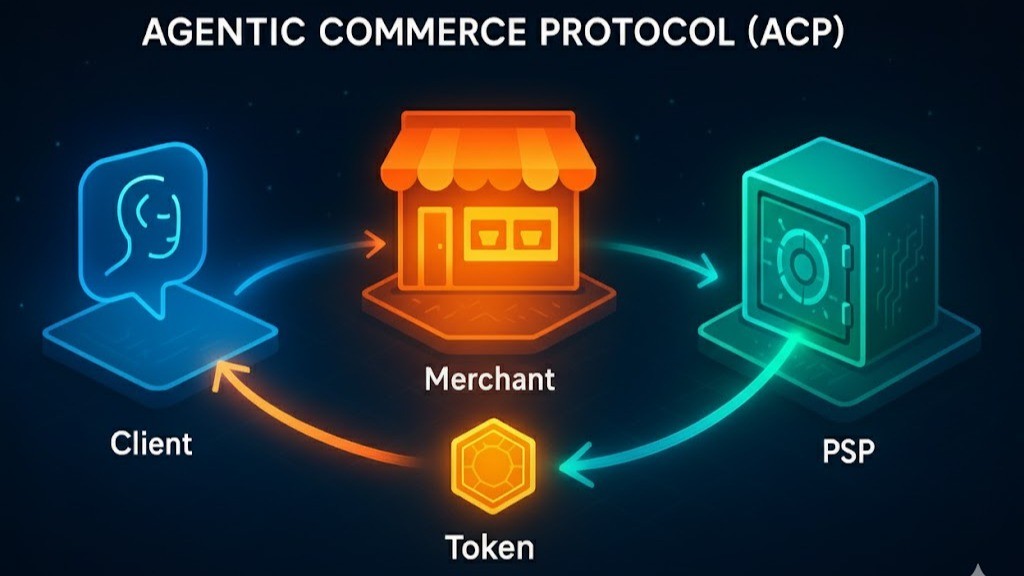
While headlines celebrated ChatGPT’s new shopping feature, something more fundamental emerged beneath the surface. The Agentic Commerce Protocol (ACP) represents the first standardized payment rail enabling AI agents to complete purchase transactions for users. This wasn’t merely another product feature. It was the first production-scale deployment of agent-initiated commerce, backed by Stripe’s payment infrastructure and OpenAI’s reach to 700 million weekly users.
Protocols have always defined eras of the internet. TCP/IP enabled packet-switched networking. OAuth standardized authorization. HTTP made the web universal. ACP may do the same for the agentic economy, providing what future analysts might see as the transactional grammar for machine-initiated commerce.
But the story begins months earlier, with a different protocol sharing the same acronym.
One acronym, two revolutions
The term “ACP” now refers to two distinct protocols launched within months of each other, revealing how rapidly the agent economy is maturing:
IBM’s Agent Communication Protocol (launched May 2025) was architected as the “HTTP of agent communication,” enabling AI agents built on different frameworks to discover and collaborate with each other. Kate Blair, Director of Product Incubation at IBM Research, envisioned a world where agents from LangChain, CrewAI, AutoGen, and custom platforms could seamlessly interact without custom integrations.
Four months later, Stripe and OpenAI co-developed the Agentic Commerce Protocol (announced September 2025), sharing the same acronym but serving an entirely different purpose: enabling AI agents to complete purchase transactions on behalf of users. Fidji Simo, CEO of Applications at OpenAI, explained: “By co-developing the Agentic Commerce Protocol with Stripe, we’re making it possible for businesses of all sizes to meet people where they are, and for shoppers to complete purchases seamlessly in conversation.”
Fascinating how a shared acronym became a convergence point. Both protocols emerged because the industry recognized the same fundamental truth: without standardized communication, AI agents would become isolated silos, unable to realize their transformative potential.
The consolidation that changed everything
Here’s where the narrative takes its most significant turn.
When Google launched its own Agent2Agent (A2A) protocol in April 2025 with 50+ technology partners including Atlassian, Box, PayPal, Salesforce, SAP, and ServiceNow, the industry faced a critical fork: fragment into competing standards, or converge around shared infrastructure.
In August 2025, IBM and Google chose convergence. IBM’s ACP officially merged with Google’s A2A under the Linux Foundation, creating a single, vendor-neutral standard for agent-to-agent communication. Kate Blair joined the A2A Technical Steering Committee, bringing IBM’s expertise into a unified development effort that now includes representatives from Microsoft, AWS, Cisco, and over 150 supporting organizations. Blair reflected on the decision:
“By bringing the assets and expertise behind ACP into A2A, we can build a single, more powerful standard for how AI agents communicate and collaborate.”
Perhaps what looked like retreat was coordination in disguise. Rather than fragmenting into competing standards as has historically slowed technology adoption, the industry learned from past protocol wars. Fragmentation kills momentum, but open standards accelerate it. What emerged was infrastructure-layer discipline: horizontal coordination across frameworks, preparing the foundation for vertical specialization.
“Two ACPs, one convergence: Communication + Commerce.”
Commerce enters the picture
With foundational agent communication standards established through A2A, the ecosystem was ready for domain-specific protocols.
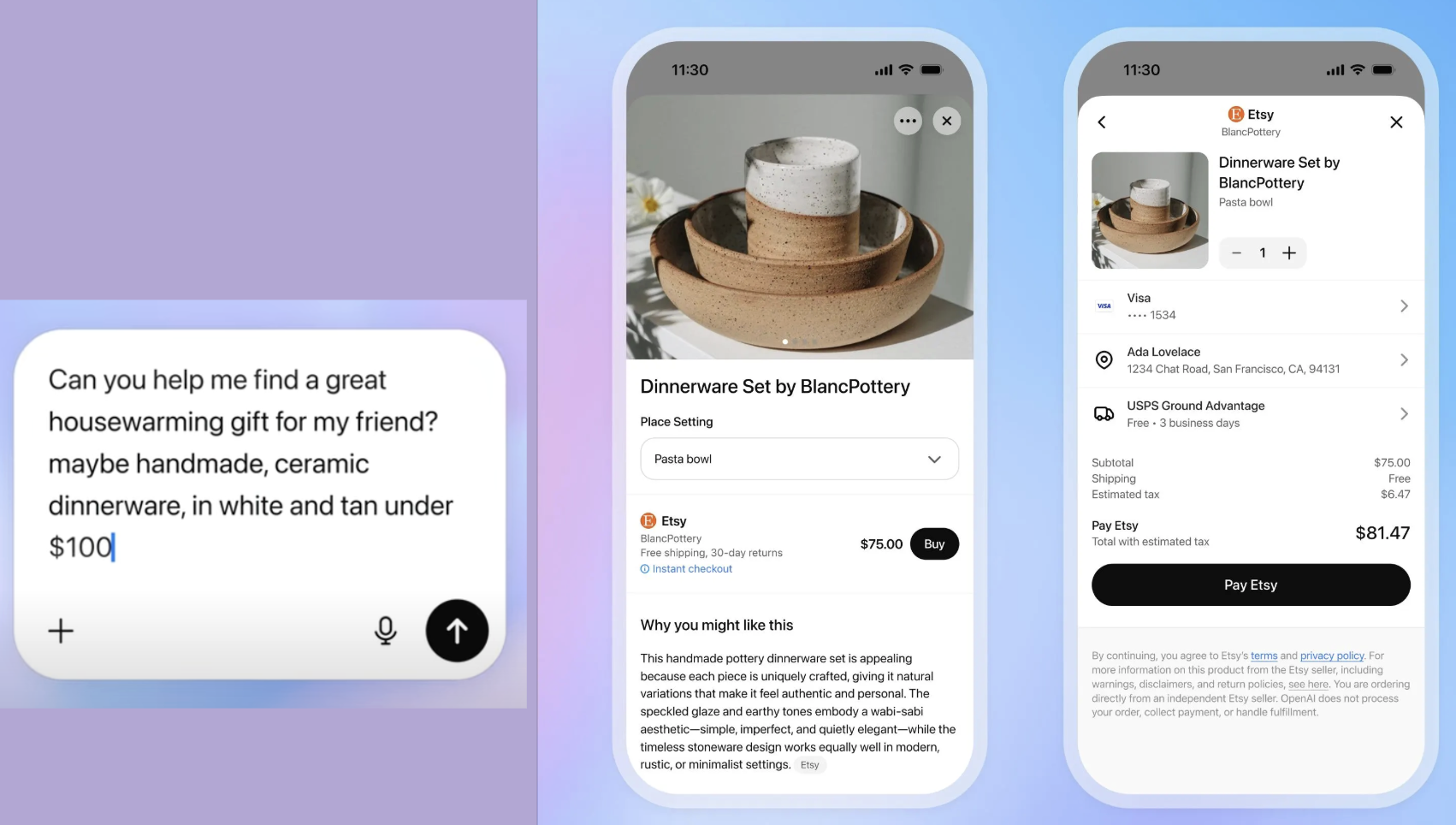
Enter Stripe and OpenAI’s Agentic Commerce Protocol, announced September 29-30, 2025, alongside the launch of “Instant Checkout” in ChatGPT. This protocol enables something unprecedented: AI agents that can initiate and complete commercial transactions on behalf of users, reaching 700 million weekly ChatGPT users and over 1 million merchants.
William Gaybrick, President of Technology and Business at Stripe, framed the challenge:
“Stripe has spent the last 15 years optimizing commerce for human buyers. Now, we are starting to do the same for agents. To support this shift, businesses must expose their products, pricing, and checkout in a way agents can use, while still protecting payment credentials and preventing fraud.”
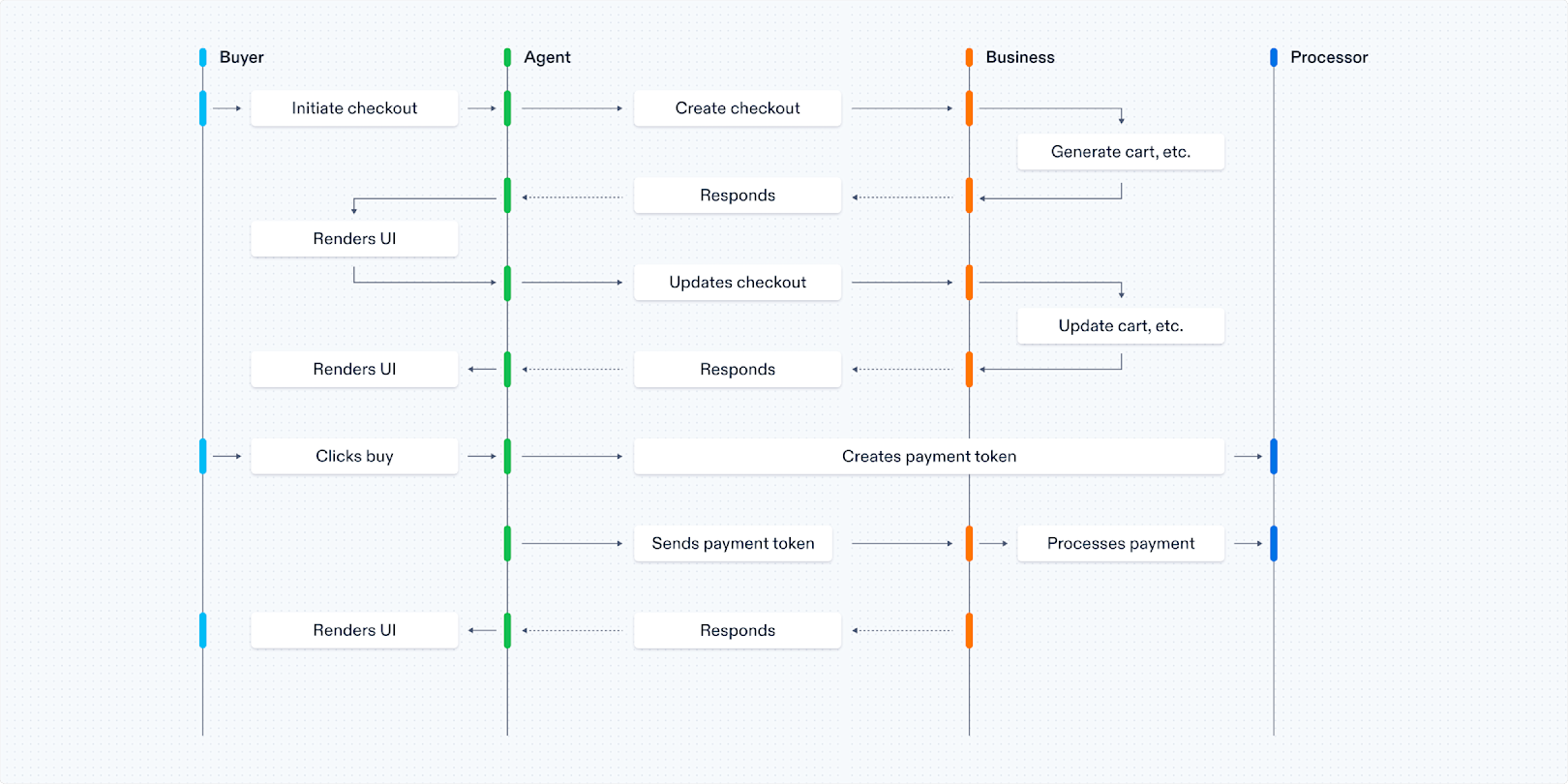
The protocol introduces Shared Payment Tokens, programmable credentials that allow agents to initiate payments without exposing buyer information, scoped to specific merchants and amounts. Think of ACP as functioning like the payment rail’s loom, weaving human intent into machine execution. Merchants remain the merchant of record, maintaining full control over products, pricing, branding, and customer relationships.
Kevin Miller, Stripe’s Head of Payments, emphasized the architectural shift:
“Agents now sit between businesses and consumers. Everything from payments and checkout to fraud checks must be re-architected.”
If A2A provides the rhythm section for agent coordination, ACP adds the melody line of transaction. Horizontal coordination (A2A) meets vertical specialization (ACP).
Currently live with U.S. Etsy sellers and rolling out to Shopify’s ecosystem (including Glossier, SKIMS, Spanx, and Vuori), this represents the first major production deployment of agent-initiated commerce at scale.
Business implications
The technical architecture matters, but the business implications are transformative:
Cost efficiency at scale. Standardized protocols reduce integration complexity from exponential (n(n-1)/2 custom connections) to linear (n connections to one standard). Industry analysis suggests 40-60% reduction in integration costs, with Gartner predicting 30% operational cost reductions and $80 billion in contact center labor savings by 2026.
Vendor independence restored. Organizations can now choose best-of-breed agents for specific capabilities without framework lock-in. The shift toward open standards means agents can collaborate across different platforms and organizations seamlessly.
New revenue channels unlocked. The agentic commerce layer creates unprecedented access to customers. Merchants can now reach hundreds of millions of users through AI platforms without rebuilding their commerce infrastructure, often with as little as one line of code for existing Stripe users.
Faster time-to-market. Pre-built SDKs, standard patterns, and comprehensive documentation dramatically reduce development cycles. The convergence around open standards means investments won’t become obsolete as the technology matures.
Worth questioning, though: what happens when agents transact faster than oversight can adapt? When agents spend on behalf of humans, where does intent reside? These aren’t hypothetical concerns. They’re architectural questions that infrastructure outpaces our capacity to answer.
The strategic imperative
“From HTTP to ACP: The next universal rail.”
This isn’t hype. It’s infrastructure. Just as HTTP became the foundation for the World Wide Web despite dozens of competing protocols, agent communication standards are now converging around a proven architecture with A2A for agent coordination and emerging vertical protocols like Agentic Commerce for domain-specific transactions.
Organizations building agent systems without these protocols are accumulating technical debt they’ll need to resolve later. Those adopting protocol-compliant architectures now are positioning themselves for the agent economy that’s rapidly materializing, not in some distant future, but in production systems serving hundreds of millions of users today.
Harrison Chase, Co-Founder and CEO of LangChain, captured the moment:
“Agents interacting with other agents is the very near future, and we are excited to be collaborating with Google Cloud to come up with a shared protocol.”
The protocols are here, the standards are converging, and the early adopters are already reaping the benefits.
Future analysts may see September 2025 as the agentic web’s 1993 moment. Not when agents arrived, but when the infrastructure became invisible enough to scale. Worth noting that infrastructure always outpaces comprehension. We’re building rails for transactions we haven’t yet imagined.
The agent economy was never waiting to arrive. It was assembling its own rails beneath our attention, protocol by protocol, transaction by transaction.
Which protocol will carry the next invisible transaction you make: human or agentic?
Sources:
-
IBM Research Blog - “An open-source protocol for AI agents to interact” research.ibm.com/blog/agent-communication-protocol-ai
-
Google Developers Blog - “Announcing the Agent2Agent Protocol (A2A)” developers.googleblog.com/en/a2a-a-new-era-of-agent-interoperability
-
Stripe Official Blog - “Developing an open standard for agentic commerce” stripe.com/blog/developing-an-open-standard-for-agentic-commerce
-
OpenAI Blog - “Buy it in ChatGPT: Instant Checkout and the Agentic Commerce Protocol” openai.com/index/buy-it-in-chatgpt
-
Forrester Research - “Interoperability Is Key To Unlocking Agentic AI’s Future” forrester.com/blogs/interoperability-is-key-to-unlocking-agentic-ais-future
-
GitHub Discussion - “ACP Joins Forces with A2A Under the Linux Foundation” github.com/orgs/i-am-bee/discussions/5
-
arXiv Technical Survey - “A Survey of Agent Interoperability Protocols: MCP, ACP, A2A, and ANP” arxiv.org/html/2505.02279v1
-
Etsy Blog - “Meeting Buyers Where They Are: Etsy partners with OpenAI to enable AI-powered shopping” etsy.com/news/meeting-buyers-where-they-are-etsy-partners-with-openai-to-enable-ai-powered-shopping
-
Agentic Commerce Protocol - agenticcommerce.dev
-
Agentic Commerce Protocol Spec - github.com/agentic-commerce-protocol/agentic-commerce-protocol