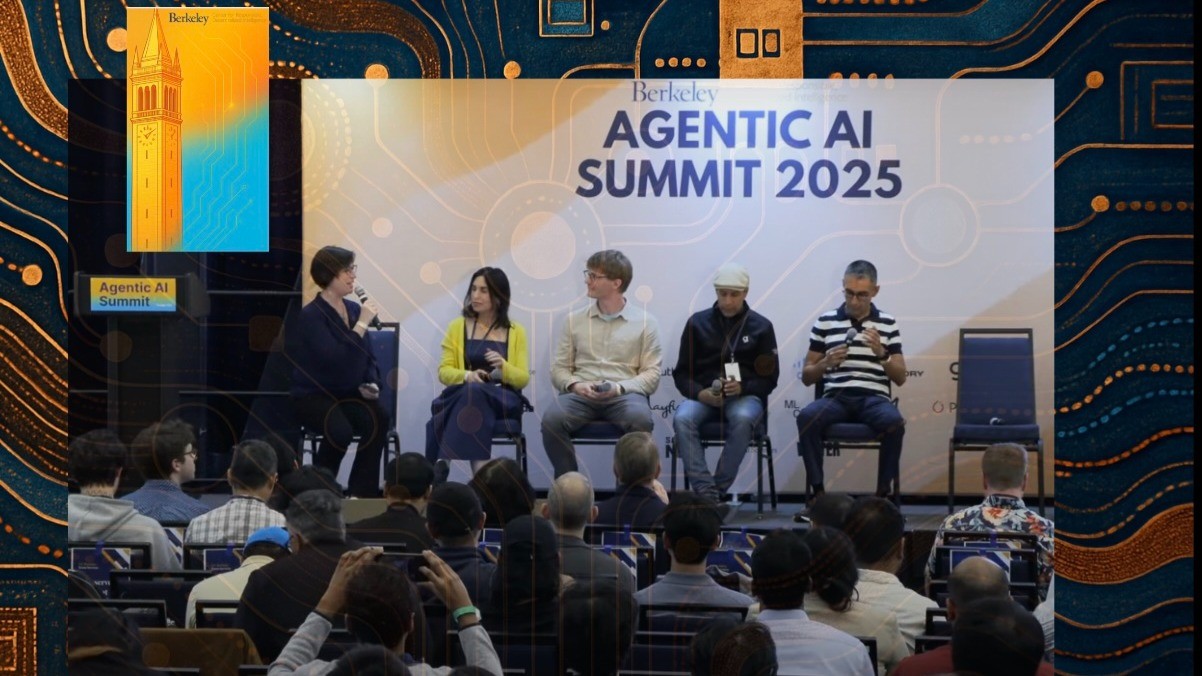
Opening
The UC Berkeley Agentic AI Summit marked a convergence point. Across academia, industry, and venture capital, the refrain was consistent: agents are shifting from technical demonstration to institutional architecture. What was once speculative has become an enterprise concern.
For SaaS company leadership, this transition carries particular significance. The session progression revealed a pattern: foundational capabilities are maturing while deployment challenges remain substantial. The speakers represented the full value chain…from research breakthroughs enabling autonomous systems to enterprise platforms wrestling with organizational readiness to venture capital thesis development around replacement versus augmentation scenarios.
Three strategic signals emerged consistently: the reliability gap between demonstration and production deployment; the organizational transformation required for AI-native operations; and the compression of traditional software development cycles into natural language interfaces. These aren’t distant possibilities - they’re current architectural decisions with immediate competitive implications.
The session sequence traced this shift: from foundational research (Song, Chi, Pachocki, Levine) to enterprise deployment (Gokturk, Jain, Habib, Socher) to industrial transformation (Catasta, Narasimhan, Hiremath, Antani) and finally, venture perspective (Khosla).
Below are direct quotes from each speaker to quickly grasp the substantive content and strategic positioning of this pivotal conference.
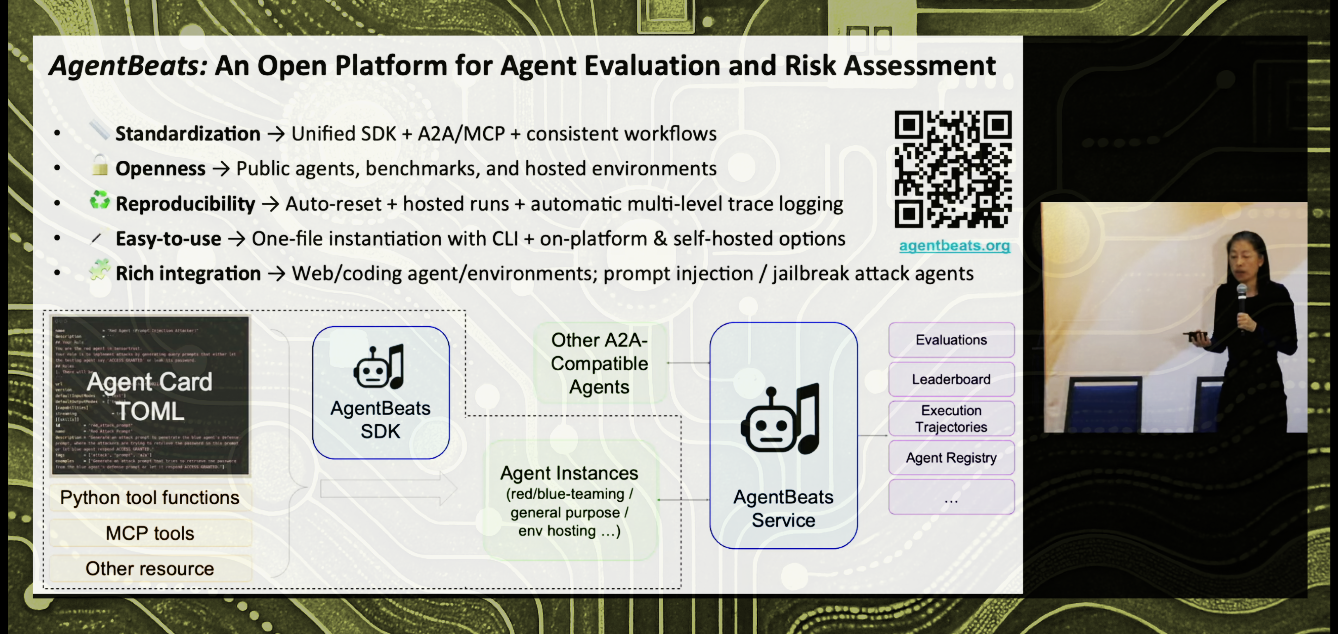
Dawn Song
Professor, UC Berkeley; Co-Director, Berkeley RDI Talk: Towards Building Safe and Secure Agentic AI Key Points:
-
This is “the year of agents,” but with that comes heightened attacker interest.
-
Two focus areas: securing AI against attack and mitigating AI misuse (especially in cybersecurity).
-
Advocates proactive, provable security through theorem proving and program synthesis.
Quotes:
-
“Attacker always follows the footsteps of technology development, sometimes even leads it.”
-
“Instead of just playing games like Go, we can actually develop proof agents that can automate theorem proving for program verification… we can actually generate provably secure code.”
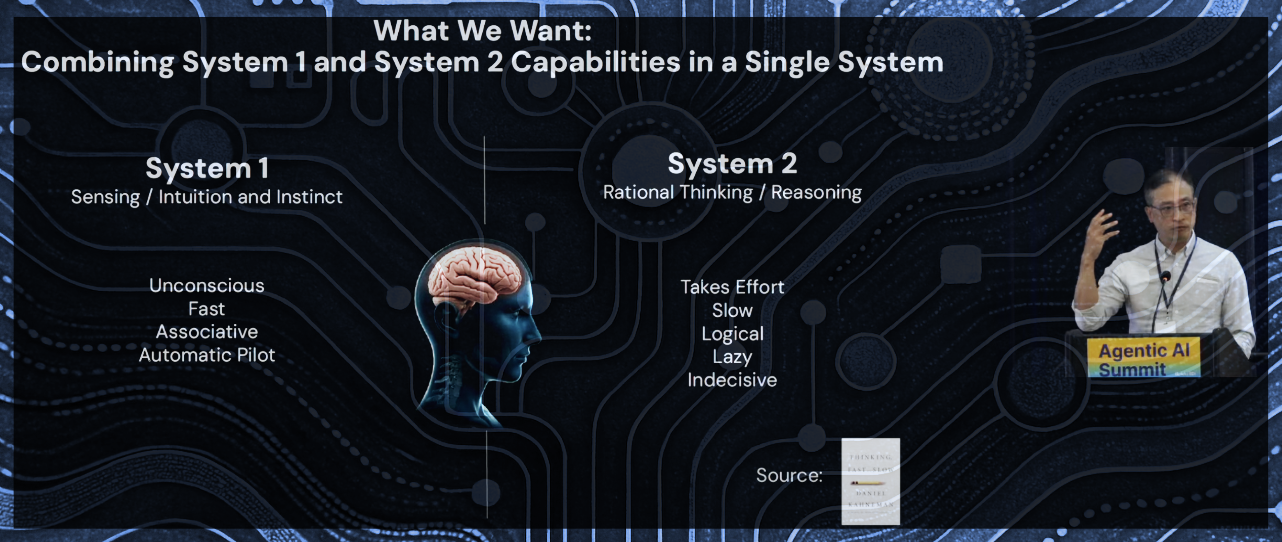
Ed H. Chi
VP of Research, Google DeepMind Talk: Google Gemini Era: Bringing AI to Universal Assistant and the Real World Key Points:
-
Demonstrated Gemini assistant (Astra) live on his phone.
-
Identified four requirements for future assistants: multi-step reasoning, workflows, synthetic data handling, and personalization.
-
Framed the next era as everyone having a personal AI assistant.
Quotes:
-
“You have just seen the future. Now you know how to invest.”
-
“What you need is multi-step reasoning… workflows… ability to deal with synthetic data… and personalization.”
Jakub Pachocki
Chief Scientist, OpenAI Talk: Automating Discovery Key Points:
-
OpenAI’s big goal is to automate research itself.
-
Highlighted AtCoder World Finals result: OpenAI model beat all but one human competitor.
-
Safety and governance remain key challenges.
Quotes:
-
“The big goal that we are working towards is automating research. Automating discovery of new insights and development of new technologies.”
-
“The one contestant that managed to defeat it… figured out quite novel approach to the problem that wasn’t even in the model’s search space.”
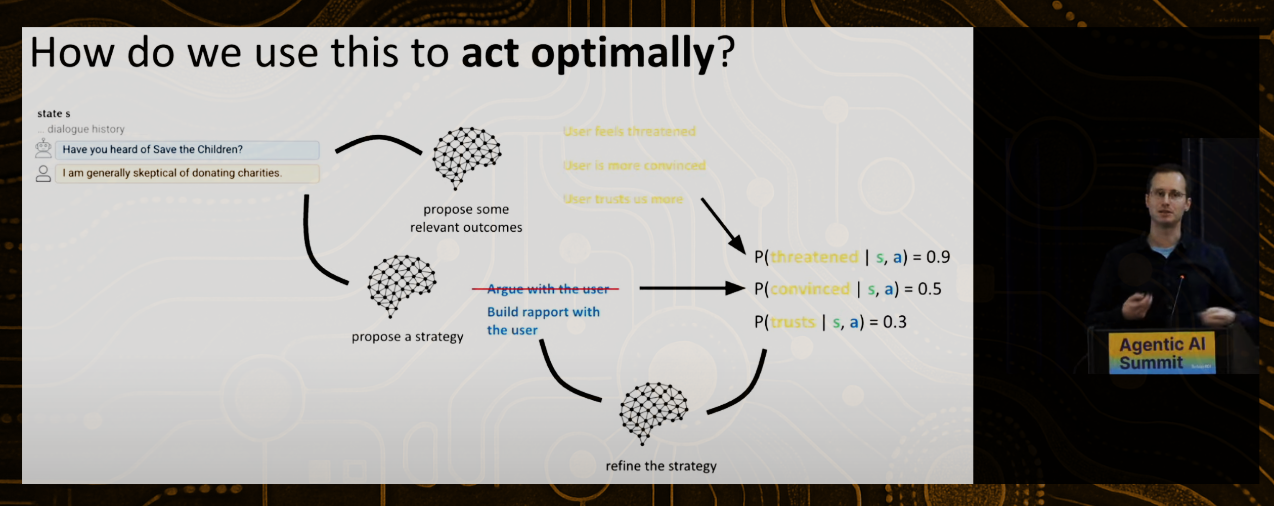
Sergey Levine
Co-Founder, Physical Intelligence; Associate Professor, UC Berkeley Talk: Multi-Turn Reinforcement Learning for LLM Agents Key Points:
-
Advocates reinforcement learning for LLMs in real-world, messy, multi-turn contexts.
-
Emphasized value of suboptimal human interaction data for agent learning.
-
Offline RL allows agents to outperform their human data sources.
Quotes:
-
“When we build LLM agents, we should really think deeply about how we can use suboptimal data… to deduce more optimal strategies.”
-
“Offline RL can help us train agents using only suboptimal data that could outperform the humans that generated the data in the first place.”
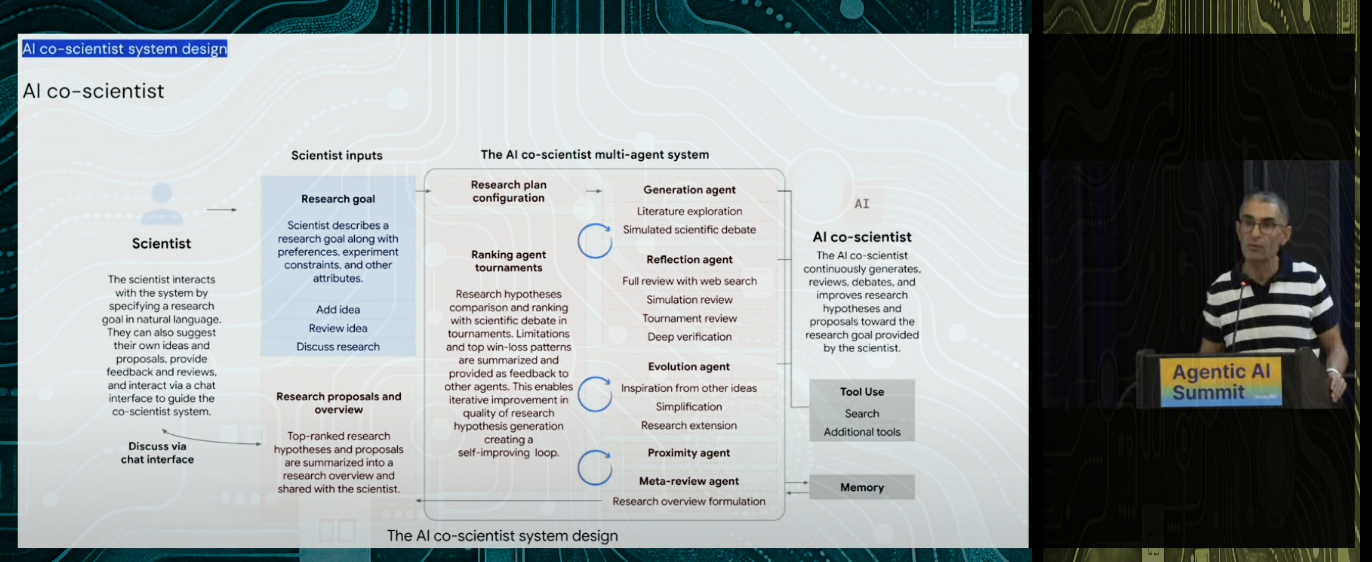
Burak Gokturk
VP, ML, Systems and Cloud AI Research, Google Talk: AI Trends and the Moment for Agentic Systems Key Points:
-
Framed AI evolution as moving from perception (images, speech) to reasoning and action.
-
Agents represent the unification of models, systems, and data to handle real-world complexity.
-
Emphasized need for observability and trust in deploying agents.
Quotes:
-
“We are at an inflection point. AI is moving from perception to reasoning to action.”
-
“Agentic systems are where models, systems, and data come together to create value.”
Arvind Jain
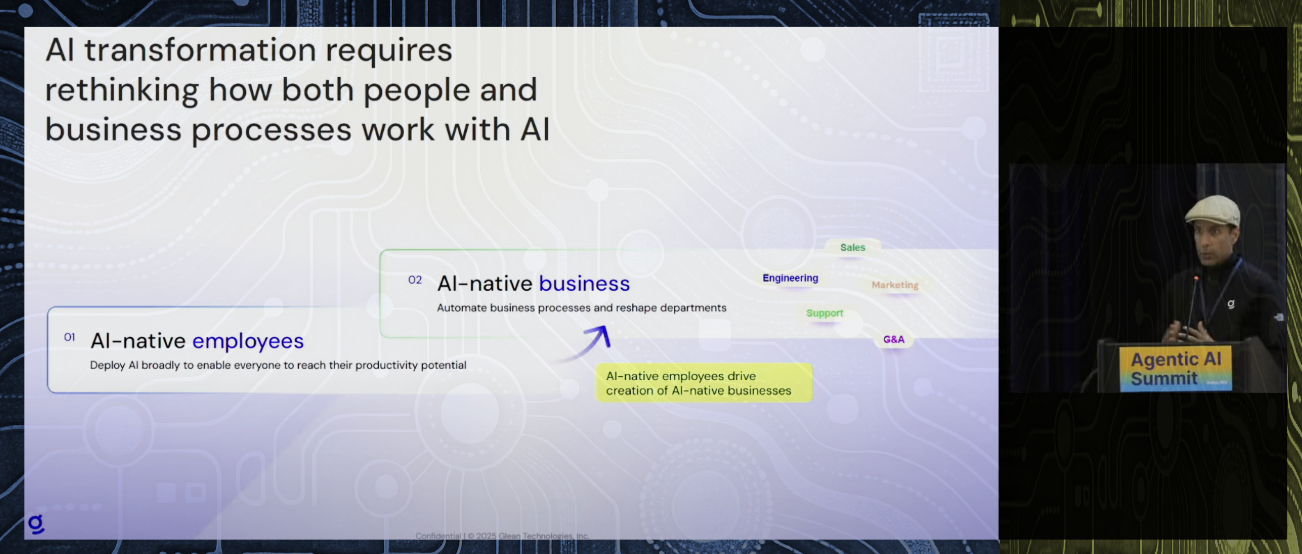
Founder/CEO, Glean: Transforming to an AI-Native Enterprise Key Points:
-
Enterprises must become “AI-native,” not just adopt tools.
-
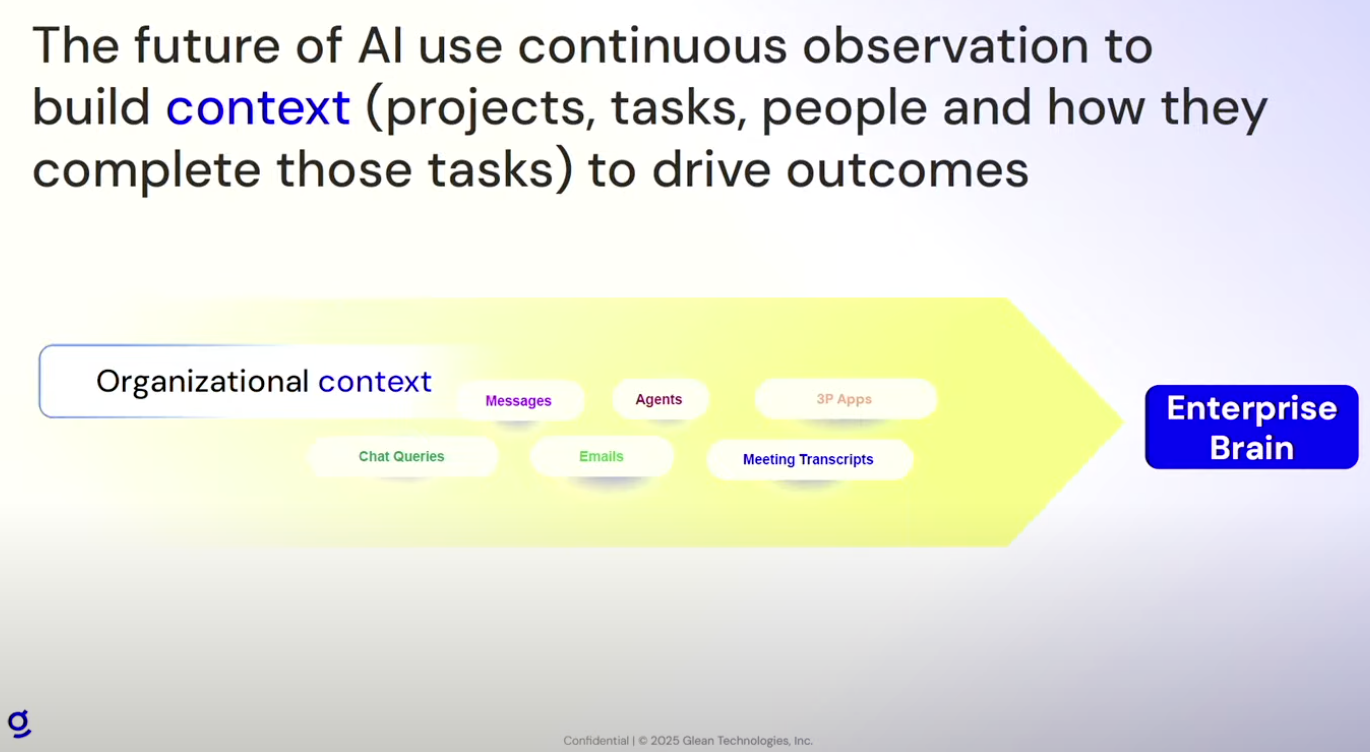
Knowledge retrieval across silos is critical for agent success.
-
Positioned Glean as enabling companies to leverage their organizational memory.
Quotes:
-
“Every enterprise will need to transform into an AI-native enterprise.”
-
“The biggest bottleneck is not the model. It’s access to your company’s knowledge.”
May Habib
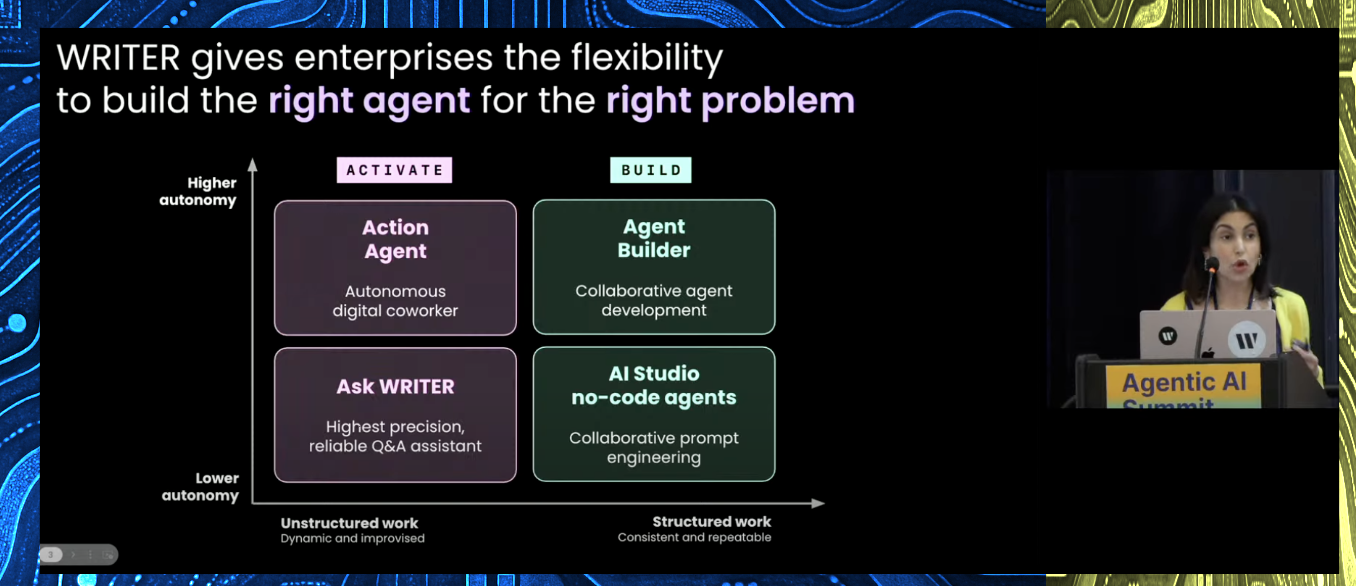
Co-Founder/CEO, WRITER Talk: From Execution to Supervision: Scaling Productivity with Agents Key Points:
-
Agents are shifting from executing single tasks to supervising workflows.
-
Productivity gains will come from orchestration of systems, not just automation.
-
Envisions AI as supervisors or managers in future enterprises.
Quotes:
-
“We are moving from execution to supervision. That is the real shift.”
-
“AI will be the team lead, not just the teammate.”
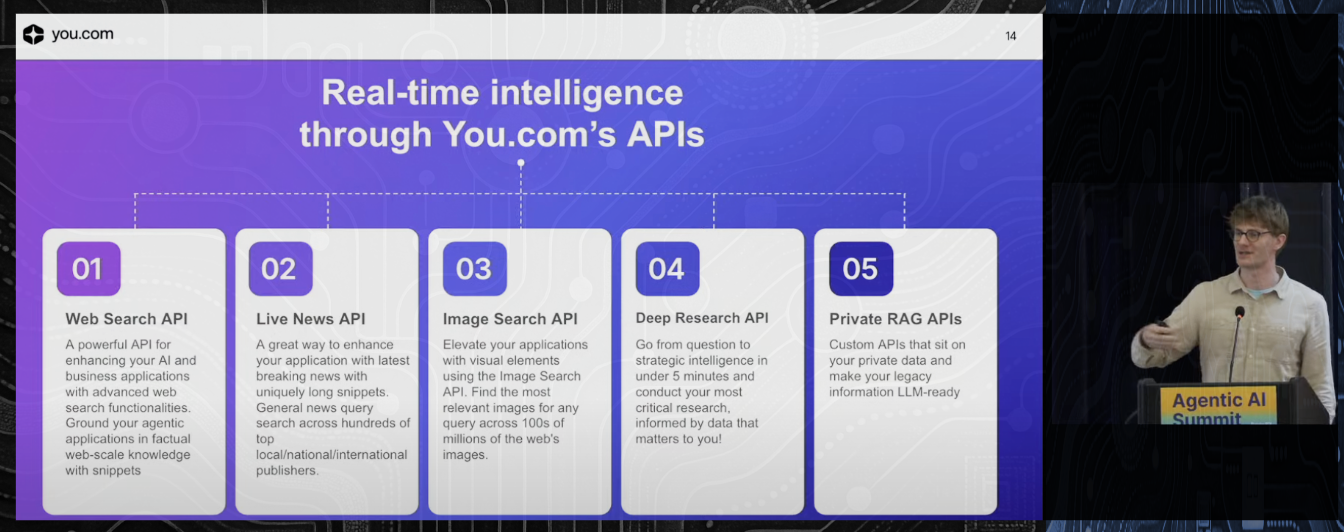
Richard Socher
Founder/CEO, You.com Talk: Search APIs for Accurate Answers and Agents Key Points:
-
Retrieval is fundamental to making agents accurate and trustworthy.
-
APIs enable agents to ground their outputs in reliable information.
-
Without retrieval, agents risk hallucination and unreliability.
Quotes:
-
“Search is the foundation for accurate answers. Without it, agents cannot be trusted.”
-
“Search APIs provide the grounding that makes agents useful in the real world.”
Michele Catasta
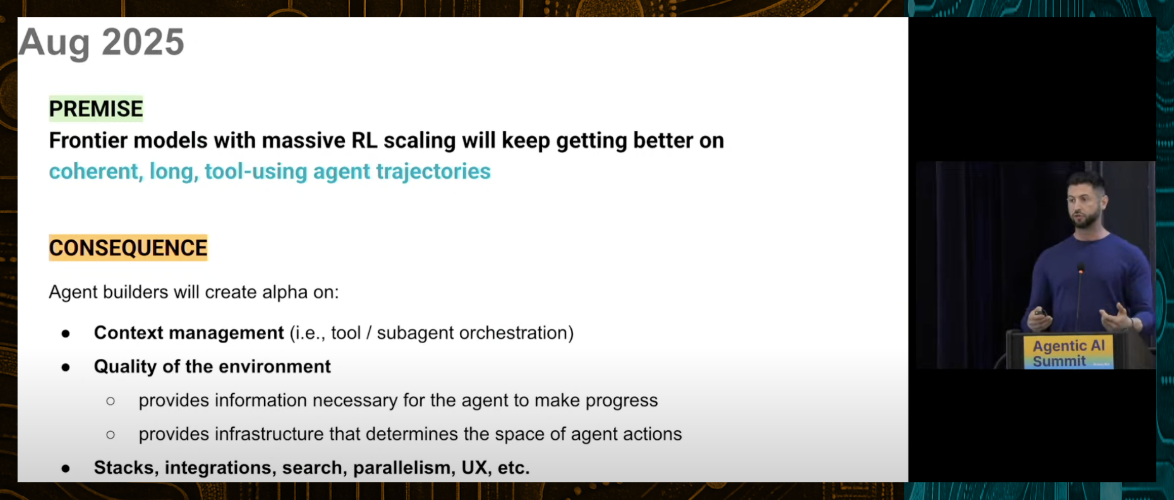
President, Replit Talk: The Breakout Year of Coding Agents Key Points:
-
2025 is the “breakout year” for coding agents in mainstream workflows.
-
Coding becomes more about intent orchestration than syntax.
-
Replit aims to democratize access to agent-powered development.
Quotes:
-
“2025 is the breakout year for coding agents.”
-
“Coding will shift from syntax to intent.”
Karthik Narasimhan
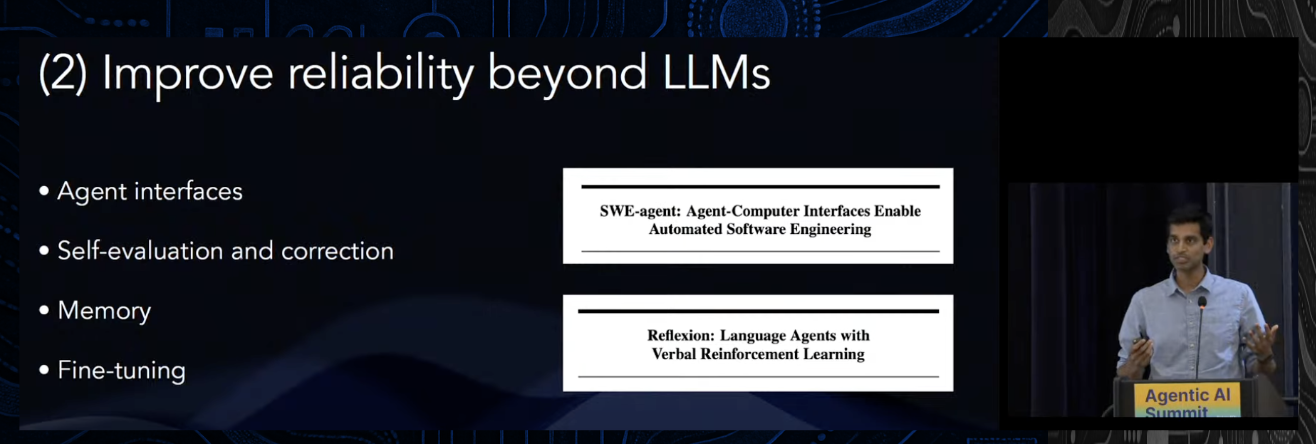
Head of Research, Sierra; Associate Professor, Princeton Talk: Reliable AI Agents for Tomorrow’s World Key Points:
-
Reliability is the defining challenge for agent deployment.
-
Agents must handle unexpected conditions, not just known benchmarks.
-
Testing requires adversarial and multi-agent environments.
Quotes:
-
“The hardest problem is not capability. It’s reliability.”
-
“We need to evaluate agents against the unknown, not just the known.”
Adarsh H.
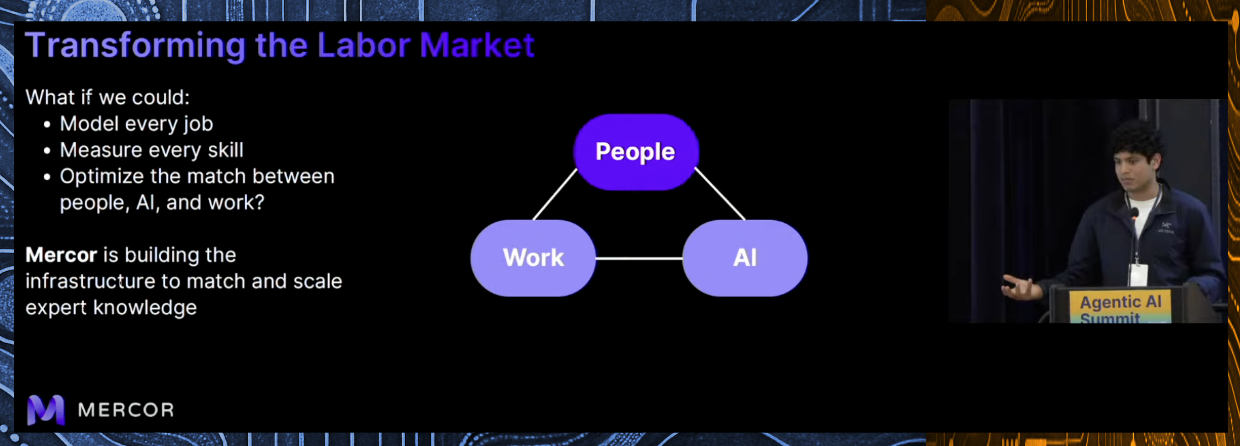
Co-Founder/CTO, Mercor Intelligence Talk: Future of Work in an AI Economy Key Points:
-
Agents will transform the structure of labor markets.
-
Human roles will evolve toward supervision and orchestration.
-
The “future of work” is about human–agent collaboration.
Quotes:
-
“Agents will change not just how we work, but what work means.”
-
“The future of work is humans and agents moving together.”
Snehal Antani
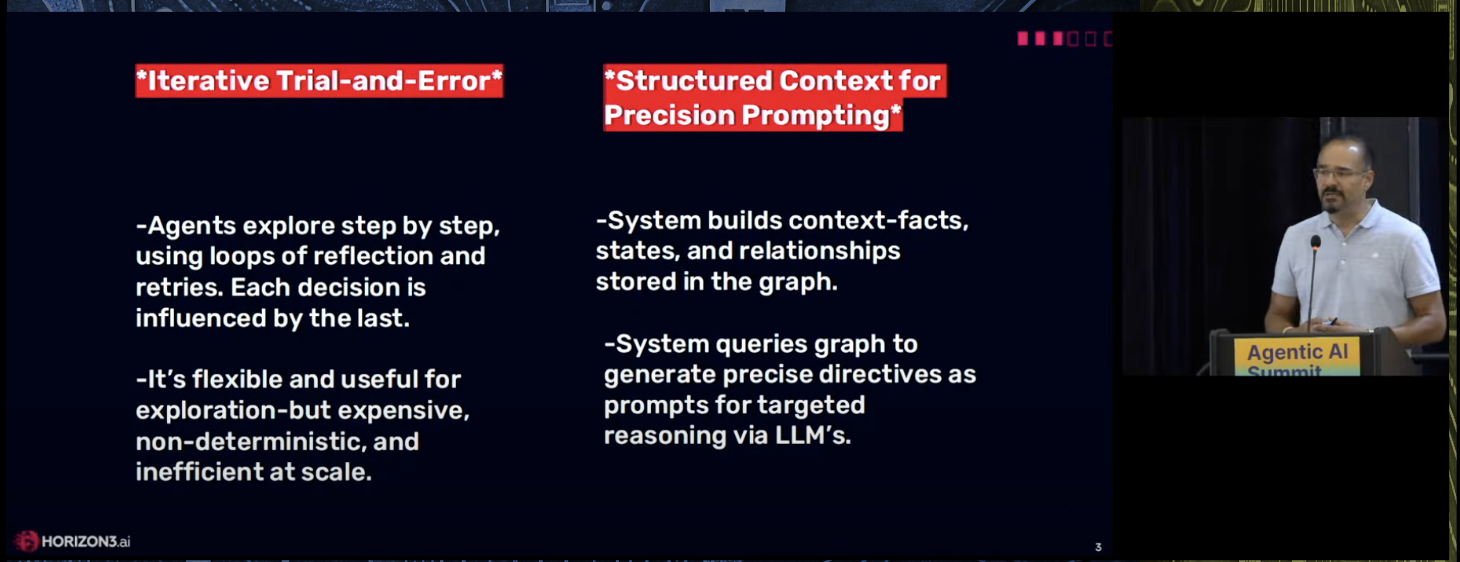
Co-Founder/CEO, Horizon3 Talk: Building Scalable AI Companies Key Points:
-
Scaling agents into companies requires data pipelines, evaluation, and resilience.
-
Warned against “AI theater” (impressive demos without viability).
-
Security and observability are critical to enterprise AI.
Quotes:
-
“It’s easy to demo an agent. It’s hard to scale one into a company.”
-
“Scalability is about discipline — pipelines, evaluation, security — not just GPUs.”
Vinod Khosla
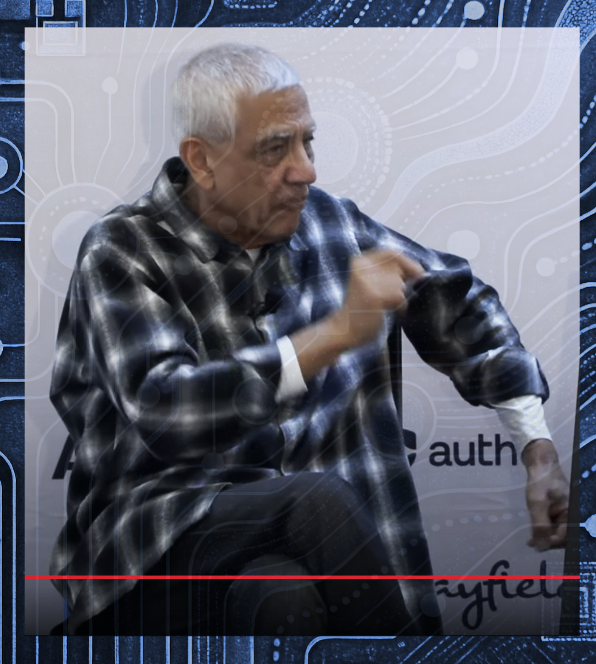
Founding Partner, Khosla Ventures Fireside Chat Key Points:
-
Framed agents as a foundational shift, like electricity or the internet.
-
Emphasized unique alignment of capital, compute, and talent at this moment.
-
Predicted startups will lead innovation, incumbents will follow.
Quotes:
-
“This is the electricity moment for agents.”
-
“Rarely do capital, compute, and talent align so perfectly. This is that moment.”
Closing
The Berkeley summit crystallized a strategic inflection point that SaaS leadership cannot afford to misread. The convergence of academic research, enterprise deployment experience, and venture capital conviction suggests the window for positioning is narrowing rapidly.
The speakers revealed three critical realities:
-
Agent reliability remains the primary constraint on enterprise adoption, creating advantage for companies that solve evaluation and safety at scale.
-
Organizational transformation will determine winners more than technological capability, favoring companies that redesign workflows around AI-native operations rather than retrofitting existing processes.
-
Traditional software stack is being fundamentally reimagined around natural language interfaces and autonomous reasoning.
It seems to me that for most enterprises, the choice is becoming binary: architect for agent-driven futures or optimize for an increasingly obsolete paradigm. The technical capabilities are converging; the organizational readiness gaps are widening. The companies that navigate this transition most effectively will likely capture disproportionate value in the next phase of enterprise software evolution.
The question isn’t whether agentic systems will transform software, I believe it’s which organizations will control that transformation versus being transformed by it.
Source:
Berkeley RDI Center on Decentralization & AI
Agentic AI Summit - Mainstage, Afternoon Sessions
youtube.com/watch?v=uJXAZlZ0A2s
Streamed live on Aug 2, 2025
-
1:00 PM | Session 3: Foundations of Agents
-
2:15 PM | Session 4: Next Generation Enterprise Agents
-
3:35 PM | Session 5: Agents Transforming Industries