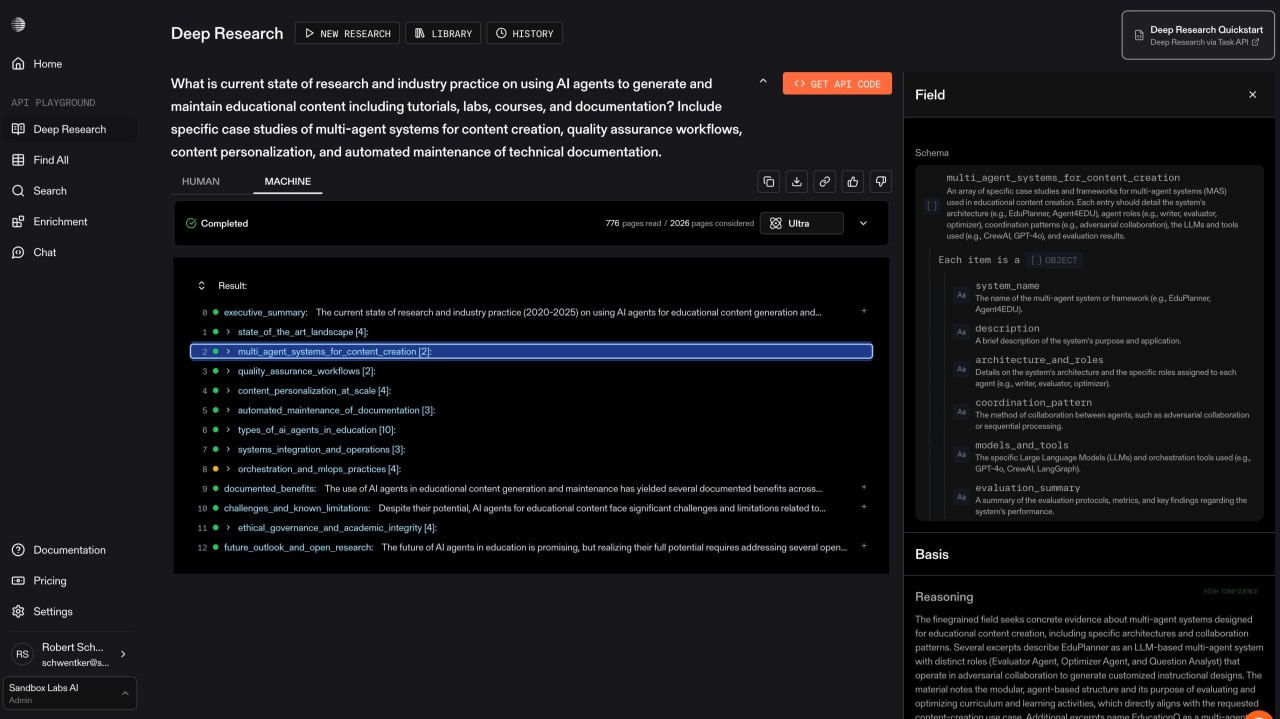
Intro I just got hands‑on with Parallel Web Systems Deep Research platform. In a few focused runs I mapped the clearest signals on how AI agents are already changing education content in the enterprise. Here’s what I found, and how I’d apply it to build a living learning destination for any team serious about education at product velocity.
5 Takeaways One Can Use Tomorrow
1) The winning pattern is a governed co‑pilot, not full automation. Multi‑agent systems (MAS) with writer/editor/evaluator roles outperform single prompts. Human review remains essential because quality gaps persist.
2) Speed & quality can rise together. Coursera’s hybrid grading took feedback time from ~15 hours to about a minute while providing far more detailed guidance. That’s what happens when rubrics meet agents.
3) Personalization at scale is real. Large adaptive systems have delivered millions of individualized paths with sizable gains in mastery and accuracy. The point isn’t novelty—it’s consistent outcomes.
4) Docs can be evergreen. Agent pipelines like DocAider sync documentation to code on every PR. In the enterprise, teams that pair docs‑as‑code with multi‑agent CI reduce staleness and support faster adoption.
5) Cost control is doable. When quality requirements stabilize, custom‑tuned smaller models can cut inference cost ~10× with equal or better output quality.
A Practical Blueprint for an AI Learning Destination
Phase 1: 0–90 days
-
Release Sync Agent: Auto‑draft tutorial updates from release notes/Jira; SME approval; publish to Hubs/Notes. Metric: ≥30% reduction in content lag; ≥80% helpful.
-
RAG Coach: Cited answers over official docs + runnable labs (Replit/v0). Metric: 1,500+ organic views/tutorial; P95 ≤5s; ≥80% helpful.
Phase 2: 6 months
- Localization & accessibility agent, Assessment agent, Journey orchestrator; eval harness with golden sets; governance & compliance checks.
Phase 3: 12 months
- Certification pipeline, ROI attribution, voice concierge for exec learning; content freshness SLA ≤7 days after release; +20% trial activation where education CTAs appear.
Why This Matters to Product & GTM Leaders
-
Faster activation: Education that ships with the feature, not months later.
-
Lower support load: Evergreen tutorials & labs reduce repetitive “how do I…?” tickets.
-
Observable impact: Tie learning to product usage, expansion, and retention.
What I’d Pilot First
-
Two anchors: Release Sync Agent + RAG Coach. Small team. Clear SLOs. Weekly evals.
-
Two vertical labs: Finance (document extraction & governance) and Healthcare (PHI‑safe RAG). Localized samples to prove the a11y/localization agent.
Risks, Managed Upfront
-
Accuracy: Retrieval with citations, planner‑critic loops, SME sign‑off.
-
Bias & privacy: fairness audits, PHI/PII scanning, provenance.
-
Cost/latency: caching, router‑by‑task, small‑model first, targeted fine‑tunes.
Closing
With the right agents, education becomes an operating system. Releases update lessons automatically. Learners get coached, not just linked. Leaders see activation move. I’m building toward that future…happy to compare notes with teams across SF who want their learning to move at product speed.
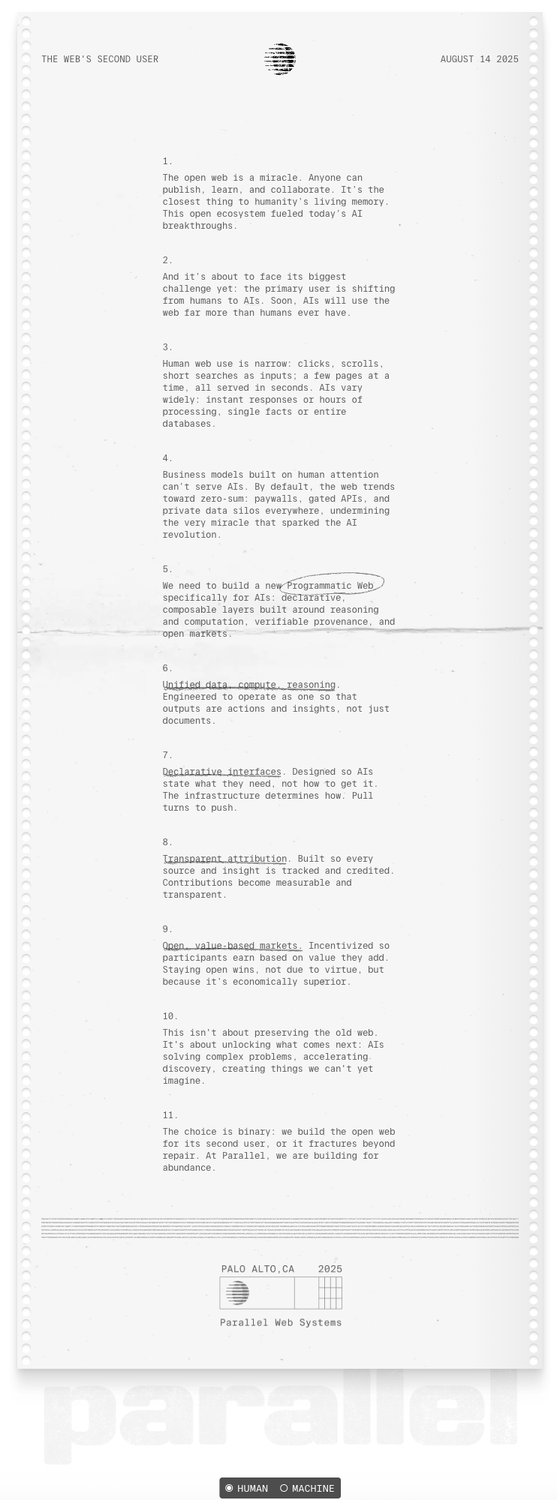
Appendix: Context from Parallel’s “Web’s Second User” Manifesto
Parallel’s recent manifesto frames a bold shift: as AIs become the web’s “second user,” they may soon surpass humans in how they access, process & act on information.
For education & enterprise content, this vision provokes important questions:
-
What happens when the largest “learners” on the web are no longer human?
-
How do we design attribution, interfaces & governance so AI agents can learn responsibly, not just efficiently?
-
Can education itself evolve into the operating system for this next phase of the web?
I’m including the artifact below not as endorsement but as a frontier perspective worth considering. It’s one way of imagining the infrastructure shift already underway in San Francisco’s AI ecosystem.
About Parallel - [HUMAN] | [M@CHINE]
![[M@CHINE]](./img-003.png)
https://x.com/schwentker/status/1965574975798345827
https://bsky.app/profile/schwentker.bsky.social/post/3lygyha3kmk2l