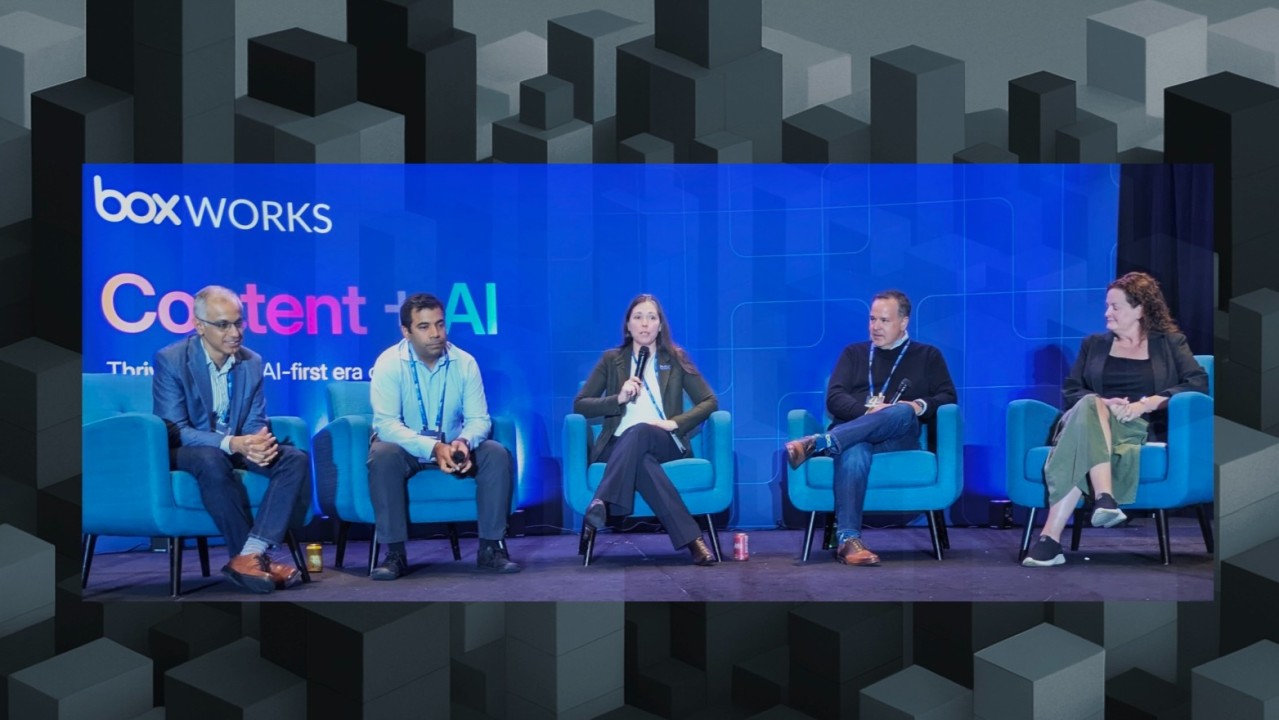
VP Panel: The Innovation Velocity Challenge
The BoxWorks VP panel revealed a fundamental tension in enterprise AI adoption: product development moves at unprecedented speed while organizations struggle to absorb change. Six senior leaders wrestled w/ managing AI innovation velocity against enterprise readiness constraints.
The Release Velocity Reality
Todd Guerrieri, VP of Global Consulting Services, captured the dissonance: “The pace of innovation is mind-boggling. I’ve been at Box a long time, and I’ve never been somewhere where that has happened - this period of time, more releases. It blows my mind how fast & what velocity the releases are coming.”
Internal adoption illustrates the challenge. “The number of use cases internally that are surfacing up that would like Consulting help has gone through the roof,” Todd noted. Even Box employees need structured guidance to identify AI applications.
Catherine Powell, Senior Director of Product Management, offered a practical framework: “I have been challenging in every one of my interactions—could AI be helpful for what we’re doing together? It’s really interesting how much folks are not thinking about AI front of mind.”
Bottom line: Speed of innovation demands organizational pattern recognition frameworks, not just feature training.
Platform Strategy Over Feature Chasing
Jeff Paul, VP of Customer Success, articulated Box’s positioning: “We’re a platform for content, not an AI company.” This distinction shapes both competitive strategy & implementation approaches.
“You’ve got this content platform—highly secure, lots of governance, scalable. You’ve got an AI platform built on top of the content platform, so it respects the security. Then you’ve got the workflow platform,” Jeff explained.
The platform philosophy creates implications beyond technology. Teams need mental models for understanding how AI capabilities interact w/ existing systems, security requirements, & business processes…not just feature lists.
Kelash Kumar “KK” - VP of Product Management, acknowledged infrastructure realities: “The more times you share something with some number of people, the more difficulty it gets for us to do things. We are currently engaged in infrastructure projects that will never make a keynote because it’s the least exciting end user feature ever.”
Platform investments don’t generate demo excitement but enable everything else. Organizations need frameworks for evaluating AI capabilities within existing architectures.
Real-World Implementation Patterns
The panel shared specific examples revealing adoption patterns:
Customer Success Agent: “We built an agent for the customer success managers on assessing customer health,” one panelist explained. “We calculated it’s going to save our customer success managers about 900 hours of time.”
SOW Writing Agent: Todd described internal development: “We built an agent around how we write SOWs & the RFP type process. The team put together what I think is an awesome POC.”
Assessment Agent Breakthrough: A Texas-based customer “doubled their claims throughput” by implementing assessment agents for insurance processing. “They have images, lots of images and documents. They have pretty complex documents, so they do all the extract on it.”
Customer innovation exceeded vendor expectations. Jen Galvan from Customer Success shared: “They put a field that was intended for a human—AI Effectiveness. How well did the AI fill in this field? Then they ran it & realized the AI was filling that field in & grading itself.”
This customer discovered AI evaluation patterns through experimentation, creating feedback loops Box hadn’t anticipated.
Infrastructure Constraints Shape Adoption
Performance boundaries affect user behavior. KK’s collaboration limit example: “After we send somewhere between 17-18,000 individual collaborations to users, they start experiencing latencies.”
This creates requirements around workflow design, not just feature usage. Teams need guidance on collaboration patterns that scale & sharing strategies that respect system limits.
Security governance evolves faster than understanding. Manoj Asnani from Security & Compliance, emphasized both excitement & concern: “Obviously, you’re being a security person, it’s also terrifying from the security standpoint. What AI can do & all the bad things that potentially could happen.”
The solution requires sophisticated approaches: “We built these agents which classify your content better, increase your coverage with more than a million threats a year. How do we help them drill down to the ones they should pay attention to?”
Consulting Evolution: Implementation to Orchestration
The consulting transformation reveals how AI changes professional services from technical setup to organizational capability building.
Traditional implementation focuses on configuring systems. AI consulting requires designing agent orchestration, ensuring consistency across federated systems, & managing organizational change for workflow transformation.
Todd explained the shift: “The concept of Box Labs is basically setting customers up with proof of concepts. Some are paid, some aren’t, depending. Some are run internally by the customer—they just want our support.”
This moves consulting from delivery to facilitation. Instead of implementing predefined solutions, consultants help customers experiment w/ possibilities, evaluate results, & scale successful patterns.
Multiple panelists emphasized creativity over technical training. Jen noted: “The sheer amount of creativity that you all have—how you solve problems, putting pieces together.”
The Federation Future
The panel’s vision for federated agents creates new requirements beyond traditional enterprise software adoption.
Jeff’s federation model differs fundamentally from integration approaches: “The walls you have between systems—different permissions models—you trust what you put in Box, same thing for your Outlook, same thing for your ERP system.”
Agent federation respects system boundaries instead of eliminating them. “Box will provide a search agent that is the best agent at figuring out what’s in your unstructured content. The federated search thing will essentially turn into a consolidation & surfacing layer.”
This requires understanding distributed architectures, permission inheritance, & security boundary management—not data consolidation strategies.
Managing Agent Orchestration
Todd highlighted emerging complexity: “The notion that you have all these agents & how do you make sure that your user experience is consistent across them—if you had the same file in Gemini vs different repository, what would those agents return on a query?”
This creates new planning requirements. Teams need frameworks for designing agent interactions, managing data consistency across systems, & ensuring user experience coherence.
Customers are already pushing boundaries. One customer working w/ “four or five different AI systems” is experimenting w/ agent workflows that coordinate across platforms Box didn’t design.
Security & Governance Challenges
Manoj’s security perspective reveals the complexity of AI governance: threat detection agents that “classify your content better, increase your coverage with more than a million threats a year.”
But federation multiplies governance challenges. Teams need frameworks for managing AI governance across systems they don’t control, w/ agents they didn’t design, processing data w/ varying sensitivity levels.
The metadata example shows sophisticated customer thinking beyond vendor capabilities. Organizations are inventing evaluation methodologies & developing governance patterns that vendors haven’t anticipated.
The Velocity Paradox Solution
The panel revealed that traditional training models break down when features change weekly. The solution requires different infrastructure:
Capability identification frameworks that help teams identify AI applications through structured workflow analysis
Platform literacy development that builds mental models progressively: content management foundations, AI capability integration, workflow orchestration design
Experimentation methodology that teaches hypothesis-driven learning, evaluation criteria development, & result interpretation
Infrastructure awareness integration where teams understand system boundaries as part of capability planning
Implementation Framework
Success requires learning systems that operate at innovation speed while building organizational capability systematically:
-
Structured discovery over comprehensive training
-
Platform thinking development across three layers (content, AI, workflow)
-
Experimentation methodology curriculum
-
Consulting transformation preparation for agent orchestration design
-
Federated system planning & organizational change management
The velocity paradox isn’t just a product challenge: it’s an organizational learning infrastructure challenge that requires matching platform strategy with systematic capability building.
Part 3 of 4 in the BoxWorks 2025 series. Final: Aaron Levie’s strategic vision for the intelligent content platform future.