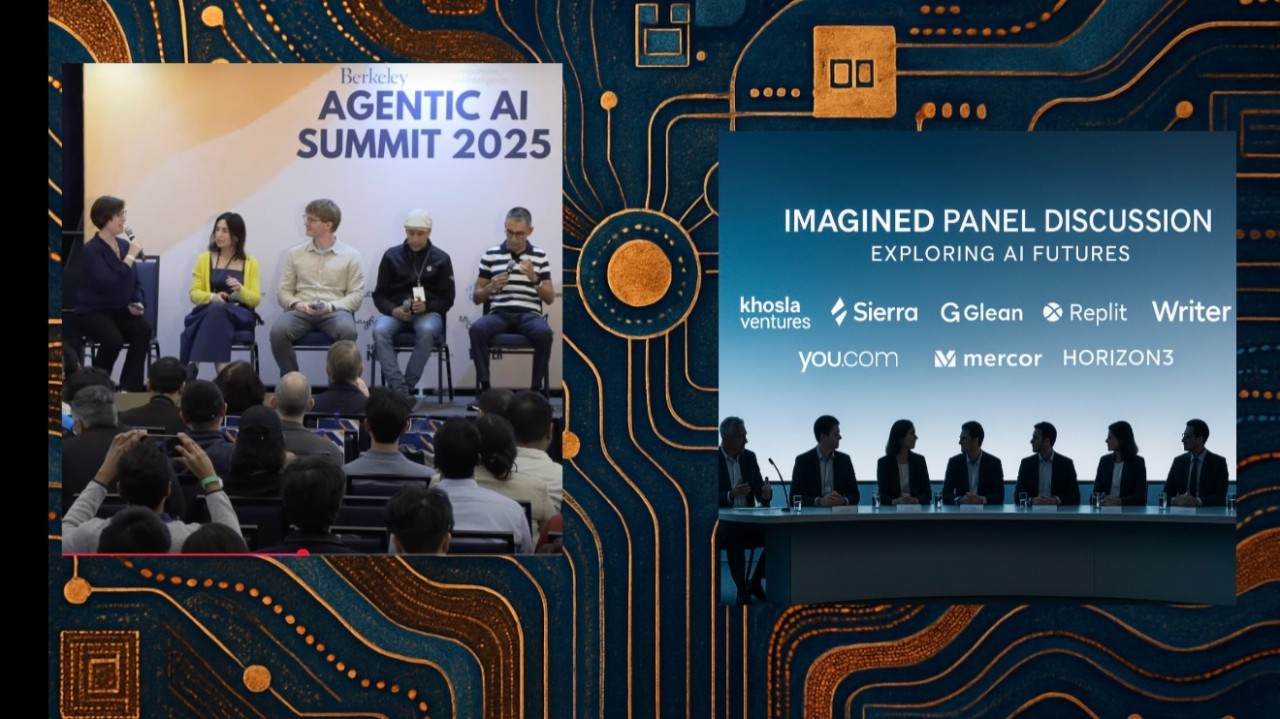
Imaginary Panel with:
Moderator: Vinod Khosla, Founding Partner, Khosla Ventures
Panelists: Karthik Narasimhan (Sierra), Arvind Jain (Glean), Michele Catasta (Replit), May Habib (Writer), Richard Socher (You.com), Adarsh H. (Mercor), Snehal Antani (Horizon3)
Based on insights from the UC Berkeley Agentic AI Summit and Vinod Khosla’s predictions about AI agents for everyone, computers as utilities, an explosion of creativity, and corporate sector disruption, this imaginary panel explores what might unfold when these enterprise AI leaders confront the venture capitalist’s most provocative forecasts.
This exercise serves three purposes:
-
First, to explore the creative capabilities of Claude’s model in synthesizing complex viewpoints and generating realistic dialogue
-
Second, to predict what a futuristic panel discussion might reveal about strategic tensions between current AI builders and visionary investors
-
Third, to extend conversations beyond what was covered in the UCB forum, pushing ideas into unexplored territory
Additional motivations for creating this imaginary panel likely include:
-
Testing whether Claude can maintain consistent character voices across extended dialogue
-
Exploring how different business models and technical approaches might clash when confronted with radical predictions
-
Creating a thought experiment that reveals hidden assumptions about the pace and nature of AI transformation
-
Generating content that bridges the gap between academic research insights and venture capital thesis development
-
Perhaps most importantly, using the Socratic method of Vinod’s questioning style to expose contradictions between what these companies are building today and the world they claim to be creating tomorrow
VINOD’S IMAGINARY OPENING STATEMENT:
“I believe we’re heading toward something far more radical: the complete transformation of how work gets done, how companies operate, and how humans interact with technology.
I’ve made four predictions that I want to test against the companies actually building these systems.
-
AI agents will become available to everyone - not just enterprises with IT budgets, but every human on the planet.
-
Computers will become invisible utilities, like electricity - you won’t think about using AI any more than you think about using the power grid.
-
Explosion of creativity unlike anything in human history when the cost of creation approaches zero.
-
Fortune 500 companies will either transform completely or cease to exist by 2040.
I suspect most of them are still thinking incrementally - building better tools rather than replacement systems. I’ve spent 25 years watching innovation, and large breakthroughs never come from experts extrapolating the past. They come from entrepreneurs imagining impossible futures and making them happen.
So today, I’m going to push each of these builders to think beyond their current business models. Are you building the future I’m describing, or are you building for a world that’s about to disappear? Let’s find out.”
AI Agents for Everyone
VINOD: Let me start with something I’ve been saying for years: within this decade, we’ll have AI agents for everyone - not just technical people, but my grandmother, a farmer in rural India, a small business owner in Ohio. The question is whether you’re building for that world or still building for enterprises with IT departments. Michele, you’re closest to this with Replit - are you building for a billion programmers?
MICHELE (Replit): We’re already seeing it happen. A marketing person can now build a working prototype in 90 seconds without knowing any code. But the real shift isn’t just democratizing programming - it’s that the interface becomes natural language. The computer adapts to humans instead of humans learning computer languages.
VINOD: Exactly. But Michele, most people still think of programming as a technical skill. What happens when programming becomes as common as using a calculator?
MICHELE: Every knowledge worker becomes a creator of digital tools. Instead of being constrained by existing software, they conjure exactly what they need. We’re moving from a world of pre-built applications to on-demand software creation.
ARVIND (Glean): Vinod, we’re seeing this in enterprise already, but there’s a massive preparation gap. Companies don’t have their workflows documented, their data organized. The technology for AI agents is ready, but the organizational readiness is the bottleneck.
VINOD: Arvind, you’re thinking like an incumbent. What about the companies that start AI-native? They don’t have legacy workflows to document - they build workflows around AI agents from day one.
ARVIND: That’s the real disruption we’re seeing. Startups using our platform are outperforming entire Fortune 500 departments because they’re not constrained by existing processes. They design work around AI capabilities rather than trying to fit AI into human-designed processes.
MAY (Writer): The interface question is critical. We’ve had to build completely different UX paradigms - structured workflows for less autonomous tasks, and open workbenches for more creative work. The same person might need both in a single day.
KARTHIK (Sierra): But reliability remains the constraint. AI agents for everyone only works if they’re trustworthy for everyone. We’re still in the “intern” phase - useful but requiring oversight. The jump to autonomous operation is massive.
VINOD: Karthik, you’re still thinking about today’s limitations. What if reliability improves exponentially, not linearly? What if next year’s AI agents are as reliable as today’s humans?
KARTHIK: Then we skip the gradual adoption curve entirely. If reliability suddenly jumps, we go straight from productivity tools to replacement systems. Most organizations aren’t prepared for that speed.
RICHARD (You): The infrastructure layer determines who wins the “agents for everyone” race. You need accurate, real-time information access. We’re seeing that search and knowledge retrieval become the foundation - whoever controls that controls the agent experience.
SNEHAL (Horizon3): In cybersecurity, we’re already at “agents for everyone” - our system runs completely autonomously, finding vulnerabilities faster than any human team. The question isn’t whether AI agents will be everywhere, but whether we can secure them at scale.
Computers as Utilities
VINOD: My second prediction: computers will become like electricity - invisible utilities that just work. You won’t think about “using AI” any more than you think about “using electricity” when you flip a light switch. Arvind, you’re building what could be the electrical grid for enterprise AI. How close are we?
ARVIND: We’re in the early infrastructure phase. Every company needs a unified platform that connects all their systems & data. Right now, enterprises are dealing with hundreds of AI tools across different departments. That’s not utility-level simplicity.
VINOD: But utilities start fragmented and consolidate. We had hundreds of local power companies before we had grids. Are you building the grid, or are you building a local power company?
ARVIND: We’re building the grid. The vision is one AI platform that understands all your company’s data and processes, so any employee can get any answer or complete any task through natural language. No app switching, no interface learning.
MICHELE: For developers, we’re already seeing this utility model. They don’t think “I’m using AI” - they just describe what they want built. The AI becomes invisible infrastructure, like how we don’t think about TCP/IP when browsing the web.
MAY: The challenge is that different work requires different levels of AI autonomy. A utility needs to be both simple enough for universal access and sophisticated enough for complex tasks. We’re designing systems that automatically adjust their level of autonomy based on context.
RICHARD: The utility model requires infrastructure that most people don’t see. Real-time knowledge graphs, accuracy verification, source attribution - all invisible to the user but essential for reliability. The companies building this infrastructure layer will control the utility experience.
VINOD: Richard, you’re describing the problem with most infrastructure thinking - you’re building for today’s requirements. What if the infrastructure needs change completely? What if accuracy becomes perfect and source attribution becomes irrelevant?
RICHARD: Then the competitive advantage shifts to speed and comprehensiveness. But I’d argue accuracy will remain the differentiator. Perfect accuracy on limited information loses to high accuracy on comprehensive information.
ADARSH: The utility model breaks down when you need specialized expertise. Our platform shows that certain tasks still require human-level judgment to train AI systems properly. The utility works for common tasks, but breaks at the edges of capability.
SNEHAL: Cybersecurity will never be fully utility-like because the adversarial environment constantly evolves. You need systems that can adapt and learn in real-time, not just provide predictable service like electricity.
Explosion of Creativity
VINOD: Third prediction: we’re heading toward an explosion of creativity unlike anything in human history. When everyone can create professional-quality content, when the cost of creation approaches zero, what happens? May, you’re enabling this directly - what are you seeing?
MAY: We’re seeing people create in ways that were never possible before. A marketing person builds a complete campaign including copy, visuals, and strategy in hours instead of weeks. But more importantly, we’re seeing ideas that couldn’t exist without AI - creative concepts that require AI capability to execute.
VINOD: But May, what about the flood of content problem? If everyone can create professional-quality content, doesn’t that devalue all content?
MAY: Quality will matter more, not less. When production barriers disappear, the constraint becomes having something worth saying. The tools amplify human creativity and judgment, they don’t replace them.
MICHELE: In programming, we’re seeing an explosion of small, purpose-built applications. Instead of trying to fit their needs into existing software, people are creating exactly what they need. The diversity of solutions is incredible.
RICHARD: The curation layer becomes critical. When everyone can create, discovery becomes the bottleneck. The platforms that help people find exactly what they want from this explosion of content will capture enormous value.
VINOD: Richard, you’re still thinking about content discovery like it’s 2024. What if AI agents know you so well they pre-create content personalized for you? What if you never browse or search because everything is pre-generated for your specific needs and preferences?
RICHARD: That’s actually where we’re heading with our research agents. Instead of searching for information, the AI researches topics proactively and delivers exactly what you need before you ask. Creation becomes predictive.
KARTHIK: The explosion of creativity also creates an explosion of bad content. The reliability and quality control problems we face in AI agents apply to creative content too. How do you maintain standards when the volume increases 1000x?
ADARSH: We’re seeing this in hiring - everyone can now create impressive portfolios and applications using AI. The challenge becomes identifying genuine human capability versus AI-enhanced presentation. The evaluation criteria are completely changing.
SNEHAL: In cybersecurity, the creativity explosion is already happening on the attack side. AI-generated phishing, personalized social engineering, creative exploitation techniques. The defense side needs the same creative explosion to keep up.
Corporate and Sector Disruption
VINOD: Finally, the big one: corporate and sector disruption. I’ve predicted that the 2030s will see the fastest rate of Fortune 500 company demise we’ve ever seen. Most existing companies will run fundamentally differently or not at all. Which of your customers do you expect to exist in 2040?
KARTHIK: The ones that redesign themselves around AI capabilities rather than trying to maintain existing structures. We’re working with companies that are essentially rebuilding their customer interaction model from scratch. The ones clinging to current processes won’t make it.
ARVIND: Honestly? Maybe half. The companies that treat AI as a productivity enhancement will get disrupted by companies that treat AI as their core operating system. We’re seeing two-person startups outperform hundred-person teams at Fortune 500 companies.
VINOD: Arvind, if that’s true, why are you selling to Fortune 500 companies instead of the two-person startups?
ARVIND: We’re doing both. But the Fortune 500 companies have the data and resources to fund the development of these AI-native operating systems. They’re essentially paying us to build the tools that might replace them.
MAY: The disruption is already visible in creative industries. Traditional marketing agencies are being replaced by individual creators using AI tools. The question isn’t whether disruption will happen, but how fast incumbents can adapt.
MICHELE: In software development, we’re seeing the death of the traditional software company. Why hire a team to build software when you can describe what you want and have it created instantly? The value shifts from implementation to vision and strategy.
RICHARD: Industries built on information asymmetry get disrupted first. Professional services, consulting, even aspects of healthcare and education - anywhere expertise was scarce and expensive. When expertise becomes free, those business models collapse.
VINOD: Richard, you’re describing the surface disruption. What about second-order effects? If professional services collapse, what happens to office real estate, business schools, professional licensing bodies?
RICHARD: Everything built around human limitation gets questioned. Professional licensing exists because human expertise is scarce and inconsistent. When AI provides better expertise consistently, why maintain the artificial scarcity?
ADARSH: We’re in a weird transition where companies desperately need human experts to train AI systems, but those same AI systems will eventually replace the experts. It’s a self-terminating business model.
SNEHAL: The companies that survive will be those that can adapt faster than AI can replace them. In cybersecurity, that means constantly evolving your defensive strategies faster than attackers can automate their offense.
VINOD: Let me push everyone on timing. You’re all talking about gradual transitions. But I’ve seen how these disruptions actually happen - they look gradual until they’re sudden. Snehal, your AI hackers work 50x faster than humans. That’s not gradual improvement, that’s discontinuous change.
SNEHAL: Exactly. When the cost advantage becomes that extreme, adoption doesn’t follow a curve - it follows a cliff. Companies either adapt immediately or they’re gone.
MAY: We’re building for that cliff moment. Our supervision frameworks aren’t just about safety - they’re about helping organizations manage the transition when human oversight becomes economically impossible.
KARTHIK: The challenge is that reliability needs to match the speed of disruption. If AI agents cause major failures during rapid adoption, it could slow everything down. The technical and social systems need to evolve together.
MICHELE: But history shows that technical capabilities eventually win over social resistance. The question isn’t whether this transformation happens, but whether individual companies and people position themselves correctly for it.
VINOD: Which brings us back to my core thesis. The next decade won’t be about improving existing business models with AI. It will be about completely new business models that can only exist because of AI. The companies building for improvement are building for a world that’s about to disappear.
ARVIND: That’s why we’re not just building AI tools - we’re building the platform for AI-native organizations that don’t exist yet.
VINOD: And that’s why some of you will build billion-dollar companies, and some of you will be footnotes in the history of this transition. The question is: are you building for the world as it is, or the world as it will be?
[Imaginary Panel concludes]