Why the most valuable programming artifact may have never code at all
Hidden Mathematics of Value
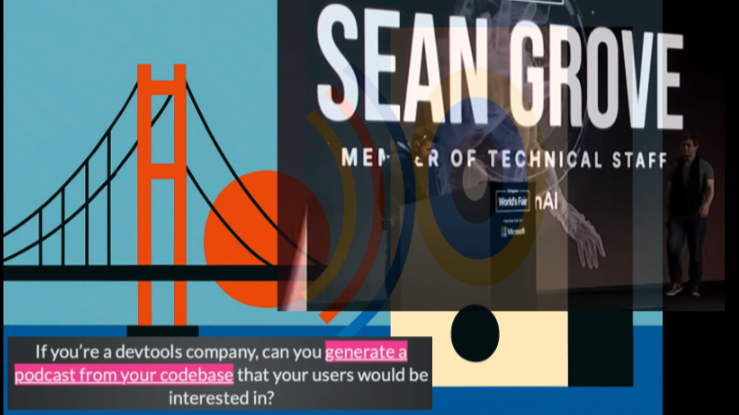
Software’s quiet revolution unfolds not in deployment pipelines or framework wars, but in the architecture of value creation itself. OpenAI’s Sean Grove’s presentation at AIEWF 2025 crystallizes what executives sense but struggle to articulate: the fundamental unit of programming is shifting from code to communication. This isn’t technological change masquerading as evolution—this represents economic transformation disguised as engineering practice.
The mathematics reveal themselves when Grove poses his deceptively simple question to developers: “Keep your hand up if you feel that the most valuable professional artifact that you produce is code.” Hands remain raised until he delivers the paradox reshaping everything: “Code is sort of 10 to 20% of the value that you bring. The other 80 to 90% is in structured communication.” The economics of modern software development suddenly surface—talking to users, distilling stories, planning implementation, translating plans into systems, testing whether outcomes match intentions. Code emerges as byproduct, not product. The real work happens in translation layers between human intent & machine execution.
Psychology of Intent Expression
Yet something deeper stirs beneath these percentages. Grove’s observation about vibe coding reveals the psychological dimension: “Vibe coding tends to feel quite good. And it’s worth asking why is that? Well, vibe coding is fundamentally about communication first. And the code is actually a secondary downstream artifact of that communication.” The satisfaction derives not from syntax mastery but from intent expression. Teams experience flow when communicating desired outcomes rather than manipulating implementation details.
This suggests profound implications for how knowledge moves through organizations. Traditional engineering teams organize around code repositories & deployment artifacts. But if specification becomes the primary value container, organizational memory patterns must reorganize around intent repositories. Consider the tribal knowledge that currently lives in senior developers’ heads—the implicit understanding of why certain architectural decisions emerged, what problems particular abstractions solve, which edge cases drove specific implementations. This knowledge typically transfers through code reviews & pair programming sessions, embedding itself in implementation rather than specification.
Constitutional Frameworks & Precedent Systems
Grove’s constitutional analogy penetrates deeper than metaphor when he observes: “The US constitution is literally a national model specification. It has written text which is aspirationally at least clear and unambiguous policy that we can all refer to.” Both documents establish governance frameworks, version control mechanisms, & enforcement protocols. But constitutions also reveal how specifications evolve through interpretation rather than modification. Judicial review functions as a grader system, establishing precedents that disambiguate original intent without altering source documents.
This pattern suggests how organizational specifications might evolve. Teams could develop precedent systems where ambiguous specification interpretations create binding clarifications, building institutional memory around intent interpretation rather than code archaeology. The specification becomes living constitutional framework rather than static requirements document. Engineering decisions reference specification precedents rather than implementation patterns, creating alignment mechanisms that scale beyond individual team knowledge.

Executable Architecture & Cross-Domain Programming
OpenAI’s Model Spec illustrates this transition in practice. What appears as markdown files becomes constitutional document governing AI behavior across millions of interactions. Grove describes it as “a living document that tries to clearly & unambiguously express the intentions & values that OpenAI hopes to imbue its models with.” But the document transcends human alignment—it becomes executable through deliberative alignment techniques where specifications serve simultaneously as training material & evaluation criteria. The specification compiles to behavior, documentation, testing protocols, & compliance mechanisms without intermediate translation layers.
This architectural shift creates curious knowledge distribution patterns. Grove notes that “product managers also write specifications. Lawmakers write legal specifications. This is actually a universal principle.” The implication ripples beyond role boundaries—if specifications become the primary programming artifact, domain expertise becomes programming capability. Legal teams write executable compliance specifications. Marketing teams author customer journey specifications that compile to user experience implementations. Finance teams create budget allocation specifications that generate spending approval workflows.
Governance Reconceptualization & Power Redistribution
The tribal knowledge problem intensifies & transforms simultaneously. Teams currently struggle with knowledge trapped in individual minds, but specification-first development could democratize programming across organizational functions while creating new knowledge isolation risks. What happens when business logic lives in legal team specifications rather than engineering implementations? How do cross-functional teams maintain coherence when multiple domains author executable specifications with overlapping responsibilities?
Grove’s prediction carries unsettling implications: “The person who communicates most effectively is the most valuable programmer. And literally, if you can communicate effectively, you can program.” This suggests profound power redistribution within organizations. Engineering gatekeeping diminishes as specification authoring democratizes programming capability. But new gatekeeping patterns might emerge around specification quality, interpretation authority, & execution prioritization.
Governance frameworks require fundamental reconceptualization beyond surface process adjustments. Current engineering governance assumes code as primary artifact—pull request reviews, deployment approvals, performance monitoring, security scanning. Specification-driven development demands governance around intent clarity, interpretation consistency, execution fidelity, & outcome measurement. Teams need mechanisms for specification conflict resolution when multiple authors create overlapping or contradictory requirements. They require precedent systems for ambiguity resolution & authority hierarchies for specification modification rights.
Universal Translation & Cognitive Load Evolution
Consider the epistemological implications. Grove observes: “In the same way that having a source code that you pass to a compiler allows you to target multiple different architectures, you can compile for ARM 64, x86 or web assembly. The source document actually contains enough information to describe how to translate it to your target architecture.” Specifications become universal translators between human intention & diverse execution contexts—generating TypeScript implementations, Rust servers, documentation, tutorials, podcasts from single source documents.
This universality creates both opportunity & vulnerability. Organizations that develop superior specification frameworks gain sustainable advantages as these frameworks become organizational intelligence source code. But specification quality directly impacts execution quality across all derived artifacts. Poor specifications propagate errors across documentation, implementations, & training materials simultaneously. The failure modes concentrate rather than distribute.
Grove envisions development environments evolving from Integrated Development Environments to “Integrated Thought Clarifiers” that “pull out the ambiguity & ask you to clarify it & it really clarifies your thought so that you & all human beings can communicate your intent to each other much more effectively.” This suggests emerging market opportunities in specification authoring platforms, intent validation systems, & collaborative specification management tools.
Economic Transformation & Competitive Inversion
Yet deeper questions emerge around cognitive load distribution. If specifications carry primary value, teams must invest heavily in specification quality while maintaining execution capability. The cognitive demands might intensify rather than simplify—requiring both precise communication skills & technical execution understanding. The tooling evolution Grove describes could either augment human specification capabilities or create new dependency patterns where teams rely on artificial assistance for fundamental communication tasks.
The economic transformation Grove identifies reaches beyond individual organizations toward industry-wide value chain reconfiguration. Software companies currently compete on implementation quality, deployment efficiency, & feature velocity. Specification-driven development shifts competition toward intent clarity, specification framework sophistication, & execution fidelity. Companies with superior specification capabilities could dominate markets through better requirement capture, stakeholder alignment, & outcome achievement rather than technical implementation advantages.
Grove’s closing observation carries prophetic weight: “Software engineering has never been about code… Engineering is the precise exploration by humans of software solutions to human problems. It’s always been this way. We’re just moving away from sort of the disparate machine encodings to a unified human encoding.” The companies recognizing this transition earliest will architect competitive advantages around human-readable specifications that compile to machine-executable systems.
The paradox resolves itself through inversion: in an age of infinite computational possibility, constraint becomes human clarity. Advanced technology companies discover their most valuable code was never code at all—it was always the structured communication that code inadequately captured. The future belongs to organizations treating communication as their most critical engineering discipline, but this future demands new forms of organizational intelligence, governance sophistication, & cognitive collaboration that few institutions currently possess.
Grove’s final plea reveals the ultimate dilemma: “This is aligning agents at scale… you then realize that you never told it what you wanted & maybe you never fully understood it anyway. This is a cry for specification.” The very tools designed to execute specifications will require specifications to operate safely—creating infinite recursion where the solution becomes the problem, & the most powerful programming paradigm in history might program itself beyond human comprehension.