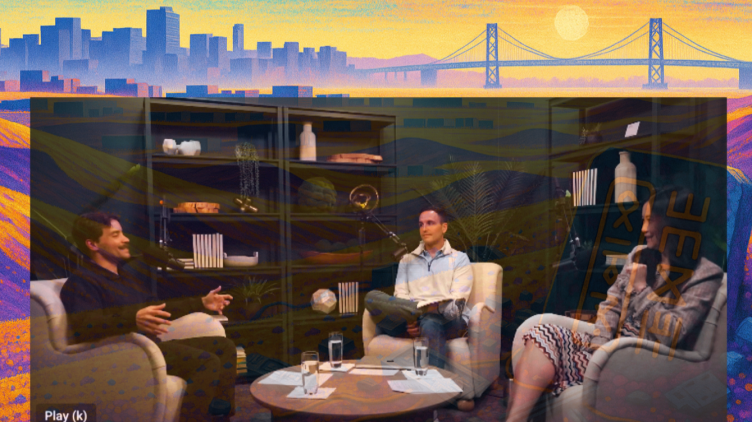
Web’s unit of work is shifting from prebuilt code to just-in-time generation per user. v0 by Vercel now serves 3M+ builders, with Fortune 10 companies using it on enterprise tier.
“In the next 3 years we’re going to see kingdoms collapse… companies born on the internet that haven’t made AI adjustments fast enough, and new AI-native companies rise to unprecedented heights very quickly,” says Guillermo Rauch, CEO of Vercel.
This isn’t hyperbole. It’s pattern recognition at architectural scale.
Three Foundational Shifts
Static → Dynamic → Generative
We’ve moved through distinct epochs of web architecture. Static sites gave way to dynamic applications that compute responses based on user context and real-time data. Now we’re entering the generative phase.
“I think of the web as being the place where everything will be generative just in time for everybody,” Rauch explains. “I think you won’t even notice it’s an ephemeral app. Everything will be ephemeral for that matter.”
Think beyond personalization. This is about applications that didn’t exist until the moment you needed them. Every pixel becomes intentional rather than simply rendered from templates.
As Jensen Huang argues, pixels will increasingly be generated rather than rendered. This applies perfectly to web experiences.
Frameworks → Intelligence
Frameworks were humanity’s attempt to encode best practices into reusable patterns. React gave us component thinking. Next.js provided full-stack conventions. Tailwind systematized design tokens.
But frameworks still required developers to learn abstractions, memorize APIs, and navigate documentation. LLMs represent a categorical leap: compressed expertise that responds to natural language.
“LLMs seem to me like a generational leap, like more general than a framework and potentially something that opens up the top of funnel to every person on the planet because all you need to know is to use your natural language and generate code,” Rauch says.
This isn’t about replacing developers with AI. It’s about expanding who gets to participate in software creation. “Your customer is no longer the developer. Your customer is the agent that the developer or non-developer is wielding.”
Synchronous vs Asynchronous Agents
Current AI interactions mostly follow ChatGPT model: you ask, it responds immediately. This synchronous pattern works for quick questions and simple generations. But future belongs to asynchronous agents.
“You have the synchronous agents. This is open evidence or ChatGPT. You go there and you ask a question and you get an answer right away,” Rauch explains. “And then you have the more potentially interesting long-term which is the asynchronous agents. These are the agents that can work and solve broader problems and can collaborate with other agents potentially with other humans not just you and can work for prolonged amounts of time.”
Picture the difference between a chat conversation and hiring a consultant. Synchronous agents give instant answers. Asynchronous agents take your high-level intent, develop a plan, execute across multiple systems, and return with completed work.
Leapfrog Effect
Perhaps most profound implication is how this compresses learning curves. New developers no longer need to accumulate decades of hard-earned lessons about browser quirks, framework gotchas, or deployment complexities.
“People that are getting into software today have this incredible access to what we’ve all learned collectively,” Rauch observes. “In some ways you’re kind of leapfrogging the past generation. Past generation has their gray hairs and hard-earned lessons on how to build these interfaces.”
This creates a generational shift where new builders start with expert wisdom as baseline, then iterate at speeds that weren’t previously possible.
Developer Playbook 2.0
Transitioning to AI-native development requires rethinking fundamental assumptions:
Design for agents first Publish machine contracts: OpenAPI + JSON Schemas + function calling. Stable action names that survive refactors. Deterministic errors agents can retry.
Stream as default Render partials. Enforce token budgets. Track tail latency and abandon rates.
Make work resumable Idempotent ops, durable job queues, DLQs, retries with backoff, webhooks, audit trails.
Harden secrets automatically Server-side by default. Disallow clientside secret usage at build time. Red-team prompts and tools. Rauch says v0 prevents “a thousand vulnerabilities per day relative to what the LLM had the inclination to ship.”
Instrument agent UX Acceptance rate, pass@k, tool-success rate, escalation rate, hallucination flags, recovery time. “AI products have that kind of built in which is amazing,” Rauch notes about inherent metrics.
Author for LLMs Provide llm.txt, tool catalogs, worked examples, and MCP endpoints where relevant. “You have to think about a web for agents.”
Blend sync and async Chat for quick intent capture. Background agents for multi-step work with resumable checkpoints.
Continuous auto-QA Agents probe sign-up, purchase, permission flows, and top 5 user paths on a schedule. “You want robots that are constantly watching everything and repairing it.”
Performance as product Stream first paint, cache predictables, precompute hot paths. Treat p95 and p99 as SLAs.
Domain expertise over generality Retrieval, small fine-tunes, and curated evals per domain. Expert agents beat general chat for production. “I see a world of millions if not hundreds of millions of agents,” Rauch says.

Strategic Questions for Navigation
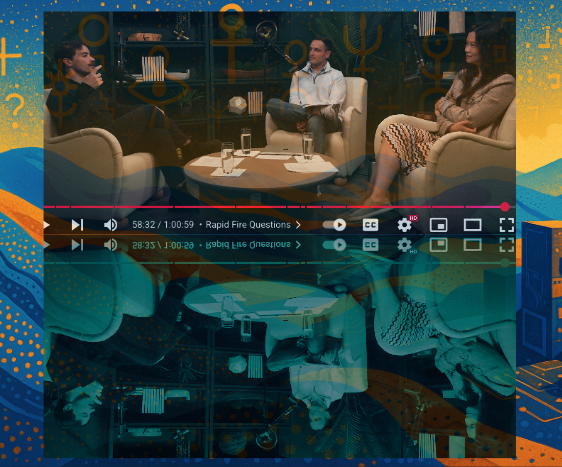
Organizations navigating this transition face fundamental questions. Sequoia Capital’s interview probed critical implications:
“Does that mean that eventually your developer customer is not producing a single app that’s going to serve a bunch of users? Those users are each somehow interfacing with something the developer has done on v0 or on Vercel. It’s generating applications on the fly for each individual user?”
Rauch confirmed: “That’s right. That’s wild. It’s almost like a direct human to agent interface.”
“Will it also lead to better apps, better software in the world or will it just produce more noise?”
“I think it’ll lead to better apps for sure,” Rauch responded, explaining how they systematically analyze error patterns and embed solutions into models.
“How far are we from just fully self-driving infrastructure?”
“I think we’re practically almost there,” Rauch answered. “Best case scenario, we have Vercel being able to automatically scale for any kind of workload.”
Board Lens: What to Ask Leadership
-
Where are APIs still human-legible docs instead of machine-legible contracts?
-
Which user journeys are auto-QA monitored by agents every hour?
-
What is the eval suite that ties model changes to revenue and risk?
-
How will roadmap split between agent UX and human UX over the next 12 months?
-
What percent of workloads stream today, and what is the target?
Velocity Imperative
Timeline Rauch projects reflects exponential nature of AI capabilities combined with network effects of software distribution. Unlike previous technology transitions that required new hardware adoption, this leverages existing internet infrastructure.
“I have this aversion now to searching for software because the idea that I can generate it seems in my mind to beat the total latency of finding the software installing it,” Rauch admits.
ChatGPT has become one of Vercel’s fastest-growing customer acquisition channels. “People would come to our booth and tell them that they learned of Vercel because ChatGPT told them to use Vercel,” Rauch says about AI Engineering conference attendees.
Implications Beyond Software
This transformation extends beyond software development into fundamental questions about human-computer collaboration. When latency between idea and implementation approaches zero, clarity of intent and quality of judgment become limiting factors.
“AI I feel like is that human amplifier of our business, that token factory that Jensen talks about for our business,” Rauch explains about AI’s role in scaling expertise.
Bold Prediction: What Happens When Kingdoms Fall
Assuming Rauch’s three-year timeline proves accurate, here’s what digital landscape looks like in 2028:
-
Software creation becomes as accessible as writing. Every domain expert routinely generates custom applications for their specific needs. The profit pool shifts dramatically toward platform operators who provide infrastructure for generation and experience orchestrators who curate AI-generated experiences.
-
Traditional software companies split into two categories: infrastructure providers and experience designers. Companies that built their moats around software scarcity find themselves competing in an abundance market.
-
App stores transform into agent marketplaces where you buy capabilities, not applications. The concept of “downloading apps” becomes as antiquated as mailing letters.
-
Developer roles evolve dramatically. Traditional coding becomes entry-level work. Senior engineers become “AI orchestrators” who design agent workflows. The most valuable developers become “human-AI interface designers.”
-
A new class of digital inequality emerges between those who can effectively communicate with AI systems and those who cannot. “Prompt literacy” becomes as fundamental as traditional literacy.
By 2028, we won’t be building software. We’ll be conducting symphonies of intelligence, where human creativity and AI capability merge into something entirely new.
Bottom line Web’s unit of work is changing. Ship machine-first contracts, stream by default, make work resumable, and put agents on QA. Winners will treat performance, reliability, and domain expertise as scaffolding for generation at scale.
https://bsky.app/profile/schwentker.bsky.social/post/3lwd3kbax5s2f