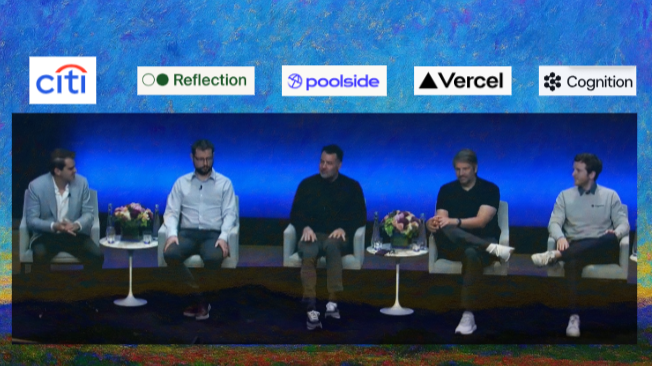
Reflections on Citi Gen AI Summit 2025: Impact of Gen AI on Software Development
Where are we in the GenAI hype cycle today? How is the software development lifecycle fundamentally different from the past? What are the hard engineering challenges that still face us in getting to AGI? These questions, posed by Blaze O’Byrne at Citi’s recent summit, frame the most significant transformation in enterprise software since the internet. The answers reveal we’re entering what industry leaders call the “decade of agents” - a paradigm shift that will reshape how enterprises build, deploy, and manage software systems.
Rise of autonomous coding agents signals enterprise transformation
ReflectionAI and poolside represent the vanguard of this transformation, each raising unprecedented funding rounds that signal investor confidence in autonomous coding agents. Reflection.ai secured $130 million at a $555 million valuation with its multi-agent architecture combining large language models with reinforcement learning from code execution feedback. Their Asimov agent demonstrates 60-80% preference rates over competitors in blind testing with open-source maintainers, focusing on organizational knowledge capture and autonomous task completion.
As Ioannis Alexandros Antonoglou, CTO of Reflection.ai, emphasized at the summit: “I think it’s the decade of agents. We will see agents really changing the economy and the way that we do things and the way that engineering teams operate, how software is being built and also how processes within enterprises happen.”
Poolside.ai’s $626 million funding at a $3 billion valuation positions it as the highest-valued AI coding company, taking a foundation model approach specifically built for software development from first principles. Operating a 10,000 GPU training cluster, Poolside has developed proprietary non-Transformer architectures enabling linear attention and magnitude-faster inference than traditional models. Their focus on government, defense, and high-compliance environments reflects growing enterprise demand for controlled, high-performance coding agents.
Jason Warner, CEO of Poolside and former CTO at GitHub, noted: “Neural networks are the most important digital technology of our lifetime. They’re going to rewrite most of everything that we do.”
Cognition’s Devin achieved groundbreaking SWE-bench performance of 13.86% - nearly 7x better than previous state-of-the-art. Devin’s deployment at Goldman Sachs for infrastructure management and enterprise implementations demonstrating 12x efficiency improvements prove that fully autonomous coding agents can deliver transformative value. As Russell Kaplan, President at Cognition, observed: “The large majority of the work is pulling in things from the backlog or the wish list that probably wouldn’t have even been done in the first place.”
Vercel’s V0 tool exemplifies democratization of software creation, enabling non-engineers to build applications through natural language. Malte Ubl, CTO of Vercel, explained the transformation: “Rather than coming to a meeting with a document, you come with a working application and that’s where you start the project.”
Market forces indicate fundamental enterprise software disruption
The AI coding tools market represents a $4.86 billion industry expanding to $26.03 billion by 2030 with 27.1% compound annual growth. However, the true transformation extends beyond market size to fundamental changes in enterprise software procurement and development approaches. 92% of companies plan increased AI investments, yet only 1% report AI maturity, indicating we’re still in early adoption of massive transformation.
Enterprise adoption patterns reveal dramatic workflow shifts. Research shows 264% ROI from Vercel adoption, including 90% time savings managing infrastructure and 4x more website enhancements released. GitHub Copilot demonstrates 55% faster task completion with statistical significance, while productivity increases of 20-35% are becoming standard across enterprise implementations.
Switching costs reduction is accelerating as AI enables more modular architectures and reduces vendor lock-in. Enterprises are experiencing a 2-4 percentage point shift from buying to building internal solutions, representing a potential $35-40 billion reallocation toward internal development capabilities enhanced by AI agents.
Technical breakthroughs enable transition from tools to autonomous workers
Reinforcement Learning from Execution Feedback represents the most significant breakthrough in AI coding capabilities. This approach enables AI agents to learn from trial and error like human developers, moving beyond pattern matching to genuine problem-solving capabilities.
Performance improvements are dramatic. Claude 4 reached 72.5% on SWE-bench, a benchmark using real GitHub issues from production repositories, compared to previous state-of-the-art around 42%. This represents not incremental improvement but a quantum leap in autonomous coding capability.
The “co-pilot” versus “co-worker” paradigm defines current enterprise decision-making. Co-pilot tools provide human-in-the-loop assistance with immediate productivity gains and lower implementation risk. Co-worker agents like Devin and Reflection’s Asimov operate autonomously, handling complete workflows from planning to deployment but requiring greater organizational adaptation.
Current limitations remain significant. Context window constraints affect large enterprise codebases, security vulnerabilities aren’t caught by basic execution testing, and models can generate syntactically correct but semantically flawed code. However, execution feedback training is enabling rapid improvement in autonomous capabilities while reducing training costs by orders of magnitude.
Enterprise SDLC transformation requires organizational rewiring
Leading enterprises are fundamentally restructuring software development workflows around AI agents rather than simply adding AI tools to existing processes. As Jason Warner noted from his GitHub experience: “I measured two things above all else. When we had an idea how long it took us to get it to production and when we had a fault in production, how long it took us to recover from that.”
Coding represents only 10-15% of the software development lifecycle, explaining why early GenAI productivity gains haven’t translated to faster time-to-market. Strategy, planning, and conceptualization account for the majority of lead time, while release processes consume 30-40% of the cycle. This insight drives enterprises to deploy agents across the entire SDLC rather than focusing solely on code generation.
The skills revolution is already underway. Senior developers are shifting to complex problem-solving and AI agent supervision, while junior developers transition to agent oversight rather than code writing. As Malte Ubl observed: “If you are like a software engineer with 20 years of experience, it’s a career change now.”
Decade ahead: strategic preparation for autonomous enterprise software
Industry consensus suggests AI agents will execute 15% of daily work decisions by 2028, growing from effectively 0% in 2024. Gartner expects 75% of enterprise software engineers to use AI code assistants by 2028, while the GenAI software market will reach $227 billion by 2030 with 36% compound annual growth.
Vendor ecosystem consolidation is accelerating around platform leaders. While OpenAI maintains overall market leadership, Google and Anthropic have made considerable progress. The shift toward third-party applications over custom builds reflects maturing vendor capabilities and enterprise risk management preferences.
Infrastructure evolution requires new enterprise architectures. Organizations are shifting from application-focused to multiagent architectures where hundreds or thousands of distinct AI agents communicate to achieve business goals. Three deployment patterns are emerging: super platforms with built-in agents, AI wrappers for secure API communication, and custom agents using proprietary data.
Career adaptation strategies must emphasize human-AI collaboration over replacement fears. Critical new skills include prompt engineering for code generation, AI-generated code review for quality and security, enhanced communication for cross-functional collaboration, and understanding legal and ethical implications of AI-generated content.
Strategic imperatives for C-suite leaders
Immediate operational preparation requires CEO-level commitment to organizational rewiring, not just technology adoption. Successful transformation demands balanced implementation combining autonomous agents for predictable processes with human-AI collaboration for complex judgment-based tasks.
Budget reallocation should anticipate infrastructure cost increases while labor costs decrease. Enterprises should plan for careful compute spend monitoring while investing in modular frameworks for reusable agent development, data layers for consistent training, and risk controls for continuous agent improvement.
Governance frameworks become critical with EU AI Act enforcement beginning February 2025. Unified data and AI governance enables innovation while managing regulatory and security risks, particularly crucial given shadow AI adoption affecting nearly all employees.
The evidence is compelling: enterprises that successfully navigate this transformation will achieve sustained competitive advantages through enhanced productivity, accelerated innovation, and optimized resource allocation. The decade of agents has begun, and the window for strategic preparation is narrowing rapidly. Organizations that delay adoption risk falling behind as the performance gap between traditional development methods and AI-enabled approaches continues to expand exponentially.
As Jason Warner (former CTO at GitHub and current CEO of Poolside) observed, the capability differences between first and second-generation AI coding tools are “stark.” The companies positioning themselves for success are those treating this as a strategic inflection point requiring fundamental business model evolution rather than incremental tool adoption.
The question for enterprise leaders is not whether AI agents will transform software development, but how quickly they can adapt their organizations to capture the competitive advantages this transformation enables.
Appendix A: Vibe Coding for Executive Leadership
Opening Paragraph: Vibe coding represents a strategic inflection point where business stakeholders can directly translate requirements into functional software without technical intermediaries. This capability fundamentally alters enterprise resource allocation, competitive advantage timelines, and organizational agility by eliminating the traditional bottleneck between business need and technical implementation.
Five Strategic Implications:
-
Competitive Advantage Acceleration: Organizations can now prototype, test, and deploy customer-facing solutions in days rather than quarters, enabling rapid market response and experimentation that previously required significant technical resources and budget allocation.
-
Budget Reallocation Opportunities: IT spending shifts from routine application development to infrastructure, security, and integration oversight, while business units gain direct capability to address operational needs without cross-departmental project management overhead.
-
Risk Management Evolution: While vibe coding reduces time-to-market risks, it introduces new governance challenges around shadow IT, data security, and application proliferation that require updated compliance frameworks and oversight protocols.
-
Talent Strategy Transformation: The most valuable employees become those who combine deep domain expertise with AI collaboration skills, while traditional developer roles evolve toward system architecture, security, and complex problem-solving rather than routine coding tasks.
-
Vendor Relationship Disruption: Enterprise software procurement strategies must adapt as internal teams can now build custom solutions that previously required expensive third-party licenses, fundamentally altering build-versus-buy decision matrices.
Executives who successfully harness vibe coding will achieve sustained competitive advantages through enhanced organizational responsiveness, optimized resource allocation, and accelerated innovation cycles. The window for strategic preparation is narrowing as early adopters establish operational advantages that will compound over time, making immediate governance framework development and talent strategy evolution critical priorities.
Appendix B: Technical Platform Differentiation for Advanced Devs
The autonomous coding landscape features distinct technical architectures optimized for different enterprise use cases, from organizational knowledge capture to real-time application generation. Understanding the fundamental differences between Reflection.ai’s Asimov, Vercel’s V0, Cognition’s Devin, and Poolside’s foundation models enables strategic platform selection based on specific technical requirements and deployment contexts.
Five Technical Distinctions:
-
Architecture Philosophy: Reflection.ai’s Asimov employs multi-agent reinforcement learning with organizational context integration, Vercel V0 uses transformer-based UI generation with real-time compilation, Devin operates as a comprehensive autonomous software engineer with tool manipulation capabilities, while Poolside builds domain-specific foundation models with proprietary non-Transformer architectures.
-
Context Handling: Asimov excels at organizational knowledge graphs and codebase understanding for enterprise integration, V0 focuses on component-level UI generation with limited context persistence, Devin maintains session-level context for multi-step engineering tasks, and Poolside processes massive codebases through linear attention mechanisms designed for software-specific patterns.
-
Deployment Models: Asimov integrates into existing enterprise workflows through API endpoints and organizational tooling, V0 operates as a web-based interface for immediate application generation, Devin functions as an autonomous agent handling complete software engineering projects, while Poolside offers both foundation model access and full-stack enterprise deployment for high-security environments.
-
Performance Optimization: Asimov achieves 60-80% preference rates through RLCEF training on enterprise codebases, V0 demonstrates rapid UI generation with immediate visual feedback, Devin reaches 13.86% SWE-bench performance through end-to-end autonomous task completion, and Poolside claims magnitude-faster inference through custom architectures optimized for code generation.
-
Enterprise Integration: Asimov prioritizes organizational knowledge capture and team workflow integration, V0 focuses on democratizing application creation for non-technical users, Devin emphasizes autonomous project completion with minimal human oversight, while Poolside targets government and high-compliance environments requiring data sovereignty and custom model training.
Platform selection should align with specific technical requirements: choose Asimov for organizational knowledge integration and team augmentation, V0 for rapid UI prototyping and business user empowerment, Devin for autonomous software engineering projects requiring minimal supervision, and Poolside for enterprise environments demanding custom foundation models and maximum security control. The optimal approach often involves hybrid deployment strategies leveraging multiple platforms for different aspects of the development lifecycle.
Sources
Company Analysis & Funding:
-
Reflection AI Raises $130 Million to Build Autonomous Coding Systems | PYMNTS.com
-
Superintelligence startup Reflection AI launches with $130M in funding - SiliconANGLE
-
Introducing Asimov: The Code Research Agent for Engineering Teams | Reflection AI
-
AI coding startup Poolside raises $500M from eBay, Nvidia, and others | TechCrunch
-
poolside: Software Reimagined Using First Principles - Medium
-
Here’s the full list of 49 US AI startups that have raised $100M or more in 2024 | TechCrunch
-
Report: Cognition Business Breakdown & Founding Story | Contrary Research
-
Report: Vercel’s Business Breakdown & Founding Story | Contrary Research
-
Cognition | Introducing Devin, the first AI software engineer
Market Research & Analysis:
-
AI Code Tools Market Size & Share | Industry Report, 2030 - Grand View Research
-
Goldman Sachs is piloting its first autonomous coder in major AI milestone for Wall Street - CNBC
Technical Research & Performance:
-
RLEF: Grounding Code LLMs in Execution Feedback with Reinforcement Learning - arXiv
-
Brief Review — AlphaCode 2 Technical Report | by Sik-Ho Tsang | Medium
-
AI Coding Agents in 2025: Cursor vs. Windsurf vs. Copilot vs. Claude vs. VS Code AI - Kingy AI
Industry Analysis & Governance:
-
Top 10 Insights From Forrester’s State of Generative AI in 2024 Report - LinkedIn
-
GenAI in Numbers - Gartner and Forrester Predictions - Frends iPaaS
-
What Forrester’s 2024 AI Predictions Mean For Technology Executives - Forrester
-
Gartner Says 75% of Enterprise Software Engineers Will Use AI Code Assistants by 2028
-
Forecast Analysis: AI Software Market by Vertical Industry, 2023-2027 - Gartner
-
AI Governance Software Spend Will See 30% CAGR From 2024 To 2030 - Forrester
Shadow AI & Security: