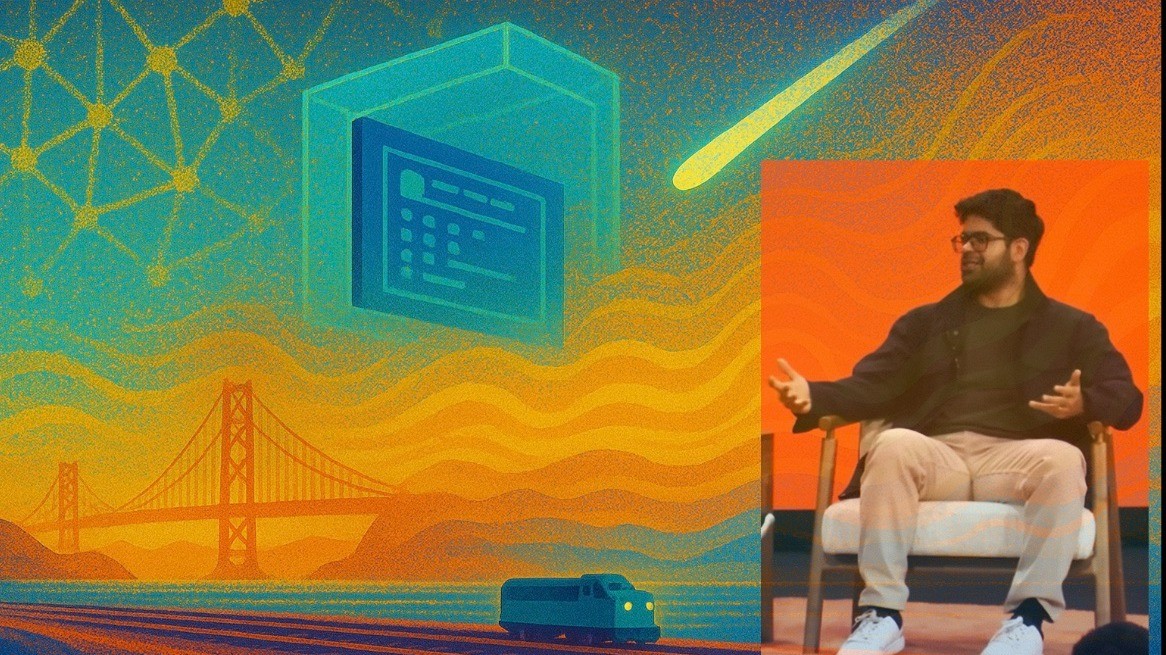
Bottom line: On a Tuesday morning in August, Perplexity AI offered to buy the gate to two-thirds of the internet. The $34.5 billion all-cash bid for Google Chrome signals browser ownership as the critical chokepoint for AI platform dominance. This David versus Goliath moment - an $18 billion startup bidding nearly double its valuation for Google’s crown jewel - transforms competitive dynamics across the generative web.
Strategic imperative: Perplexity CEO Aravind Srinivas positions browsers as “cognitive operating systems” where AI agents orchestrate tasks asynchronously. The Chrome acquisition attempt leverages regulatory pressure while Comet browser development demonstrates technical capability. Speed becomes the only sustainable moat against well-funded competitors building similar capabilities.
The formal bid that reshapes AI competition
Perplexity submitted a formal $34.5 billion all-cash offer for Google Chrome on August 12, 2025, representing the first concrete attempt to acquire infrastructure powering 3.5 billion users. The bid, submitted under internal code name “Project Solomon,” includes $3 billion in additional Chromium development investment and commitments to maintain Google as default search initially.
The timing appears strategically calculated. Federal regulators could force Chrome divestiture within weeks as an antitrust remedy following the 2024 monopoly ruling. Multiple large investment funds agreed to finance the transaction, according to Chief Business Officer Dmitry Shevelenko, though specific backers remain undisclosed.
This represents more than opportunistic positioning. Srinivas articulates browser control as foundational: “The browser is the ultimate context basically. It has access to every single thing we do. It’s a product we live on for both work and life.” The Chrome bid demonstrates recognition that browser ownership determines which companies control human-AI interaction patterns rather than accepting vendor constraints.
Google declined comment on the bid, having previously called DOJ divestiture proposals “wildly overbroad.” However, the offer creates immediate competitive pressure regardless of acceptance probability.
Srinivas’s strategic positioning against incumbents
Aravind Srinivas frames Perplexity’s competitive strategy around speed and focus rather than resources. “The only mode you have is speed. You have to innovate. You have to move faster than everybody else. And it’s like running a marathon but at an extremely high velocity,” he explains.
This velocity advantage emerges from structural differences with incumbents. Google faces innovator’s dilemma constraints: “For Google, one mistake tanks their stock. Like you remember the live demo of Bard where it failed and the stock went down 6%. So we knew that there was a lot of advantages for us.”
The competitive analysis extends beyond Google. Srinivas acknowledges OpenAI and Anthropic will build competing browsers: “I’m fully working with the assumption that OpenAI will also build its own browser. Anthropic will also try to build its own browser. Google already has one called Chrome.” His response focuses on execution speed rather than market protection.
Narrative differentiation: “Let there exist 100 chatbots but we are the most focused on getting as many answers right as possible we focus on speed time to first token on app or web like we’re still the fastest despite doing search.” Accuracy becomes brand positioning while technical performance maintains competitive advantage.
Browser as cognitive operating system architecture
Srinivas conceptualizes browsers beyond traditional navigation tools. The vision centers on autonomous agent orchestration: “You think about each query or each prompt could be that and that will be our new browser comet. So, we’re putting all our energy into that.”
The technical architecture mirrors cloud computing patterns: “We hope to make it like a cloud where you launch several tasks in parallel that are running asynchronously. And pulling all your personal contacts, your email, your calendar, your Amazon, your, you know, all all sorts of social media accounts that you have and you go and do research on real estate, the markets, and these are all like just processes running on your browser.”
This represents fundamental shift from request-response patterns toward continuous computation. Traditional browsers optimize for human latency; AI-native browsers optimize for agent orchestration across multiple concurrent workflows.
Context engineering advantage: “That’s essentially what a lot of people call as like context engineering so that is important to as the like like it’s like two axes right like intelligence and then context and personalization.” Browser control provides comprehensive user context that isolated AI applications cannot access.
Comet browser demonstrates technical capability
Perplexity launched Comet browser in July 2025 for premium subscribers at $200 monthly, demonstrating AI-native browser development capability. Srinivas describes practical applications: “I was able to like book or change my flight on United and just ask the sidecar to sort of go and do it for me.”
The browser enables agent workflows impossible through traditional interfaces: “You can schedule your meetings. You can reply to some of your emails that you don’t even want to read. You can like for example let’s say you’re hosting a Y combinator event and you say I only want to accept Stanford dropouts and it can go through the entire list of people who applied and just filter based on who’s you know took scrape their LinkedIn URLs filter based on whether they were Stanford and whether they dropped out or not.”
Multi-step reasoning capability: These examples demonstrate browser-based agents performing complex workflows requiring authentication, data analysis, and decision-making across multiple applications. Traditional chatbots cannot access authenticated sessions or manipulate web forms directly.
Comet waitlist approaches one million users despite premium pricing and rough edges, suggesting significant market demand for browser-based AI capabilities.
Competitive moats through browser ownership
Srinivas identifies browser control as more defensible than chat interfaces: “The browser is much harder to copy than like yet another chat tool.” This stems from infrastructure complexity, user switching costs, and accumulated context advantages.
Infrastructure barriers: Browser development requires years of engineering investment in rendering engines, security models, extension ecosystems, and enterprise management tools. Acquiring Chrome eliminates these development cycles while providing immediate global distribution.
Network effects emergence: “The browser will definitely be one play to like you know figure this out because as your browsing history and like which again you can still export but not the same as just getting a dump a CSV dump and your passwords your wallet your agent remembers you there’s a lot of tasks that are running on the browser that you rely on your day-to-day life and work.”
Traditional AI products lack strong network effects since conversation histories transfer easily between platforms. Browser-based agents create stickiness through accumulated personal data, running tasks, and authentication integration.
Strategic timing and regulatory opportunity
The Chrome acquisition attempt leverages unique regulatory circumstances. DOJ antitrust proceedings specifically target browser control as remedy for Google’s search monopoly, potentially creating forced divestiture opportunity.
Srinivas positions this within broader competitive dynamics: “Until then, if you had to compete with Google and you had to build something that needed a lot of AI in it, good luck, right? Like cuz you never have an AI outside Google that’s even equal, leave alone being better. But now it’s a completely reversal of the situation thanks to open AI or anthropic or open source models.”
The regulatory window combines with AI capability parity to create acquisition opportunity unlikely to recur. Browser ownership determines AI platform control for the next computing paradigm.
Publisher economics shift: Publishers report 50% traffic drops as AI-generated summaries replace traditional search clicks. Browser-controlled AI agents could accelerate this trend, concentrating economic value in platforms mediating between users and web content rather than traditional website publishing.
Implementation challenges and technical integration
Acquiring Chrome would fundamentally alter Perplexity’s technical strategy compared to purpose-built Comet development. Chrome’s mature codebase includes 16+ years of optimizations for traditional browsing rather than AI agent deployment.
Technical complexity: Integrating AI capabilities into Chrome’s multi-process architecture requires managing memory allocation between browser processes and inference engines, balancing agent computation with browsing responsiveness, and retrofitting agentic capabilities into established rendering pipelines.
However, Chrome provides proven infrastructure advantages: Blink rendering engine and V8 JavaScript engine offer performance guarantees, established auto-update mechanisms enable global software distribution, and enterprise management tools represent years of development investment.
Security model evolution: Traditional browser security assumes human-initiated actions with predictable timing and permissions. AI agents operating autonomously require new threat models around credential handling, cross-origin requests, and data exfiltration through agent behavior patterns.
Business model evolution beyond advertising
Srinivas positions Perplexity’s business model as fundamentally different from Google’s advertising approach: “For us, this is the only thing we care about. accuracy at the level of answers, accuracy at the level of tasks, orchestrating all these different tools.”
Subscription and usage models: “We think like we can grow at least, you know, a few billions a year in just subs, which is a great business. usage based pricing where people are paying an agent for completing a task or people have recurring tasks and they pay based on you know every single use of the task.”
Transaction fees represent additional revenue streams as agents complete purchases: “If people start buying more through AIs, taking a cut out of the transactions is good.” This aligns platform incentives with user outcomes rather than attention capture.
The Chrome acquisition enables these business models at unprecedented scale while avoiding Google’s advertiser conflict constraints.
Platform consolidation endgame
The Chrome bid signals broader AI platform consolidation where companies seek vertical integration from models to user interfaces. Browser ownership provides multiple defensive advantages: embedding AI into daily workflows, creating switching costs through personalization, and generating data advantages for model improvement.
Srinivas acknowledges competitive reality: “Brand definitely has a big value, right? Like there are cursor competitors, perplexity competitors like OpenAI will have like their own cursor. OpenAI has perplexity within chat GPT that did not kill any of these companies.”
Success requires execution velocity rather than market protection: “Even now, we worry about it and the only solution is to move fast and keep shipping.”
Strategic outcome: Whether Perplexity’s Chrome gambit succeeds depends on regulatory decisions and Google’s defensive responses. However, the bid itself demonstrates AI companies recognize browser ownership as essential infrastructure for generative web dominance. This represents the most significant potential reshuffling of internet infrastructure since Google launched Chrome in 2008, with implications extending into fundamental human-computer interaction architecture.
The emergence of browser-native AI agents transforms computing paradigms from search-and-click patterns toward continuous AI-mediated workflows. Organizations controlling this transition shape the next decade of digital experience rather than adapting to vendor-defined constraints.
Appendix A: Vibe Coder Context
The browser-as-operating-system paradigm shift reveals fundamental tensions between traditional web architecture and AI agent requirements. For developers building at this intersection, several technical challenges emerge that require deep understanding of both browser internals and AI system integration patterns.
Five critical implications for development teams:
-
Event loop collision patterns: Browser event loops optimize for user interaction responsiveness, typically 16ms frame budgets. AI inference introduces computation spikes lasting hundreds of milliseconds, creating blocking scenarios that break interface responsiveness. Solutions require careful orchestration between main thread, web workers, and service workers to maintain smooth user experience during agent operations.
-
Memory management complexity: Chromium’s multi-process architecture isolates renderer processes for security and stability. AI agents require persistent model state and conversation context that conflicts with process isolation boundaries. Traditional garbage collection patterns break down when managing large language model memory allocation alongside standard DOM manipulation and JavaScript execution.
-
Authentication flow disruption: Browser security models assume human-initiated authentication with predictable timing patterns. AI agents performing rapid sequential actions across multiple authenticated sites trigger anti-bot detection systems. Developers need new approaches to credential handling that maintain security while enabling autonomous agent behavior.
-
Cross-origin orchestration: Traditional same-origin policies prevent cross-site data access for security reasons. AI agents orchestrating workflows across multiple enterprise applications require elevated permissions while maintaining isolation between unrelated sites. This necessitates new permission models that understand agent intent versus traditional user browsing.
-
State synchronization challenges: Agent actions across multiple browser tabs, applications, and external APIs create distributed state management problems that traditional session handling cannot address. When agents perform concurrent operations impossible for human users, existing state synchronization patterns fail, requiring new architectural approaches to maintain consistency.
These challenges reflect the fundamental shift from browsers as content consumption tools toward platforms for autonomous AI operation. Developers succeeding in this transition combine deep browser architecture knowledge with AI system design principles to create seamless agent experiences rather than awkward mode-switching interfaces.
Appendix B: References
Primary Sources:
-
Perplexity AI Chrome acquisition bid documentation, August 12, 2025
-
Perplexity CEO Aravind Srinivas On Comet, Search, & The Future Of AI | Semafor Tech, August 6, 2025: https://www.youtube.com/watch?v=sM9xd8kkes0
-
Aravind Srinivas at AI Startup School, June 16, 2025: https://www.youtube.com/watch?v=2jOnoTEk-xA&t=351s
Financial and Market Analysis:
-
CNBC, Fortune, Bloomberg, CNN, TechCrunch coverage of Chrome acquisition bid
-
DOJ antitrust proceedings and Chrome divestiture proposals
-
Browser market share analysis and competitive landscape data
Technical Documentation:
-
Chrome Chromium architecture and multi-process browser design
-
Perplexity Comet browser launch and technical specifications
-
AI agent implementation patterns and browser security models
Industry Context:
-
AI platform competition dynamics and venture funding patterns
-
Browser wars historical analysis and platform consolidation trends
-
Generative web economics and publisher traffic impact studies