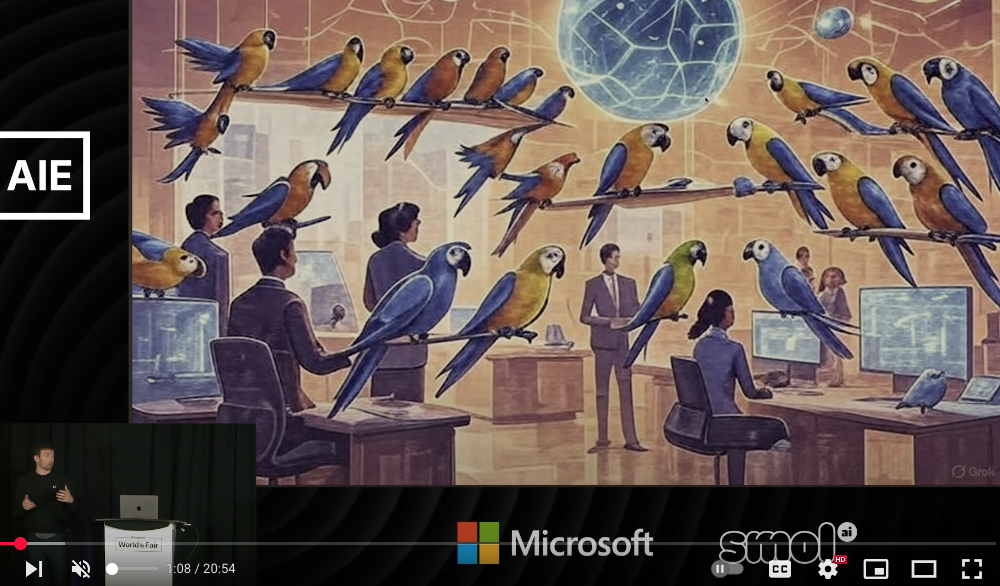
Path to autonomous agents runs through more human control, not less.
Harrison Chase, CEO of LangChain, has offered a set of observations that complicate the conventional AI narrative. While much of the industry remains fixated on building fully autonomous systems, enterprises finding real traction with agent deployment seem to be doing the opposite: placing humans more deeply into the loop, not as obstacles to automation, but as essential partners in reliability.
“It’s easy to build a prototype of an agent,” Chase notes, “but hard to put one into production.” That production gap reveals a core enterprise tension: systems that impress in demos often stumble under real-world ambiguity, governance risk, or operational scale.
The emerging pattern? Success appears to come not from removing human touchpoints, but from redesigning them strategically in ways that enable agents to draft, observe, and adapt while preserving human judgment where it matters most.
Enterprise Reliability Equation
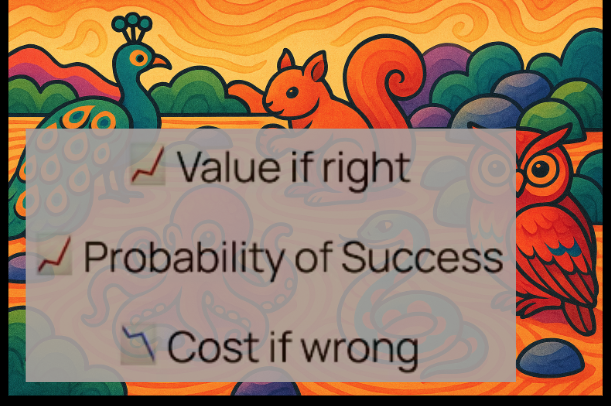
Chase frames enterprise agent adoption through a deceptively simple formula: Probability of Success × Value When Right - Cost When Wrong > Operating Cost. This isn’t just math; it’s psychology. Enterprise buyers don’t just evaluate technical capability; they evaluate existential risk.
“If there’s big costs when it’s wrong then it will be less likely to be adopted,” he explains. This drives successful agents toward what he calls “high-value, reversible tasks”: domains where the upside justifies the uncertainty and mistakes can be undone.
Legal research agents produce drafts for attorneys to refine. Investment analysis tools synthesize market data into briefs rather than making trades automatically. Code agents craft pull requests that ask for approval rather than merging blindly. The pattern emerges: value creation paired with reversibility.
Beyond Workflow-Agent False Binary
The industry loves clean categories: workflows versus agents, deterministic versus agentic. Chase challenges this thinking: “Instead of workflows versus agents it’s oftentimes workflows and agents. We see that parts of an agentic system are sometimes looping calling a tool and sometimes they’re just doing A after B after C.”
This spectrum thinking led to LangGraph, his team’s framework that lets developers embed deterministic sequences within agentic flows. “As we think about building tools for this future,” he notes, “it really leans into this spectrum of workflows and agents and allows you to be wherever is best for your application.”
Enterprises deploying agents successfully aren’t choosing sides; they’re orchestrating hybrid architectures where critical paths stay deterministic while exploration happens within defined boundaries.
Observability Imperative
Observability isn’t just a technical need; it’s how enterprises build agentic trust loops with risk committees, IT, and users. Technical reliability matters, but perceived reliability often matters more. “There’s oftentimes really high error bars that people have when they think about how likely an agent is to work,” Chase observes. “This technology is new. When trying to get something built or approved or put into production inside an enterprise, there’s a lot of uncertainty and fear around this.”
His team’s observability platform, LangSmith, reveals this dynamic. Built for developers to debug agents, it became crucial for communicating with stakeholders. The strategic insight: visibility creates a three-layer trust loop. Agent execution becomes developer visibility, which becomes stakeholder comprehension.
“You can see every step that’s happening inside the agent. This reduces the uncertainty that people have around what the agent is actually doing. They can see that it’s making three, five LM calls; it’s not just one. They’re actually being really thoughtful about the steps.”
One customer used LangSmith data in their enterprise review panel and “ended the meeting under time, which almost never happens.” The transparency didn’t just improve the agent; it transformed the conversation from fear to data-driven assessment.
Human-in-Loop as Competitive Advantage
Most successful enterprise agents follow a dual-loop architecture: agents propose reversible actions, humans apply domain knowledge checkpoints. Chase points to two critical patterns:
Reversibility by design: “Make it easy to reverse the changes that the agent makes. Code’s really easy to revert; go back to the previous commit.” This is why code agents found early success. Every change creates a commit; every commit can be undone.
Approval architectures: “Rather than merging code changes into main directly, open up PR; that’s putting the human in the loop. The effect of the agent isn’t making changes; there’s the human who’s approving what the agent does.” This completely changes cost calculations in enterprise minds.
The pattern extends beyond code as a reusable design system. Deep research agents ask clarifying questions upfront, then produce reports for human review rather than publishing directly. “It doesn’t take this and publish it as a blog out on the internet or email it to clients; it produces a report that can be read and decisions made about what to do with it.”
Evolution Toward Ambient Computing
Chase envisions a future where agents operate in backgrounds, triggered by events rather than chat prompts. But this ambient computing doesn’t mean autonomous computing. “Ambient does not mean fully autonomous,” he emphasizes. “When people hear autonomous they think the cost of this thing doing something bad is really high because I’m not going to be able to oversee it.”
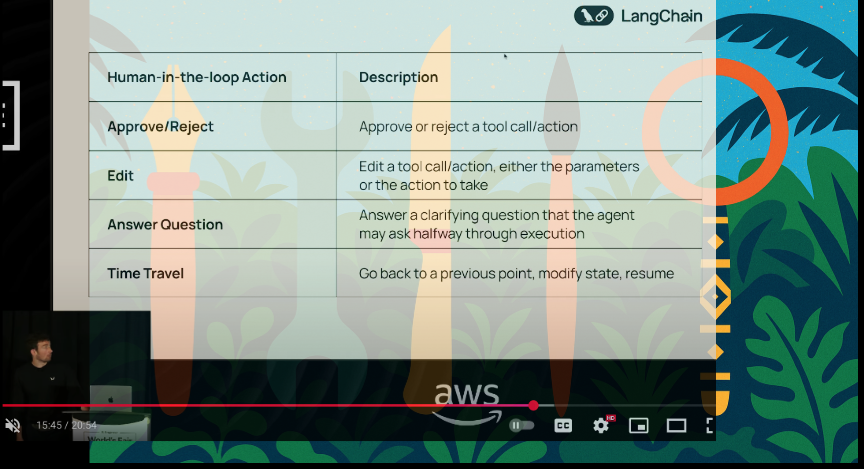
Just as alerting systems escalate to humans only when thresholds are crossed, ambient agents should surface only when ambiguity or impact demand judgment. Instead, ambient agents embed multiple human interaction patterns:
-
Approve/reject workflows for tool calls requiring explicit permission
-
Edit capabilities when agents propose incorrect actions
-
Question/answer loops when agents need clarification
-
Time travel allowing humans to rewind and redirect agent execution
“If it messed up on step 10 out of 100, can reverse back to step 10 and say ‘Hey, resume from here but do this other thing slightly differently.’”

Sync-to-Async Bridge
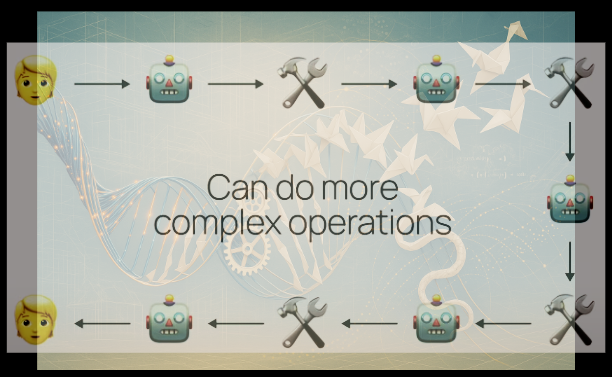
Between today’s chat agents and tomorrow’s ambient systems lies what Chase calls “sync-to-async agents.” These Persistent Draft Loops preserve intentionality while multiplying throughput. Agents don’t close the loop until a human opens the next phase.
“The human kicks it off, uses that human-in-the-loop at the start to calibrate on what it wants to do,” he explains. Deep research tools and modern coding assistants exemplify this evolution, moving from instant responses toward persistent collaborators.
This intermediate stage matters because it preserves human agency while unlocking agent capability. “I can only really have one, maybe two chat boxes open at the same time, but now there can be hundreds of these running in the background.”
Sync-to-async agent models are a bridge to scale: preserving intentionality while multiplying throughput. The pattern suggests enterprise adoption will happen through asynchronous reliability rather than real-time performance.
Strategic Implications for Enterprise Leaders
Chase’s insights reveal why enterprise AI adoption follows different rules than consumer AI. Success comes not from building better black boxes but from architecting reliability through human partnership.
For C-suite executives evaluating AI investments: Focus on domains where value is high and mistakes are reversible. Legal research, financial analysis, and code generation succeed because they create valuable drafts while preserving human judgment. Ask: Are investments targeting irreversible AI or reversible augmentation?
For product strategists designing AI features: Design for transparency and control, not autonomy. Users need visibility into agent reasoning and ability to guide agent behavior. The goal isn’t replacing human decision-making; it’s augmenting it. Ask: Can users preview and intervene in agent behavior?
For engineering leaders implementing agent systems: Embrace the workflow-agent spectrum. Critical paths should remain deterministic while agentic exploration happens within defined boundaries. Invest heavily in observability, not just for debugging but for stakeholder communication. Ask: Have teams defined deterministic guardrails and exploratory buffers?
Reliability Principle: Control Enables Scale
Chase’s framework reveals a fundamental principle: control enables scale, not constrains it. Enterprises successfully deploying agents aren’t trying to eliminate human involvement; they’re redesigning it strategically.
“Human-in-the-loop is one of the big things that we see people selling into enterprises and building inside enterprises really leaning into,” Chase notes. This isn’t a temporary compromise or technical limitation. It’s a fundamental recognition that enterprise reliability emerges from human-AI partnership, not human-AI replacement.
As AI capabilities accelerate, companies that win won’t be those building the most autonomous systems. They’ll be those building the most reliably collaborative ones: systems that amplify human judgment rather than replacing it, that create transparency rather than opacity, that enable control rather than demanding surrender.
The future of enterprise AI isn’t about agents working alone. It’s about agents working with humans, more capably, more transparently, and more reliably than ever before.
What patterns are emerging in enterprise AI adoption?
How are organizations balancing autonomy with control in AI implementations?
References:
- 3 ingredients for building reliable enterprise agents - Harrison Chase, LangChain/LangGraph
youtube.com/watch?v=kTnfJszFxCg