
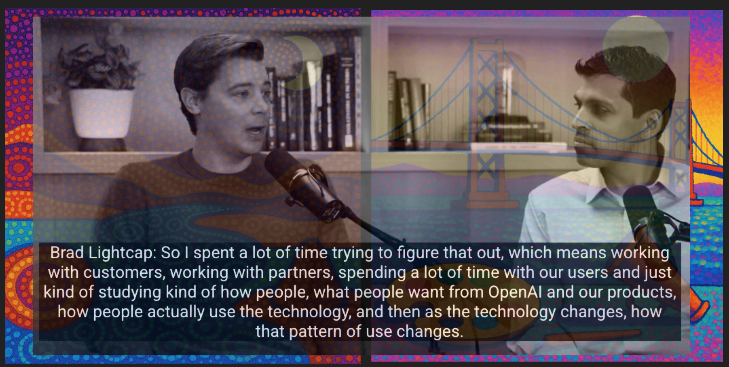
What happens when a five-person team can suddenly accomplish what previously required fifty? This isn’t science fiction—it’s the economic reality unfolding in real-time, according to Brad Lightcap, OpenAI’s Chief Operating Officer, and Ronnie Chatterjee, their Chief Economist, in a recent conversation about AI’s impact on work and productivity.
“We’re rate limited by talent, by people,” Lightcap observes. “Real economic growth in the world rounds to zero in most places… It’s really hard for the average company, whether it’s a small business, large business, financial services company, an insurance broker, a hospital to find people that can actually produce better tools, better systems, and ultimately better outcomes for customers.”
But what if that fundamental constraint is shifting?
The Democratization Nobody Saw Coming
Consider this striking observation from Chatterjee: “When they have a ChatGPT account or subscription, they have the world’s smartest brain at their fingertips to solve hard problems. It’s not intermediated by a government or a big business. It’s something they can use to solve problems.”
The implications ripple outward from there. Small businesses—traditionally constrained by access to expertise—suddenly have capabilities that were previously the exclusive domain of large enterprises. As Chatterjee notes: “There’s what they call in economics a missing middle in so many countries where you had a bunch of small businesses and you have a few large businesses, but the small businesses don’t grow large… Why is that not true? Because they often don’t have the mentorship, the coaching, the support, the advice to actually know what to do to grow their business.”
What changes when that barrier dissolves?
The Agency Multiplier Effect
Lightcap identifies something particularly intriguing: “AI is interesting because it really is kind of a reflection of your will, right, and your desire… There’s an incredible level of agency, I think that’s required to extract the most out of AI.”
This isn’t just about tool adoption—it’s about a fundamental shift in what becomes possible for individuals and small teams. “You’re gonna see the rewards accrue to people who… can not only figure out what it is that they want, and what good looks like, but then can kind of figure out how to activate the systems to be able to work on their behalf,” Lightcap explains.
The research reveals something counterintuitive: rather than replacing human judgment, AI amplifies the value of certain distinctly human capabilities. But which ones?
The Soft Skills Premium
Here’s where conventional wisdom gets turned on its head. Chatterjee’s research shows: “A lot of people think in this world is getting more and more technologically sophisticated. All of a sudden, the soft skills, the social skills, being able to connect with people would be less valuable. It’s actually the opposite.”
Why? “Once you make these abilities and these capabilities democratized to be able to write code, for example, then some of the other things actually start to matter more in the market.” The ability to identify problems, lead teams, make strategic decisions—these become premium skills precisely because the technical execution becomes more accessible.
Consider Marc Benioff’s recent statement that Salesforce would increase salespeople while not hiring more software engineers. As the conversation notes: “Sales is actually a big part of it as people who are networked, who know a lot of other people… humans with human connections.”
The Historical Pattern We’re Missing
What does history tell us about technological disruption? Lightcap offers this perspective: “1900 you had 40% of the US economy working in agriculture. Today, it’s 2%. And we produce some multiple more agriculture output than we did in 1900.”
The pattern is consistent: “The direction of travel of technology is toward always toward individual empowerment… every past technological revolution and every past phase change, it always drives toward the individual and what the individual is capable of.”
But here’s what makes this moment different: “It would be weird to tell someone in 1900, for example, that there are people today whose entire job is to make content for a small little device, that people consume many many hours a day, and that those people can make a perfectly viable economic living.”
We’re not just automating existing work—we’re creating entirely new categories of value creation.
The Demand Expansion Paradox
Perhaps the most surprising finding from OpenAI’s data: “When we cut the price of our models, which is really cutting the price of intelligence, we see a disproportionate increase in demand for that model.”
Lightcap continues: “What happens when you’ve got, if you can cut the price of good legal advice, for example, by a factor of 100, do you see a corresponding thousand x increase in the demand for legal services? Same in health care, same in education, same in software engineering.”
This isn’t just theoretical. As Chatterjee explains: “When you sort of make intelligence too cheap to meter and that intelligence is providing legal advice or financial management advice… all of sudden, you get a bunch of new people accessing that never could access it before. So it’s opening up the market.”
What This Means for Every Business Leader
The research suggests we’re not facing a zero-sum displacement scenario, but rather a fundamental expansion of what’s economically possible. However, the benefits aren’t automatic—they accrue to those who understand how to leverage human agency alongside artificial intelligence.
The question isn’t whether your industry will be affected, but how quickly you recognize the shifting competitive landscape. As Chatterjee notes about sector adoption: “Sectors that are less regulated, where there’s less red tape, rules of the road that need to be followed, those are the sectors that are going to change the quickest.”
But regulation isn’t the only factor. “In sectors where you have highly skilled workers who are bringing these tools to work using things like ChatGPT, building on our API, those sectors are gonna transform more quickly.”
The Skills That Matter Most
What should leaders focus on developing? The research points to several key areas:
Critical thinking and problem identification: “We’re still gonna need people to identify those problems to chase after,” Chatterjee observes. The ability to decide which problems are worth solving becomes premium.
Adaptability and learning agility: “You’ll need those skills, and you’ll need a sense of some other kind of higher order cognitive skills, resilience, grit, things that they’re gonna need to adjust to these changes in the market.”
Collaboration and leadership: Research from Harvard’s David Deming shows that “people who are great at leading teams… they’re also the same people who are great leading agents.”
The Institutional Lag
One of the most fascinating insights relates to the speed of institutional adaptation. Lightcap notes: “The people adapt faster than the institutions. But the question here will be, how do we work with policymakers and with the institutions themselves to try and help the institutions adapt?”
This creates temporary advantages for organizations that can move quickly and adapt their processes, cultures, and strategies ahead of broader institutional change.
Looking Forward
The conversation reveals something profound: we’re not just witnessing technological change, but economic restructuring. Small teams with big ideas and strong execution capabilities may find themselves competing effectively against much larger organizations.
The question for every leader becomes: In a world where intelligence becomes “too cheap to meter,” what unique value does your organization create? How do you position your team to benefit from, rather than be disrupted by, this fundamental shift in economic dynamics?
The evidence suggests the future belongs not to those who resist these changes, but to those who thoughtfully integrate human agency with artificial intelligence to create new forms of value.
Perhaps the most important insight is this: the transformation is already underway. The only question is whether you’re positioned to benefit from it.