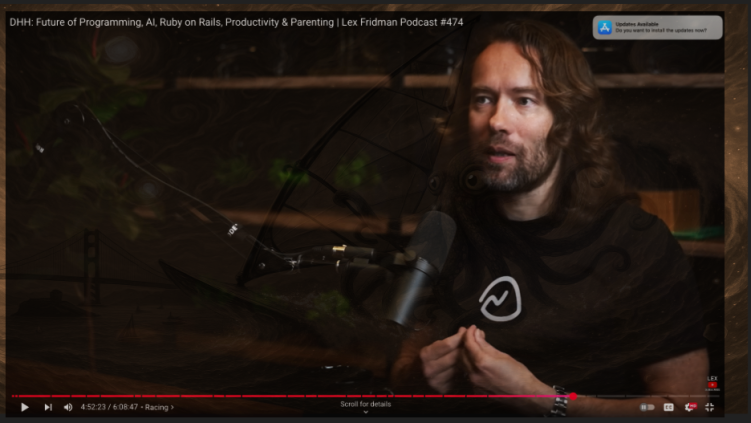
David Heinemeier Hansson (aka DHH) is a legendary programmer, creator of Ruby on Rails, co-owner & CTO of 37signals that created Basecamp, and race car driver. This reflection integrates observations from his recent interview, exploring the paradoxical wisdom of doing less to achieve more. Thanks to Lex & team for an excellent interview.
Metamorphic Principle: When Less Becomes More
There’s something profoundly metamorphic about leaders who transform constraint into capability. Like pressure turning carbon into diamond, the disciplined embrace of limitation often reveals unexpected strength. When a board welcomes someone who has spent decades proving that small teams can handle massive scale, they’re not just adding technical expertise—they’re inviting a living paradox that challenges conventional growth thinking.
Consider the counterintuitive mathematics: if stable, well-worn technology has shipped thousands of times without drama, perhaps the problem isn’t the stack. Perhaps it’s the accumulated weight of well-intentioned complexity. A director who has sharpened a single toolset for twenty years brings an institutional memory that whispers: “More code is more liability, not more capability.”
Paradox of Joyful Constraint
“Small teams are more fun… Not a stepping stone on the way to a thousand people. I actually like being a small team.”
Here lies the paradox that confounds MBA casebooks: what if optimal size isn’t maximum size? What if the destination isn’t scale but sustained creative flow? This perspective suggests that meaningful work happens when builders can still feel the clay in their hands, when the feedback loop between intention and outcome remains immediate and visceral.
The implications ripple beyond technology into any domain where expertise compounds over time. In education, this translates to curricula that offer “a soft ramp that never ends”—easy entry, infinite depth. In leadership development, it suggests that mastery might be more valuable than span of control. The paradox invites us to question whether we’re optimizing for the right metrics.
Genius of the Long Game
“In Ruby we’re still running 90% of the first draft, thirty years on. If you get the core right, you don’t need the churn.”
Genius often masquerades as simplicity. When foundational principles prove durable across decades, we glimpse something profound about the nature of lasting impact. The racing trophies earned on weekends, the frameworks that endure, the principles that don’t need constant revision—these point toward a different kind of intelligence.
This isn’t about stagnation; it’s about the wisdom to distinguish between surface turbulence and deep currents. In any field where practitioners install systems meant to run for years, change for its own sake isn’t innovation—it’s entropy that erodes trust. The genius lies in recognizing when the foundation is sound and having the courage to build patiently upon it.
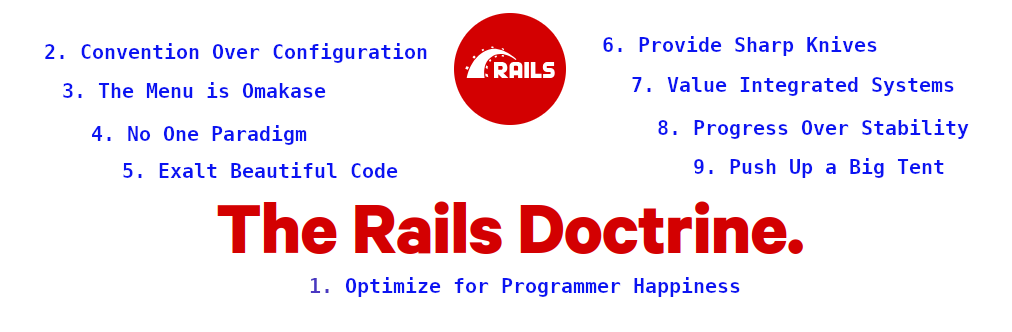
Three Invitations for Reflection
Guard the Baseline. Sometimes the most courageous roadmap is the “no-map” quarter—only refinement and deepening. What would it mean to resist the urge to add and instead focus on perfecting what already works?
Train for Mastery, Not Handoffs. When knowledge stays close to the craft, teams develop institutional wisdom that transcends individual contributors. How might we create environments where expertise compounds rather than fragments?
Celebrate Boring Wins. When systems hum quietly through another cycle, when the infrastructure becomes invisible because it simply works—these moments deserve recognition. What would change if we honored reliability as much as novelty?
Inquisitive Humility
Perhaps the deepest lesson isn’t about technology or team size at all. It’s about the humility to ask: What if we’re solving the wrong problem? What if the constraints we’re trying to escape are actually the boundaries that give our work meaning?
The metamorphic leader doesn’t provide answers so much as model better questions. They suggest that wisdom might lie not in accumulating more tools, but in understanding fewer tools more deeply. Not in managing more people, but in creating conditions where fewer people can do more meaningful work.
In a world that often equates growth with goodness, such leaders offer a different mathematics—one where division by the essential multiplies impact, where subtraction becomes a form of addition, where the path to more might paradoxically lead through less.