
How Sound & Gesture Are Redefining Computing
OpenAI’s upcoming hardware device, detailed in Part 1, could trigger the largest shift in human-computer interaction since the mouse. Not because it’s another gadget, but because it creates an entirely new category: ambient computing platforms that transform interaction from visual interfaces into conversational, spatial experiences responding to gesture & sound.
This isn’t incremental innovation. It’s the emergence of computing’s third dimension.

From Flat to Dimensional: The Renaissance Parallel
In the early 15th century, a line of paint changed the world. Artists in Florence began painting with perspective, not merely decorating flat surfaces, but creating windows into three-dimensional space. This wasn’t just an artistic technique; it was a cognitive revolution. As Jacob Bronowski observed in “The Ascent of Man,” the discovery of perspective fundamentally changed how humans understood reality itself.
Today, we stand at an identical inflection point. The mouse-&-screen paradigm that has dominated computing for forty years is giving way to something fundamentally different: a world where we point & summon, where sound becomes the bridge between spatial interaction & emotional cognition, where computing learns to speak in harmonious tones that feel as intuitive as musical scales.
The Thesis: The next great computing platform will not be won with a better screen, but with a new, intuitive language of gesture & sound. Market leadership will be determined not by consumer gadgets, but by enterprise adoption, where a “sonic vocabulary” can solve tangible, billion-dollar productivity problems.
Why Past Attempts Failed: Beyond the Screen Trap
The path toward ambient computing is littered with expensive lessons. Google Glass, Microsoft HoloLens, Meta’s VR pivot, Humane Pin, Rabbit R1, each represented genuine attempts to transcend the screen-centric paradigm, yet each stumbled on a fundamental error: they projected 2D interfaces into 3D space instead of reimagining interaction itself.
These devices asked users to overlay digital information onto physical reality rather than transform the nature of interaction. The market has spoken clearly: consumers do not want another gadget; they want computing to become more human.
The emerging wand paradigm takes a different approach entirely. Instead of showing users more information, it enables them to converse with their environment through gesture, voice, and spatial awareness. This time is different because AI has finally learned to speak & listen, making sound the most natural post-screen interface.
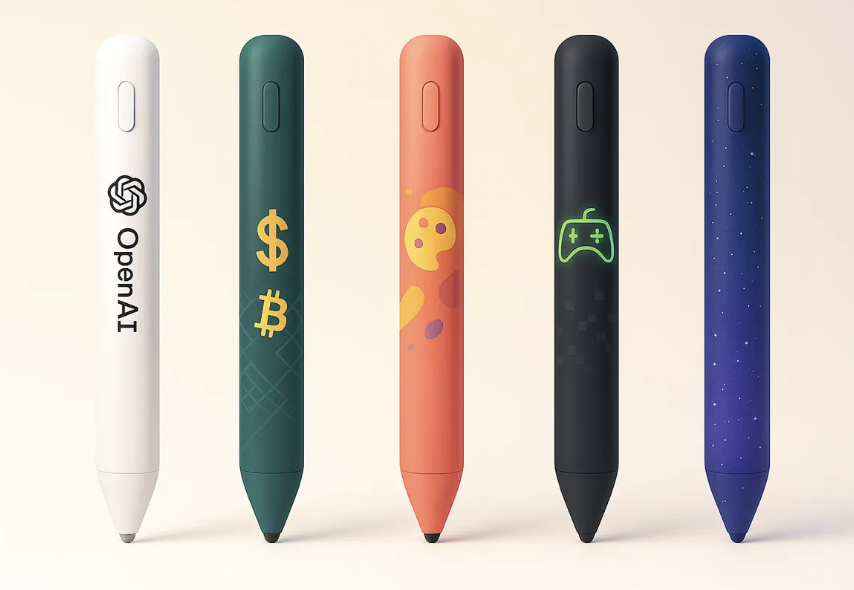
The Enterprise Beachhead: Where Productivity Meets Premium Pricing
The enterprise opportunity isn’t about productivity metrics—it’s about solving the collaboration translation problem. In every meeting, there are three conversations happening: what people say, what they mean, and what actually needs to happen. Ambient computing doesn’t just transcribe; it triangulates between these layers.
When someone gestures toward a screen and says “like we discussed last quarter,” the device knows this refers to slides 12-15 from the Q3 strategy deck, understands the unspoken tension about budget constraints, and surfaces the follow-up actions that never got completed. This isn’t productivity theater—it’s organizational memory made ambient.
The real enterprise value is in cultural contexts where hierarchical communication creates information gaps. Japanese companies, where junior members rarely challenge senior decisions, suddenly have devices that can surface contrary data without social friction. Brazilian startups, where rapid iteration creates institutional amnesia, gain continuity across pivots.

The development of enterprise-ready sonic vocabularies, professional tone palettes that won’t disrupt office environments, becomes as important as visual interface design. Success will not be uniform; cultural context will be the primary determinant of adoption. Markets like Japan, with their comfort with anthropomorphized technology, are primed for rapid integration, whereas others will lag.
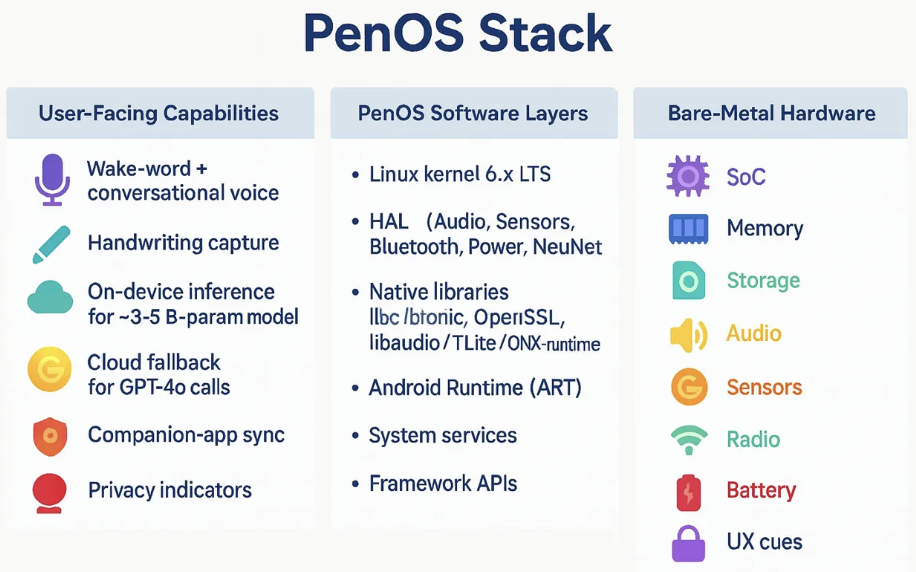
The Architecture: PenOS and the Sonic Grammar
The technical foundation extends far beyond any single device. At its core lies a speculative PenOS stack: a Linux kernel optimized for continuous operation, complemented by hardware abstraction layers managing everything from neural processing units to privacy indicators.
What makes this architecture compelling isn’t just its technical sophistication, it’s the philosophical shift it represents. Traditional operating systems optimize for computational efficiency; ambient computing platforms must optimize for human attention. The PenOS concept suggests an entirely new category: operating systems designed for continuous, contextual awareness rather than discrete task execution.
The challenge becomes as much about social engineering as software engineering, building systems that are always listening yet never intrusive, contextually aware yet respectful of boundaries.

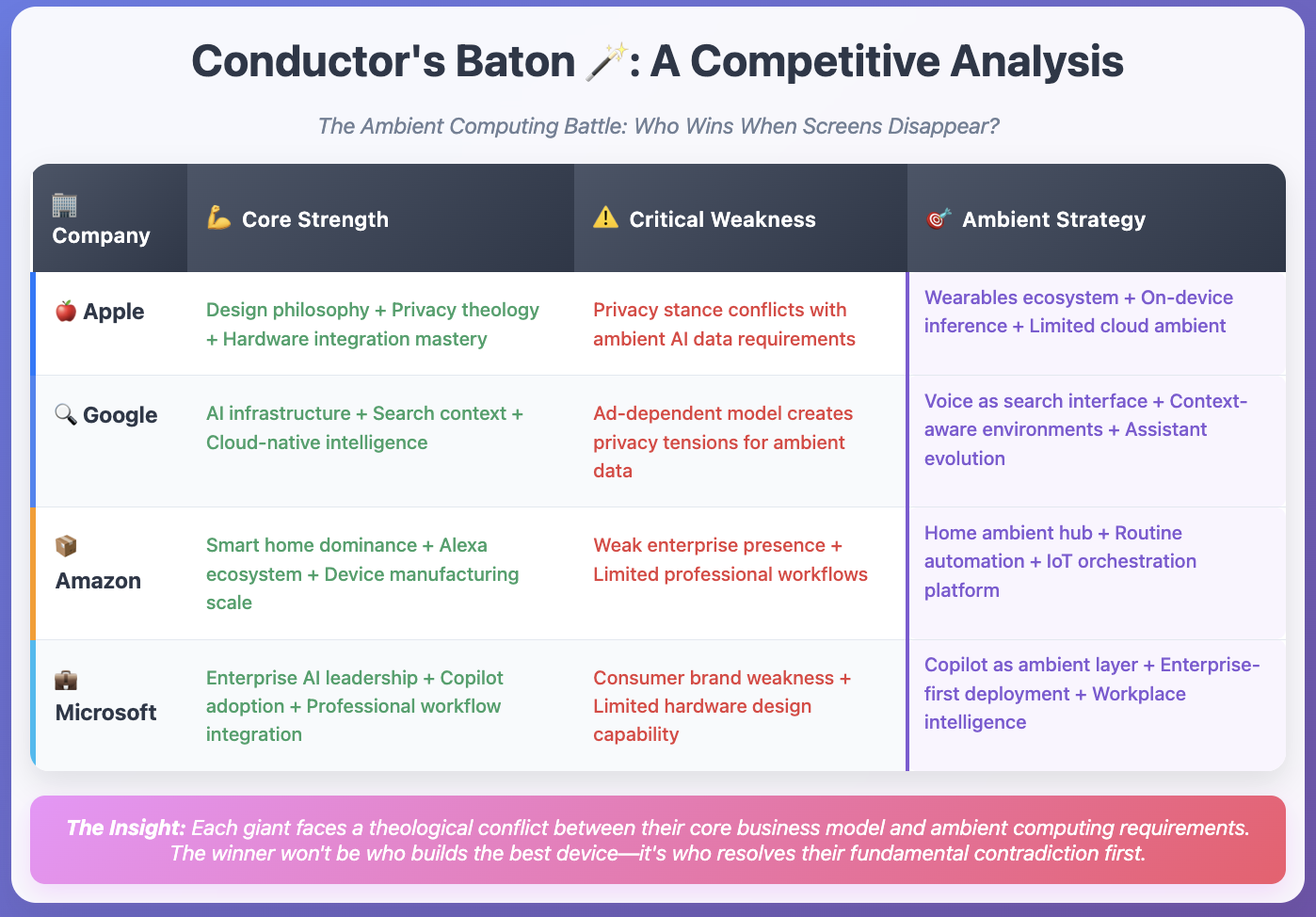
Platform Competition Analysis
Company Strength Weakness Ambient Strategy Apple Design, privacy, integration Data collection limits On-device inference, limited cloud Google Search, AI capabilities Ad model privacy conflict Voice as context-rich search interface Amazon Device ecosystem, Alexa Enterprise weakness Smart home ambient hub expansion Microsoft Enterprise AI, cloud Consumer brand gap Copilot for ambient workflows
Apple’s challenge is not engineering; it is theological. Its deep-rooted privacy stance is fundamentally at odds with the data required for truly predictive, ambient AI. They will likely build a more limited, on-device version, creating a market opening for a more capable cloud-native competitor.
What makes this architecture compelling is its hybrid approach to inference: maintaining a 3-5 billion parameter model locally, with intelligent fallback to larger models when context demands deeper reasoning. This addresses both latency and privacy concerns while enabling the kind of contextual awareness that makes ambient computing feel magical rather than intrusive.
Culture as Code: Why Tokyo & São Paulo May Lead
The geographic rollout of ambient computing platforms will follow cultural rather than economic gradients. Japan’s comfort with robotics and anthropomorphized technology suggests natural early adoption, while Brazil’s mobile-first digital transformation provides a testing ground for leapfrog deployment patterns.
Gesture-forward cultures may lean more easily into motion as input. A comfort with embodied technology may enable sonic grammar development. Developer communities in Spain, Portugal, Morocco, and Argentina could become unexpected centers of innovation around ambient computing applications.
The key insight: ambient computing success depends less on infrastructure sophistication than on cultural willingness to integrate AI assistance into daily workflows.
Market Timing: AI Finds Its Voice
Current developments in the SF Bay Area during summer 2025 reveal voice and sound at the absolute forefront of AI innovation. From OpenAI’s advanced voice models achieving emotional realism to the proliferation of AI-powered audio generation tools, the region’s tech ecosystem is discovering that sound may be the most natural interface between human consciousness and artificial intelligence.
This timing isn’t coincidental, it suggests that ambient computing’s breakthrough moment coincides precisely with AI’s discovery of its own voice. The mathematical relationships that Pythagoras discovered between musical intervals and cosmic harmony find their contemporary expression in how AI models process speech and generate sonic experiences that feel intuitively human.

The Sound of Success: From Mouse Clicks to Musical Prompts
Beyond visual and haptic feedback lies the sonic dimension of 3D ambient computing. Just as Brian Eno’s Windows startup sounds created emotional connections to computing moments, ambient devices are developing their own musical vocabulary.
Picture the gentle swipe tone for navigation, the confident point chime for selection, the satisfying whoosh for deletion, the creative swish for generation commands. These aren’t arbitrary interface sounds, they become the foundational melody of ambient computing, where audio cues create spatial awareness and emotional resonance.
Different gestures trigger different harmonic progressions, creating a kind of gestural music that makes interaction feel less mechanical and more expressive. The sonic landscape becomes as carefully designed as the visual interface, perhaps even more important in a world where screens fade into the background.
Pathway to Adoption: The Five-Stage Rollout
Ambient computing platform maturation will progress through distinct phases:
Stage 1: Developer Sandbox - Creating compelling development environments and early applications that demonstrate platform capabilities.
Stage 2: Pilot Workflows - Organizations test ambient computing applications in controlled environments, focusing on workflow integration and productivity measurement.
Stage 3: Enterprise Sync - Broader organizational adoption as platforms demonstrate measurable business value and ecosystem effects emerge.
Stage 4: Consumer Familiarity - Early adopters drawn to productivity enhancements as the platform becomes valuable through network effects.
Stage 5: Norm Internalization - Ambient AI assistance becomes expected rather than novel, requiring generational change as much as technological improvement.
Just as Slack became ubiquitous inside organizations before leaping to startups and communities, ambient platforms will earn trust in boardrooms before living rooms.
The Medici Moment: Altman and Ive as Renaissance Catalysts
The OpenAI-Ive collaboration represents more than a strategic business partnership, they are the Medici of this new Renaissance. Their partnership is the catalyst that brings together AI research capabilities with industrial design expertise. This is the synthesis of Ive’s obsession with simple, human objects and Altman’s quest for democratic, accessible intelligence.
Incumbent timing will determine whether new entrants can establish sustainable platform positions. Swift competitive reactions might limit market opportunity for independent platforms, while delayed responses could allow new paradigms to achieve enough scale to defend against platform incumbents.

The Harmonic Revolution: Computing’s Third Dimension
Jacob Bronowski understood that perspective wasn’t just about seeing, it was about understanding. The ambient computing era will teach us that interaction isn’t just about interfaces, it’s about intelligence itself becoming environmental, contextual, and harmonic.
The first computing revolution was logical. The second was visual. This third is harmonic.
When AI assistance becomes as unconscious as perspective is for contemporary artists & when that assistance speaks in harmonious tones that feel as intuitive as musical scales, the boundaries between human and artificial intelligence blur in ways that create entirely new forms of collective intelligence.
Just as Renaissance perspective reframed space, ambient intelligence will reframe time. It listens before it asks. It helps before it interrupts. And in doing so, it may become the most human technology we’ve ever built.
But unlike perspective, this paradigm thinks back. Our challenge is not just to build it, but to guide it, shape it, and ask it to listen ethically. In the music of ambient computing, we may finally hear the technological harmony that Pythagoras glimpsed in the mathematical relationships governing both sound and space.
The author has advised organizations from the United Nations to Fortune 500 companies on technology strategy and digital transformation. This continues the analysis from Part 1, which explored the profound partnership between Sam Altman and Jony Ive and their shared vision of truly personal AI.
🪄 Appendix: The Baton of Understanding
The room hesitates. Faces cloud with uncertainty; the data isn’t aligning. You feel the weight of stalled conversation, the fragile thread of attention about to snap. You raise the slender baton, part pen, part conductor’s wand & draw a gentle arc in midair.
A single harmonic tone rises, clean and pure like struck crystal. The wall awakens: three luminous points of insight appear, arranged with quiet elegance. Your voice, calmly mirrored by the room, narrates what everyone senses but can’t articulate:
“Inventory stalled due to typhoons near Manila. Singapore’s production ahead of schedule. Recommended pivot: realign shipments immediately.”
The baton hasn’t summoned a mere transcription. It’s woven conversations from Manila’s logistics team, weather models from the Pacific, and hushed tensions in yesterday’s Slack channels into a cohesive understanding. Another small gesture, and the room softly pulses acknowledgment, ready, attentive, clear.
No clicks. No apps. No friction. Just intention, resonating into insight.
We are entering computing’s third dimension.
References:
https://openai.com/index/navigating-the-challenges-and-opportunities-of-synthetic-voices
https://www.linkedin.com/pulse/io-moment-when-ai-becomes-truly-personal-robert-schwentker-2l2vc
&