
How Cursor’s perfectly timed podcast with Stripe’s CEO exposed the real state of AI adoption amid Silicon Valley’s most dramatic weekend
Executive Summary
While Silicon Valley buzzed about Windsurf’s chaotic acquisition weekend, Cursor quietly released a podcast with Stripe CEO Patrick Collison that revealed something unexpected: AI’s most powerful users are often its most careful critics.
Collison’s candid reflections on AI’s limitations, Stripe’s technical decisions, and the future of programming tools exposed a paradox reshaping the industry. His measured skepticism contrasts sharply with the acquisition frenzy, suggesting that sustainable AI adoption demands integration over disruption.
Cursor’s strategic timing wasn’t coincidental. As competitors fought over talent and model access, they demonstrated something more valuable: partnership with sophisticated users who demand both capability and craftsmanship.
The deeper question: Why do those closest to AI’s technical realities remain its most thoughtful skeptics? And what does this tell us about which companies will actually survive the current transformation?
The Timing Tells the Story
On July 12th, 2025, as Silicon Valley processed the aftershocks of Windsurf’s dramatic weekend, Cursor released a podcast that cut through the acquisition noise with surgical precision. Windsurf, a highly-regarded AI development platform, had experienced rapid, unexpected ownership shifts… initially targeted by OpenAI, then losing core talent to Google DeepMind, before finally being acquired by Cognition.
Patrick Collison, CEO of one of the world’s most successful developer-facing companies, sat down to discuss not strategy or market dynamics, but something more fundamental: how the builders of our digital infrastructure actually use AI. The critical lesson from Collison’s reflections is that sustainable AI adoption demands deep integration, careful skepticism, and rigorous craftsmanship, not merely rapid innovation. Those closest to AI’s technical realities remain its most thoughtful skeptics.
The Skeptic’s Advantage
Collison articulated a revealing perspective on AI’s writing limitations, noting directly: “I wish they were useful for writing. I usually end up dissatisfied with the writing that they produce… my personal style differs from the personal style, so to speak, of the models.”
Such explicit dissatisfaction from an influential tech leader underscores the gap between AI-generated content and professional expectations. Collison’s nuanced approach contrasts sharply with Silicon Valley’s all-or-nothing narratives. He uses “LLM chat tools a lot… mainly for answering factual or empirical questions,” demonstrating how sophisticated users parse AI’s capabilities with precision.
If the CEO of Stripe finds AI writing unsatisfactory, what does this tell us about the gap between AI capabilities and professional standards?
Integration Over Disruption
By emphasizing human-AI collaboration rather than full automation, Cursor differentiated itself precisely when developer confidence was shaken by abrupt changes in tool access and ownership, as seen during Windsurf’s uncertain transition. Collison’s description of his coding workflow revealed this collaborative approach: “I obviously use LLMs for writing code and… typically mediated through Cursor.”
The phrase “mediated through” carries profound significance. Not replaced by, not automated through, but mediated… suggesting partnership rather than substitution. This philosophical difference may explain why Cursor avoided the acquisition frenzy that consumed others.
Early Decisions Shape Long-Term Futures
Collison offered crucial perspective on technical decision-making: “Initially we decided to use MongoDB at Stripe and we decided to use Ruby at Stripe, and those are still quite foundational technologies.” He explained how Stripe “had to build a lot of infrastructure in order to make MongoDB as fault tolerant and as distributed and as durable as we needed it to be.”
MongoDB, a document-based database that stores data in flexible JSON-like formats rather than traditional tables, required extensive customization to meet Stripe’s reliability standards. The result: 99.99986% API availability… just 44 seconds of downtime across an entire year. This demonstrates that execution and infrastructure matter more than initial tool selection.
Are we choosing AI coding tools based on flashy demonstrations or sustainable foundations?
AI’s Productivity Paradox
Collison offered a cautionary note on productivity metrics: “We’re not living in some massively accelerated period of economic growth for the world writ large… I think we’re seeing that the diffusion of these technologies through the economy really takes time and involves substantial complexity.”
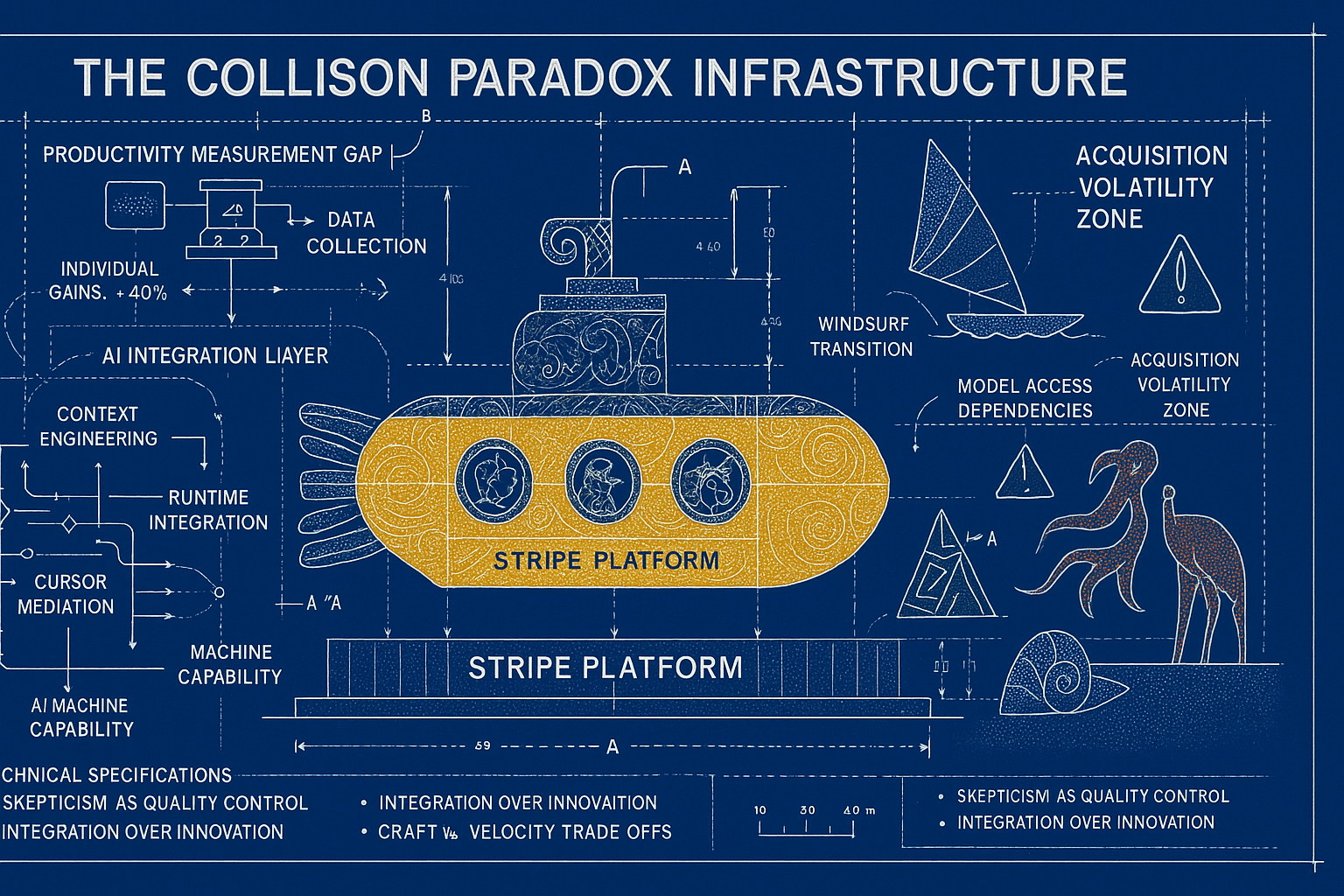
This perspective from someone whose company processes global commerce provides essential counterweight to transformation narratives. Despite individual productivity gains reported by developers, aggregate economic measurements remain elusive. The disconnect suggests AI coding tools may be creating local optimization rather than systemic transformation.
If AI coding tools are so transformative, why aren’t we seeing clear economic gains yet?
Craftsmanship in the Age of Automation
When Truell pressed Collison about Cursor’s role in maintaining software quality, the conversation revealed deeper concerns about AI’s impact on craftsmanship. Collison articulated a fear that extends beyond individual productivity: “There’s obviously a concern with AI that it leads to the creation of more slop, and more kind of crappy things, but not more of the best things.”
This tension between velocity and craftsmanship may determine which AI coding tools achieve sustainable success. Truell’s questions exposed how Stripe thinks about this balance: “We really care about what we call at Stripe craft and beauty… we want our software to be well-designed and pleasant to use… not only in the superficial pixel sense, but also in the deep it works very well sense.”
The Windsurf acquisition’s chaotic weekend exemplifies what happens when market dynamics prioritize rapid acquisition over sustainable development practices. Truell’s strategic timing of this podcast, amid that chaos, positioned Cursor as the thoughtful alternative.
In the rush toward AI-generated code, are we sacrificing the very craftsmanship that makes software reliable?
The Development Environment Evolution
Michael Truell’s questions about Cursor’s future direction prompted Collison’s most revealing insight about programming tools: “I think the basic idea of a development environment and not just text editor is really the right idea… maybe this is what cursor becomes… it’s such a mistake that we have ended up with development environments where there is such a separation between the runtime and the text editing.”
Truell’s strategic questioning revealed Cursor’s architectural philosophy, as Collison described their approach: “We are playing with ideas around letting the AI increasingly take time into the background to run it as code and react to the output… the AI can come back to you with 70% of something and then you can bring it into the foreground really quickly, work with it, and then spin it back off to the background.”
This vision of background AI processing represents a fundamental shift from current practices, suggesting development environments where human intention and machine capability operate in sophisticated partnership rather than simple automation.
The Cursor Inflection Point
As dust settles from the Windsurf acquisition weekend, Cursor’s strategic positioning becomes clear. While competitors fought over talent and model access, Cursor demonstrated sustainable integration with sophisticated user workflows. Collison’s adoption pattern… enthusiastic use for specific tasks, thoughtful skepticism about broader applications… may represent the mature approach that determines long-term winners.
His uncertainty about AI’s unexpected beneficiaries was refreshingly honest: “I’m struck by how many predictions have held up reasonably poorly… even from people who are on the face of it extremely well informed.”
The paradox persists: AI’s most powerful users remain its most careful critics. That skepticism, rather than unlimited enthusiasm, may be the signal that separates sustainable transformation from temporary disruption.
The software industry’s relationship with AI appears to be entering a phase of sophisticated skepticism, where the most successful adopters are also the most thoughtful about limitations. Whether this leads to better tools or tempered expectations may determine how the next wave of billion-dollar acquisitions unfolds.
Attribution: Insights and quotes in this analysis are based on the transcript of a recent podcast conversation between Patrick Collison (Stripe) and Michael Truell (Cursor)