When Failure Becomes Fortune: The Windsurf Story
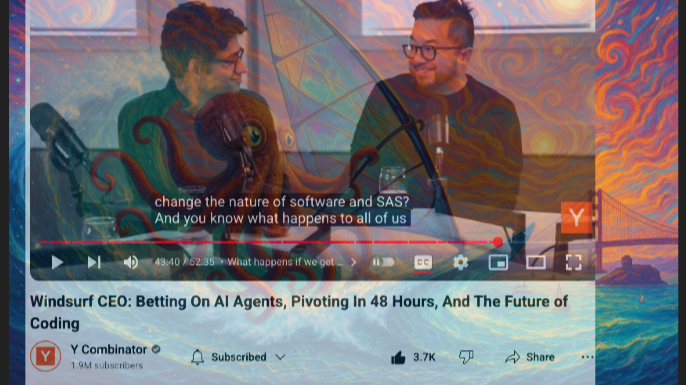
“I think startups are basically like getting slapped in the face probably over and over again,” Varun Mohan told his Y Combinator audience just months before Google paid $2.4 billion for his team and technology. What he didn’t mention was how those slaps would soon turn into the largest talent acquisition in AI coding history.
The weekend of July 11-12, 2025, will be remembered as a pivotal moment in software development. OpenAI’s $3 billion deal to acquire Windsurf collapsed on Friday, and by Monday, Google had swooped in with a $2.4 billion offer that fundamentally altered the competitive landscape.
The Philosophy of Productive Failure
Mohan’s approach to failure proved prophetic. “One of the things I hate the most is doing something and not knowing if it’s working or not. And it’s actually very freeing to know when something fails because that’s very obvious,” he explained. “The faster you fail actually the faster you can decide to do something new.”
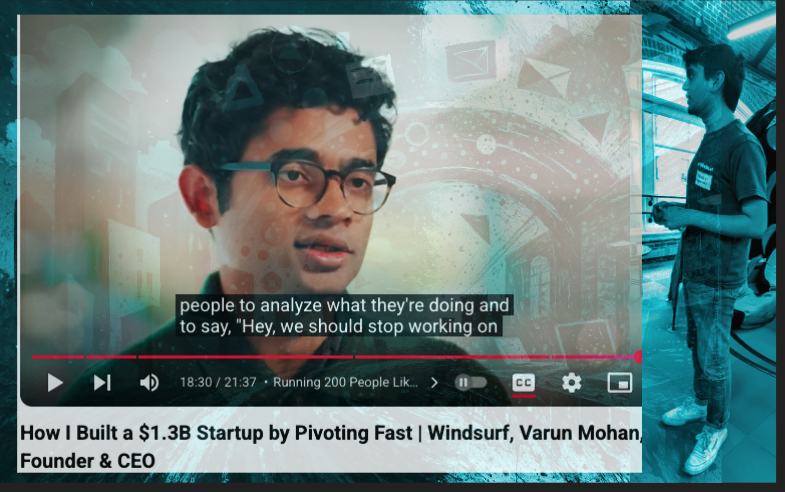
This philosophy shaped Windsurf’s entire trajectory. “We had raised somehow magically $28 million of cash at the time and I think the big point here in our minds was it doesn’t matter if we’re doing kind of well now if we didn’t know how to scale it we kind of need to change things like really fast,” Mohan reflected on their dramatic pivot from GPU virtualization to AI coding tools.
The Pivot That Changed Everything
The transformation wasn’t gradual—it was surgical. “Weekend me and my co-founder had a conversation along the lines of I don’t think this is going to work we don’t think we know how to scale this company… we told the rest of the company on Monday and everyone started working on Codeium which is the extension product the Monday immediately after.”
That weekend decision in 2022 set in motion a chain of events that would culminate in one of the most dramatic acquisition stories in tech history. “We were not worried at all when we did the pivot. We had basically written off the company is going to be a zero and at that point anything is greater than zero.”
The Deeper Questions This Raises
1. The Antitrust Evasion Question
Was Google’s talent-only acquisition structure designed to sidestep regulatory scrutiny? Critics have said these deals “were structured to avoid antitrust scrutiny” as big tech companies pursue promising AI startups without full acquisitions. Does this represent a new playbook for acquiring innovation while maintaining regulatory compliance?
2. The Technology Replicability Paradox
If the core technology is so valuable, why did Google pay $2.4 billion for people rather than patents? Mohan’s insight offers a clue: “One of the things that I think is true for any startup is you have to keep proving yourself every single insight that we have is a depreciating insight.” In a world where insights depreciate rapidly, is human expertise the only sustainable asset?
3. The Cursor Succession Question
With Windsurf’s leadership now at Google, who fills the vacuum? Michael T. Cursor has emerged as the next major player, but will he follow the Zuckerberg model of maintaining control, or will the acquisition tsunami prove irresistible? “Tech giants such as Alphabet, Meta Platforms Inc., and Microsoft Corp. relentlessly pursue high-profile acquisitions and offer multi-million-dollar pay packages to attract top talent in the race to lead the next wave of AI.”
The Base44 Mirror: Six Months to $80 Million
The Windsurf story gains even more significance when viewed alongside Base44’s six-month journey from startup to Wix’s $80 million acquisition. The Israeli founder’s rapid success demonstrates that “the tech landscape is undergoing a major transformation as vibe coding gains momentum, shifting creation from manual development to intent-driven software development.”
Market Velocity Questions
-
Are we witnessing a Cambrian explosion where multiple coding platforms can coexist and thrive simultaneously?
-
How does the traditional software development cycle compress when AI can generate applications in minutes rather than months?
-
What happens to enterprise software procurement when domain experts can build their own tools?
The Strategic Architecture of Success
Mohan’s strategic thinking reveals sophisticated understanding of market dynamics. “You look at a company like Nvidia if Nvidia doesn’t innovate in the next two years AMD will be on their case… that’s why I’m completely okay with a lot of our insights being wrong if we don’t continually have insights that we are executing on we are just slowly dying.”
This perspective shaped Windsurf’s approach to competition. Rather than fear incumbents, they embraced the challenge: “Our company just doesn’t have like morale is not really affected by what other companies do right… co-pilot if you were to go to the beginning of 2023 everyone would have thought GitHub copilot was the product that everyone would use and there was no point building.”
The Infrastructure Layer Opportunity
While giants battle for platform dominance, infrastructure companies like Nozomio’s Nia represent a different bet: that context and codebase understanding become critical differentiators. Mohan’s experience validates this approach: “We ended up doing is having a series of systems that enable us to pack the context with the most relevant snippets of code… using all the GPU infrastructure we have to take large chunks of the codebase and in real time rank it right as the query is coming in.”
The Context Wars
-
Will proprietary context systems become the new moats in AI coding?
-
Can independent infrastructure providers survive as foundation models improve?
-
How do network effects develop when every developer interaction teaches the system?
Timing and Market Maturation
The speed of value creation suggests fundamental shifts in software economics. “This notion of just a developer is probably going to broaden out to what’s called a builder and I think everyone is going to be a builder,” Mohan predicted. “I think software is going to be this very very democratized thing.”
Critical Timing Questions
-
Is this the optimal moment to exit, before foundation models commoditize specialized tools?
-
How long can differentiated coding platforms maintain their advantages?
-
What’s the window before big tech companies build competing solutions internally?
The Evaluation Revolution
Mohan’s emphasis on rigorous evaluation systems proved crucial: “The evals for code are actually really cool… basically the idea is code you can leverage a property of code which it can be run right… you can take a lot of open source projects and find commits in these open source projects with tests attached to them.”
This technical insight suggests that companies with superior evaluation capabilities will dominate. “Strong evals go a long way,” became more than a development philosophy—it became a competitive advantage.
The Future Architecture
As the dust settles from the Windsurf acquisition, several scenarios emerge for the industry’s future structure:
The Platform Consolidation Theory: Major tech companies absorb leading AI coding startups, creating integrated development environments that lock in users through ecosystem effects.
The Specialized Tools Thesis: Independent companies like Cursor build “the new Adobe” for developers, maintaining autonomy while serving professional developers who demand best-in-class tools.
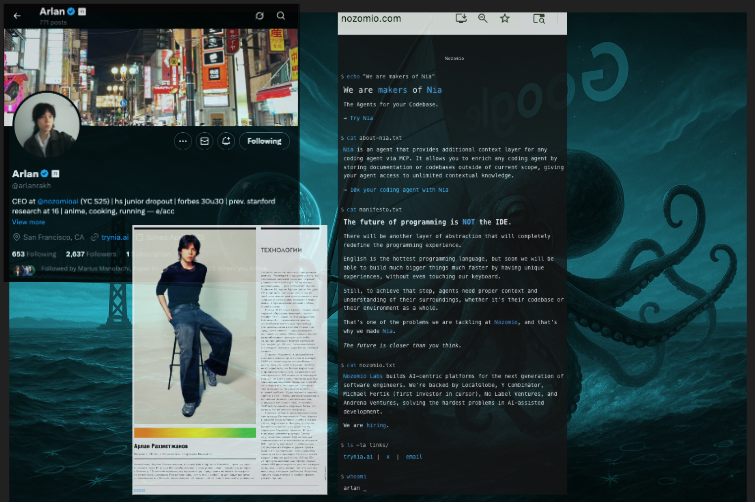
The Infrastructure Layer Bet: Companies like Arlan Rakhmetzhanov’s Nozomio thrive by providing critical infrastructure that multiple platforms require, similar to how database companies serve many applications.
The Democratic Future: “Everyone is going to be a builder” becomes reality, creating massive markets for simple, powerful tools that serve non-technical creators.
Investment Signals in the New Paradigm
For investors evaluating the post-Windsurf landscape, Mohan’s journey suggests that speed of technical iteration, powered by rigorous evaluation systems, matters more than traditional metrics. “Speed of feature development and market responsiveness” becomes the ultimate differentiator in a world where insights depreciate rapidly.
The acquisition premium paid for Windsurf—and the speed at which Google moved to prevent competitors from acquiring the team—signals that we’ve entered a new phase where technical talent and execution capability command unprecedented valuations.
The Transformation Ahead
“The future of programming is NOT the IDE,” as Nozomio’s manifesto declares. We’re witnessing the emergence of that next abstraction layer, where “English is the hottest programming language, but soon we will be able to build much bigger things much faster by having unique experiences, without even touching our keyboard.”
The Windsurf acquisition represents more than a successful exit—it’s a signal that the future of software creation is being written now, by teams that understand that in a world of rapidly depreciating insights, the ability to fail fast, learn quickly, and rebuild boldly becomes the ultimate sustainable advantage.
The weekend that changed Windsurf’s trajectory may well have changed the trajectory of software itself.