
A mid-sized SaaS company celebrating 40% productivity gains from AI implementation suddenly faces an uncomfortable reality: their success metrics are inverting. Fewer support tickets mean fewer agents needed. Automated workflows reduce seat requirements. The AI that made them more efficient is making them less profitable. Their CFO stares at declining subscription revenue and asks the existential question: “How do we monetize making customers need us less?”
This scenario isn’t hypothetical: it’s happening across thousands of software companies as artificial intelligence fundamentally rewrites the economics of digital business. As Martin Casado of Andreessen Horowitz observes, “From an application standpoint, we’ve abdicated logic. The yes or no, the what it’s doing, that always came from the programmer. But now we’re like ‘come up with the answer for me.’” This isn’t disruption. This is inversion.
When software writes software, traditional revenue models collapse. When agents negotiate with agents, billing systems must evolve from monthly workflows into real-time economic orchestration platforms. The companies mastering this transition first will capture disproportionate advantage in the AI economy.
The Great Economic Inversion
Traditional software economics assumed scarcity: limited users, finite seats, predictable license consumption. AI introduces radical abundance, infinite content generation, autonomous task completion, self-improving systems that operate without human intervention. Scott Woody of Metronome crystallizes this paradox: “The core value isn’t who has access to data; it’s what can this software do for me.”
Efficiency gains now threaten foundational revenue assumptions. Success metrics invert across every traditional SaaS model. Optimal AI performance potentially means declining subscription revenue. Customer success becomes customer independence. The economic assumptions that made software profitable are being digested and reconstructed in real-time.
The U.S. Copyright Office’s 2025 report adds legal complexity to these economic questions, clarifying that human input remains required for AI-generated code to be copyrightable. This creates new value attribution challenges: when AI writes code, who owns the intellectual property? When automated systems generate business value, how should compensation flow?

Billing as Economic Nervous System
This economic inversion demands infrastructure evolution, starting with how companies measure and capture value. During his tenure at Dropbox, Scott Woody discovered that “billing was more of a product surface than a monthly workflow.” In AI-native companies, this evolution accelerates dramatically: billing systems must become real-time intelligence networks that measure value creation as it happens, not after invoices are sent.
“We’re building monetization infrastructure,” Woody explains. “Take all the processes of how a company generates and captures value and turn it into software infrastructure.” The contrast with traditional quarterly billing cycles is stark. OpenAI’s Metronome integration went live in under two weeks with no engineering lift, granting real-time transparency into token consumption. Their CFO, Sarah Friar, noted that pricing updates that previously required months now happen in hours via Metronome’s UI.
Consider the practical implications: AI workloads can scale from hundreds to millions of API calls within hours. Traditional billing systems designed for predictable monthly growth collapse under exponential usage bursts. Companies need circuit breakers that prevent $100K bills from runaway AI processes, predictive alerts based on usage patterns, and automated cost optimization across multiple model providers.
This evolution raises fundamental questions about organizational capability. Can traditional finance departments operate at AI speeds? Will competitive advantage shift from product features to economic sensing capability? The answer increasingly appears to be yes, companies with superior billing intelligence can optimize margins dynamically, predict customer lifetime value based on AI usage patterns, and create platform effects where economic efficiency attracts more users.

Context Engineering: The New Assembly Language
The billing transformation connects directly to how AI systems actually create value. Andrej Karpathy has reframed AI infrastructure around “context engineering” - what information enters the model matters more than how perfectly you ask. This shift from programming as instruction-writing to programming as curation creates new professional disciplines and, crucially, new economic measurement challenges.
“We’re building systems to build other systems,” notes Casado. This recursive architecture demands infrastructure primitives that didn’t exist in traditional software. Context becomes the new compute. Data pipelines become intelligence highways. Indexes become strategic assets. Each layer requires different economic measurement and optimization strategies.
The emergence of specialized roles reflects this complexity:
Context Architects design optimal data input strategies, but their success must be measured in real-time cost-performance metrics across different model providers. A well-architected context strategy might reduce token consumption by 40% while improving output quality; direct economic impact that billing systems must capture and attribute.
AI Pricing Strategists manage dynamic token-tier pricing, but they need granular usage telemetry to optimize across OpenAI, Anthropic, Google, and specialized model providers. Their decisions affect both customer experience and margin optimization on every API call.
Economic Telemetry Engineers build billing systems that predict and control AI costs in real-time. Unlike traditional software monitoring, they must track semantic usage patterns, predict inference bursts, and automatically route workloads for cost optimization.
Prompt Orchestrators optimize model interactions for cost-performance balance. Their work directly impacts the fundamental unit of AI economics * the token * making their optimization strategies inseparable from billing intelligence.
These roles illustrate how context engineering creates new value attribution challenges. When a prompt orchestrator’s optimization reduces costs by 30%, how should that value be captured and distributed? Traditional software didn’t require such granular economic measurement of technical optimizations.
Developer Multiplication Paradox and Its Economic Implications
Despite automation anxiety, Matt Bornstein predicts developer expansion: “We’re going to have more developers… creating so much great software accessible to so many people.” IBM’s July 2025 survey validates this thesis, showing 82% of developers use AI tools weekly, with 78% reporting measurable productivity boosts. This developer multiplication creates new economic dynamics that billing systems must accommodate.
More developers using AI tools means more granular cost attribution needs. Each developer’s AI-assisted productivity contributes differently to business value. Some use AI for code generation, others for debugging, still others for architecture design. Traditional time-tracking becomes irrelevant when a developer can prototype in hours what previously took weeks.
Aaron Levie captures the persistent human element: “People buy software because someone else made decisions about workflows and operational logic.” Even when AI writes code, humans must still define purpose, constraints, boundaries. This human-AI collaboration creates new value creation patterns that require sophisticated economic measurement.
The paradox extends beyond individual productivity. More AI-empowered developers can create exponentially more software, but that software increasingly incorporates AI services with variable, usage-based costs. Development teams must understand not just technical architecture but economic architecture, how their technical choices affect ongoing operational costs and revenue models.
Will “software specification” emerge as the critical professional skill? The evidence suggests yes, and this skill encompasses both technical specification and economic specification, understanding how architectural decisions affect real-time cost structures and business model sustainability.
Darwinian Pricing in Liquid Markets
The developer productivity gains and context engineering complexity feed directly into pricing model evolution. “Pricing models are kind of Darwinian,” Woody observes. “The ice caps have melted. It’s unclear what’s optimal for this new climate.” Metronome’s 2025 study revealed that 52% of SaaS firms now run over 100 pricing experiments per quarter: Darwinian pricing has moved from theory to mainstream practice.
Traditional wisdom, never change pricing more than once every five years, becomes obsolete when AI capabilities and usage patterns shift monthly. Salesforce changed fundamental pricing three times in twelve months, treating pricing as a dynamic optimization problem rather than a static strategy. This agility becomes a survival mechanism in AI-accelerated markets.
The economic implications extend beyond individual companies. When pricing becomes fluid and experimental, market dynamics accelerate. Companies with superior pricing intelligence can identify optimal models faster, capture more value from AI-driven efficiency gains, and respond to competitive pressures in real-time.
Finance functions must evolve from quarterly planning to continuous strategy. Will pricing become an AI-optimized function itself? Early evidence suggests this is already happening. Companies are using machine learning models to optimize pricing based on usage patterns, customer behavior, and competitive positioning, creating recursive loops where AI optimizes the pricing of AI services.
This dynamic pricing environment creates new requirements for billing infrastructure. Systems must support hundreds of concurrent pricing experiments, track performance metrics across different models, and automatically implement optimal strategies. The companies building this pricing intelligence infrastructure are creating defensible advantages that compound over time.
Avoiding Anthropomorphic Trap
The technical and economic transformations described above create a dangerous temptation toward magical thinking. Casado warns against humanity’s greatest AI vulnerability: “This anthropomorphic fallacy… goes back to the Promethean legend.” AI capabilities seduce users into assuming human-like understanding and reliability, obscuring systematic constraints and engineering realities.
“Formal systems came out of natural languages for a reason,” Casado notes. Professional disciplines developed specialized languages to avoid ambiguity. AI doesn’t eliminate this need, it amplifies it. The same precision required for effective prompt engineering applies to economic orchestration. Vague business requirements produce expensive, suboptimal AI implementations.
Success requires balancing AI’s transformative potential with rigorous system thinking. This balance becomes especially critical in billing and economic measurement, where imprecision can compound into significant financial impact. Companies that maintain engineering discipline while embracing AI capabilities will distinguish themselves from those seduced by anthropomorphic assumptions.
The anthropomorphic trap extends to economic assumptions. Treating AI usage patterns like traditional software consumption leads to billing system failures and revenue model breakdown. AI doesn’t consume resources like humans, it operates in exponential bursts, creates recursive value loops, and generates costs that correlate with business outcomes rather than simple usage metrics.
Professional clarity in both technical implementation and economic measurement will distinguish winning AI implementations from spectacular failures. The companies developing this dual precision are building sustainable competitive advantages in the AI economy.

Economic Supercycle Synthesis
Unlike previous infrastructure waves, AI arrives with monetization blueprints already established. “We figured out how to monetize it” from the beginning, Woody notes. AWS and Snowflake socialized variable-cost thinking among CFOs. Market dynamics support immediate economic transformation rather than requiring years of infrastructure development followed by monetization experimentation.
This accelerated monetization timeline creates unique opportunities and pressures. Companies can’t wait for infrastructure maturity before addressing economic models. Technical implementation and billing transformation must happen simultaneously. The organizations mastering this economic-technical co-evolution will capture disproportionate market share.
Historical infrastructure patterns reduce costs, expand markets, drive adoption; and accelerate under AI while merging technical capability with economic measurement in real-time. The result is an economic supercycle where technology advancement and business model innovation reinforce each other continuously.
Organizations face simultaneous technical and economic transformation challenges. Cultural adaptation may determine success more than technological sophistication. Teams must develop fluency in both AI capabilities and economic orchestration. Finance departments must understand token economics. Engineering teams must consider cost optimization. Product managers must design for variable value creation.
Bottom Line Forward: AI doesn’t just eat software: it digests the economic assumptions that made software possible, then reconstructs them as real-time value orchestration systems. Success belongs to organizations mastering continuous economic-technical co-evolution. In the AI era, economic intelligence operates as essential infrastructure alongside artificial intelligence. Systems without real-time economic telemetry and feedback loops will fail fast.
Sources July 2025:
Erik Torenberg, Martin Casado, Jennifer Li, Matt Bornstein (a16z): “The Future of Software Development - Vibe Coding, Prompt Engineering & AI Assistants”
Scott Woody (Metronome), Martin Casado; “Tech Executives: AI Has Changed SaaS Forever (Don’t Fall Behind)”
IBM: AI can write code, but can it beat software engineers?
Challenges and Paths Towards AI for Software Engineering
Appendix 1: AI Billing Evolution - From $20 to $20 Million
This appendix extends the main article’s analysis of billing transformation by mapping specific infrastructure adaptations required for exponential AI usage growth. As discussed in “Billing as Economic Nervous System,” companies scaling from experimental to hyperscale AI deployment require qualitatively different billing capabilities at each order of magnitude.
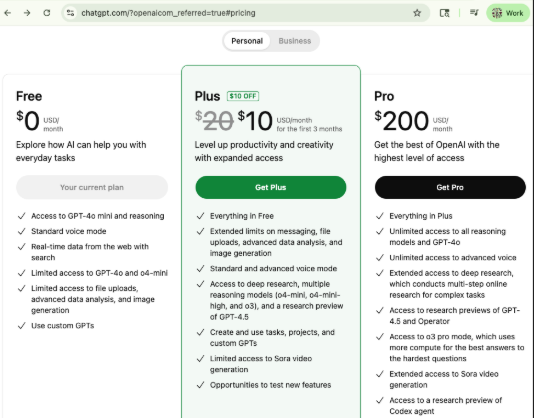
Exponential Billing Challenge
The billing transformation described in the main article becomes concrete when examining actual scaling patterns. Traditional SaaS billing assumed linear, predictable growth trajectories. AI usage patterns fundamentally differ, characterized by exponential bursts, workload volatility, and the need for real-time cost optimization across multiple model providers. Each order of magnitude increase demands qualitatively different billing capabilities.
AI SaaS Billing Nuances Supporting Exponential Change (18-Month Scale: $20 → $20M)
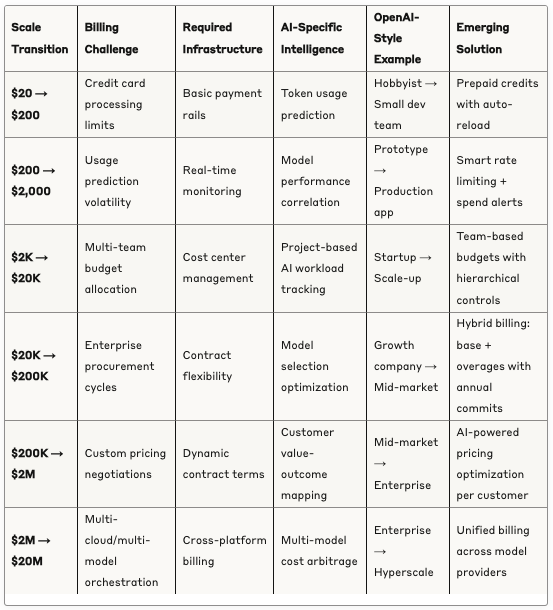
Critical AI-Native Billing Infrastructure
Real-Time Economic Intelligence
-
Context length optimization: Billing adjusts based on prompt efficiency
-
Model capability matching: Route requests to cost-optimal model for task
-
Latency-cost arbitrage: Balance speed vs. expense based on application needs
-
Fine-tuning ROI tracking: Measure custom model performance vs. generic alternatives
-
Semantic usage clustering: Group similar AI tasks for volume discounting
-
Inference pattern learning: Predict and pre-allocate resources for recurring workflows
Adaptive Cost Control
-
Micro-burst protection: Prevent $100K bills from runaway AI processes
-
Predictive spend alerts: Machine learning on usage patterns
-
Circuit breakers: Automatic throttling at defined thresholds
-
Dynamic credit pools: Auto-scaling payment authorization
Enterprise Economic Orchestration
-
SSO + billing: Identity-aware cost allocation
-
API-first billing: Programmatic budget management
-
Audit trails: Compliance-ready usage tracking
-
Multi-currency support: Global expansion without payment friction
Intelligence Convergence
As Scott Woody observed, “billing becomes more of a product surface than a monthly workflow.” In AI-native companies, billing infrastructure evolves into the economic nervous system, continuously sensing value creation, predicting usage patterns, and optimizing cost-performance trade-offs in real-time.
At hyperscale ($20M+), billing infrastructure transcends cost management to become competitive advantage. Companies with superior economic orchestration can:
-
Route workloads across model providers for optimal cost/performance
-
Predict customer lifetime value based on AI usage patterns
-
Optimize margins dynamically across thousands of concurrent inference requests
-
Create platform effects where billing efficiency attracts more users
Strategic Implications
The companies mastering exponential AI billing complexity first will capture disproportionate market share. As Martin Casado noted about infrastructure layers, “every layer of the stack has maintained some level of value and margin.” In the AI era, billing infrastructure itself becomes a defensible layer, with network effects, switching costs, and optimization advantages that compound over time.
Success may require treating billing not as operational overhead but as core product intelligence that enables the economic orchestration of artificial intelligence at scale.
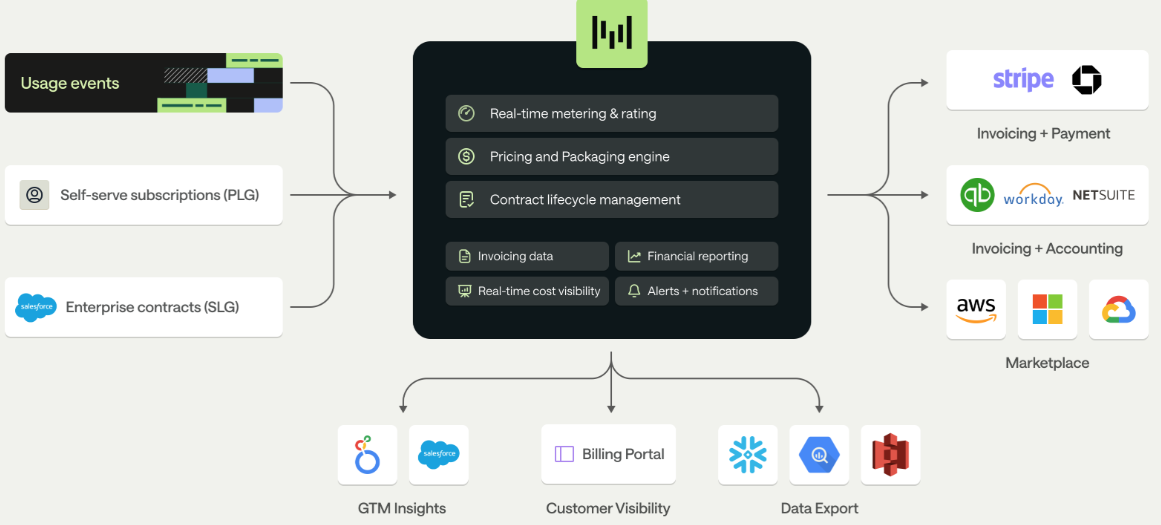
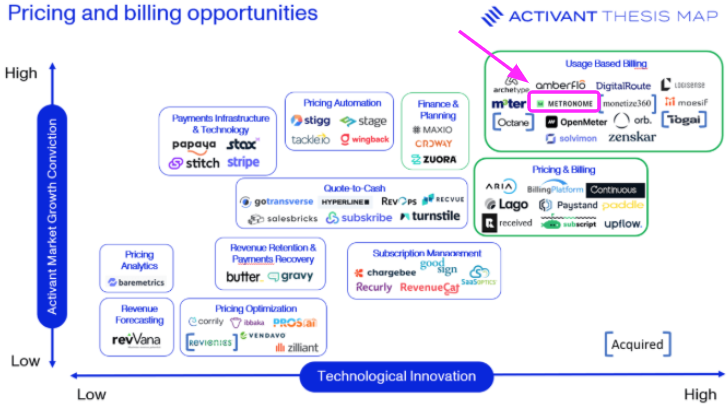
Appendix 2 FinOps Framework: “FinOps in the AI Era”
This appendix provides a practical framework for implementing the economic orchestration capabilities discussed throughout the main article. While the article identifies the need for new professional competencies in AI economics, this framework maps the organizational evolution required to achieve them.
The AI Economic Maturity Progression
Research across AI-scaling companies reveals consistent organizational evolution patterns. Companies progress through recognizable FinOps maturity stages, each requiring new professional competencies that didn’t exist in traditional SaaS environments. This progression directly supports the main article’s thesis about economic-technical co-evolution.
CRAWL Phase: Economic Visibility & Foundation
Core Activity: Tag LLM services, separate prod/dev environments, create dashboards
AI Cost Analyst Role: This professional functions as the financial archaeologist of AI spend. While others see mysterious cloud bills, the AI Cost Analyst decodes which models, prompts, and workloads drive costs. They create comprehensive tagging strategies, categorize inference types, and map spending patterns that executives can understand and act upon.
Key Functions:
-
Model usage taxonomy and tagging strategies across all AI services
-
Cost attribution systems spanning teams, projects, and AI service providers
-
Basic spend visualization and trend identification capabilities
-
Clear separation of experimental versus production AI workloads
WALK Phase: Control & Accountability
Core Activity: Assign cost accountability, set budgets with alerts, auto-pause idle resources
AI Resource Governor Role: This professional serves as the economic traffic controller for AI systems. When runaway processes attempt to spend $50K on GPT-4 calls within an hour, automated controls activate. They design spending guardrails that protect budgets while maintaining innovation velocity through surgical precision rather than blanket restrictions.
Key Functions:
-
Budget allocation and enforcement frameworks across AI initiatives
-
Real-time spend alerts and automatic throttling mechanisms
-
Resource scheduling and auto-pause systems for cost optimization
-
Cross-functional accountability frameworks linking AI costs to business outcomes
RUN Phase: Predictive Intelligence & Integration
Core Activity: Predict spend via ML, use anomaly detection, automate provisioning, integrate ERP systems
Economic Intelligence Engineer Role: This professional builds the nervous system that makes AI economics predictable. Their systems transcend reporting historical data to forecast future patterns. They create predictive models for next month’s inference costs based on product roadmaps, automatically route workloads to optimal price-performance ratios, and integrate AI spending into enterprise financial planning processes.
Key Functions:
-
Machine learning models for accurate AI cost forecasting
-
Anomaly detection systems for identifying unusual spending patterns
-
Automated model provider arbitrage and intelligent workload routing
-
ERP integration enabling holistic financial planning with AI costs
-
Dynamic budget reallocation systems based on measured business outcomes
Cross-Phase Evolution: The AI Economic Orchestrator
AI Economic Orchestrator Role: This professional synthesizes all maturity phases into strategic advantage. While others manage AI costs, the Economic Orchestrator orchestrates AI economics. They help companies transform billing complexity into competitive moats. Their domain encompasses technical optimization, financial strategy, and business model innovation, achieving the economic-technical co-evolution described throughout the main article.
Strategic Functions:
-
Economic model design for AI-native business models and pricing strategies
-
Cross-provider optimization and risk management across the AI ecosystem
-
Integration of technical performance metrics with financial outcomes
-
Strategic guidance on build versus buy decisions for AI infrastructure investments
Organizational Maturity Indicators
Crawl → Walk Transition: Can pause runaway processes before budget damage occurs Walk → Run Transition: Predictive spend accuracy within 15% monthly variance Run → Orchestration: Billing intelligence directly drives product strategy decisions
Framework Implementation
This framework recognizes that FinOps in the AI era transcends traditional cost management to become a core organizational capability. Economic intelligence operates as essential infrastructure alongside artificial intelligence, supporting the main article’s central thesis that success requires mastering continuous economic-technical co-evolution.
Companies implementing this framework systematically develop the economic orchestration capabilities needed to thrive in the AI economy, where billing systems become competitive advantages and financial intelligence determines technical success.