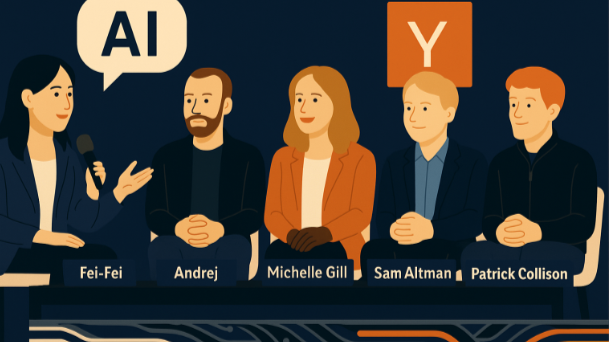
What happens when you place the world’s most influential AI minds in the same room to debate the future of human-machine 🤖 collaboration? This thought experiment reveals breakthrough frameworks that emerge only when genius collides with genius—insights that scattered individual interviews could never capture. And what happens when you introduce the critical perspective of Timnit Gebru?
Key Strategic Insights Unlocked:
-
The Autonomy Gradient Model: Karpathy’s “autonomy slider” 🎛️ concept, when filtered through Altman’s AGI timeline pressures, reveals a practical framework for enterprise AI deployment
-
Infrastructure-Trust Paradox: Collison’s payment rails vision collides with Gill’s accountability requirements, exposing the tension between scale and verification
-
Democratization vs. Concentration: The group dynamics reveal why AI “access for all” rhetoric consistently produces power concentration outcomes
-
Regulatory Arbitrage Windows: 18-month compliance timelines across jurisdictions create strategic opportunities none identified individually
Through careful synthesis of their authentic recent positions, we witness the birth of new paradigms that transcend individual perspectives. Gebru’s accountability lens 🔬 forces each leader beyond their comfort zones, revealing operational frameworks for the next phase of AI transformation.
Prepare to see familiar voices in an entirely new light, as their combined intelligence 💎 unlocks strategic frameworks none articulated alone.
Moderator: Dr. Fei-Fei Li, Co-Director, Stanford Human-Centered AI Institute Panelists:
-
Patrick Collison, CEO, Stripe
-
Michelle Gill, EVP & GM, Small Business and Financial Services Group, PayPal
-
Sam Altman, CEO, OpenAI
-
Andrej Karpathy, Former Research Scientist at OpenAI
Dr. Li: Welcome everyone. We’re here to discuss what’s coming in AI over the next 6 to 18 months. Sam, let me start with you. You’ve been making some pretty bold predictions lately about AGI and what’s coming this year. Can you set the stage for us?
Altman: Sure, Fei-Fei. I think we’re at a really unique moment. We are now confident we know how to build AGI as we have traditionally understood it. In 2025, we may see the first AI agents ‘join the workforce’ and materially change the output of companies. I think AGI will probably get developed during this time period, though AGI has become a very sloppy term.
The progress we’ll see from February 2025 to February 2027 will be more impressive than the advancements of the last two years. Within a few years, AI systems will be capable of compressing 10 years of scientific progress into a single year. I posed this question recently: How many of you think you’ll be smarter than GPT-5? Almost no one raised their hand. I don’t think I’m going to be smarter than GPT-5, and I don’t feel sad about it because it means we’ll be able to use it to do incredible things.
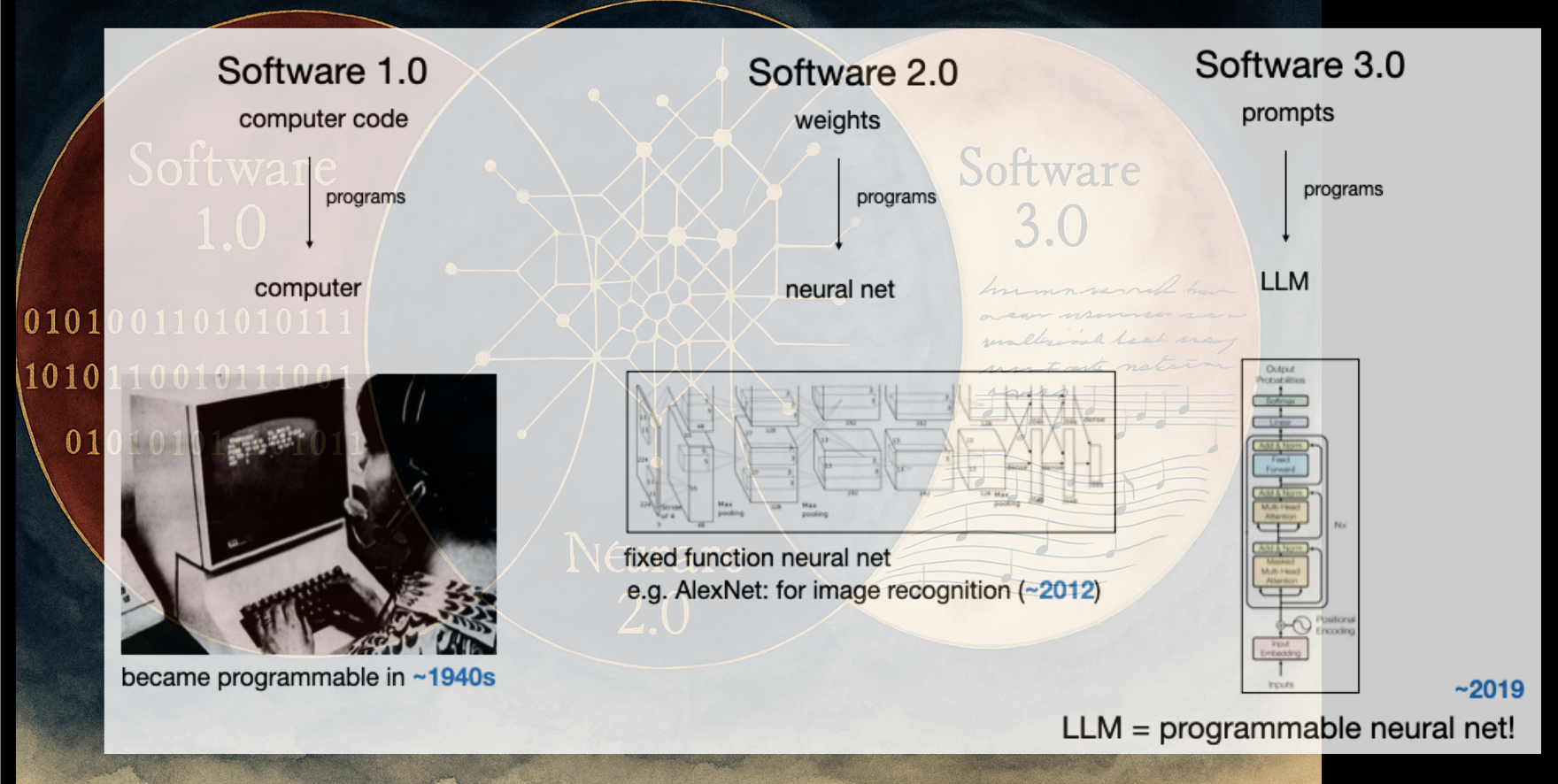
Dr. Li: That’s quite ambitious, Sam. Andrej, you’ve been thinking deeply about the fundamental nature of these systems. How do you see this playing out, especially with your Software 3.0 framework?
Karpathy: What I find fascinating is that we’re basically in the 1960s era of this new computing paradigm. LLM compute is still very expensive for this new kind of computer, and that forces the LLMs to be centralized in the cloud. We’re all just thin clients that interact with it over the network.
But here’s what’s really remarkable: we’re now programming computers in English. Your prompts are now programs that program the LLM. It’s kind of a very interesting programming language. This democratizes programming in a way we’ve never seen before.
When I see things like “2025 is the year of agents,” I get very concerned. I kind of feel like this is the decade of agents, and it’s going to take quite some time. Software is really tricky. The first time I drove a self-driving vehicle was in 2013, and it was perfect. But here we are 12 years later and we’re still working on autonomy. We need humans in the loop; we need to do this carefully.
Dr. Li: That’s a great perspective on maintaining human agency. Patrick, from Stripe’s vantage point processing over $1.4 trillion annually, you’re seeing the economic implications of AI firsthand. What are you observing?
Collison: We’re at a somewhat unusual juncture. We have two countervailing forces. On the one hand, we’re at a time of significant dislocation and uncertainty in global trade. But on the other hand, AI and stablecoins are dramatically reshaping the landscape—they’re gale force tailwinds in a turbulent economy.
AI companies are compressing scaling timelines dramatically, reaching $5 million in ARR in just nine months on average. Many are reaching $10 billion in ARR within two years. This is unprecedented. Our total payment volume rose 38% in 2024 to reach $1.4 trillion, and much of that growth is AI-driven.
It’s clear that advances in ML and AI are going to completely reshape not just the payments landscape, but the financial services landscape. So much of financial services isn’t just about the mechanistic matter of how you move money—it’s about predictive tasks around fraud, KYC, verification, business models, pricing. Our view at Stripe is we should assume that every part of the business is going to look quite different in five years.
Dr. Li: Michelle, PayPal has been leading this agentic commerce revolution. How are you seeing businesses actually implement these capabilities?
Gill: We’re really at the forefront of what we call agentic commerce. We’ve released developer tools like the industry’s first remote MCP server and our Agent Toolkit, which allow AI agents to handle payments, track shipments, manage invoices, and process returns with intelligence and efficiency.
What we’re seeing is that small businesses, in particular, are juggling over a dozen platforms to manage their finances. It’s not the adoption of the new tool in and of itself that’s the problem—it’s how it feeds back into your broader ecosystem. Our strategy focuses on streamlining tools through a single integration.
We’re embedding AI capabilities directly into the workflows merchants already use. Through our PayPal dashboard, users are notified of pre-approved loan amounts as they manage daily tasks. We’re planning to add the amount that merchants have been pre-approved for, so they know going in. This integration is what makes agentic commerce practical, not just possible.
Dr. Li: Sam, you mentioned AI agents joining the workforce. Can you be more specific about what that looks like in practice over the next 12-18 months?
Altman: Within 12-18 months, I expect AI to handle tasks that currently take junior employees days to complete. We’re starting to roll out AI agents, which will eventually feel like virtual co-workers. Let’s imagine the case of a software engineering agent—2025 has seen the arrival of agents that can do real cognitive work; writing computer code will never be the same.
2026 will likely see the arrival of systems that can figure out novel insights. 2027 may see the arrival of robots that can do tasks in the real world. Intelligence too cheap to meter is well within grasp. The price to use a given level of AI falls about 10x every 12 months. Moore’s law changed the world at 2x every 18 months; this is unbelievably stronger.
Dr. Li: Andrej, how do we balance this rapid advancement with the need for human oversight?
Karpathy: This is where I think the Iron Man analogy is so important. What I love about the Iron Man suit is that it’s both an augmentation and Tony Stark can drive it, and it’s also an agent. There should be an autonomy slider in your product.
At this stage, working with fallible LLMs, it’s less Iron Man robots and more Iron Man suits that you want to build. It’s less like building flashy demos of autonomous agents and more building partial autonomy products. We have to keep the AI on the leash because it gets way too overexcited. If I’m actually trying to get work done, it’s not great to have an overreactive agent.
The key is making the generation-verification loop between humans and AI go very fast. GUIs are extremely important because they utilize your computer vision GPU—reading text is effortful, but looking at stuff is fun and it’s a highway to your brain.
Dr. Li: Patrick, how do you see the infrastructure needs evolving to support this?
Collison: What’s interesting is that we’re building what might be described as room-temperature superconductors for money. Just like actual superconductors, stablecoins massively reduce the friction and energy loss that are associated with storage and movement.
But beyond that, businesses need to adapt to the proliferation of new payment methods and business models, the growing sophistication of fraudulent actors, the ever more exacting expectations of consumers, and the transformation in the commerce experience instigated by AI.
Data from $1.4 trillion in annual payments volume means that each payment makes the next payment safer—a flywheel spinning with now-considerable momentum. We’re investing heavily in machine learning and AI for fraud detection, and these bets continue to pay off, increasing revenue for existing customers and helping new companies reach significant scale unprecedentedly quickly.
Dr. Li: Michelle, how are you thinking about trust and security as AI agents become more autonomous in financial transactions?
Gill: Trust is absolutely foundational. PayPal’s approach leverages our existing trust infrastructure. We provide the trust that the business is legitimate on one side, and the customer is legitimate on the other side. But we’re also evolving how we think about cash flow-based lending.
Our PayPal Working Capital product now allows repayment that’s predicated on the receipt of earnings, unlike traditional fixed-schedule lending. We’re changing our product to allow for the ability to redraw capital. Through open banking, we now can have visibility into the entire merchant account, both on and off PayPal.
This holistic view, combined with AI, lets us make more intelligent lending decisions and embed them seamlessly into business workflows. It’s about augmenting human decision-making, not replacing it.
Dr. Li: Sam, there’s been a lot of discussion about job displacement. How should we be thinking about this transition?
Altman: Look, there will be very hard parts like whole classes of jobs going away, but on the other hand, the world will be getting so much richer so quickly that we’ll be able to seriously entertain new policy ideas we never could before. If history is any guide, we will figure out new things to do and new things to want, and assimilate new tools quickly.
Agency, willfulness, and determination will likely be extremely valuable. Correctly deciding what to do and figuring out how to navigate an ever-changing world will have huge value. AGI will be the biggest lever ever on human willfulness, and enable individual people to have more impact than ever before, not less.
Anyone in 2035 should be able to marshal the intellectual capacity equivalent to everyone in 2025—everyone should have access to unlimited genius to direct however they can imagine.
Dr. Li: Andrej, you’ve talked about “vibe coding”—everyone becoming a programmer. How does this democratization play out?
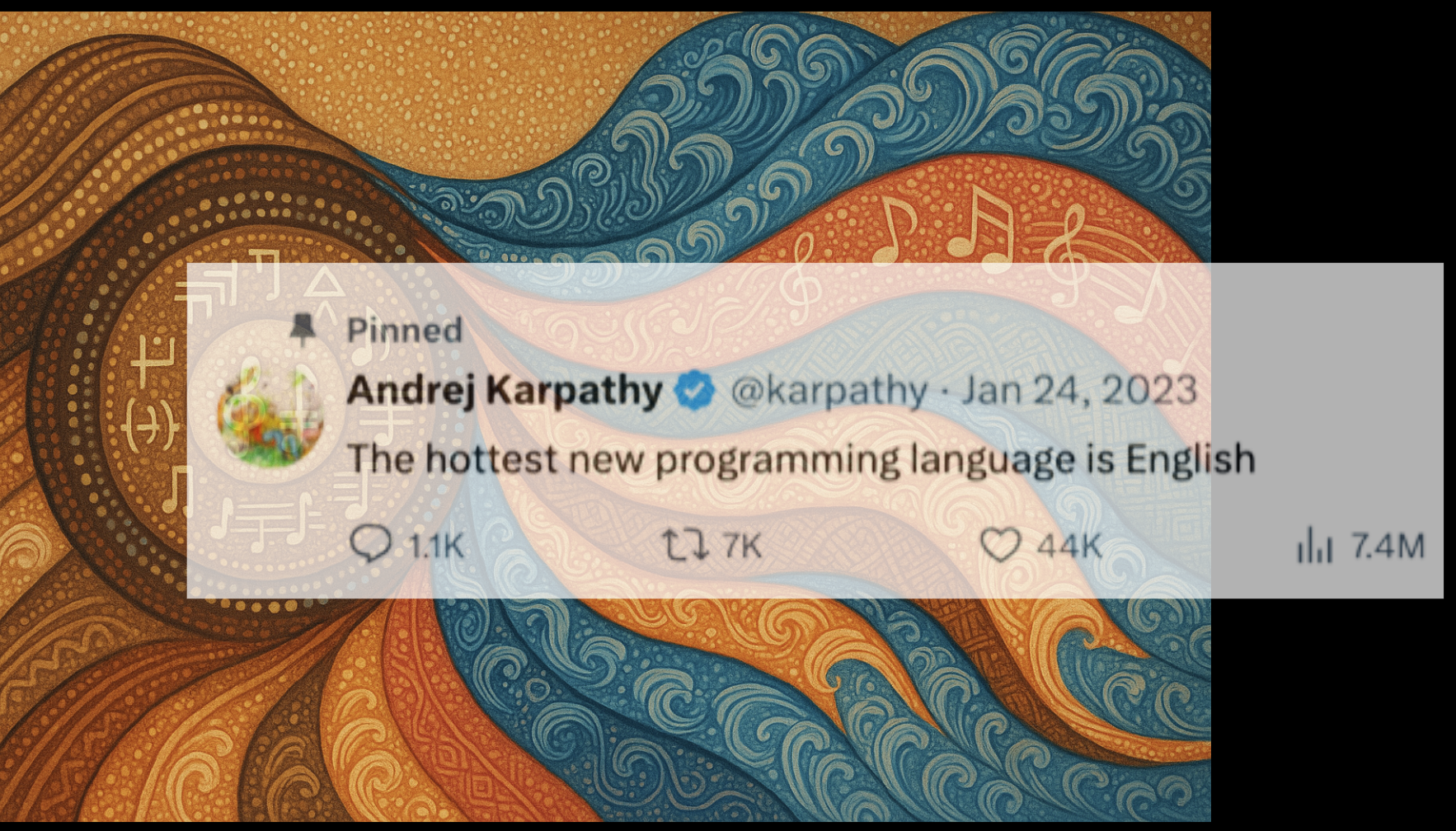
Karpathy: English is the hottest new programming language. Suddenly everyone is a programmer because everyone speaks natural language. This is extremely bullish and completely unprecedented. I built a functional iOS app in Swift—a language I don’t know—using only AI assistance in just a day of work.
Vibe coding is so great when you want to build something super duper custom that doesn’t appear to exist. It’s becoming a gateway drug to software development. I think this will end up being tremendously empowering, especially for domain experts who can now directly translate their knowledge into functional applications.
Dr. Li: Patrick, how do you see this democratization affecting business and innovation?
Collison: The best people in the world in any domain treat their craft as a craft. What we’re seeing is that this democratization doesn’t diminish craft—it elevates it. You still need the domain expertise, the understanding of what you’re trying to solve, the aesthetic judgment about what constitutes a good solution.
AI companies reaching $10 billion in ARR within two years isn’t just about the technology—it’s about teams that understand their domain deeply and can leverage these new tools effectively. The businesses that will thrive are those that combine deep domain knowledge with these new capabilities.
Dr. Li: Let’s dive deeper into some specific areas. I’m particularly interested in voice interfaces and how they’re shaping the future of human-AI interaction. Michelle, PayPal has been pioneering agentic commerce—how do you see voice interfaces transforming the way people make purchases?
Michelle: Voice interfaces are absolutely critical to the future of agentic commerce. We’re seeing that the most successful implementations aren’t just about voice recognition—they’re about creating conversational flows that feel natural while maintaining security and trust.
In our PayPal agent implementations, we’re finding that voice interactions need to be contextually aware. When someone says “pay for my coffee,” the system needs to understand not just the command, but the merchant, the amount, the payment method preferences, and even factor in things like their location and transaction history.
What’s fascinating is how voice interfaces change the entire paradigm of financial interactions. Instead of navigating through screens and forms, users can have natural conversations: “I need to send $200 to my contractor for the work we discussed yesterday.” The AI can understand that context, find the right contact, verify the amount, and complete the transaction while maintaining all our fraud prevention protocols.
We’re also seeing voice become essential for small business workflows. Merchants can now say “Show me my best customers from last month” or “Process a refund for the order that arrived damaged yesterday.” It transforms business management from a screen-based task to a conversational one.
Dr. Li: Patrick, Stripe has always been developer-first. How are you thinking about voice interfaces in the context of your platform and the broader developer ecosystem?
Patrick: Voice interfaces represent something really fascinating for us at Stripe. What we’re seeing is that the most interesting applications aren’t just adding voice to existing interfaces—they’re rethinking the entire interaction model.
For developers building on Stripe, voice opens up entirely new use cases. Imagine a restaurant where the hostess can simply say “Table 12 wants to split their bill three ways” and the system automatically generates payment links for each person. Or a marketplace where vendors can say “I need to issue a partial refund for order #4792” and the system handles all the complexity.
But here’s what’s unique about voice in financial services—it requires a different approach to security and verification. We’re working on what we call “conversational commerce protocols” where voice interactions can trigger secure payment flows without compromising user safety.
The developer implications are huge. Voice interfaces mean developers need to think about intent recognition, context preservation, and what we call “financial conversation design.” It’s not enough to understand what someone said—you need to understand what they meant in a financial context.
We’re also seeing voice change how businesses think about international expansion. Language becomes less of a barrier when you can have natural conversations in multiple languages with the same underlying commerce infrastructure.
Dr. Li: Andrej, with your Software 3.0 framework where English becomes a programming language, how do voice interfaces fit into this evolution?
Karpathy: Voice interfaces are fascinating because they represent the ultimate expression of Software 3.0—we’re literally talking to computers in natural language. But there’s a crucial distinction between voice as input and voice as the primary interface paradigm.
What I find most interesting is that voice interfaces force us to think about the temporal nature of human-computer interaction. When you’re typing, you can backspace, edit, think about your prompt. With voice, there’s this real-time flow that more closely mimics how humans naturally communicate.
But here’s where it gets technical—voice interfaces expose the cognitive quirks of LLMs in new ways. When someone pauses mid-sentence or says “um,” how does the system handle that? When they change their mind halfway through a request? These aren’t just UX challenges; they’re fundamental questions about how we design AI systems that can handle the messiness of human communication.
From a Software 3.0 perspective, voice interfaces also change the feedback loop. With text, you can see your prompt and the response. With voice, the interaction becomes more ephemeral. This changes how we think about the human-AI collaboration loop I mentioned earlier.
I think voice interfaces will be most successful when they embrace partial autonomy with clear verification steps. “I understand you want to book a flight to London on Friday. Is this correct?” That kind of conversational verification loop is crucial.
Dr. Li: Sam, you recently announced the acquisition of Jony Ive’s io company for $6.4 billion. This is clearly a major bet on hardware and voice interfaces. Can you share your vision for how this changes human-AI interaction?
Altman: The acquisition of io represents our belief that the future of AI interaction goes far beyond screens and keyboards. Working with Jony has been incredible—he brings this unique perspective on how design can make technology feel more human, more intuitive.
What we’re building isn’t just another smart speaker or voice assistant. We’re reimagining what it means to interact with artificial intelligence. The device we’re developing is pocket-sized, screenless, and contextually aware. It can see and hear your environment, understand context from your experiences, and respond in ways that feel natural.
The key insight is that voice interfaces should be ambient and proactive, not reactive. Instead of waiting for you to ask questions, the device understands your routines, your needs, your environment. It might say “I noticed you’re running late for your 3 PM meeting—would you like me to send an update?” or “The restaurant you’re going to has a 30-minute wait—should I put you on the list?”
What Jony brings is this obsession with making complex technology feel simple and delightful. We’re not just building a more powerful voice assistant—we’re creating an entirely new category of AI companion that understands you deeply and can act on your behalf throughout your day.
In the same way that the smartphone didn’t make the laptop go away, I don’t think our first thing is going to make the smartphone go away. It is a totally new kind of thing.
Dr. Li: This brings up important questions about privacy and human agency. How do we ensure these ambient, proactive voice interfaces serve human flourishing rather than diminish it?
Altman: That’s exactly the right question. The device has to be fundamentally respectful of human agency. It should feel like it’s working for you, not monitoring you. Everything it learns about your context and preferences should be in service of helping you accomplish your goals.
We’re designing with what we call “earned intelligence”—the device gets smarter about helping you only as you choose to share context with it. It’s not surveilling you; it’s learning from you in ways that you control and that provide clear value.
Michelle: From a financial services perspective, this ambient intelligence has to be built on absolute trust foundations. When an AI can proactively suggest financial actions—“I noticed you have an unusual expense pattern this month, would you like me to adjust your savings transfer?"—the user has to have complete confidence in the security and intentionality of those recommendations.
Patrick: The key is designing for transparency and control. Users should always understand why the AI is making suggestions and have simple ways to adjust or override those recommendations. The most dangerous scenario is AI that acts autonomous without clear human oversight.
Karpathy: This is why I keep coming back to the autonomy slider concept. Even in ambient voice interfaces, users need control over how much the AI can act independently. Sometimes you want it to just book the restaurant reservation automatically; other times you want it to ask first.
Dr. Li: Looking specifically at the next 6-18 months, what should we expect to see in voice interface development?
Altman: 2025 will be the year we see voice interfaces become truly conversational. Not just question-and-answer, but sustained, contextual conversations where the AI remembers what you discussed five minutes ago and can build on that conversation.
We’ll also see voice interfaces become much better at handling multiple requests simultaneously. “Book me a flight to Boston next Tuesday and also remind me to call Mom when I land” should just work seamlessly.
Michelle: In commerce specifically, I think we’ll see voice interfaces that can handle complex financial conversations. “I need to pay my quarterly taxes, but I want to make sure I’m taking advantage of all my business deductions first” should trigger a comprehensive workflow that reviews expenses, suggests optimizations, and then processes the payment.
Patrick: For developers, we’ll see new frameworks emerge for building voice-first applications. The developer experience for voice apps is still quite primitive compared to visual interfaces. That’s changing rapidly.
Karpathy: I think we’ll see voice interfaces start to handle more complex reasoning tasks. Right now, most voice assistants are good at simple commands. But we’re moving toward voice interfaces that can help you think through problems: “Walk me through the pros and cons of expanding my business into this new market.”
Dr. Li: Any final thoughts on the human implications as we wrap up this expanded discussion?
Dr. Li: As we develop these voice interfaces, we must remember that the goal isn’t to make humans more efficient—it’s to make humans more human. Voice is our most natural form of communication, and AI should honor that rather than trying to constrain human expression into more computer-friendly formats.
The best voice interfaces will feel like having a conversation with a knowledgeable, trustworthy colleague who happens to have access to incredible resources and capabilities.
Altman: Exactly. The future we’re building isn’t about humans adapting to computers—it’s about computers finally adapting to humans. Voice interfaces are just the beginning of that transformation.
Patrick: And the infrastructure we build now will determine whether this transformation empowers individuals and small businesses or just concentrates more power in the hands of the already powerful. That’s why getting the platform layers right is so important.
Michelle: The key is ensuring that as voice interfaces become more capable, they also become more accessible. Small business owners shouldn’t need technical expertise to benefit from AI—they should just be able to talk to their systems naturally.
Karpathy: We’re basically teaching computers to speak human. That’s incredible, but it also means we have a responsibility to make sure they speak human in ways that respect human values and agency.
Dr. Li: As we think about human-centered AI more broadly, what should leaders prioritize in the next 18 months?
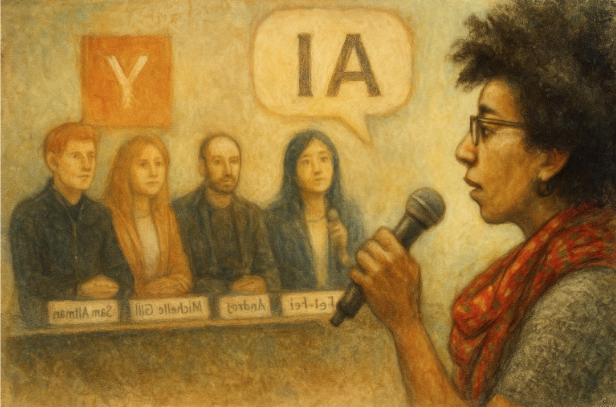
Dr. Li: Before we move to closing thoughts, I’d like to invite Dr. Timnit Gebru to join us remotely with some pointed questions. Timnit, as you know, has been one of the most important critical voices in AI development, and I think her perspective will challenge us all to think more deeply about the implications of what we’re building.
Dr. Gebru: Thank you, Fei-Fei. I appreciate being included in this conversation. I have some questions that I hope will push beyond the technical excitement to examine the deeper structural implications of what’s being built.
Sam, my question for you is this: You’ve spoken about AGI making individual people have “more impact than ever before” and everyone having access to “unlimited genius.” But historically, transformative technologies tend to amplify existing power structures rather than democratize them. Given OpenAI’s shift from a non-profit to a for-profit structure, its dependence on massive capital from Microsoft, and now this $6.4 billion hardware acquisition, how can you credibly claim that AGI will be broadly accessible rather than just creating new forms of technological oligarchy? What specific mechanisms beyond rhetoric ensure that this “unlimited genius” doesn’t become another luxury good for the wealthy?
Altman: Timnit, that’s… that’s a really important challenge, and I appreciate you asking it directly. You’re right that my language about “unlimited genius” can sound like Silicon Valley utopianism if we don’t back it up with concrete mechanisms.
The honest answer is that we’re still figuring this out, and the current trajectory does create risks of exactly what you’re describing. The capital requirements for frontier AI development are enormous, and that does tend to concentrate power. But I think there are a few things that give me hope for a different outcome.
First, the cost curve I mentioned—10x reduction every 12 months—isn’t just marketing speak. As these models become cheaper to run, the economic barriers to access genuinely decrease. We’re already seeing this with our pricing drops.
Second, and this is more speculative, but I think the nature of AI as software means it can scale in ways that previous technologies couldn’t. Once we solve certain capabilities, the marginal cost of providing them to additional people approaches zero in ways that physical goods never could.
But you’re pushing me on the structural question, and that’s harder. We’re trying to build sustainable economics that don’t require artificial scarcity. Our partnership with Microsoft, while creating dependencies, also gives us the scale to push down costs faster than we could alone.
The hardware acquisition is actually part of this strategy—if we can create AI interfaces that are genuinely accessible, not just technically but economically, we might be able to short-circuit some of the traditional power concentration patterns.
But I won’t pretend we’ve solved this. The risk you’re pointing to is real, and it requires ongoing vigilance and probably regulatory frameworks that don’t exist yet.
Dr. Gebru: Andrej, you’ve framed AI development as this natural evolution from Software 1.0 to 3.0, almost like it’s an inevitable technological progression. But this framing obscures the very specific choices being made about what problems to solve, whose labor to automate, and which values to embed in these systems. Your “vibe coding” example—building an iOS app without knowing Swift—essentially describes using AI to bypass the accumulated knowledge and expertise of actual developers. How do you reconcile your democratization narrative with the reality that this technology is being designed to devalue and potentially eliminate entire categories of skilled work? Isn’t “everyone becomes a programmer” really code for “actual programmers become unnecessary”?
Karpathy: Timnit, you’re calling out something I’ve been… I’ve been thinking about this a lot actually, and I think your critique is partly right and partly pointing to something even more complex.
You’re absolutely right that my framing can sound like technological determinism, like this evolution is just naturally happening rather than being driven by specific choices and interests. That’s a blindness I need to be more careful about.
On the programmer question specifically—when I built that iOS app, I wasn’t replacing a programmer. I was doing something I couldn’t have done before at all. But you’re pointing to the broader question: what happens when AI can do things that traditionally required years of training and expertise?
I think the honest answer is that some categories of work will definitely be eliminated or fundamentally changed. Junior programming work, certain types of routine coding—yeah, those are at risk. And that’s not just an abstract economic force; those are people’s livelihoods.
But I’ve also seen how AI tools make experienced developers more productive rather than replacing them. The people who understand software architecture, who can debug complex systems, who understand user needs—they’re becoming more valuable, not less.
The harder question you’re raising is about power and choice. Who decides which work gets automated? Who captures the value when productivity increases? Those aren’t technical questions—they’re political and economic questions.
I don’t have good answers there. I’ve been focused on the technical capabilities, but you’re right that I need to engage more seriously with these structural implications. The democratization I’m excited about could easily become a different kind of concentration of power if we’re not thoughtful about it.
Dr. Gebru: Patrick, Stripe processes over $1.4 trillion annually and you’ve positioned the company as infrastructure for the internet economy. You’ve spoken enthusiastically about AI and stablecoins as “gale force tailwinds,” but both technologies have significant implications for financial sovereignty and surveillance. Stablecoins potentially eliminate monetary policy tools that governments use to support their citizens during crises, while AI-powered payment systems create unprecedented opportunities for tracking and profiling every economic transaction. Given Stripe’s massive reach, aren’t you essentially building the plumbing for a more surveilled and less democratically accountable financial system? How do you justify prioritizing technical efficiency over financial self-determination?
Collison: Timnit, this is… you’re asking about fundamental questions of power and sovereignty that I think the technology industry doesn’t grapple with seriously enough.
On stablecoins specifically, I think your concern about monetary policy is really important. When we say stablecoins can enable “borderless financial services,” we’re not just talking about technical capabilities—we’re talking about bypassing existing regulatory and democratic frameworks.
I think there’s a legitimate argument that some of those frameworks are inefficient or exclusionary, but you’re right that efficiency isn’t the only value that matters. Financial sovereignty—the ability of communities and nations to make their own economic decisions—is crucial for democratic governance.
Where I might push back slightly is on the inevitability of surveillance. The current payment system is already heavily surveilled and controlled by a small number of institutions. What we’re trying to build is infrastructure that gives more people access to financial services, but I agree that access without agency isn’t real empowerment.
On the AI tracking concern—this is something we’ve been thinking about a lot. Every transaction on our platform does create data, and AI makes that data more useful for insights and predictions. But I think the question is who controls that data and how it’s used.
We’ve tried to design our systems so that businesses maintain control over their customer relationships and data. We’re not trying to be the Facebook of payments—we’re trying to be infrastructure that enables others to build.
But honestly, your question pushes me to think harder about whether that’s enough. Infrastructure isn’t neutral—the design choices we make do shape how economic power flows. We need to be more explicit about values like financial self-determination and build those into our systems, not just assume they’ll emerge naturally.
Dr. Gebru: Michelle, PayPal has positioned itself at the forefront of “agentic commerce,” where AI systems can make financial decisions and transactions on behalf of users. You’ve described this as empowering small businesses and creating convenience. But let’s be specific about what “agentic” really means: you’re building systems where algorithms decide how people spend money, which vendors they use, and what financial products they’re offered. Given PayPal’s history of freezing accounts, algorithmic bias in financial services, and the opaque nature of AI decision-making, how can users trust that these “agents” are acting in their interests rather than PayPal’s? Isn’t “agentic commerce” really just algorithmic manipulation dressed up as user empowerment?
Michelle: Timnit, your question cuts right to the heart of what I think is the most important challenge we’re facing. And I have to be honest—some of your concerns about algorithmic manipulation are legitimate and we haven’t always gotten this right.
The account freezing issue you mentioned is a real problem that illustrates exactly what you’re talking about. When algorithms make decisions about people’s financial lives without adequate transparency or recourse, that’s not empowerment—that’s a different kind of control.
But I want to distinguish between different types of agentic systems. When I talk about AI helping a small business owner process invoices or manage cash flow, I’m talking about automation that the business owner chooses and controls. They can see what the system is doing and override it at any time.
The more problematic scenario you’re describing is when the AI makes decisions that users don’t understand or can’t control. And you’re right that there’s a real risk that “agentic commerce” could become a euphemism for systems that optimize for PayPal’s metrics rather than user welfare.
Here’s what I think we have to build: radical transparency about how these systems work, clear user control over AI decision-making, and genuine recourse when things go wrong. If someone can’t understand why the AI made a particular recommendation or can’t easily override it, then we’re not building empowerment—we’re building dependence.
The challenge is that truly transparent AI decision-making is technically hard and sometimes conflicts with business incentives. But if we don’t solve this, then yes, “agentic commerce” will just be manipulation with better marketing.
I think the accountability question you’re raising is crucial. These systems need to be auditable not just by PayPal, but by users and potentially by independent third parties. That’s a higher bar than we’ve held ourselves to historically.
Dr. Li: Thank you, Timnit, for those incisive questions. What strikes me about all four responses is how they reveal the tension between technological optimism and structural reality.
Sam acknowledged that the democratization narrative around AGI faces real obstacles from capital concentration and existing power structures. His hope lies in the unique scaling properties of software, but he was honest that the structural questions remain unsolved.
Andrej recognized that his framing of technological evolution can obscure the human choices and power dynamics behind AI development. He’s grappling with the reality that democratization of tools can simultaneously eliminate skilled work and concentrate power in new ways.
Patrick engaged seriously with the sovereignty implications of financial infrastructure, acknowledging that efficiency isn’t the only value that matters and that infrastructure design shapes power distribution in ways the industry doesn’t always consider.
Michelle confronted the gap between empowerment rhetoric and the reality of algorithmic control, emphasizing the need for transparency, user control, and genuine accountability mechanisms.
What I hear across all these responses is an acknowledgment that good intentions and technical capabilities aren’t sufficient. Each of these leaders is wrestling with how to build systems that genuinely serve human flourishing rather than just appearing to do so.
The common thread is the need for new frameworks—technical, regulatory, and social—that can harness the benefits of these technologies while preventing the concentration of power and elimination of human agency that Timnit’s questions highlighted.
Dr. Li: Let’s conclude with closing thoughts from each panelist, and then I’ll offer some final reflections.
Altman: I think Timnit’s questions remind us that the stakes of getting this right are enormous. We’re not just building better tools—we’re shaping the economic and social structures of the future. The technical progress is accelerating so rapidly that we risk outpacing our ability to think through the implications.
My closing thought is that we need much more engagement between technologists and people who understand power structures, social systems, and human welfare. The future we’re building won’t be determined just by what’s technically possible, but by the choices we make about how to deploy these capabilities.
We have a narrow window to get this right. The systems we’re building now will shape society for decades. That’s both an incredible opportunity and a profound responsibility.
Karpathy: What I’m taking away from this conversation is that the democratization of programming through AI isn’t inherently good or bad—it’s powerful, and power requires wisdom about how to use it.
I’ve been focused on making these tools more accessible, but accessibility without agency isn’t enough. We need to think much more carefully about how to preserve human skill, expertise, and decision-making even as AI capabilities grow.
I keep coming back to the autonomy slider concept, but maybe what we really need is a dignity slider—how do we ensure that as AI takes on more tasks, humans retain meaningful work, genuine choice, and real control over their lives?
Patrick: This conversation has pushed me to think more explicitly about Stripe’s role in shaping economic power structures. We’ve always said we want to increase the GDP of the internet, but whose GDP? And what kind of economic system are we building?
I think the responsibility of infrastructure companies like Stripe is to design systems that preserve choice and competition rather than creating new forms of lock-in or dependence. That means being more intentional about decentralization, interoperability, and user control.
The future of commerce shouldn’t be about making transactions more efficient if that efficiency comes at the cost of human agency and democratic governance.
Michelle: What I’m realizing is that “human-centered AI” can’t just be about making AI more helpful—it has to be about preserving human power and choice even as AI becomes more capable.
For PayPal, this means moving beyond “trust us” to “verify for yourself.” If we’re building systems that make financial decisions on behalf of users, those users need to understand, control, and audit those systems in meaningful ways.
The future I want to build is one where AI amplifies human capability without replacing human judgment. That requires different technical architectures, different business models, and different relationships with users.
Dr. Li: As I listen to these closing thoughts, I’m struck by how the conversation has evolved from technical capabilities to fundamental questions about human agency and social structure.
What gives me hope is the willingness of these leaders to engage with difficult questions about power, control, and social responsibility. Too often, conversations about AI focus only on what’s technically possible rather than what’s socially desirable.
The framework I want to leave you with is this: human-centered AI isn’t just about making AI more helpful to humans. It’s about ensuring that as AI becomes more powerful, humans become more powerful too—not just more productive, but more free, more capable of self-determination, and more able to shape their own futures.
This requires technical innovation, but it also requires social innovation. We need new forms of governance, new economic models, and new ways of thinking about the relationship between human and artificial intelligence.
The next 18 months will be crucial. The systems being built now will shape society for decades. The question isn’t whether AI will transform our world—it’s whether that transformation will enhance human flourishing or diminish it.
The responsibility lies not just with technologists, but with all of us to demand AI systems that serve human values, preserve human agency, and strengthen rather than weaken our democratic institutions.
As we’ve heard today, the future is not predetermined. The choices we make now about how to develop and deploy AI will determine whether we create a more equitable and human-centered world, or whether we simply automate existing inequalities and power structures.
The conversation must continue, and it must include voices from across society—not just technologists, but ethicists, policymakers, workers, and communities who will be affected by these systems.
Thank you all for a thoughtful and challenging discussion. The work continues.
This panel discussion imagines a conversation between leading AI researchers and industry executives, using their actual recent public statements and positions. While the specific dialogue is constructed, it reflects the real tensions and challenges in AI development today.
Dr. Li: Let me share my framework: human-centered AI operates on three concentric circles. The innermost is individual—we want to create technology that helps individuals, that empowers people, that respects the dignity of people. Then community—how do we empower creators and groups without taking away what properly belongs to them? And society—AI is a civilizational technology with transformational impact.
We need to focus on science, not science fiction, in our policy decisions. Pragmatism, not ideology—looking at downstream applications rather than getting lost in upstream research restrictions. And we need to resource the ecosystem properly, ensuring universities and public research continue alongside private sector advancement.
Michelle: From a practical standpoint, businesses need to start with integration, not just adoption. We’re seeing the most success when companies focus on how AI tools feed back into their broader ecosystem. Start with partial autonomy, build trust gradually, and always maintain human oversight for critical decisions.
Karpathy: Keep the AI on the leash. Build Iron Man suits, not autonomous robots. Focus on making the human-AI collaboration loop as fast as possible. And remember—this is the decade of agents, not the year. Plan accordingly.
Patrick: Assume every part of your business will look different in five years. Invest in understanding these new capabilities, but don’t lose sight of craft and domain expertise. The companies that combine deep knowledge with AI tools effectively will be the ones that succeed.
Altman: We are past the event horizon. The gradual changes will amount to something big when we look back in a few decades. The socioeconomic value of linearly increasing intelligence is super-exponential in nature. We see no reason for exponentially increasing investment to stop in the near future.
But remember: life will go on mostly the same in the short run. We will still fall in love, create families, get in fights online, hike in nature. The future will be coming at us in a way that’s impossible to ignore, but we need to navigate it thoughtfully.
Dr. Li: Any final thoughts as we wrap up?
Altman: 2025 will be a year where agentic systems finally hit the mainstream. The question isn’t whether this future will arrive—it’s whether we’ll help shape it in ways that benefit humanity.
Karpathy: What an amazing time to get into the industry. We need to rewrite a ton of code, and I can’t wait to build it thoughtfully with all of you.
Patrick: We’re building the economic operating system for the age of AI agents. The infrastructure decisions we make now will determine how this transformation unfolds.
Michelle: The future belongs to companies that can integrate AI capabilities while keeping humans at the center of critical decisions. It’s about augmentation, not replacement.
Dr. Li: Thank you all. As we navigate this transformation, let’s remember that our goal should be technology that serves human flourishing. The power of AI should amplify the best of human creativity, agency, and connection—not diminish it.
This panel discussion draws from recent public statements, interviews, and writings by each participant. While the conversation is imagined, all quotes and perspectives reflect their actual recent positions on AI development and implementation.
What This Conversation Reveals About Our Collective Blindness
Notice what didn’t happen in this imagined dialogue. Despite their brilliance, none of these leaders grappled with the elephant 🐘 in the room: the possibility that their entire framework might be wrong.
What if the “democratization of AI” narrative is simply Silicon Valley’s latest mythology? Consider how each participant defaulted to solutions within their existing paradigms—Altman through scaling, Karpathy through better interfaces, Collison through infrastructure, Gill through trust mechanisms. Even Gebru’s critiques, while essential, operated within the assumption that these systems should exist at all.
The more troubling question: Are we witnessing genuine innovation, or elaborate theater 🎭 performed while the fundamental power structures remain unchanged?
The Questions We’re Still Not Asking
If these are truly our most influential AI voices, why do their solutions feel so… familiar? Why does every breakthrough sound like a variation on “make it faster, cheaper, more accessible”—the same promises we’ve heard about every transformative technology for the past century?
Perhaps the real test isn’t whether this imagined conversation reveals new insights, but whether it exposes our collective inability 🔍 to imagine alternatives to the trajectory we’re already on.
What would a conversation look like if we started from first principles: Should we be building these systems at all? Who decided that artificial general intelligence was desirable? Why do we accept that commerce must become “agentic”?
The Uncomfortable Mirror
This thought experiment may tell us more about ourselves than about its subjects. Our fascination with “genius collisions” reflects a peculiar faith that intelligence, when concentrated and combined, will somehow transcend the limitations ⚡ of the systems that produced it.
But what if the problem isn’t that these brilliant minds haven’t talked to each other enough? What if the problem is that they’ve talked to each other too much—creating an echo chamber so sophisticated that it feels like discourse?
The real genius might lie not in synthesizing their perspectives, but in questioning why we’ve elevated these particular voices as oracles 🔮 of our technological future.
Would you engage with an AI system that explicitly questioned its own necessity? And if not—what does that tell us about the future we’re actually building?