Reflections on monetary policy, technological disruption, and the future of economic intelligence
Live stream link here: youtube.com/watch?v=uj23mfmIFek
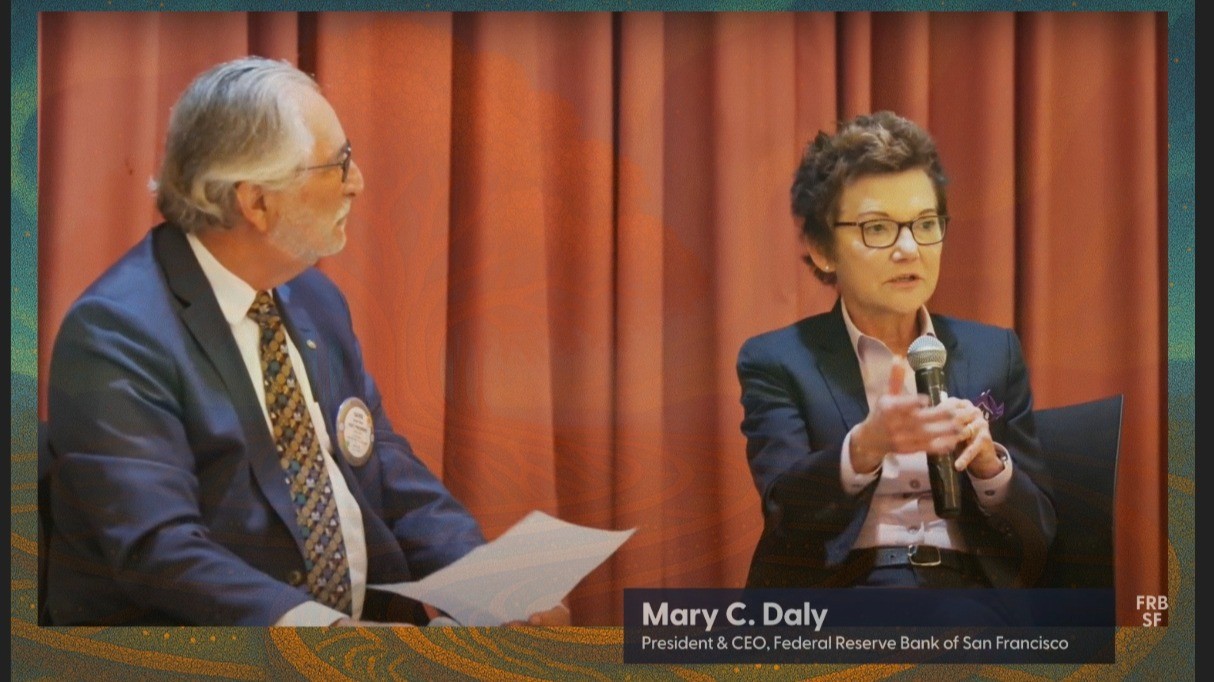
The Rotary Club of Oakland Rotary Club of Oakland isn’t typically where you’d expect profound insights about artificial intelligence and monetary policy to intersect. Yet last Thursday, watching Federal Reserve Bank of San Francisco President Mary C. Daly field questions from local business owners, retired CPAs, and civic leaders, something crystallized about the moment we’re living through—one where the most powerful economic institutions are grappling with technological forces that defy traditional frameworks.
“Data is a plural word. It’s not a singular word,” Daly emphasized, her voice carrying the weight of someone who has navigated multiple economic crises. “And it is not just the headlines you see on inflation and unemployment. It’s all the information that myself and the other 11 reserve bank presidents and everyone at the board of governors collects from our businesses and our communities and our civic leaders that tell us how the economy has been but also where it’s headed.”
This wasn’t academic theorizing. This was a central banker acknowledging that in an era of accelerating change, the Fed’s traditional models need augmentation from human intelligence networks—a recognition that feels particularly prescient as generative AI reshapes how we gather, process, and act on information.
The Personal Algorithm of Economic Policy
Daly’s personal story reads like a case study in adaptive intelligence. Transitioning out of high school at 15 to support her family, earning a GED, then ultimately completing a PhD in economics from Syracuse University before becoming one of the most influential economic voices in America. It’s a trajectory that embodies the kind of continuous learning and adaptation that organizations across sectors are now confronting in the AI age.
“I came of age in the late ’70s and early ’80s, watching my parents and everyone in our community struggle with high inflation and then struggle with the recession that was required to bring that inflation down,” she reflected. “That experience taught me that you really want to try to get ahead of these problems before they get there.”
This framework—anticipating disruption rather than merely reacting to it—feels particularly relevant as businesses and institutions navigate the AI transition. The Fed’s approach of gathering intelligence from diverse human networks while maintaining analytical rigor offers a template worth examining.

The Divine Coincidence and the AI Paradox
When the moderator pressed Daly on how the Fed balances its dual mandate of price stability and full employment, she introduced what economists call the “divine coincidence”—those periods when monetary policy can achieve both goals simultaneously with a single tool.
“Sometimes they’re aligned, but not always,” she explained. “When there’s tension, we evaluate trade-offs over time. Monetary policy has lag effects—it may take 18 months for a rate change to work through the economy.”
This temporal complexity mirrors challenges facing organizations implementing AI systems. The technology promises to enhance both productivity (economic growth) and employment (through augmentation rather than replacement), but the timing and interaction effects remain uncertain. Financial institutions, in particular, face this paradox acutely—AI can improve risk assessment and customer service while potentially displacing traditional roles.
A small business owner from Oakland captured this tension perfectly: “My clients are very concerned about what’s going to happen. Is there anything you can help me with in how I can communicate with my clients without increasing their fears?”
Daly’s response was both practical and profound: “Talking to your clients, talking to people, telling them what you’re thinking and what you’re struggling with actually really helps.”
Economic Intelligence Networks in Practice
The Fed’s approach to information gathering offers insights for any organization navigating technological disruption. Rather than relying solely on quantitative models, they actively seek qualitative intelligence from businesses across their district.
“I’ve spent a lot of time visiting businesses since the beginning of the year, asking: ‘What are you doing? Here’s all this uncertainty—what are you doing in terms of your plans?’” Daly explained. “What I hear is: ‘We’re just continuing to go forward. If we had a development project we were going to do or business expansion we were going to do, we’re going to do that.’”
But the adaptation is nuanced: “What’s different is that you moderate the tail or the risk distribution on the project. If you thought you might open 15 stores, you might open 10 stores, but that’s not the same as stopping entirely.”
This describes a pattern visible across industries grappling with AI integration—not paralysis, but calibrated experimentation. Organizations are proceeding with core initiatives while adjusting risk profiles and timelines.

The Independence Framework
Perhaps the most intriguing aspect of Daly’s presentation was her discussion of institutional independence amid external pressures. When an audience member asked about recent political pressures on Fed leadership, her response revealed principles that extend beyond monetary policy.
“If you’re in central banking, you really have to know your responsibilities and stick with those, because if we don’t, then Americans suffer,” she stated. “Our work serves every American and countless global citizens.”
This clarity of mission provides a framework for organizations implementing AI systems. Rather than being swayed by technological determinism or market hype, successful AI integration requires similar institutional clarity about core responsibilities and stakeholder impact.
The Measurement Challenge
A particularly revealing moment came when the moderator asked whether the Fed’s century-old dual mandate needed updating for modern economic realities. Daly’s response suggested something profound about institutional adaptation:
“I don’t think it’s a good time to change the mandates. I actually think the mandates are very valuable… When I go out into communities and talk to people about what we do, they care about jobs and they care about inflation.”
Yet she acknowledged evolution in execution: “We review our framework for how we execute on that mandate every five years. We’re in the middle of a framework review right now.”
This distinction—stable mission, evolving methodology—offers a template for organizations integrating AI. The fundamental value proposition may remain constant while the mechanisms for delivering that value transform dramatically.

Human Networks in an AI World
One of the most striking aspects of Daly’s approach is her emphasis on human intelligence networks. Despite having access to sophisticated economic models and vast datasets, she consistently returns to conversations with business owners, community leaders, and civic organizations.
“In all the cities I’ve been to, there are cranes everywhere. In Boise, Idaho, these cranes are dominating the skyline. They are continuing to build,” she observed, describing how ground-truth observations inform policy decisions.
This human-centric approach to intelligence gathering becomes more valuable, not less, as AI systems proliferate. While algorithms can process vast amounts of quantitative data, understanding intent, sentiment, and emerging behaviors still requires human networks and qualitative insights.

The Oakland Perspective
Daly’s bullishness on the Bay Area despite recent challenges offers insights into how leaders think about technological disruption and regional resilience.
“Yes, the pandemic was hard on the Bay Area. No matter where you live, you felt it. But there’s activity coming back, and people have an entrepreneurial spirit. We live in a beautiful place with a highly skilled and educated workforce, and people want to participate.”
This cautious optimism isn’t naive—it’s based on observing adaptive capacity in real time. The same entrepreneurial networks that created previous technology waves are now experimenting with AI applications, from financial services automation to new forms of economic analysis.

Implications for Financial Services and Beyond
The Fed’s approach to managing uncertainty while maintaining institutional credibility offers lessons for financial services companies navigating AI integration. Several patterns emerge:
Distributed Intelligence: Rather than centralizing decision-making in algorithmic systems, successful institutions appear to be augmenting human networks with AI capabilities.
Temporal Complexity: Recognizing that policy changes (whether monetary or technological) have lag effects that require patience and careful monitoring.
Stakeholder Communication: Transparently sharing uncertainty and thought processes rather than projecting false confidence about unpredictable outcomes.
Mission Clarity: Maintaining focus on core responsibilities while adapting methodologies to new technological realities.
The Broader Canvas
What made this conversation particularly compelling was watching a central banker navigate questions that extend far beyond traditional monetary policy. From wealth inequality to civic engagement to small business communication strategies, Daly demonstrated how economic leadership increasingly requires understanding technological and social dynamics that transcend traditional disciplinary boundaries.
When asked about the Fed’s role in addressing inequality, she reframed the question: “What we’ve learned through history is that a durable expansion actually closes gaps. So what the Fed is really doing by following our Congressional mandate—creating a strong and stable economy with price stability and full employment—is we help create the conditions that allow all the other elected officials, businesses, and communities to help close those gaps.”
This systems thinking—creating conditions for distributed problem-solving rather than attempting direct control—parallels successful AI implementation strategies across sectors.
Looking Forward
As organizations across industries grapple with AI integration, the Fed’s approach offers a compelling framework: maintain institutional clarity, gather intelligence from diverse human networks, acknowledge uncertainty while taking principled action, and adapt methodologies while preserving core mission.
The conversation in Oakland suggested that the most successful institutions won’t be those that replace human judgment with algorithmic systems, but those that thoughtfully combine human intelligence networks with technological capabilities to better serve their stakeholders.

Perhaps the most profound insight came not from Daly’s prepared remarks, but from her response to the small business owner worried about communicating with anxious clients: “It’s a time for us as humans to have more conversation, not less conversation.”
In an age of artificial intelligence, that might be the most human—and most economically valuable—wisdom of all.
https://bsky.app/profile/schwentker.bsky.social/post/3lqitmyomlk2r