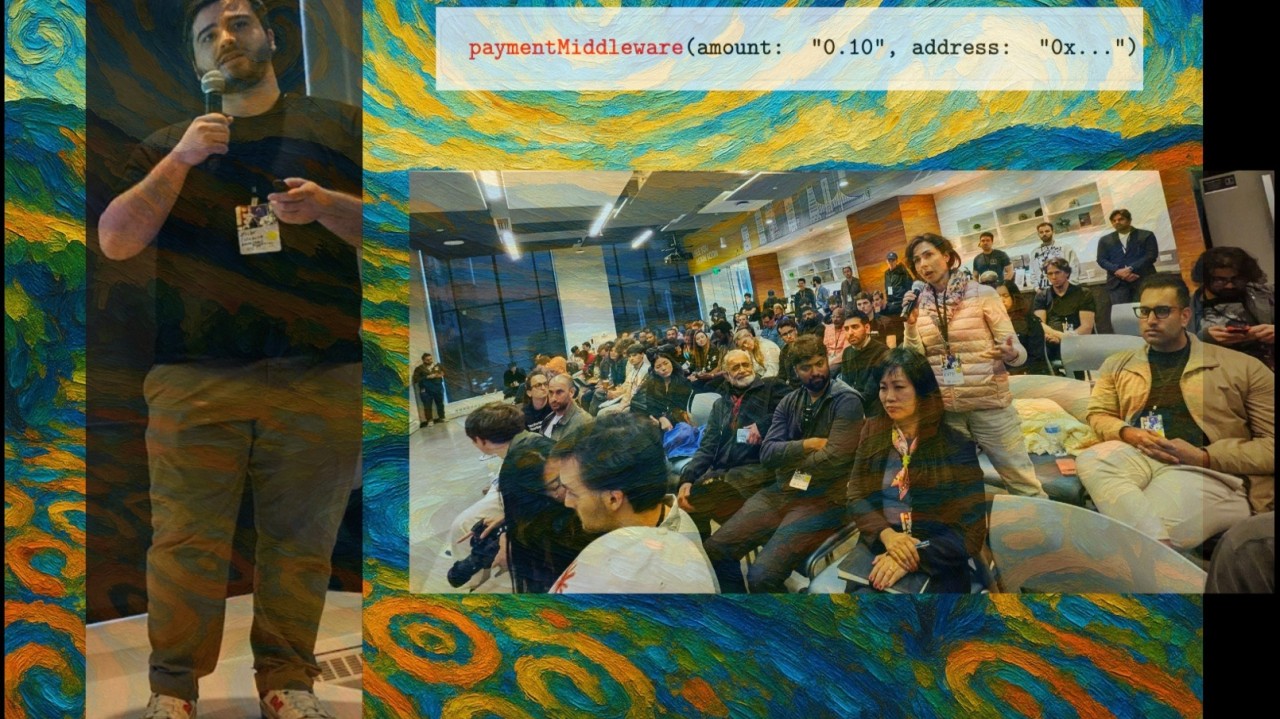
“The files are in the computer.” With that half-joking, half-urgent invocation of Zoolander, Erik Reppel—Head of Engineering for Coinbase Developer Platform—opened his talk at the AWS GenAI Loft by proposing a foundational reboot of the internet itself. But this was no retro trip. Instead, Erik brought the audience into a lucid, and at times sobering, view of a world rapidly hurtling toward autonomous software agents and probabilistic interactions—without the infrastructure to support them.
This wasn’t a product pitch. It was a call to reimagine protocols at the very bedrock of the web.
From HTML to Agents: The Legacy of Human-Centric Design
The internet, Erik reminded us, was engineered for people. It was standardized through HTML and HTTP for rendering content to human eyes—“specifically to display information for humans,” he said. Web 1.0 gave us the static web. Web 2.0 brought in interactivity via JavaScript, JSON, and the now-ubiquitous ability to write into databases. But in both cases, the experience centered around human initiation.
Today, as Erik Reppel pointed out, “computers are no longer waiting for humans to initiate something.” AI agents, LLMs, and autonomous routines are beginning to navigate and act across digital landscapes. Yet the digital terrain they operate on is deeply hostile to them.
“An LLM sees a page full of HTML,” he explained, “and it’s 600,000 tokens of junk. It costs $7 just to read the page, and it might not even be able to find the needle in that haystack.” He flashed a side-by-side comparison of an HTML page versus the underlying JSON data, underscoring the absurdity: “The data is already in the machine-readable format—we just don’t serve it that way.”
Deterministic Humans vs. Probabilistic Machines
One of Erik’s sharpest insights was the ontological mismatch between traditional software and AI. “If you write code, it does the same thing every time. With an LLM, you’re dealing with probabilities. You might get the right outcome once, and the wrong one the next.”
This introduces fragility in agent-based workflows. Agents must parse poorly structured data, navigate inaccessible UIs, and cope with non-standardized inputs—particularly around one critical element: payments.
“Payments are the worst part of the internet,” Erik declared, “and the most important.” He displayed a standard 14-field checkout form: a UX nightmare for humans and an impenetrable maze for agents. Even the best modern payment workflows are still tailored around logged-in returning users—not autonomous actors.
Enter x.402: A Payment Protocol for the Agentic Web
The heart of Erik’s presentation was the unveiling of x.402, an open protocol for internet-native payments. Named after the long-dormant HTTP status code 402—“Payment Required”—the standard proposes a compact, browser- and agent-friendly method of handling financial exchanges.
“We’ve had this status code since HTTP 1.1,” Erik said. “It’s been reserved for future use. That future is now.”
x.402 encapsulates:
-
A standardized HTTP response header to signal payment is needed
-
A JSON body explaining how to pay
-
A signature scheme to validate the transaction request
-
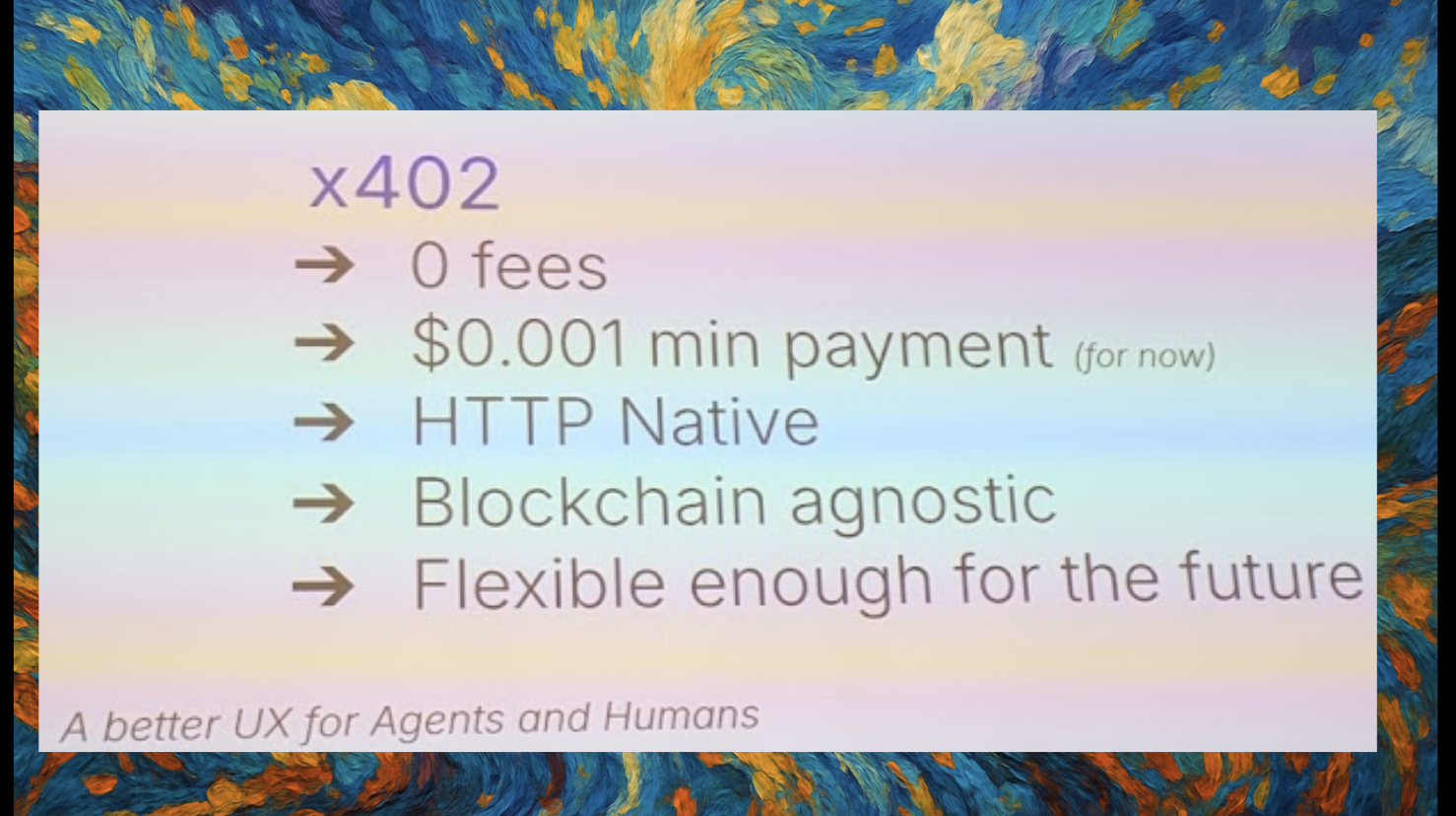
A blockchain-agnostic design: use crypto, credit cards, or future programmable money tools
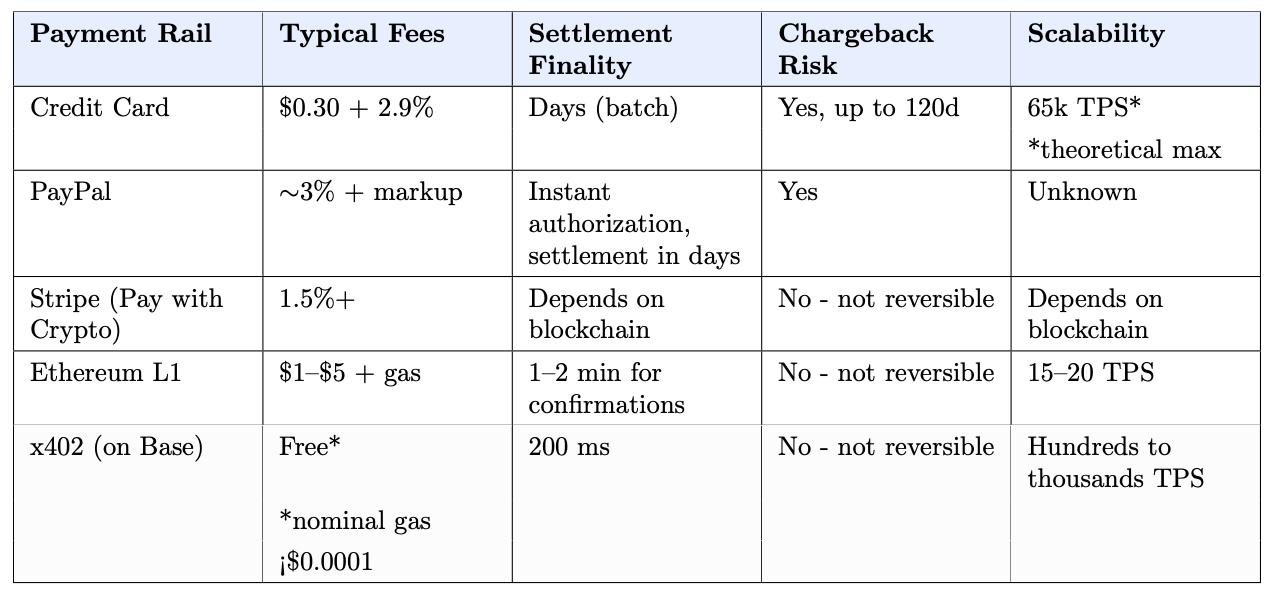
“It takes 14 fields down to three clicks. Zero protocol-level fees. Sub-cent payments. It’s fast—block processing now happens in sub-two seconds. Soon it’ll be 200 milliseconds.”
More provocatively, Reppel said x.402 isn’t just for humans. It’s designed so agents can initiate, fulfill, and confirm payment flows with a single line of code.
Static vs. Dynamic Agents: The Next Battlefront
Right now, most AI agents are static—they’re provisioned with fixed tools. Coinbase’s platform is pushing toward dynamic agents: self-configuring AI that selects tools in real time based on task demands.
Using x.402, he demonstrated a dynamic agent executing a meta-task: “Tell me a joke about the weather and the S&P 500.” The agent was able to:
-
Discover it needed tools for real-time financial data and weather
-
Select an HTTP tool requiring payment
-
Execute the request using x.402
“The immersion property of LLMs is real. They can reason. What they lack is structured capability. Standards like x.402 let us bridge that gap.”
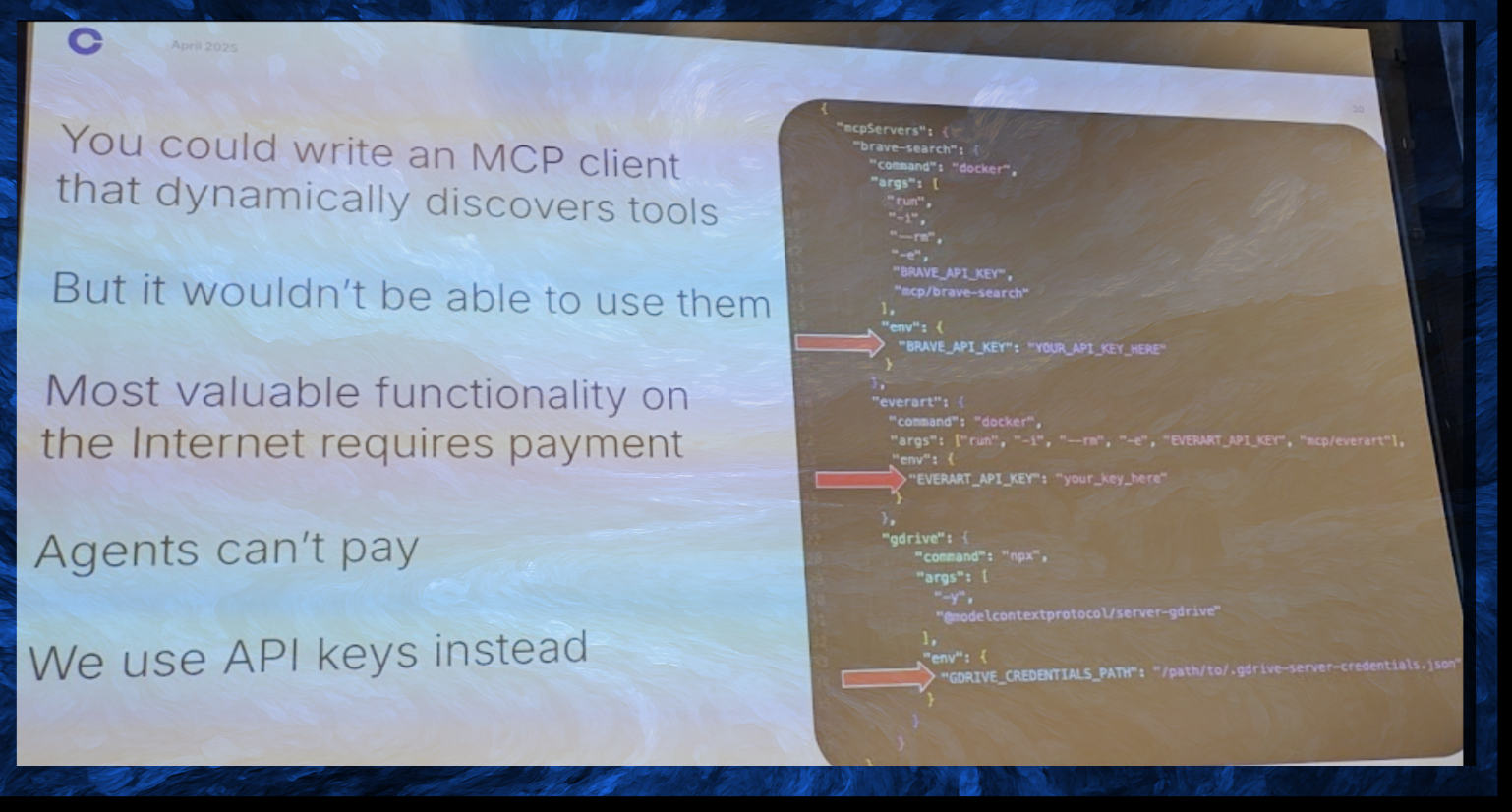
But even here, challenges remain: “Agents today can’t consistently provision API keys. MCP (Model Context Protocol) solves part of the access pattern problem, but it doesn’t handle discovery, authentication, or payment. x.402 does one thing—but we need many more standards.”
Technical Architecture: How x.402 Works
For the engineers in the room, Erik broke down the technical implementation:
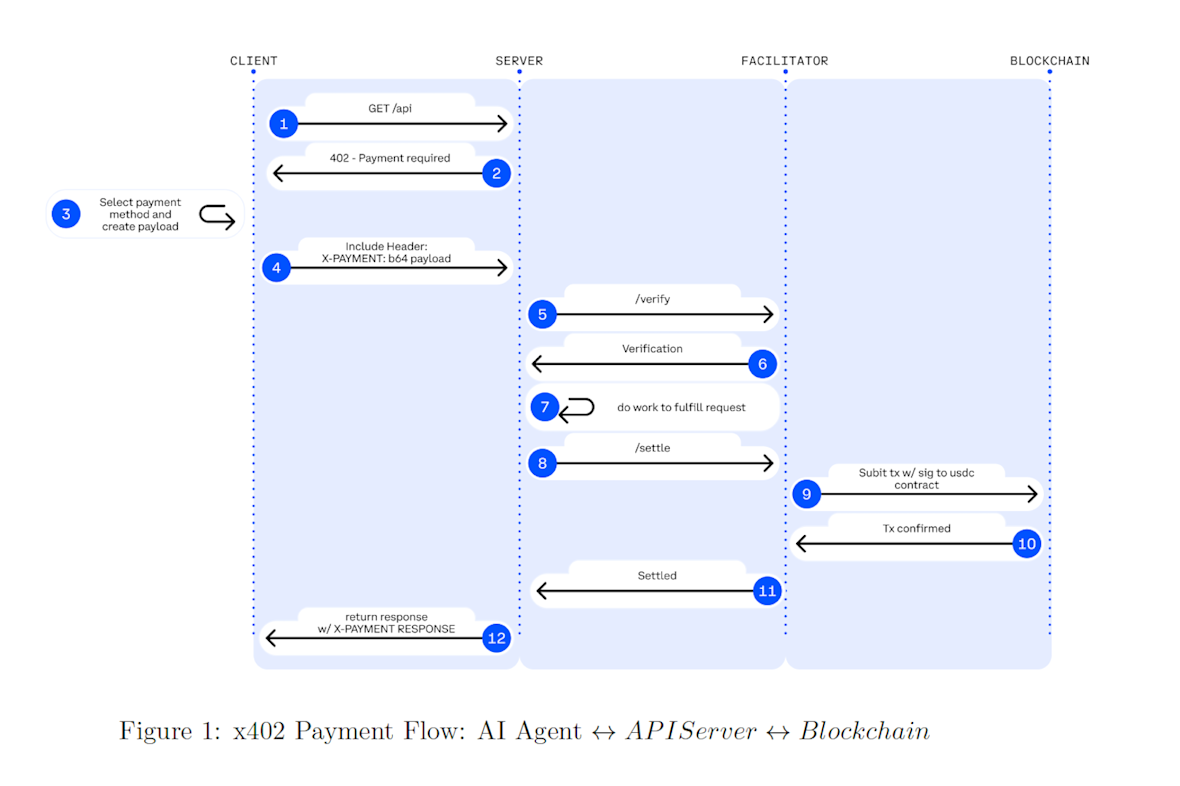
The x.402 protocol introduces a 402 HTTP status code response along with a standardized JSON body that communicates payment requirements. When a server requires payment, it sends this response, which includes a header continuity feature to ensure request integrity and a signature mechanism that validates the transaction request.
Crucially, the protocol abstracts away the settlement layer, allowing developers to integrate payment functionality without worrying about the underlying infrastructure that actually processes the transaction. “You just have a nice clean integration API,” Reppel explained.
The implementation is blockchain-agnostic but currently uses crypto rails because, as Erik noted, “they’re the most internet-native for now.” However, he emphasized that the standard is flexible enough to accommodate future evolution of digital payment methods.
The Philosophical Underpinnings
Throughout his talk, Erik gestured toward a deeper philosophical shift. The transition from deterministic to probabilistic computing represents more than just a technical evolution—it’s a fundamental reconceptualization of how software engages with the world.
“The original sin of the internet,” Erik said, quoting Marc Andreessen, “was that they didn’t bake in economics natively to the web.” This missing layer has hampered the development of autonomous agents capable of independently navigating economic systems.
By standardizing payment protocols, x.402 attempts to rectify this original omission. It positions payment as a first-class citizen of the internet, rather than an awkward bolt-on that requires human mediation.
Implications for Stakeholders
For technology strategists and board-level executives, Erik’s presentation hints at a pivotal shift: the gradual transition from human-mediated to agent-mediated transactions. Organizations structured around human-centric web interfaces may find themselves at a disadvantage as agentic interactions become more prevalent.
For developers, x.402 offers a streamlined way to handle micro-transactions without the overhead of traditional payment systems. The single-line integration for agent-based systems suggests a future where payment processing becomes as trivial as rendering a text string.
For the blockchain community, x.402 represents a bridge between traditional web architecture and crypto-native systems—potentially accelerating adoption by providing a standardized interface for payment interactions.
Looking Ahead: Beyond x.402
The presentation concluded with a call for broader standardization efforts. While x.402 addresses the payment layer, Reppel suggested that similar standards will be needed for discovery, authentication, and other core internet functions if we are to build a truly agent-friendly web.
“It’s not a trade-off,” Erik emphasized. “Making the internet better for agents makes it better for humans too.”
The code for x.402 is open-source on GitHub (github.com/coinbase/x402), and more information can be found at x402.org. Erik invited interested developers to explore the examples, all of which are open-source and available for experimentation.
In the world of agent-based computing, x.402 represents a small but significant step toward reimagining the web not just as a human playground, but as a shared infrastructure for both carbon and silicon intelligence. As Erik noted in his closing remarks, “We’re just getting started.”
Resources:
coinbase.com/en-sg/developer-platform/discover/launches/x402