
The Power Players Behind the Financial Revolution
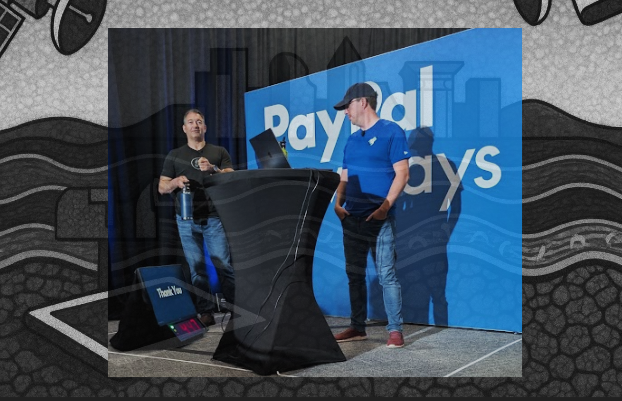
When Ian Barile & Samuel Beard took the stage at Town Square C on April 30, 2025, they weren’t just presenting another fintech innovation—they were unveiling nothing less than the future of money itself. As architects of PayPal’s stablecoin strategy, they brought complementary perspectives to what has rapidly become one of the most successful blockchain implementations in mainstream finance.
“What we think is the next generation of payments is going to be fast, interoperable, inclusive, and 24x7,” declared Barile with characteristic conviction. “PYUSD is 100% backed by USD reserves kept in bankruptcy-remote accounts. Your funds are protected, even in the unlikely event that something happens to us.”
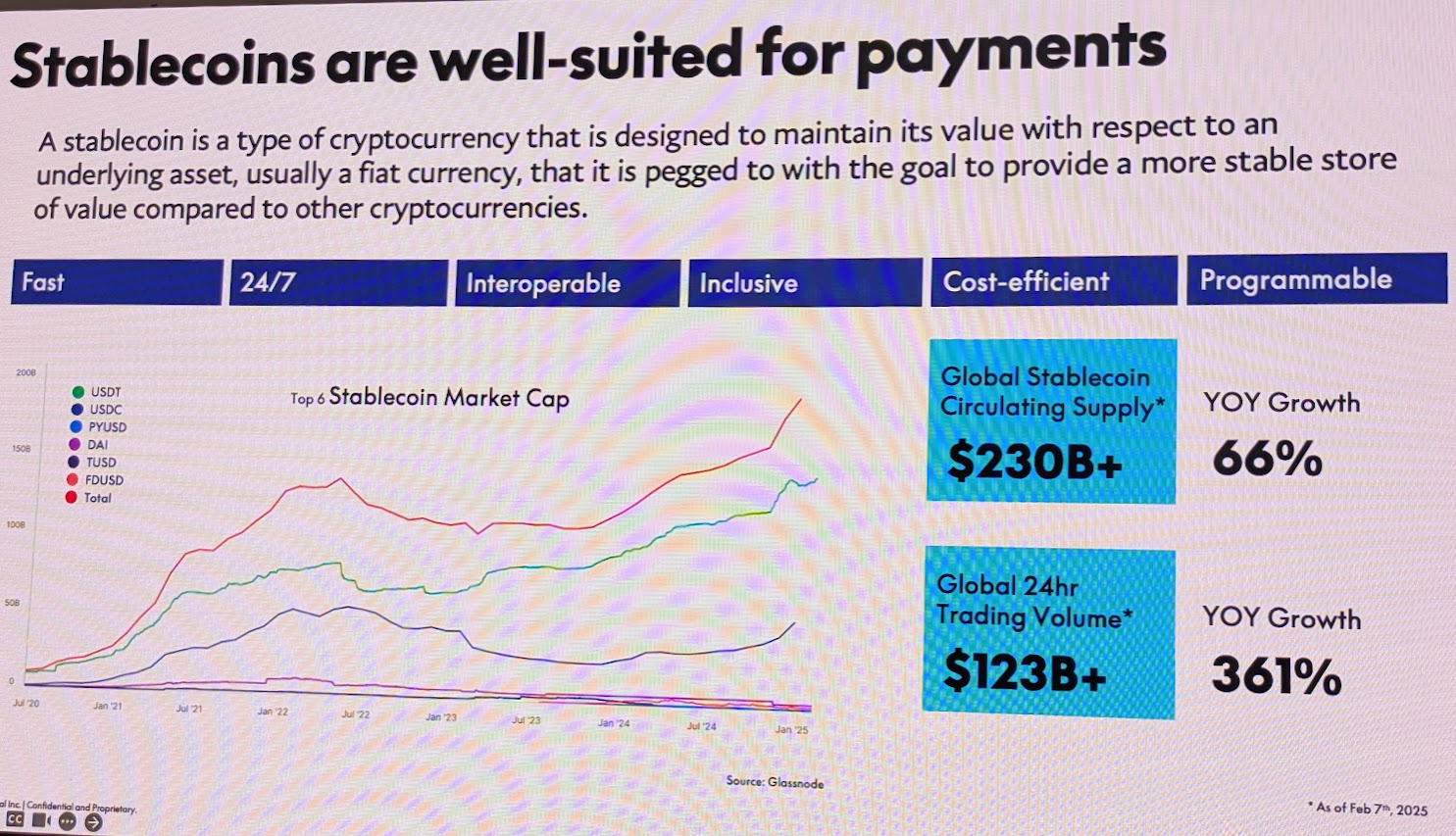
Meanwhile, Beard emphasized the explosive market validation: “Today, we’ve got over 230 billion dollars worth of stablecoins in circulation. In a 24-hour period, 123 billion of that is moving.” These aren’t just numbers—they represent a seismic shift in how value flows through the global economy, with PYUSD positioned at the epicenter.
In partnership with Paxos Trust Company—the regulated entity that issues PYUSD—PayPal has created a digital currency that operates on multiple blockchains while maintaining the regulatory compliance and consumer trust that enterprise adoption demands. This collaboration marries PayPal’s massive network of over 400 million active accounts with Paxos’s blockchain expertise, creating what may become the most widely-used bridge between traditional finance and Web3.
In this article, we’ll explore how PYUSD is transforming business payments today, its growing global adoption, and the real questions businesses are asking about implementing this technology.
Understanding Stablecoins and PYUSD: Beyond the Basics
“Traditional payments systems are run on banks with inter-bank messaging systems,” Barile explained during his presentation. “We really feel that the next generation of payments is going to be done on peer-to-peer networks without a central intermediary.”
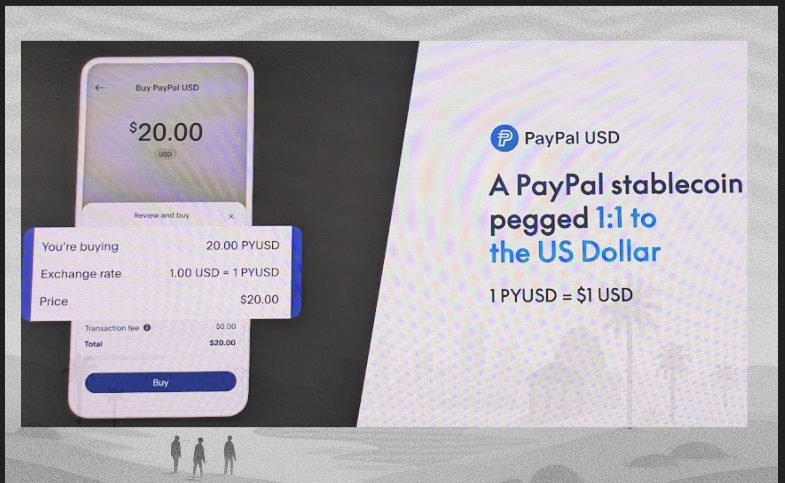
Unlike volatile cryptocurrencies that make headlines with their boom-and-bust cycles, stablecoins represent the practical, business-ready face of blockchain. PYUSD maintains a consistent 1:1 peg to the US dollar—ensuring that 1 PYUSD always equals 1 USD. This stability transforms it from speculative asset to functional money.
What separates PYUSD from the crowded stablecoin market is its enterprise-grade foundation:
-
Fully backed reserves: Every PYUSD token is backed by actual USD reserves held in bankruptcy-remote accounts. As Beard emphasized, these aren’t algorithmic tokens or partial reserves—they’re “carefully protected, audited and regulated” dollar claims.
-
Regulatory legitimacy: Operating under New York Department of Financial Services (NYDFS) oversight—among the most stringent in the nation—PYUSD combines innovation with compliance.
-
Multi-chain architecture: While initially launched on Ethereum, PYUSD now operates on Solana as well, with more blockchain integrations planned. This multi-chain approach expands both utility and reach.
-
Enterprise integration: Unlike peer projects, PYUSD comes integrated with PayPal’s network of 35+ million merchants and processes over $1.2 trillion in annual transactions.
-
Advanced programmability: Smart contracts enable automation of complex financial transactions without intermediaries—from escrow to conditional payments.
As Paxos notes in their documentation, PYUSD offers “near-instant global settlements, low to no-cost transactions, and can be integrated with the most widely used exchanges, wallets, and dApps”—making it a versatile building block for next-generation payment systems.
The Growth of Stablecoins in Global Markets: Data Tells the Story
“We can see today already the benefits that the market sees in stablecoins just from the market cap growth,” Beard explained while pointing to an exponential growth chart. “From 2020 until the beginning of this year, the growth has really been up and to the right, and that’s despite a broader crypto correction in 2022.”
The numbers are staggering: over $230 billion in stablecoin circulation with approximately $123 billion moving in a 24-hour period. This isn’t speculative value—it’s actual commerce and capital flow.
What’s particularly revealing is the regional adoption patterns. Beard highlighted this with compelling data visualization: “In green, we have stablecoins. In orange, we have Bitcoins. And in gray, we have all other cryptocurrencies.”
The chart revealed three distinct patterns:
-
Volatility hedge in emerging economies: “We see big stablecoin uses in areas where underlying fiat currencies are volatile, such as in Latin America, MENA and Africa,” Beard noted. These regions are adopting dollar-denominated stablecoins as practical alternatives to local currencies that may experience significant inflation.
-
Growing mainstream adoption: Even in North America and Western Europe, “where traditionally cryptocurrencies have been seen as an investment vehicle,” stablecoins now account for approximately one-third of transactions—with that percentage growing steadily.
-
Cross-border focus: The data revealed that international payments—particularly those crossing currency zones—have become a primary use case for stablecoins, with PYUSD positioning itself at this intersection of global commerce.
As recently as April 2025, PayPal announced an expanded partnership with Coinbase to “increase the adoption, distribution, and utilization of the PayPal USD (PYUSD) stablecoin,” further accelerating growth. PayPal CEO Alex Chriss described this collaboration as enabling “greater commerce applications,” signaling the company’s strategic focus on PYUSD as a core business technology rather than a crypto experiment.
PYUSD vs. Traditional Payment Rails: A Business Perspective
When comparing PYUSD to traditional payment methods, the advantages become clear:
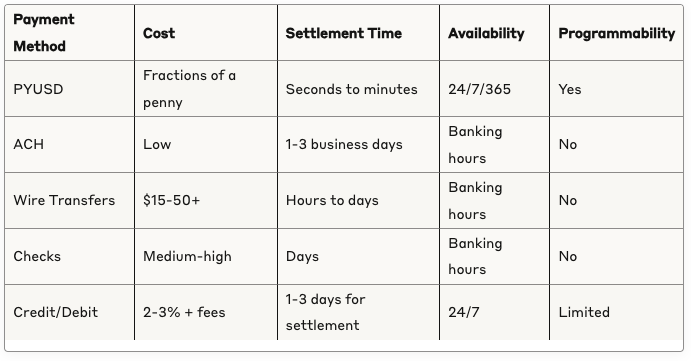
For businesses conducting international transactions, these differences can have significant impacts on operations, cash flow, and customer relationships.
Real-World Business Applications
The practical applications of PYUSD are already being demonstrated across various business contexts:
Cross-Border Remittances
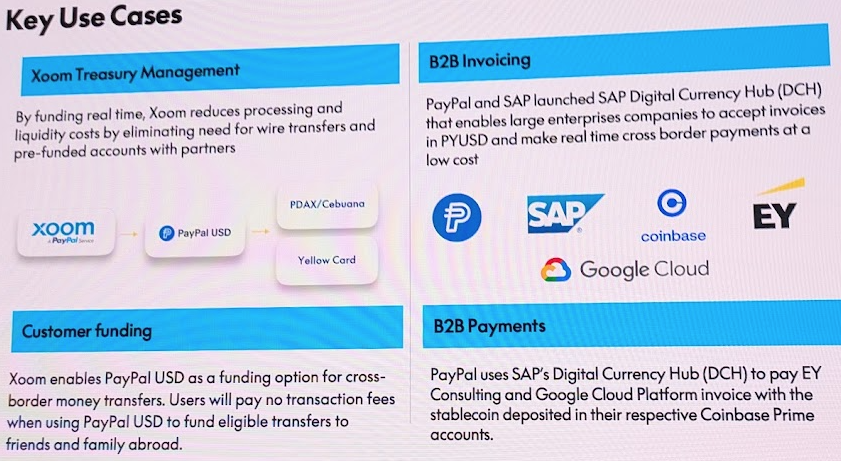
PayPal’s own Xoom international remittance service has implemented PYUSD to solve challenges with pre-funding partner accounts around the world. Previously, the company had to forecast transaction volumes and pre-fund partner accounts well in advance due to processing times. With PYUSD, transfers to partners can be completed in seconds at minimal cost, allowing for real-time adjustments to transaction volume spikes.
Additionally, customers can now pay for Xoom transactions using PYUSD without incurring transaction fees, passing on the cost benefits of blockchain technology directly to users.
B2B Payments and Invoicing
PayPal has partnered with SAP to create the SAP Digital Currency Hub, enabling businesses to invoice and receive payments in PYUSD. Major companies including Google and EY have already utilized this system for invoice payments, demonstrating enterprise-level adoption.

Small Business Case Studies
Small businesses are finding particular value in PYUSD for international transactions:
Fig Tree Pots (US-based ceramics business): The owner, Renee Giardino, highlighted how banking delays when sourcing supplies internationally can be “catastrophic” for a small business. Transaction fees of 3-5% significantly impact slim profit margins. PYUSD enables better budgeting, scaling opportunities, and the ability to accept international wholesale orders that were previously impossible due to payment complications.
Win-Win Coffee (New York-based coffee importer): This social enterprise focuses on connecting coffee producers from countries of the African diaspora with global markets. For agricultural commodity trading, the speed of settlement is crucial for building trust with producers. PYUSD enables faster, more transparent transactions with producers who may have internet access but lack traditional banking infrastructure. The stability of receiving payment in a dollar-pegged asset helps producers plan for the future and obtain better pricing.
What the Audience Asked: Real Questions from Businesses
What made a recent PYUSD information session particularly valuable was the transparency with which PayPal addressed audience concerns. Here are several of the most insightful questions—and answers—that emerged during the Q&A portion, offering a window into what businesses are really wondering about stablecoin adoption.
Q1. Can PYUSD help me avoid chargebacks and protect against fraud?
A: Blockchain transactions are final—there’s no built-in chargeback mechanism like credit cards. Merchants must build protections into their own systems or rely on escrow contracts (which PayPal may support in the future). The trade-off: less fraud risk, but more buyer-side diligence.
Q2. Can I use PYUSD at checkout today?
A: Yes, but with a caveat. When used on PayPal, PYUSD is converted to fiat at the point of sale—so merchants receive dollars, not crypto. Still, customers holding PYUSD can pay directly. Watch this space for direct merchant PYUSD acceptance in future.
Q3. What happens if Ethereum or Solana fails? Do my PYUSD tokens disappear?
A: No. PYUSD is backed by fiat in segregated accounts. If a blockchain were deprecated, customers could still reclaim funds by verifying token ownership and redeeming from the reserve. PYUSD is not “minted money”—it’s a tokenized claim on a dollar.
Q4. How do I accept PYUSD if I’m an overseas recipient unfamiliar with crypto?
A: You don’t need to be. PayPal’s system still delivers fiat to the end-user (e.g., local currency in India or Kenya). PYUSD may only be used behind the scenes for faster intermediation. This preserves user experience while upgrading infrastructure.
Q5. Is PYUSD FDIC insured?
A: Not exactly. FDIC insurance applies to individual deposits at insured banks, up to $250,000. PYUSD funds are not FDIC-insured—but they are held in bankruptcy-remote, low-risk instruments (e.g., short-term Treasuries), as mandated by the NYDFS. That provides a strong layer of protection, but it’s not the same as government insurance.
Q6. Will PayPal offer escrow smart contracts for large B2B deals?
A: Not yet—but it’s on the internal roadmap. PayPal’s product teams are exploring smart contract-based applications for things like supply chain arbitration, milestone-based payments, and cross-border trust layers. No launch date confirmed.
Q7. What’s PayPal’s incentive? How do they make money on PYUSD?
A: PayPal does not “print money” like a central bank. Each PYUSD is backed 1:1 by a dollar in reserve. PayPal may benefit from the float on those reserves (as many stablecoin issuers do) and from expanded services layered on top of the stablecoin network.
Additional Common Questions
How is PYUSD different from traditional PayPal payments?
While PayPal already enables digital transactions between users within its ecosystem, PYUSD leverages blockchain technology to enable transactions outside the PayPal ecosystem with the same benefits of speed, security, and low cost. Users can store PYUSD in external blockchain wallets and transact with any entity accepting PYUSD, not just PayPal users.
How does PYUSD handle exchange rates in international transactions?
For international remittances, PYUSD is still subject to USD to local currency conversion rates when recipients need local currency. However, in areas where recipients prefer to receive and hold USD-pegged assets (such as suppliers who need to purchase USD-denominated equipment), PYUSD can eliminate the need for currency conversion altogether. Recipients can hold PYUSD indefinitely and are not required to immediately convert to local currency.

The Future of PYUSD: From Experiment to Infrastructure
When PayPal and Paxos launched PYUSD in August 2023, skeptics questioned whether a corporate stablecoin could gain traction in a market dominated by earlier entrants. Less than two years later, PYUSD has surpassed $1 billion in market capitalization and continues to accelerate.
“The shift toward digital currencies requires a stable instrument that is both digitally native and easily connected to fiat currency like the U.S. dollar,” said Dan Schulman, former president and CEO of PayPal during the initial launch. “Our commitment to responsible innovation and compliance, and our track record delivering new experiences to our customers, provides the foundation necessary to contribute to the growth of digital payments through PayPal USD.”
This trajectory suggests we’re witnessing just the beginning of PYUSD’s impact, with several developments on the horizon:
-
Expanded blockchain integrations: Beyond Ethereum and Solana, additional blockchain networks are being evaluated to increase interoperability and reach.
-
Smart contract escrow services: While not on the “near-term roadmap” according to Beard, there’s clearly internal excitement about leveraging PYUSD for automated escrow in supply chains and cross-border commerce.
-
Accounts payable/receivable integration: The partnership with SAP is just the beginning, with further enterprise software integrations planned.
-
Direct merchant acceptance: The current model converts PYUSD to fiat at checkout, but direct merchant acceptance of PYUSD would eliminate another layer of friction.
-
Coinbase partnership expansion: The April 2025 announcement with Coinbase signals broader institutional adoption and distribution.
Conclusion: The Stablecoin Revolution Is Already Here
As current PayPal leadership continues to build on Schulman’s vision, PYUSD has evolved from an innovative concept to essential financial infrastructure.
What makes PYUSD particularly significant isn’t just its technological foundations, but its mainstream positioning. This isn’t a crypto-native project hoping to achieve mainstream adoption—it’s a mainstream financial product leveraging blockchain technology to solve practical business problems.
When Renee Giardino of Fig Tree Pots laments turning down “a really significant wholesale from Dubai” due to payment complications, or when Win-Win Coffee highlights how PYUSD enables coffee producers in developing nations to “plan for the future and take better pricing in,” we see the transformative potential beyond technical specifications.
The recent expansion of PayPal’s partnership with Coinbase (April 2025) further validates this trajectory, with Coinbase platforms now providing fee-free purchases and easy 1:1 redemption of PYUSD while the companies jointly explore new payment use cases. This collaboration between two financial technology leaders signals growing institutional confidence in stablecoin utilities.
PYUSD represents the maturing of blockchain from experimental technology to essential business infrastructure. By addressing the core challenges of traditional payment systems—speed, cost, accessibility, and programmability—PYUSD is helping businesses of all sizes overcome financial barriers that have persisted for decades.
For forward-thinking business leaders in specific sectors—particularly those involved in cross-border commerce, remittances, or serving customers in regions with currency volatility—stablecoins like PYUSD represent one potential path to addressing longstanding payment friction. However, blockchain integration remains just one of many strategic options rather than an inevitable necessity.
Organizations should carefully evaluate whether stablecoin implementation aligns with their specific business needs, customer expectations, and regulatory environment before determining if, when, and how to incorporate this technology into their financial infrastructure. As with any emerging technology, the right approach will vary significantly across industries, business models, and regions.
This article is based on information presented at the “Blockchain Fundamentals: Practical Business Applications with PYUSD” event on April 30, 2025, and supplemented with data from Paxos (paxos.com/pyusd) and recent PayPal announcements. The Dan Schulman quote comes from the original PYUSD launch announcement on August 7, 2023: https://newsroom.paypal-corp.com/2023-08-07-PayPal-Launches-U-S-Dollar-Stablecoin
Further Reading & Technical Resources
For those interested in exploring PYUSD implementation details:
-
Original PYUSD Launch (August 7, 2023): PayPal Launches U.S. Dollar-Backed Stablecoin - The original announcement detailing PayPal’s stablecoin strategy.
-
Paxos PYUSD Hub: paxos.com/pyusd - Comprehensive information on PYUSD’s technical architecture, reserve composition, and regulatory compliance.
-
Paxos News Release: PayPal Launches US Dollar-Backed Stablecoin - Paxos perspective on the strategic partnership.
-
Coinbase & PayPal Partnership (April 24, 2025): Coinbase Blog - Coinbase and PayPal to Advance Stablecoin Payments - This partnership expands PYUSD adoption with 1:1 USD conversions across Coinbase platforms.
-
PYUSD Price & Market Data: Coinbase PYUSD Price - Real-time market data and trading information.
-
PYUSD Technical Implementation: The PayPal Developer Blog (January 25, 2024) provides detailed specifications of PYUSD’s architecture using Ethereum’s ERC-20 standard.
-
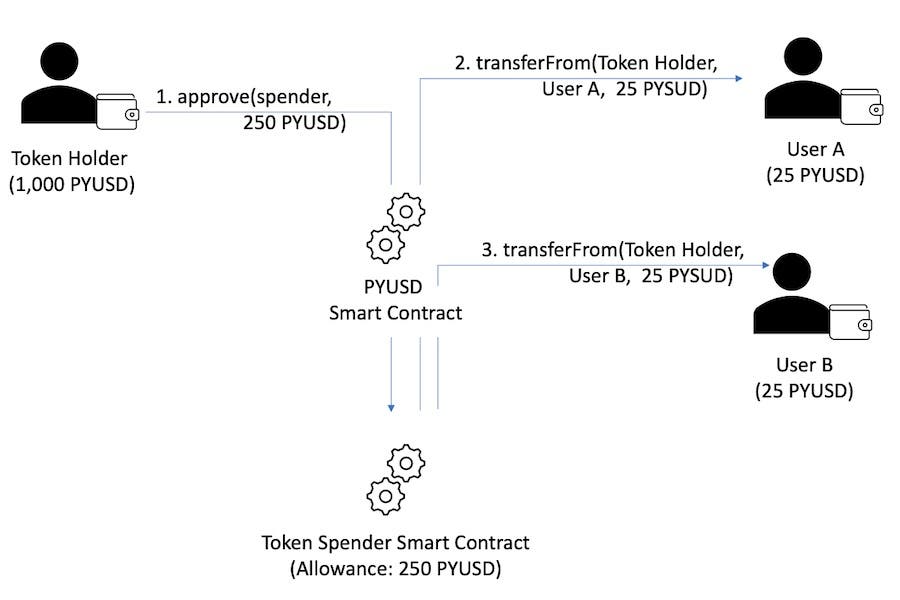
Smart Contract Details: PYUSD is deployed on Ethereum mainnet at 0xe0A8ED732658832Fac18141AA5AD3542e2EB503B and utilizes three primary functions for transfers: transfer, approve, and transferFrom (as illustrated in the technical diagram).
https://bsky.app/profile/schwentker.bsky.social/post/3locmqx3oj22y