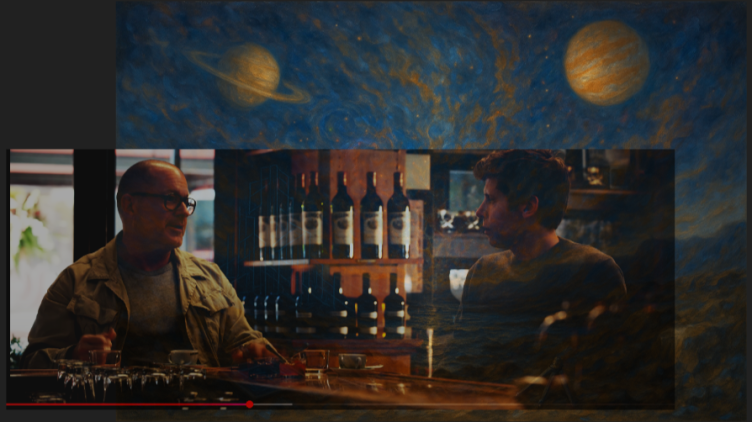
Strategic intelligence from the convergence of OpenAI and LoveFrom
The Vision Crystallizing
When Jony Ive says “this is the best work our team has ever done”—coming from the designer of the iPhone and MacBook Pro—and Sam Altman responds that their prototype is “the coolest piece of technology that the world will have ever seen,” we witness something unprecedented: two individuals who have fundamentally shaped how humanity interacts with technology describing a breakthrough that could redefine computing itself.
This carries the weight of more than hyperbole. It represents the articulation of a vision that has been building for two years, rooted in what might be considered a simple but profound observation from Altman: “We have, like, magic intelligence in the cloud. If I wanted to ask ChatGPT something right now about something we had talked about earlier, think about what would happen. I would like reached down. I would get on my laptop, I’d open it up, I’d launch a web browser, I’d start typing, and I’d have to, like, explain that thing… And that is at the limit of what the current tool of a laptop can do. But I think this technology deserves something much better.”
The Foundational Partnership
The genesis reveals something crucial about how transformational technology emerges—not through grand design, but through those rare moments when separate streams of consciousness converge into something larger. Indeed, there is something of clear-eyed assessment in how Ive describes their connection: “We had both a very strong shared vision. We maybe didn’t know exactly where we were going to go, but like, the direction of the force vector felt clear. And then this, like, deeply shared sense of values about what technology should be, when technology’s been really good, when it’s gone wrong.”
Such partnerships possess what thoughtful observers understand as the rare compatibility of mind and purpose—not the passion of first impressions, but the deeper harmony of shared principles. This alignment of values, not merely capability, becomes essential when we consider the scope of what they’re attempting. Altman’s vision from his Sequoia appearance provides the technical framework: “The platonic ideal state is a very tiny reasoning model with a trillion tokens of context that you put your whole life into. The model never retrains. The weights never customize. But that thing can like reason across your whole context… And every conversation you’ve ever had in your life every book you’ve ever read every email you’ve ever read… everything you’ve ever looked at is in there.”
The Generational Shift Already Happening
What renders this particularly compelling is that the future Altman and Ive are designing for is already emerging organically—like shoots of new growth appearing before the gardener notices the change in season. As Altman observes: “People in college use it as an operating system. They have complex ways to set it up to connect it to like a bunch of files and they have like fairly complex prompts memorized… they don’t really make life decisions without asking like ChatGPT what they should do… and it has like the full context on every person in their life.”
The io device appears designed to make this kind of intimate, contextual AI interaction effortless rather than requiring technical sophistication—perhaps democratizing what currently demands expertise in ways that echo democratic ideals, yet with careful attention to human dignity that insists upon meaningful progress.
The Democratization Imperative
Ive’s design philosophy becomes crucial here, carrying faith in human potential, though tempered with awareness of life’s smaller, profound moments: “I want this to be democratized. I want everybody to have it. I don’t want it to be the tiny percentage of the population that figures out how to use bad tools, and is really smart. I want anybody to say, hey, I have this idea. Make it happen.”
This transcends mere accessibility—it suggests a recognition that when technology becomes truly personal, the quality of that relationship becomes existential. There is an understanding here that the most powerful forces often work in quiet intimacy rather than grand gesture. The care with which it’s designed determines whether it enhances human agency or diminishes it, much as thoughtful observers understand that our tools shape us even as we shape them.
The Infrastructure Transformation
The broader implications become clear when we consider Altman’s vision for how this integrates with the digital ecosystem: “I really hope that all of this merges into one thing like you should be able to sign in with OpenAI to other services. Other services should have an incredible SDK to like take over the ChatGPT UI at some point… you’ll want to be able to use that in a lot of places.”
This suggests not merely a new device, but perhaps a new protocol layer for human-computer interaction—where our personal AI context could become portable infrastructure across all digital experiences, creating what might be understood as a kind of digital continuity of being. There is something here that recalls the understanding that the most profound changes often occur not through revolution but through the gradual evolution of manners and expectations.
The Logic of Presence
In a world where intelligence suffuses every touchpoint, what defines an experience is not just the data behind it, but the logic of its presence. The system’s ability to know when to appear, and when not to, becomes a new design challenge—one that blends engineering fluency with the moral clarity of design leadership. Behind every invisible interface lies an invisible architecture of decisions—shaped not just by algorithms, but by systems of judgment that hold the line on what makes an experience feel intentional, human, and coherent.
The Responsibility Recognition
Perhaps most tellingly, Ive’s observation about Altman reveals the weight both understand, with the clarity that comes from years spent crafting tools for millions: “The responsibility that Sam bears is— actually, is honestly beyond my comprehension… But what really struck me is what he’s worrying about is not himself and it’s not his company. What I see you worrying about are other people, are about customers, about society, about culture. And to me, that tells me everything I want to know about someone.”
This matters because they appear to be building more than just a product—they’re architecting intimacy at scale. When AI has access to our entire life context, the intentions and values of its creators become foundational to human flourishing, carrying the kind of moral weight that accompanies true influence. There is something here that recognizes the deepest human connections: that with intimacy comes an almost sacred responsibility.
The Productivity Revolution Preview
The impact is already visible in early adopters, manifesting in ways that would have delighted those who appreciate practical results. As Altman describes: “You talk to people who use our latest model and say, this is, like, genius-level in every field… they report, I’m two or three times more productive as a scientist than I was before. I’m two or three times faster to find a cure for cancer than I was before, because I have this incredible external brain. That just didn’t exist six months ago.”
The io device might make this kind of cognitive augmentation as natural as reaching for a phone—transforming the willing suspension of disbelief into a willing expansion of capability. Yet there remains something that recognizes the mind’s extraordinary capacity: that consciousness itself is wider than the sky.
The Timeline of Transformation
Altman’s predictions from Sequoia suggest we’re approaching a cascade of capability that unfolds with the inexorable logic of well-plotted narrative:
“2025 will be a year of sort of agents doing work. Coding in particular I would expect to be a dominant category… next year is a year where I would expect more like AI discovering new stuff and maybe we have AIs make some very large scientific discoveries… 27 I would guess is the year where like that all moves from the sort of intellectual realm to the physical world.”
The io launch appears positioned at what might be the inflection point where AI transitions from tool to companion—a transformation that echoes paradigm shifts in understanding, yet carrying the emotional weight of any genuine transformation of human experience.
The Design Question That Defines Everything
Ive’s core insight frames the ultimate challenge with the moral clarity that marks great design thinking: “If you’re trying to have a sense of where you are going to end up, you shouldn’t look at the technology. You should look at the people who are making the decisions, and you should look at what drives, motivates, and look at values.”
Perhaps we can build technology that knows everything about us but doesn’t manipulate us? That remembers our patterns but helps us grow? That amplifies our capabilities without replacing our agency? These questions carry the weight of authentic progress, yet also echo the keen understanding that character, not circumstance, ultimately determines outcome.
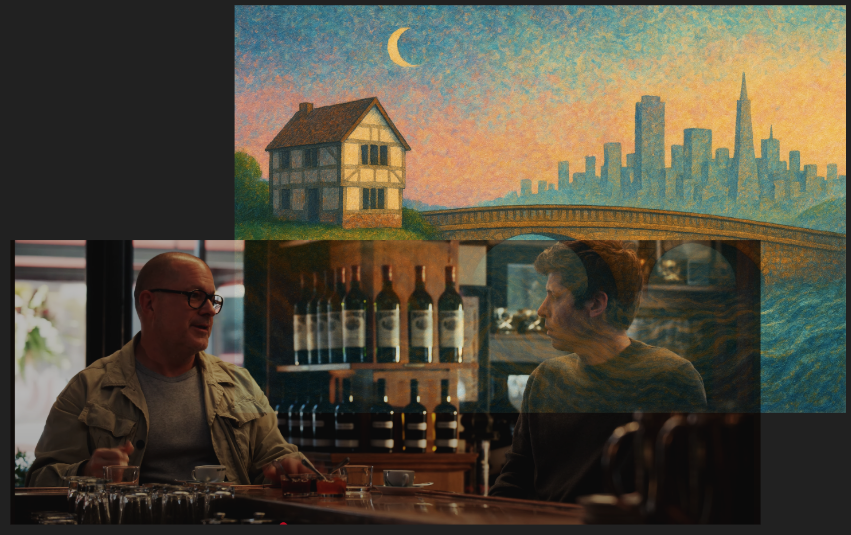
The San Francisco Context
The partnership emerges from what Ive calls San Francisco’s unique culture: “You don’t get to pick and choose freedom. Either you have like you let creative freedom be expressed in all of its weirdness or you don’t.” This environment of unconstrained creativity becomes essential when attempting to “completely reimagine what it means to use a computer”—the kind of radical reimagining that has always marked the city’s greatest innovations, though tempered with understanding about the relationship between freedom and responsibility.
The Moment of Maximum Leverage
As Ive reflects with the weight of three decades spent at technology’s leading edge: “We are sitting at the beginning of what I believe will be the greatest technological revolution of our lifetimes. I have a growing sense that everything I have learned over the last 30 years has led me to this place, and to this moment.”
There is something here of understanding about life’s pivotal moments—how they arrive not with fanfare but with a quiet certainty, a sense that all previous experiences have been preparing us for this particular threshold. This transcends product development—it represents the convergence of decades of learning about human-computer interaction at a moment when AI might become capable enough to fulfill computing’s original promise: technology that truly serves human flourishing.
The Corporate Implications
For organizations watching this unfold, Altman’s warning from Sequoia carries particular relevance, echoing the kind of institutional inertia observed in large organizations, yet also recalling the dangers of pride and prejudice in the face of necessary change: “There’s another like couple of years of fighting pretending like this isn’t going to reshape everything and then there’s like a capitulation and a last minute scramble and it’s sort of too late.”
The companies that understand this shift early—that begin thinking about how personal AI might change customer relationships, employee productivity, and organizational knowledge—could help define the next decade, much as those who grasped the implications of earlier technological transformations shaped their respective eras.
The Ultimate Vision
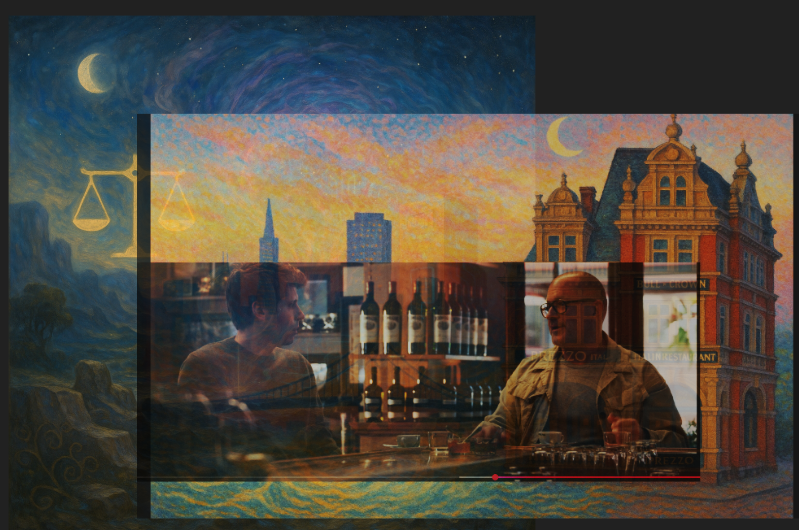
Altman’s ultimate aspiration captures what’s at stake with the kind of generous optimism that has always marked innovation at its best: “I think this will be one of these moments of just an absolute embarrassment of riches of what people go create for collective society. I am absolutely certain that we are literally on the brink of a new generation of technology that can make us our better selves.”
The io moment represents the possibility that AI finally becomes truly personal—not just in capability, but in care. Whether that potential is realized might depend on the values and intentions of those building it, carrying forward the kind of moral responsibility that great innovators have always understood accompanies their work. There is something here that resonates with understanding transformation: that the most profound changes often happen not with thunder, but in the quiet spaces where human intention meets technological possibility.
For global leadership, this represents both invitation and imperative: the future of human-computer interaction appears to be written now, by people who understand that technology’s highest purpose could be human flourishing—the phenomenon of human potential fully realized, yet grounded in the essential truth that lasting change must be built on genuine understanding rather than mere innovation.
The question remains whether we’ll be ready for the world they’re creating, and whether we’ll help shape it toward our highest aspirations rather than our lowest fears—a choice familiar to any who understand that progress without wisdom is merely motion without meaning.
Analysis compiled from the io announcement and public statements at Sequoia Capital and Microsoft Build 2025. Observations represent interpretation of publicly available information for strategic intelligence purposes.Analysis compiled from the io announcement and public statements at Sequoia Capital and Microsoft Build 2025. Observations represent interpretation of publicly available information for strategic intelligence purposes.
https://bsky.app/profile/schwentker.bsky.social/post/3lq4psty6as2i