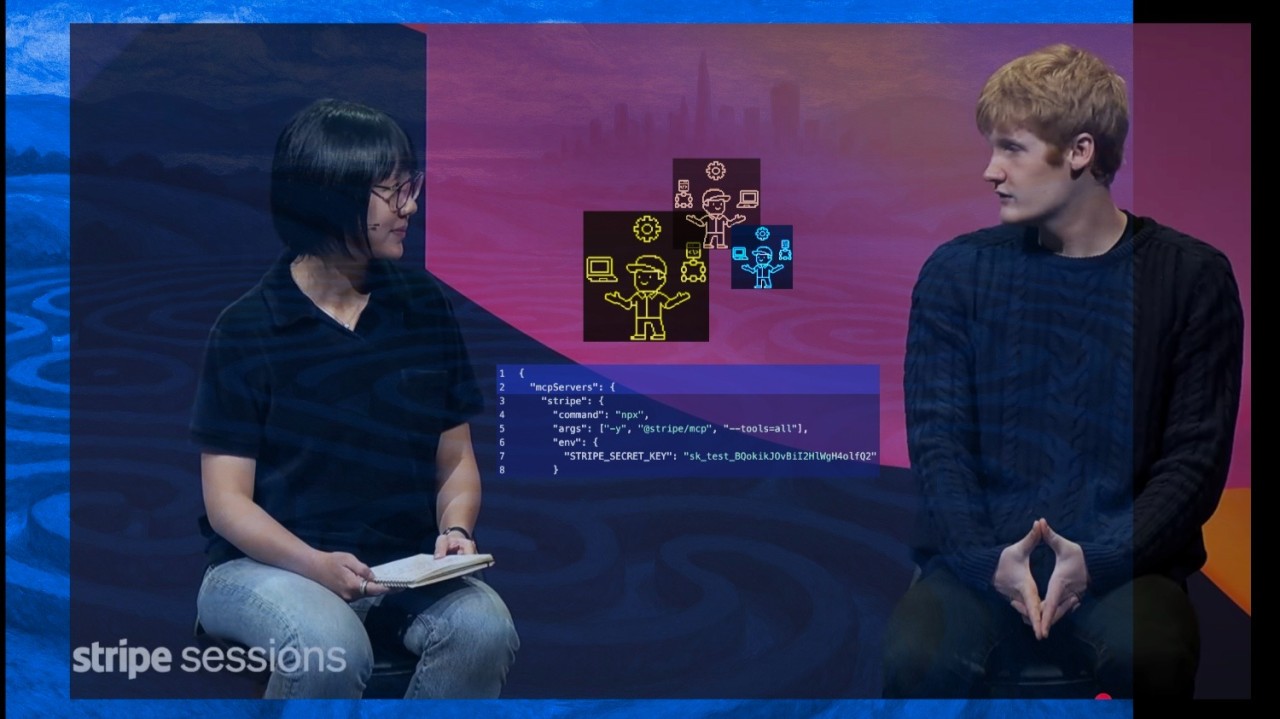
In an era where tech companies race to announce “AI moonshots,” Stripe is taking a refreshingly different approach. “At Stripe, instead of moonshots we think in terms of what we call roof shots,” explained Michelle Bu, Principal Product Architect at Stripe, during the company’s 2025 Developer Keynote. “These are useful, achievable improvements that solve a clear problem today. They’re not speculative bets or multi-year R&D projects. They’re focused, pragmatic changes that ship quickly and make your daily work easier.”
This philosophy of practical innovation over splashy announcements defines Stripe’s evolving developer strategy, unveiled at Stripe Sessions 2025 last week. The payments infrastructure company is betting that thoughtful, incremental improvements addressing real developer needs will ultimately create more value than chasing speculative technological frontiers.
The Developer Experience Challenge
The keynote acknowledged a common frustration among developers: “2025 is such an exciting time to be a developer. There’s so many new tools available to us and so many opportunities to build anything we can dream of,” Bu noted. “And we hear from you that it can be overwhelming. Many of you have told us that you’re juggling more responsibilities than ever before, from mastering these new AI capabilities to managing increasingly complicated infrastructure all while you’re trying to ship quality code faster.”
This recognition of developer overload forms the foundation of Stripe’s three-pronged approach:
-
Enabling developers to “spend more time building things that differentiate your business and less time implementing one-off processes.”
-
Making Stripe “fit seamlessly into your existing tools and systems without writing and maintaining fragile glue code.”
-
Providing “AI tools that automate the repetitive parts of being a developer while still leaving you in control of what matters, which is the creative problem solving that is why we became software developers in the first place.”
AI as Amplifier, Not Replacement
Rather than promising AI will replace human judgment, Stripe positions it as a tool for amplification. “What we’ve learned is that AI isn’t about replacing human judgment. It’s about amplifying it,” Bu explained. “AI can’t replace those thoughtful design discussions about trade-offs, but LLMs are incredibly good at reducing cognitive load, especially when it comes to synthesizing a large amount of information and helping us find patterns across that information.”
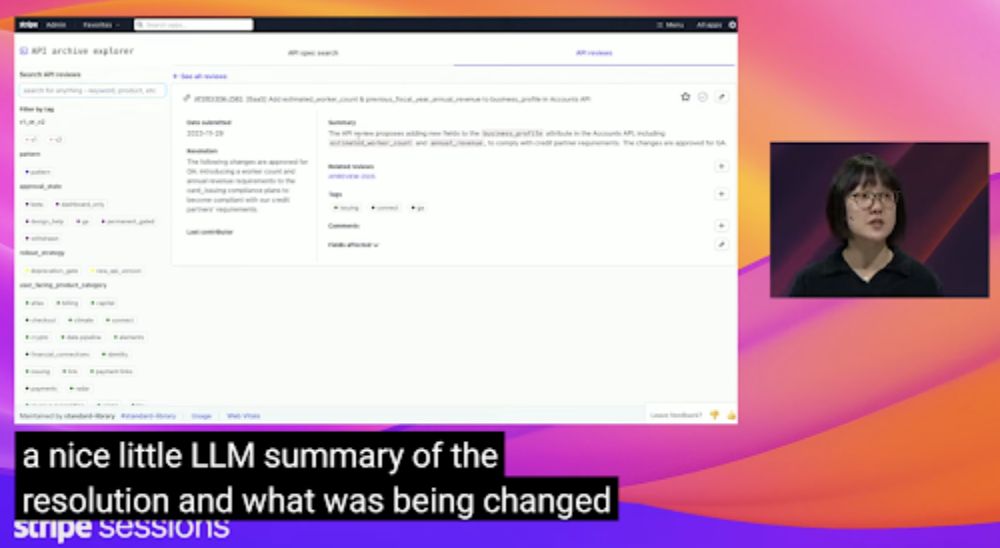
A compelling example comes from Stripe’s own internal use of AI to streamline their API design process. As the company has grown, their API review process evolved from “a few of us on couches in the office bike-shedding field names over coffee” to managing “over 500 API reviews a year with more than 100 API reviewers across time zones” and “more than 550 different endpoints.”
To address this scaling challenge, Stripe built an “API archive explorer” that uses LLMs to distill historical context from disparate sources, allowing engineers to easily see the evolution of API elements over time. They’ve also developed an AI-powered Slackbot that takes “all of our decades of established API design patterns and takes a first stab at reviewing the API design.”
This approach doesn’t eliminate human reviewers but rather enhances their effectiveness. “Our designers can now focus on the trickier aspects of the design and of course on actually writing code and building the API,” Bu noted.

The No-Code Revolution Meets Financial Infrastructure
Perhaps the most significant announcement was Stripe Workflows, a visual builder that enables non-technical team members to create custom logic triggered by Stripe events.
According to Tanya Boiteau, Product Manager at Stripe, “Workflows allow you and your team, even non-engineers, to customize processes all without writing a single line of code.”
In a live demonstration, Boiteau showed how a fraud prevention workflow could be built to automatically handle Radar’s early fraud warnings, either by refunding small charges or flagging larger ones for manual review. The system includes built-in idempotency, recursion protection, and robust observability tools.
What’s most striking is how Workflows addresses a common developer pain point: the cycle where “a non-technical colleague needs help customizing some business workflow… All of the code that you’re writing is only going to be used by one team for one use case for a few months and then of course we’ll pay off all that tech debt as a fast follow in the future. But we all know what happens next. Your one-off hacks suddenly become critical and other teams start to rely on them. And now you’re maintaining something fragile written under time pressure with no margin for error.”
As biz logic shifts from dev silos to domain experts w/ enterprise-grade guardrails, how might this redefine boundaries btw tech & operational responsibilities across the financial sector?
From Monolith to Modular: The Shift in Platform Strategy
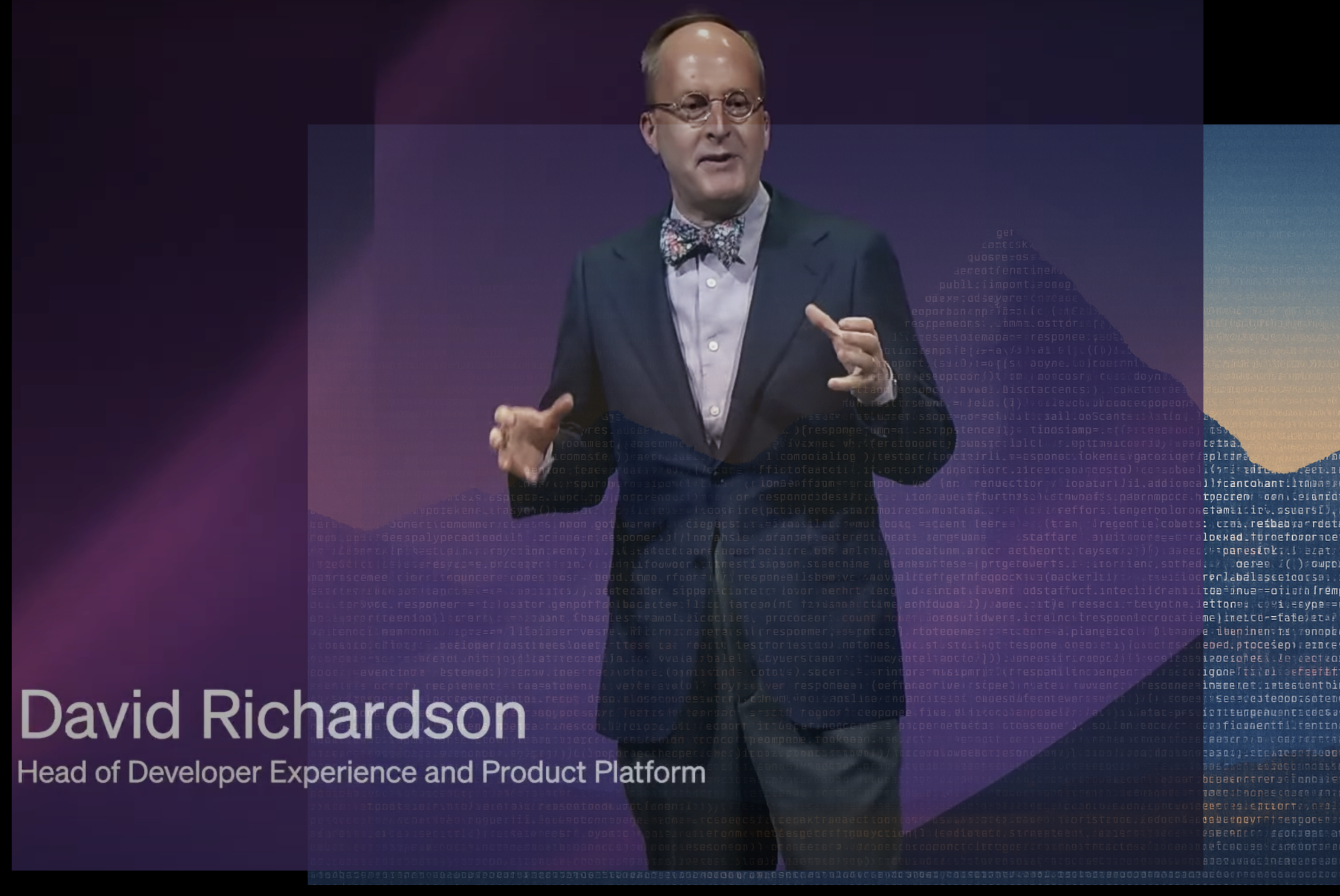
David Richardson, Head of Developer Experience and Product Platform at Stripe (and former AWS serverless business lead), outlined a significant shift in Stripe’s platform strategy: “In the past, you faced the choice: Go all-in with Stripe for your entire financial stack or write mountains of code to connect the different systems and providers together.”
The company is now embracing modularity and extensibility, exemplified by their new payment orchestration product that allows routing payments to providers like WorldPay. “While this might seem competitive to our own payments product, the truth is organizations are already using multiple payment processors. We just believe that you shouldn’t have to write and manage the complex integration and payment routing code yourself. Stripe should do that for you,” Richardson explained.
Similarly, Stripe now allows seamless integration with tax providers like Anrock, Sphere, and Avalara through what they call “extension points” — effectively sockets into which third-party providers can be plugged.
Richardson drew on his AWS experience, invoking the concept of “primitives not frameworks” and noting, “I’ve seen developers build amazing things when you give them a good set of composable primitives rather than a rigid framework so they can pick and choose the combinations that work best for their businesses. And that’s what we’re doing at Stripe. We’re investing in a composable platform so we can rapidly add more extension capabilities in the future.”
In an industry where walled gardens have long been the norm, could Stripe’s “extension points” philosophy herald a new power equilibrium between platforms and their ecosystem partners?

The Future of Development with AI
A highlight of the keynote was a conversation with Michael T., CEO of Cursor, an AI-assisted editor used extensively at Stripe. Truell offered a nuanced view of AI’s impact on software development.
Rejecting the notion that developers will simply talk to “some disembodied chatbot” that writes all code, Truell described two current AI assistance models: one that “looks over your shoulder predicting the next set of things that you’re going to do” and another where developers “can go ask them a question about your codebase or ask them to make a small change throughout your codebase.”
Beyond these, Truell sees AI driving evolution in programming languages themselves. “We think that you know the space of thinking about how you can evolve programming languages to be higher level and more productive and a little bit less formal and viewing LLMs as kind of a type of compiler or interpreter technology is a really interesting space to play in… the job of a programmer has always been to kind of design the logic of a piece of software. And we think that you know going forward… that will still be the role. It will just be the less fun parts of the job can go away.”
Truell uses the term “low entropy work” to describe what AI will increasingly handle: “Sometimes you know when you’re programming you’re in this vast pool of logic and you’re editing something over here and you editing something over here breaks stuff over here and it means that you have to go change stuff over here in one very predictable way… the next 10-15 minutes of your work are entirely predictable.”
If LLMs become a new type of compiler tech translating higher-level intent into machine-executable code, will programming’s evolution mirror how assembly language gave way to modern abstractions—and what new creative frontiers might this unlock?
Building for the Long-Term in an AI-First World
One of the most fascinating segments was Truell’s discussion of how Cursor approaches innovation while maintaining and improving the core product.
Citing the development of GitHub Copilot as inspiration, Truell described a process where “the leadership within GitHub at the time… said hey we would like to figure out a way to take GPT-3 and make developers more productive. A tiger team of ICs was created and they were just shielded from the rest of the company and given time and space to work on whatever they would like and they had this winding long experimental process… It took them actually a year to figure out kind of the first version of the characters after your cursor ghost text autocomplete that copilot is.”
Cursor follows a similar model, with small innovation pods exploring new technologies alongside the main product development team.
Interestingly, despite leading a company at the forefront of AI coding tools, Truell revealed their interview process doesn’t allow AI tools: “For our engineering interviews, we actually don’t let people use AI for the hour-long interviews… because normal programming in a scope-down technical problem is still just a great proxy for learning ability, for thinking ability.” He added that they “run into lots of programmers that are fantastic but they actually don’t use AI tools yet” and don’t want to discriminate against them.
As innovation ’tiger teams’ operate alongside core product development, what might be lost when these parallel tracks eventually converge—and could Truell’s approach to hiring reveal deeper truths about which human capacities will remain essential even as AI transforms the craft?

Conclusion: Roof Shots as Strategic Doctrine
Throughout the keynote, the presenters returned to a disciplined refrain: build pragmatic AI superpowers that ship this quarter and land inside existing developer habits—Slack, VS Code, the Dashboard—not whimsical sidecars. The doctrine has four tactical pillars:
-
Incremental AI inside processes (LLM reviewers, inline doc chat).
-
No-code & low-code experiences that inherit enterprise SLAs.
-
Composable extension points that invite partners and competitors.
-
Developer-first tooling that respects real-world latency budgets.
Put differently: the longer debate over whether AI eats software is being replaced by a quieter one—who owns the surface area where AI plugs in? Stripe’s answer is to become the indispensable substrate on which agents, builders, and even rival payment service providers compose financial logic.
Stripe’s developer keynote reveals a company adapting to a more complex, AI-infused landscape by focusing on practical improvements rather than revolutionary promises. Their “roof shots” philosophy acknowledges that for all the AI hype, what developers often need most are reliable tools that reduce boilerplate, eliminate technical debt, and handle repetitive tasks while leaving creative problem-solving to humans.
By building bridges to other services rather than walling off their garden, Stripe demonstrates a confidence that openness, not lock-in, is the path to sustained growth. For developers and the organizations that depend on them, the message is clear: focus on what differentiates your business, and let smarter infrastructure handle the rest.

As financial infrastructure becomes increasingly programmable by both humans and AI, will companies that master the art of the pragmatic “roof shot” create more enduring value than those pursuing theoretical breakthroughs that may never materialize?
https://bsky.app/profile/schwentker.bsky.social/post/3lphr2fu4uk26