
In a rapidly digitizing economy, stablecoins are evolving from speculative crypto instruments into foundational components of next-generation financial infrastructure. As Christian Catalini, Cofounder & CSO of Lightspark who moderated a recent Stripe Sessions panel, framed the discussion: “People have said stablecoin panels tend to be slow and boring, mostly because everybody agrees stablecoins are going to be the future.” Once viewed as experimental, these digital assets are now being recognized—across jurisdictions and industries—as essential rails for borderless transactions and machine-to-machine commerce. This analysis explores their growing strategic role at the intersection of AI and finance, particularly in emerging markets where programmable money may leapfrog legacy systems. As stablecoins increasingly align with AI-driven systems and automated flows, they not only reimagine what money can do, but also redefine who it can empower—reshaping the architecture of global inclusion and decentralized innovation.
Beyond the Gold Rush: Stablecoins as Critical Infrastructure
The financial world is witnessing what could be described as a gold rush in stablecoin development and adoption. As Erica Khalili, Co-founder and Chief Legal Officer/Risk Officer at Lead Bank notes, “It feels like now is the time where everyone feels like they don’t want to get left behind in the gold rush.” However, what’s most significant about this moment isn’t the speculative frenzy but rather the transition of stablecoins from crypto assets to essential financial infrastructure.
This transformation is happening through three key innovations, as Shan Aggarwal of Coinbase Ventures explains: “One is we now have low-cost layer one and layer two protocols like Base that allow for seamless money transfer and stablecoins around the world. The second is the consumer experience has gotten much more abstracted and simple through developments like embedded wallets and smart wallets that remove the need for gas and seed phrases. And third is transactional service providers that make it easier for businesses to think about payments and make fiat and stablecoins effectively interoperable.”
Paving the “Winding Dirt Roads” of Global Finance
The most compelling aspect of stablecoins may be their ability to solve long-standing problems in international banking infrastructure. Chris Maurice, Co-founder & CEO of Yellow Card, articulates this through a powerful metaphor:
“When you think of Swift and the traditional correspondent banking system, you have essentially these money movement super highways—this interstate system that is at least decently maintained. But then you have these winding dirt roads through the Grand Canyon to essentially all emerging markets around the world: to Africa, to Southeast Asia, to South America. Stablecoins are the first technology that actually pave those roads.”
This observation addresses a fundamental inequity. The correspondent banking system was designed primarily for developed markets, leaving much of the world with inadequate financial infrastructure. Maurice continues, “It provides access to businesses around those parts of the world that otherwise are not able to interact with that system because of illiquidity, disconnectivity from Swift, and because the correspondent banking system was never set up for those parts of the world.”
For emerging markets, stablecoins aren’t merely incremental improvements but represent financial inclusion at a fundamental level. “The reason you’ve seen so much adoption so quickly in emerging markets is because there is no alternative in a lot of the countries we operate in,” Maurice explains. “There’s no other option, no plan B, no incumbent.”

The Native Currency for AI Agents
Perhaps the most forward-looking use case involves stablecoins’ integration with AI systems. Sean Aggarwal highlights this potential: “I’m excited about allowing AI agents to make autonomous payments, whether for data, compute, or content—effectively in real time and at any transaction size. We believe stablecoins are the native payment rail for AI agents and agent commerce.”
Traditional payment rails fall short for machine-to-machine commerce due to their human-centric design. “Legacy payment rails weren’t built for machine-to-machine commerce,” notes Aggarwal. “They require logins, API keys, credit cards, other forms of credentials, and minimum account payments.”
Chris Maurice agrees: “AI agents and this next layer of technology make decisions rapidly in fractions of a second, so you need technology that can keep up. Stablecoins are the only payment method that can actually keep up with the speed that an AI agent and machine-to-machine commerce would operate at.”
Coinbase’s recently launched x402—named after the HTTP error code for “payment required”—demonstrates this vision through an open-source payment protocol embedded directly into API calls. This allows “AI agents to make payments directly without any type of API key or credit card or login, just deeply embedded into an API call,” according to Aggarwal.
The Interoperability Challenge
Despite their promise, stablecoins face significant adoption challenges. Chief among these is interoperability—both between different stablecoins and with traditional financial systems.
“There’s still way too much fragmentation across dimensions that are difficult to conceptualize and manage,” explains Aggarwal. “Different types of stablecoins each have slightly different reserve requirements or reserve banks, so they’re not fully interchangeable, but they sort of look and feel interchangeable. You have to deal with different on and off ramps across the world, different currencies, underlying banks.”
This fragmentation undermines the seamless experience stablecoins promise. The solution likely involves technical standards, connectivity layers, and regulatory harmony.
Success, as Dimitri Dadiomov, Co-founder & CEO of Modern Treasury observes, would be when “you say ‘stablecoin,’ you say ‘US dollars,’ you’re going to stop thinking about that as different assets, and it’s just another form of payment.”
The Path to “Credentialization”
Regulation remains both the greatest challenge and opportunity for stablecoin adoption. Erica Khalili emphasizes the importance of what she terms “credentialization”—the regulatory legitimization process:
“The credentialization of having clear, crisp regulation and policymakers embracing the technology opens the aperture of what you can do, and it feels safe. Because right now, even if you don’t understand how ACH works or how Swift works, it’s been around, it’s tested, you believe that your money will be there.”
This regulatory certainty is crucial for institutional adoption. Khalili references the GENIUS Act as an important step toward clarity, though it remains “in the political quagmire.” She adds that proper regulation ensures “banks supporting this are incentivized to keep doing it in a safe and responsible manner.”

The Banking Sector’s Response
A fascinating dynamic is emerging between traditional banks and stablecoin issuers. While some financial institutions maintain cautious distance, others recognize both opportunity and competitive threat.
Chris Maurice predicts: “Distribution will win, which is why outside of a couple of core stablecoins with some semblance of scale, a lot of this stuff is going to get eaten up by banks. Eventually, banks will get into the space, they will all issue their own tokens. It essentially becomes tokenized deposits.”
This points to a future where major financial institutions issue their own stablecoins, leveraging established trust and distribution networks. “My JP Morgan coin is going to be valuable to just about anybody that trusts that bank is actually holding those deposits,” Maurice notes.
The moderator frames this as analogous to electricity’s evolution: “This is going the way electricity went at the beginning. You had Edison bulbs that were kind of premium and you could show them off, and later you just wanted what’s cheapest to meter.”
The “Stablecoin Neobank” and Velocity of Innovation
One striking aspect of stablecoin technology is how it enables rapid financial innovation. Sean Aggarwal describes this acceleration:
“You can start a stablecoin neobank in just a couple months. You use an embedded wallet provider like Privy, you use a stablecoin like USDC, then you build a front-end app. Now with Lead Bank and Bridge, you can issue a credit card directly out of that wallet. The velocity at which you can get consumer financial services to people everywhere around the world has just accelerated significantly.”
This “modular finance” approach—assembling financial services from standardized components—represents a fundamentally different model from traditional infrastructure development. As the panel moderator noted, “Welcome to the age of modular finance.”

The Money Market Dimension
Beyond payments, stablecoins offer another compelling but often overlooked use case: efficient money markets. Dimitri Dadiomov highlights this aspect:
“A big use case people don’t talk about as much is the money market. With stablecoins, you’re getting yield that you maybe should get but aren’t getting in your checking account. Storing funds in a place where, due to information asymmetry or laziness, you haven’t put funds into the right place to earn maximum yield—stablecoins make that a lot easier.”
This efficiency removes friction between storage and spending. Traditional systems often force a choice between earning yield and having immediate access to funds. “The instant payment technology combined with storage in stablecoins is a real enabler,” explains Dadiomov. “If the self-driving dollars go to the right place where they should be earning the most yield, how do they then get accessible over the weekend, accessible at night?”
The Abstraction Layer: Hiding Complexity
For mainstream adoption, stablecoins must fade into the background of user experience. Dimitri Dadiomov emphasizes:
“From a UI perspective, from a usage perspective, how do they not have to think about it too hard? They need to know they’re using a swift wire or stablecoin for a borderless payment, but it’s not something they need to be thinking about actively—that’s not their job. Their job is to manage liquidity for the company or pay their vendor.”
Sean Aggarwal adds: “You shouldn’t really think about a difference between a stablecoin and cash. For most businesses or people, they’re different in nomenclature and technology, but should be functionally equivalent. The North Star is how you get stablecoins to be treated as cash across all these different dimensions.”
Erica Khalili shares an illustrative anecdote: “The first time we had our regulators on site and we were talking about digital assets, they asked ‘What if you lose this or lose that?’ I said, ‘I live in New York, and if I lose my wallet on the 6 train, I’m not getting that back either.’ Making things digestible is key to broadening adoption.”
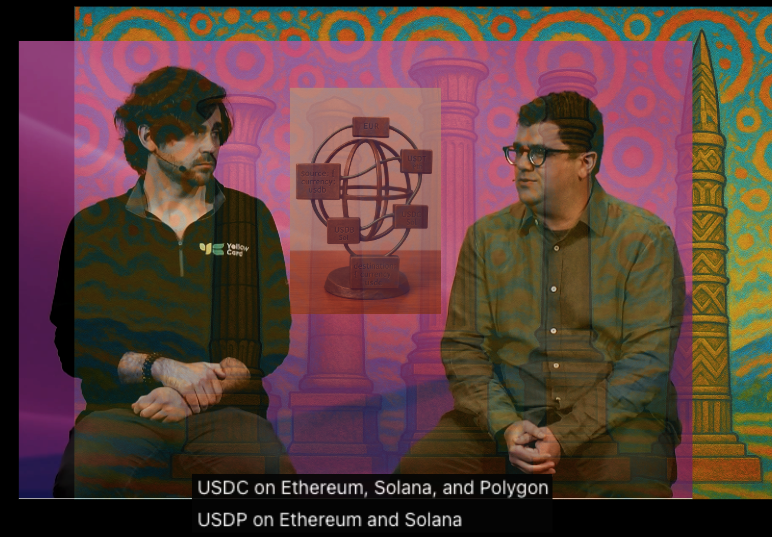
The Future Landscape
The stablecoin market will likely evolve along two dimensions, according to Sean Aggarwal:
“You already have ecosystem stablecoins with meaningful distribution, liquidity, and established distribution networks. But you’ll also see a very long tail of application or use-case specific stablecoins that don’t exist to see the light of day and be recognizable to individuals, but serve as functional utilities for applications.”
Erica Khalili predicts a natural selection process: “Everyone will issue them, and then there’ll be a flight to quality and utility that comes out of that, which will be self-selecting. Much of that will come down to distribution.”
When asked about the future, Khalili offers perhaps the most honest assessment: “I don’t exactly know what it’s going to look like, and that’s what’s exciting. I’m not presupposing. I’m seeing these things evolve in real-time. We don’t even know yet where this is going to go in the next five years, and that’s what I think is really cool about it.”
The Path Forward: Solving Real Problems
Chris Maurice emphasizes that stablecoins’ true value lies in solving fundamental problems: “A lot of fintech companies haven’t necessarily solved problems—they’ve just usurped users’ problems. It’s still a mess on the back end. They’ve made a really smooth interface for my mom, but the back end is still really messy money movement and reconciliations. Stablecoins are the first technology that actually solve those problems, as opposed to just putting a smooth interface on it.”
Sean Aggarwal contrasts this with previous fintech waves: “Ten years ago, there was the big rush toward neo-banking. It was a neo-bank every day, but they were largely nice interfaces packaged up on legacy infrastructure, with limitations on what those new banks could do and how quickly they could ship new products.”

Conclusion: From Scarcity to Abundance
Traditional financial infrastructure was built around scarcity: limited operating hours, restricted access, minimum transaction sizes, and geographical constraints. Stablecoins potentially invert this paradigm, creating financial abundance through 24/7 operation, global access, fractional transactions, and programmable money.
The transition faces challenges in regulatory frameworks, technical standards, and user experience simplification. But as Chris Maurice notes, “Stablecoins are the first technology that actually solve those problems, as opposed to just putting a really smooth interface on them.” This problem-solving potential—whether connecting emerging markets to global finance, enabling AI-driven commerce, or creating more efficient money markets—merits the serious attention of business leaders, policymakers, and technologists worldwide.
Terms Defined:
Stablecoin: Digital asset designed to maintain price stability by being pegged to reserve assets like fiat currency.
Layer 1/Layer 2: Blockchain architecture terms; Layer 1 refers to the base blockchain protocol, while Layer 2 solutions are built on top to improve scalability.
Embedded Wallet: Digital wallet technology that can be integrated directly into applications without requiring separate installation.
GENIUS Act: Proposed US legislation aimed at clarifying regulatory frameworks for stablecoins.
x402: Open-source payment protocol introduced by Coinbase, named after the HTTP error code for “payment required.”
Swift: Society for Worldwide Interbank Financial Telecommunication, the dominant messaging network for international banking transactions.
Correspondent Banking: System where one bank provides services on behalf of another, typically for cross-border transactions.
Modular Finance: Approach to financial services that assembles standardized components rather than building monolithic systems.
Sources
Closing the gap: Can stablecoins achieve true interoperability stripe.com/sessions/2025/closing-the-gap
moderntreasury.com/products/ai
lead.bank/baas-solutions/crypto
coinbase.com/developer-platform/discover/launches/x402
linkedin.com/pulse/web-agents-coinbases-vision-x402-dynamic-ai-economy-robert-schwentker-aji4c