Executive Summary: Empowering Developer Communities
As PayPal CEO Alex Chriss emphasizes, “velocity and impactful innovation” will define the next era of commerce. PayPal Dev Days 2025 made that vision tangible through real-world demos of AI-powered developer tools that are fundamentally transforming the developer landscape, creating unprecedented opportunities for organizations to expand and empower their developer communities.
The key strategic implications for empowering developer communities include:
-
Democratizing development expertise: AI tools are dramatically lowering barriers to entry, allowing domain experts with limited coding experience to create sophisticated commerce applications. Organizations can now tap into significantly larger talent pools while bringing valuable business perspective into the development process.
-
Accelerating innovation cycles: Development velocity is becoming a primary competitive differentiator. AI-powered workflows enable organizations to iterate on ideas at unprecedented speed, creating sustainable advantages in rapidly evolving markets.
-
Transforming knowledge sharing: Organizations that excel at converting specialized knowledge into AI-accessible formats will gain substantial advantages. These tools create mechanisms for capturing tacit expertise and making it available contextually within the development workflow.
-
Redefining developer relations: The role of developer programs is evolving from educational to collaborative, with successful organizations positioning themselves as active partners in developers’ AI journey. This partnership approach builds stronger ecosystem relationships while generating valuable feedback loops.
-
Blurring innovation boundaries: AI is removing traditional distinctions between internal and external development, creating opportunities for more permeable and productive ecosystems. Forward-thinking organizations are designing APIs and developer programs specifically for AI consumption, enhancing platform accessibility.
Successfully navigating this transformation requires more than just technology adoption—it demands strategic recalibration of development culture, knowledge management systems, and ecosystem engagement approaches. Organizations that recognize this fundamental shift and align their strategies accordingly will be positioned to cultivate thriving developer communities capable of driving the next generation of commerce innovation.
The Maturing of AI-Powered Development
For those in the know, PayPal’s recent Dev Days event weren’t showcasing completely novel concepts, but rather demonstrating how AI-powered development tools are coming of age. What began with GitHub Copilot’s initial release and experimental AI coding assistants has evolved into sophisticated, production-ready systems that are fundamentally changing how financial technology is built, deployed, and maintained. Three transformative sessions illustrated how AI tools are not just enhancing developer productivity, but completely reimagining the developer experience and unlocking new paths to innovation. These technologies are creating new paradigms for commerce application development that promise to reshape the competitive landscape for years to come.
The convergence of AI, developer tools, and payment infrastructure represents nothing short of a fundamental transformation in how commerce solutions are conceived and brought to market. This evolution transcends simple efficiency gains, pointing toward a future where the boundaries between business vision and technical implementation become increasingly fluid.
Accelerating Development with GitHub Copilot
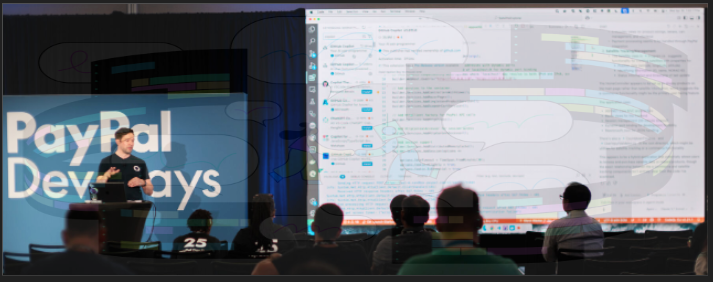
GitHub’s solutions engineer Glenn Wester demonstrated how AI-powered coding assistants are transforming PayPal’s development workflow. GitHub Copilot, which started as an experiment with OpenAI’s Codex model, has evolved into a sophisticated AI pair programmer that can significantly increase developer productivity.
“Copilot gives developers a 55% faster task completion rate using predictive text while improving code quality across 8 dimensions,” Wester explained, citing GitHub’s research findings. The tool now features multiple interaction modes including Chat for answering coding questions, Edit for making changes across multiple files, and the new Agent mode for autonomously implementing complex features.
What makes Copilot particularly valuable for financial technology development is its ability to understand context and follow customized coding conventions. By creating repository-specific instructions, development teams can ensure AI-generated code adheres to their standards and best practices—a critical requirement in regulated fintech environments.
Beyond mere code completion, Copilot is evolving into what Wester described as “ambient intelligence around GitHub,” appearing within the IDE, command line interface, and web portal. This omnipresent AI assistance transforms how developers interact with their tools and codebase, creating a continuous feedback loop that accelerates learning and innovation.
Perhaps most significant is Copilot’s ability to access authenticated data sources and third-party APIs. This capability, demonstrated through the Model Context Protocol (MCP) integration, allows the AI to reach beyond the development environment to interact with cloud services, documentation resources, and specialized tooling. For PayPal developers, this means the ability to generate compliant payment code that connects directly to PayPal’s APIs while following security best practices.
The future roadmap Wester outlined points to even more autonomous capabilities. A “software engineer agent” is under development that could implement feature requests directly from issue descriptions, potentially reducing the implementation time for standard functionality from weeks to hours. For organizations with extensive backlogs, this represents not just an incremental improvement in productivity but a categorical shift in how development capacity is conceptualized and allocated.
Vibe Coding: From Concept to Commerce in Minutes
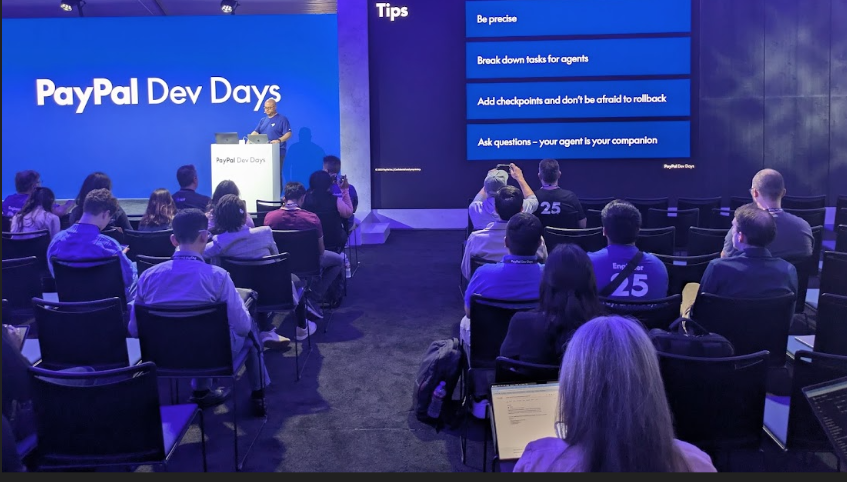
In perhaps the most visually compelling demonstration, the “Vibe Coding with PayPal + Replit” session showcased how developers can build fully functional commerce applications with integrated payments in under an hour—without writing a single line of code themselves.
Kody Low built a complete game with PayPal monetization features in minutes using Replit’s AI-powered development environment. This approach, called “vibe coding,” focuses on domain-specific knowledge and clear instructions rather than manual coding.
“The best way to learn is to do. With vibe coding, it’s not a huge time investment, but you can literally leave this session, sit down, start using Replit or any other platform to build your applications and add PayPal to your sites,” explained Kody.
For enterprises, this capability is transformative. As demonstrated in the session, product managers and non-technical stakeholders can now rapidly prototype ideas without engineering resources, allowing organizations to test concepts and gather user feedback before committing development teams.
The implications extend far beyond simple prototyping. The Replit presenter shared a case study of Zillow, where a business leader without formal engineering training built a proof-of-concept application for improving realtor performance. This prototype was compelling enough to secure executive buy-in, and after engineering refinement, the resulting solution improved key performance metrics by 10%, generating millions in incremental revenue.
This pattern—business domain experts rapidly materializing their vision, securing organizational support through working demonstrations, and then collaborating with engineers on productionization—represents a paradigm shift in the software development lifecycle. It collapses the traditional gap between business requirements and technical implementation, enabling organizations to iterate on ideas at unprecedented speed.
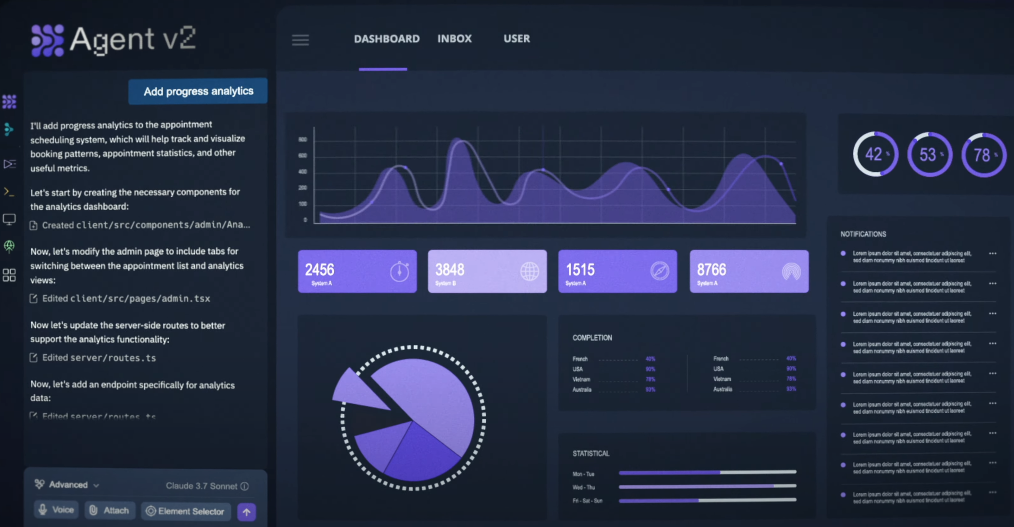
The session also highlighted how Replit’s approach to development environment configuration eliminates another traditional bottleneck. The AI-powered platform handles complex setup tasks automatically, configuring databases, authentication systems, and deployment pipelines without manual intervention. For commerce applications with strict security and compliance requirements, this standardized approach can reduce the risk of configuration errors that might otherwise lead to vulnerabilities.
Integration with PayPal’s payment infrastructure was equally seamless. The demonstration showed how developers could add payment functionality with just a few natural language instructions, with the AI handling all the technical details of API authentication, transaction processing, and error handling. This level of abstraction allows developers to focus on business logic and user experience rather than payment implementation details.
Perhaps most significantly, the applications built through this process aren’t limited to prototypes or simple demonstrations. The Replit platform creates production-ready applications with proper architecture, version control, and deployment pipelines, making the transition from concept to production surprisingly direct. This removes the traditional “throw-away prototype” phase of development, further accelerating time to market.
Modernizing Legacy Integrations with AI
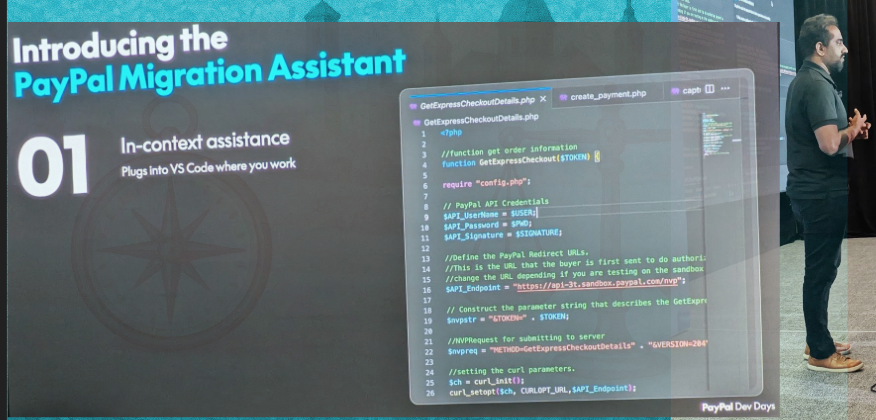
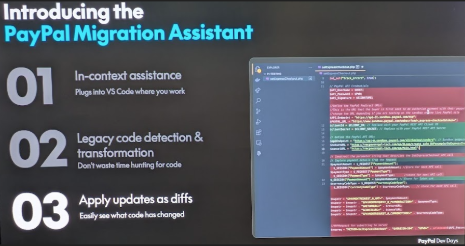
The third presentation with Mark Lummus, Navinkumar Patil et al introduced the PayPal Migration Assistant, a specialized AI tool designed to help merchants upgrade from legacy PayPal integrations to modern implementations. This tool provides in-context assistance in VS Code, automatically detects legacy code patterns, and applies necessary updates as easily reviewable diffs.

For merchants with established e-commerce platforms, upgrading payment infrastructure has traditionally been a resource-intensive process. The Migration Assistant streamlines this by analyzing existing code and suggesting modern alternatives that leverage PayPal’s latest capabilities like streamlined checkout, saved payment methods, additional payment options, and enhanced fraud detection.
PayPal is also offering a Migration Lab where developers can get personalized assistance with their upgrades, demonstrating a commitment to supporting their developer ecosystem through technological transitions. More information about the PayPal AI Migration Assistant can be found at: https://developer.paypal.com/community/blog/ai-migration-assistant/
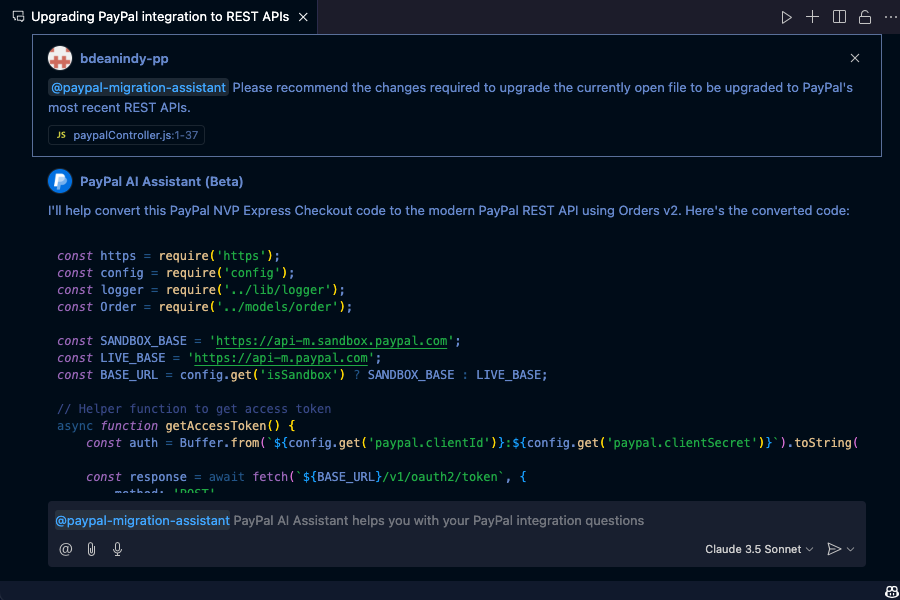
The significance of this approach extends beyond simple modernization. By using AI to analyze legacy code patterns and suggest upgrades, PayPal is effectively creating a knowledge transfer mechanism that captures decades of payment integration expertise and makes it available to developers in context. This transforms what was previously tacit knowledge, often held by a small number of experienced developers, into explicit guidance that’s accessible to anyone working on payment integrations.
The presentation highlighted how this tool addresses one of the most persistent challenges in software maintenance: understanding the intent and structure of existing code before making changes. The AI assistant can analyze an entire codebase to identify payment-related components, understand their function within the application, and suggest targeted improvements that preserve existing business logic while upgrading the underlying payment functionality.
This capability is particularly valuable for organizations with complex, long-lived applications where the original developers may no longer be available. Rather than requiring a comprehensive rewrite—an approach that often introduces new bugs and disrupts business operations—the Migration Assistant enables incremental modernization with significantly reduced risk.
The tool also serves as a dynamic education platform, explaining modern best practices and API usage patterns as it suggests changes. This embedded learning accelerates developer proficiency with new payment technologies, reducing the typical knowledge gap that slows adoption of new capabilities.
For PayPal, this approach addresses a strategic challenge: how to move their extensive merchant base to newer platforms without creating friction that might drive them to competitors. By reducing the technical barrier to migration, PayPal can accelerate adoption of their latest offerings while strengthening relationships with their developer community.
The Reimagined Developer Experience
These demonstrations collectively reveal how AI is fundamentally transforming the developer experience in ways that go far beyond simple productivity enhancements.
First, AI is collapsing the traditional distinction between design and implementation phases. With tools like GitHub Copilot in Agent mode or Replit’s vibe coding approach, the expression of intent (what the developer wants to build) is becoming increasingly inseparable from its realization (the actual code that implements it). This convergence accelerates the iteration cycle and enables more direct translation of business requirements into working software.
Second, AI is democratizing development expertise. Specialized knowledge that previously required years to acquire—whether about payment security standards, efficient algorithm implementation, or modern UI patterns—is now embedded within AI assistants and available on demand. This doesn’t eliminate the need for expert developers, but it does change their role from direct implementation to higher-level architecture and oversight, with AI handling more routine coding tasks.
Third, these tools are creating a continuous learning environment where developers receive real-time feedback, suggestions, and education within their workflow. Rather than consulting documentation or searching for examples, developers can have contextually relevant information presented alongside their code, accelerating mastery of new APIs and frameworks.
Fourth, AI is enabling more experimental approaches to development by reducing the cost of exploration. Developers can rapidly prototype multiple approaches to a problem, with AI generating alternative implementations that can be evaluated against each other. This encourages more innovative solutions by making it practical to explore a wider range of possibilities.
Finally, these tools are fostering a more conversational relationship with code. Rather than meticulously crafting syntax according to rigid rules, developers can engage in an ongoing dialogue with AI assistants, expressing their intent in increasingly natural ways and receiving intelligently generated implementations in response. This shift from imperative to declarative development approaches fundamentally changes how developers conceptualize and solve problems.
Unlocking Commerce Innovation Through AI Collaboration
The integration of AI into development workflows is creating unprecedented opportunities for innovation in the commerce sector. These advances go beyond mere efficiency improvements to fundamentally reshape what’s possible in digital commerce experiences.
The AI-powered tools showcased at PayPal Dev Days are enabling a new era of experimentation economics. What previously required weeks of developer time can now be accomplished in hours or even minutes. This dramatic reduction in the cost and time of experimentation allows organizations to test multiple approaches simultaneously, exploring a wider range of possibilities before committing resources to full implementation.
These technologies also bridge the longstanding gap between business vision and technical execution. When product managers, marketing specialists, and other non-technical stakeholders can directly participate in application creation, their domain expertise becomes immediately actionable. This creates more direct pathways from customer insight to working solutions, potentially eliminating months of requirements documentation and translation.
Cross-functional capabilities become more accessible as AI handles integration complexity. Payment processing, identity verification, fraud detection, and other specialized domains can be combined more fluidly, creating opportunities for innovative hybrid services that were previously impractical to implement. This interconnection capability supports the development of more comprehensive, end-to-end commerce experiences.
For global businesses, these tools dramatically simplify adapting applications for international markets. AI can suggest appropriate modifications for regional regulations, payment preferences, language considerations, and cultural norms. This reduces barriers to international expansion, potentially accelerating global growth strategies.
Perhaps most importantly, these technologies enable the quick testing of novel business models and monetization approaches. Organizations can rapidly implement and evaluate different pricing structures, subscription models, marketplace configurations, or transaction flows, creating data-driven paths to business model innovation rather than relying on theoretical projections.
Cultivating Developer Ecosystems with AI
The emergence of AI-powered development tools creates new imperatives for organizations seeking to build and sustain thriving developer communities. These technologies fundamentally alter traditional approaches to developer relations and ecosystem cultivation.
AI-enabled development is expanding the definition of “developer” itself. The democratization of technical creation means organizations must reconsider their outreach strategies, potentially targeting domain experts, business analysts, and product managers alongside traditional developers. This expanded audience requires different educational approaches, community structures, and success metrics.
Platform providers must optimize their offerings for AI consumption, not just human developers. This means creating thorough, structured documentation; providing clear examples of common patterns; and designing APIs with machine readability in mind. Resources that AI systems can effectively interpret and leverage become competitive differentiators in acquiring developer mindshare.
Knowledge management becomes a critical ecosystem capability. Organizations that can effectively capture, structure, and share specialized expertise through AI-consumable formats gain significant advantages in developer productivity and solution quality. This transforms institutional knowledge from a passive resource to an active participant in the development process.
Community building strategies must evolve to emphasize collaboration and co-creation rather than just education. Successful organizations are creating spaces where developers can share AI prompts, custom instructions, and successful patterns, accelerating collective learning and creating network effects that strengthen ecosystem value.
Ethical considerations require greater attention as AI capabilities expand. Organizations must provide clear guidelines for responsible AI usage within their ecosystems, addressing issues like data privacy, security best practices, and appropriate attribution. Communities that establish thoughtful governance frameworks will build stronger trust with developer participants.
The metrics for ecosystem success require recalibration. Traditional measures like number of developers, API calls, or applications built may become less meaningful than indicators of innovation quality, implementation speed, or adaptation velocity. Organizations should develop new frameworks for evaluating ecosystem health in this transformed landscape.
Envisioning the Future of AI-Powered Commerce
The convergence of AI and commerce development tools signals a profound shift in how digital commerce experiences will evolve in the coming years. For strategic leaders, understanding these dynamics is essential for positioning their organizations for future success.
For established enterprises, these technologies create pathways for continuous modernization rather than disruptive replacement. The ability to incrementally enhance and extend existing systems reduces implementation risk while still enabling innovation. Organizations can evolve their commerce capabilities alongside customer expectations, maintaining relevance without sacrificing stability.
For emerging businesses, AI-powered development dramatically changes the economics of market entry. The ability to create sophisticated commerce experiences with minimal technical expertise reduces capital requirements and accelerates time-to-market. This may lead to increased competition but also creates opportunities for specialized offerings that were previously impractical to implement.
The commerce ecosystem as a whole is moving toward greater componentization and interoperability. As AI makes integration increasingly seamless, organizations will focus more on their unique value propositions rather than reimplementing standard functionality. This shift toward modular commerce architecture enables more specialized service providers while creating more consistent user experiences.
The skills profile for commerce technology teams is evolving rapidly. Organizations will need fewer implementation-focused developers but more specialists in commerce domain knowledge, user experience design, and AI guidance. The ability to effectively direct AI tools becomes a core competency, replacing some aspects of traditional coding expertise.
The pace of commerce innovation will continue to accelerate as feedback loops tighten. With the ability to rapidly implement, test, and refine new capabilities, organizations can respond more dynamically to market signals. This creates advantages for businesses that excel at capturing customer insights and quickly translating them into enhanced experiences.
As PayPal and its partners demonstrated, the most significant competitive advantage may come not from the technology itself, but from how effectively organizations integrate AI into their development processes, knowledge management systems, and strategic planning. By approaching AI as a strategic partner rather than just an implementation tool, forward-thinking organizations can fundamentally reimagine their approach to commerce development.
AI isn’t just changing how we build commerce—it’s changing who can build, what we build, and how fast we evolve. The next chapter in digital commerce will be written not just in code, but in collaboration—with AI as a creative partner.
References:
GitHub
https://github.com/features/copilot
https://docs.github.com/en/copilot/customizing-copilot/extending-copilot-chat-with-mcp
https://www.hypertest.co/software-development/what-is-github-copilot-the-benefits-and-challenges
Replit
Vibe Coding 101 by Matt Palmer: https://www.youtube.com/watch?v=2v5Fs7Xr11Y
PayPal
https://developer.paypal.com/community/blog/dev-days-2025
https://paypalevents.swoogo.com/developer_day25
https://developer.paypal.com/community/blog/ai-migration-assistant
Bluesky post
https://bsky.app/profile/schwentker.bsky.social/post/3lojzzt55j22m