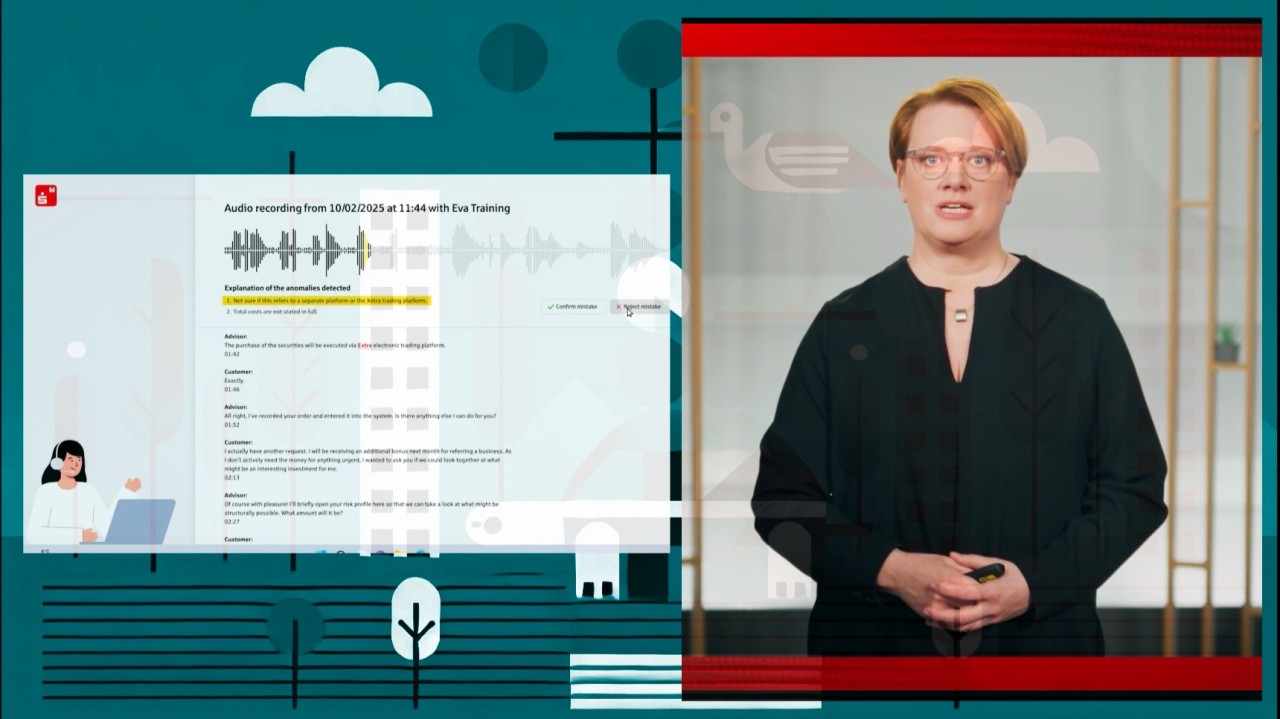
At NVIDIA GTC 2025, Julia Koch, Executive Director at Finanz Informatik, unveiled one of Europe’s largest AI workplace transformations, showing how AI is reshaping banking from the inside out.
In a world where AI transformation is often characterized by flashy customer-facing applications, Germany’s largest banking technology provider has taken a fundamentally different approach. Finanz Informatik (FI) is quietly delivering what might be one of the most consequential AI implementations in the European financial sector – not by creating another customer chatbot, but by transforming how 200,000 banking employees work every day.
At NVIDIA GTC 2025, Julia Koch, Executive Director at Finanz Informatik, offered a rare glimpse into how the company built one of the first custom-made personal AI assistants operated entirely in-house and designed specifically for banking workplace environments. What makes this implementation particularly noteworthy is its scale (serving 200,000 employees across 400 legal entities), its 100% on-premises approach in an era of cloud-first thinking, and its deep integration with core banking systems.
The Scale: Banking for Half of Germany
Before diving into the AI transformation, it’s worth understanding the sheer scale of Finanz Informatik’s operations. As the IT service provider for the Savings Banks Finance Group, FI supports 343 savings banks, 5 regional building associations, 6 state banks, 6 public insurers, and other financial entities across Germany – collectively serving approximately 50 million customers, representing more than half of Germany’s population.
With 6,900 employees, FI operates the largest finance cloud in the EU banking sector and ranks among the top three IT service providers in Germany by revenue. Their technological decisions affect how financial services are delivered to roughly every second household in Germany.
The Human-Centered AI Strategy: Starting with Employee Experience
What makes FI’s approach distinctive is their decision to focus first on employee experience rather than customer-facing AI. Koch explained this strategic choice:
“The real potential of generative AI for savings banks and their customers does not come from separate apps and isolated solutions. It comes through deep integration with our core banking platform.”
Instead of launching yet another customer-facing AI application, FI identified that their greatest efficiency opportunity lay in augmenting the capabilities of their human workforce. The 200,000 employees across the Savings Banks Finance Group perform countless routine tasks daily that, even with existing digital systems, remain manual and time-consuming.
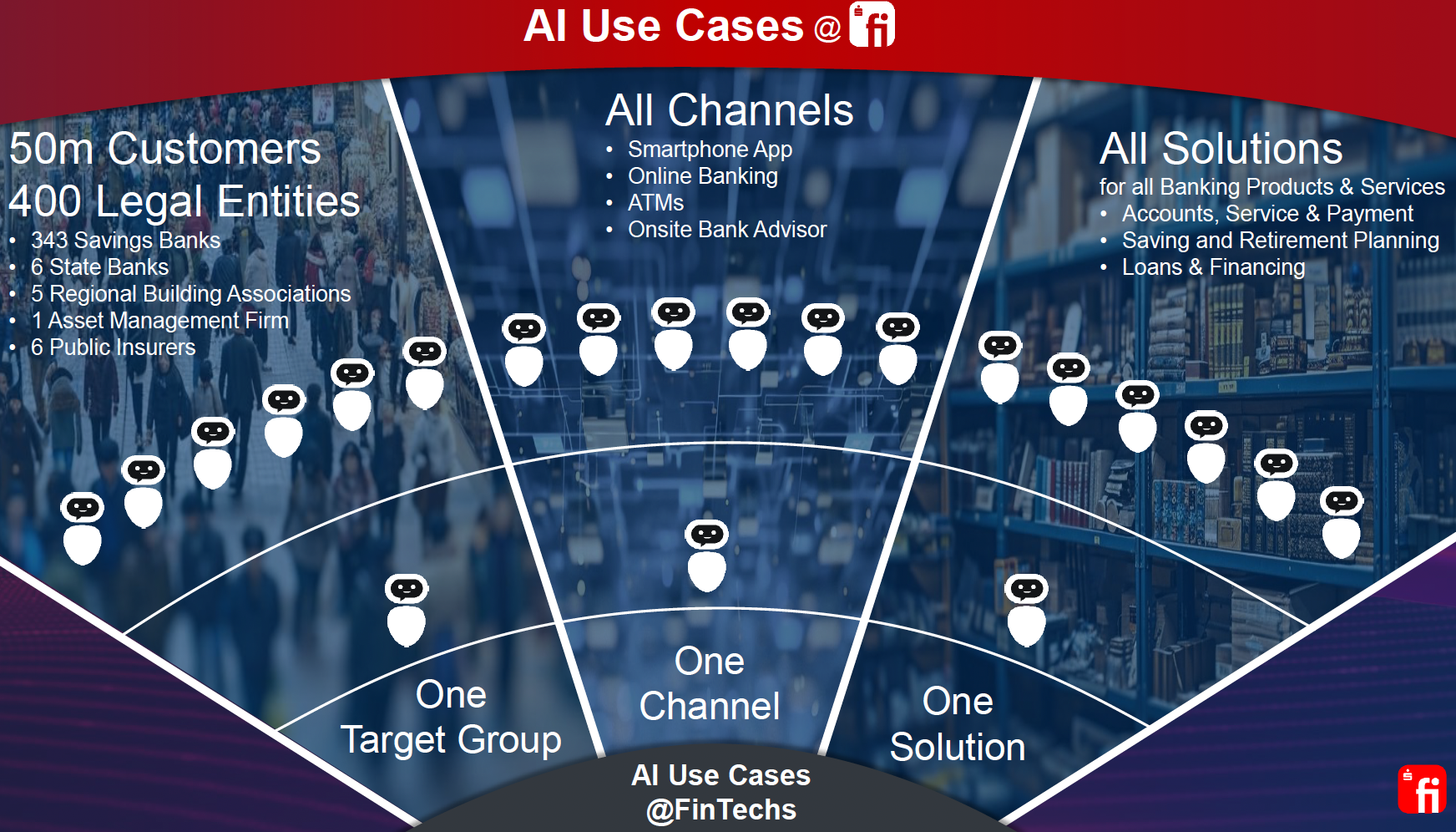
As Koch described it, this led to a focus on creating “millions of micro-transformations” in daily operations. Each small efficiency gain might save only minutes per task, but multiplied across thousands of employees performing these tasks repeatedly, the cumulative impact becomes transformative.
S-AIPilot: From Concept to Reality
The flagship of this strategy is S-AIPilot, FI’s AI assistant for banking employees. Unlike generic AI tools, S-AIPilot is deeply integrated with the core banking system, has specialized banking knowledge, and operates entirely within FI’s secure data centers.
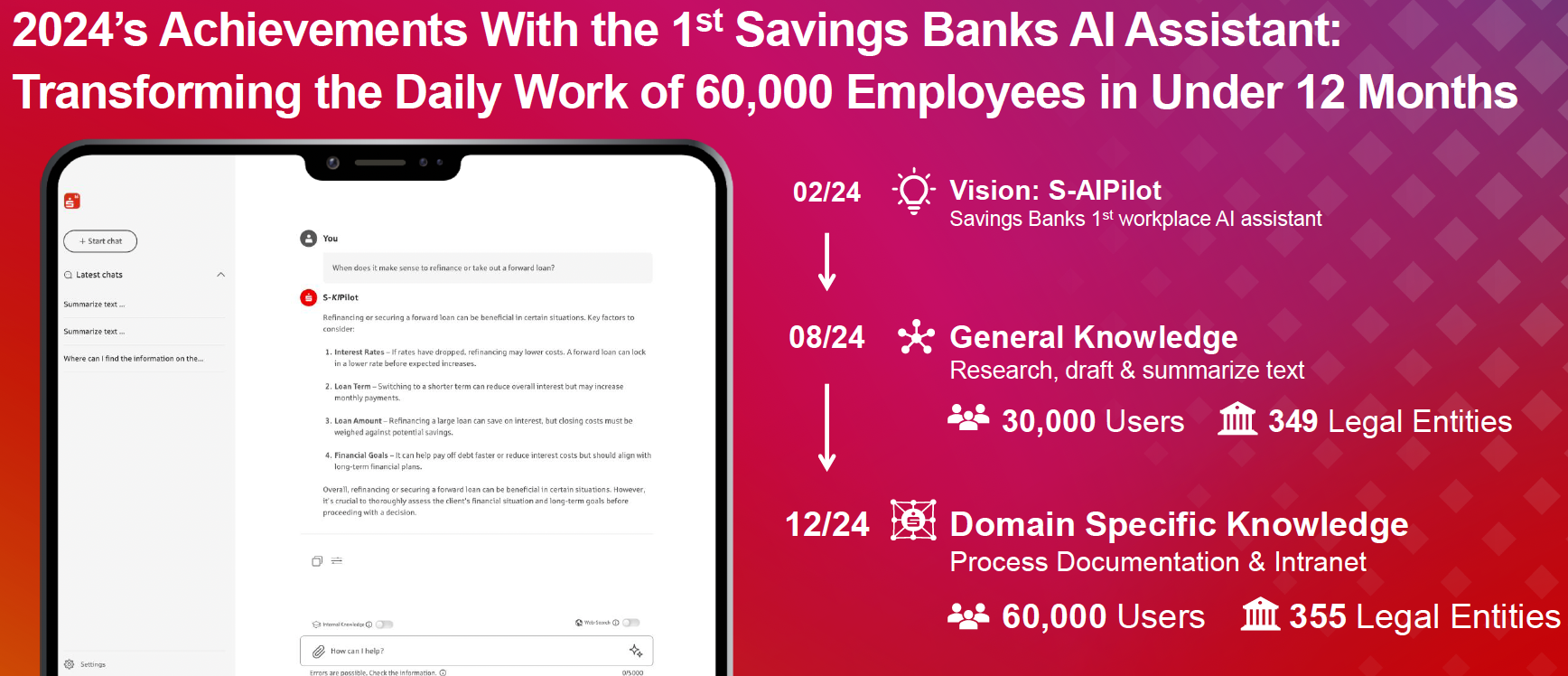
The implementation journey began in February 2024 with the initial vision, expanded to 30,000 users across 349 legal entities by August 2024, and reached 60,000 users by December 2024. The rapid adoption reflects both the technical success and the employee-centered design of the system.
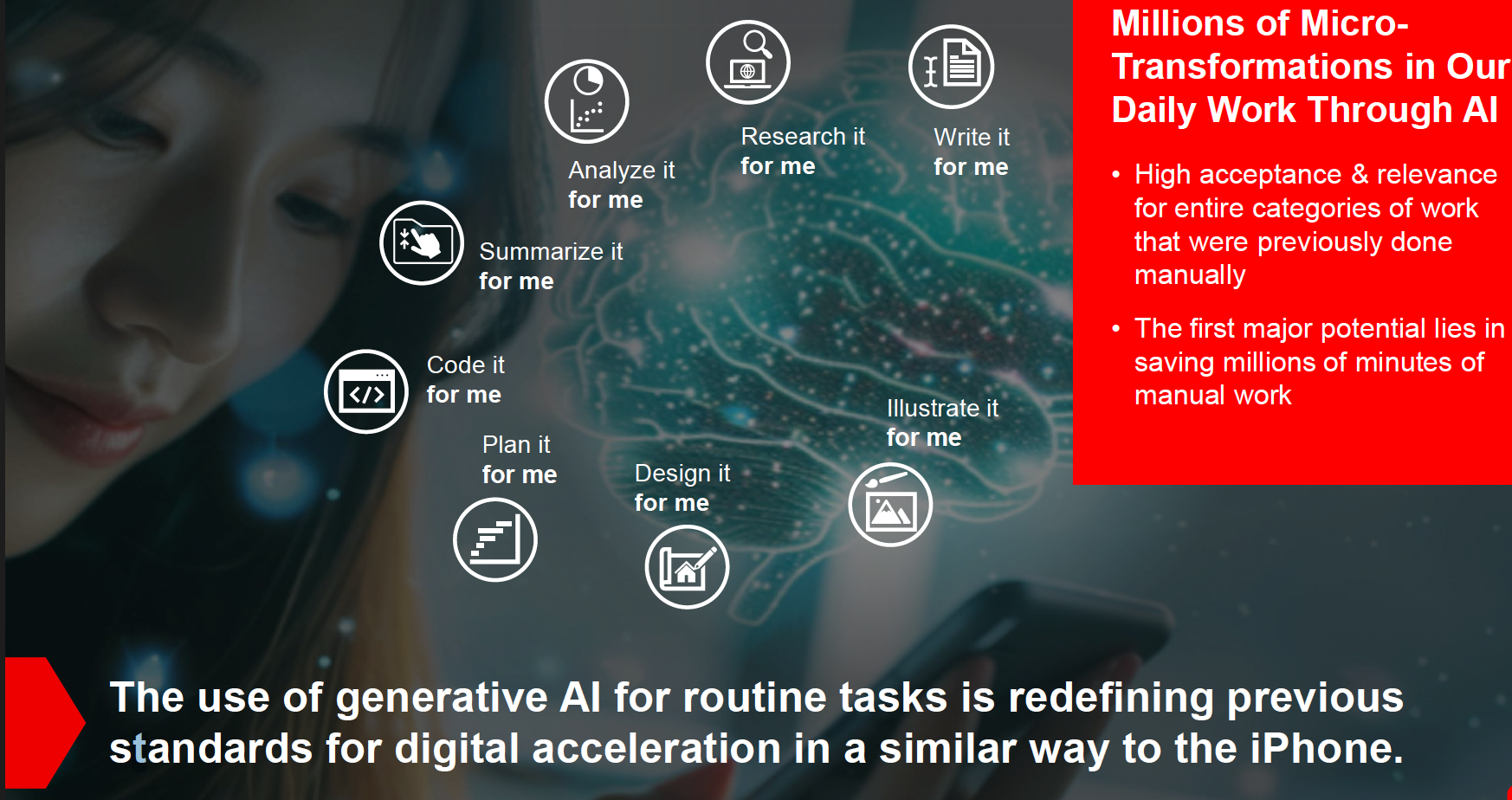
The assistant started with basic capabilities for research, drafting, and summarizing text, then expanded to include domain-specific knowledge like process documentation and intranet content. This progression demonstrates FI’s methodical approach to building AI literacy and adoption across the organization.
From Generative AI to Agentic AI: The Evolution
Koch articulated a clear vision for the evolution of their AI capabilities, distinguishing between current generative AI implementations and the future potential of agentic AI:
“The next big potential for the Savings Banks is Agentic AI. Generative AI redefines previous standards for digital acceleration in a similar way to the iPhone. But Agentic AI will be an even bigger game changer.”
This shift represents a fundamental transformation in how work gets done. While generative AI helps employees write emails, analyze data, and complete discrete tasks more efficiently, agentic AI will enable multi-step workflows where the AI takes partial autonomy over complex processes.
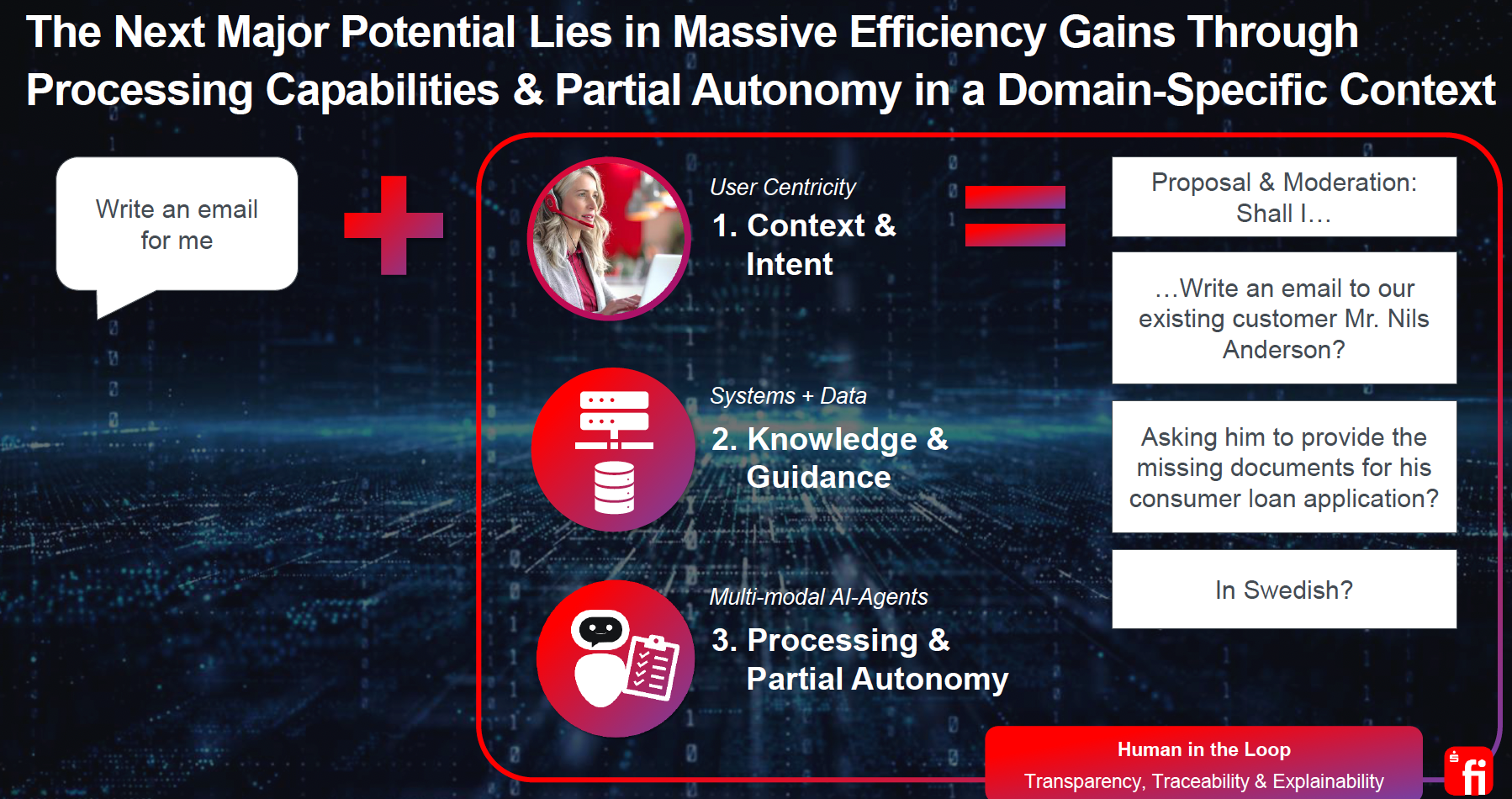
The key distinction Koch highlighted was the addition of three critical capabilities beyond basic generative AI:
-
Context & Intent - AI with a precise understanding of what users are working on and what they want to accomplish
-
Knowledge & Guidance - Access to specific banking knowledge and processes
-
Processing & Partial Autonomy - The ability to carry out multiple steps in sequence with limited human intervention
With these capabilities, instead of employees writing prompts, the AI will proactively offer assistance based on the context, including relevant customer and process information. By 2025, FI plans to expand to multimodal capabilities (handling speech, text, and documents) and partly autonomous agents that can manage complex multi-step workflows.
The Technical Architecture: 100% On-Premises by Design
Perhaps the most surprising aspect of FI’s implementation is the decision to build their AI infrastructure entirely on-premises rather than using cloud-based services. This choice wasn’t made primarily for cost reasons but stemmed from their strategic vision for AI in banking.
Koch explained: “If we want to achieve deep integration with our core banking system, it means operating AI technology where the financial platform is operated: in our data centers.”
This architecture includes:
-
A multi-agent system with specialized AI agents for different banking tasks
-
Open-source large language models operated 100% on-prem
-
NVIDIA GPU infrastructure (including H100 and H200 GPUs)
-
Triton Inference Server and NVIDIA NIM for optimized model deployment
The architecture incorporates both generative capabilities (information retrieval, text generation, function calling) and what FI calls “perceptive capabilities” - structured workflows for specific purposes that provide control and compliance in business-critical processes.
The Results: Transforming the Banking Workplace
By the end of 2024, FI had successfully deployed S-AIPilot to 60,000 employees across 355 legal entities - a remarkable achievement in less than 12 months. The system now handles a wide range of tasks, from drafting and summarizing texts to providing domain-specific knowledge about banking processes.
One particularly interesting use case involves the regulatory review of investment advisory services. Quality assurance managers previously had to manually review recordings of telephone-based investment advisory sessions, each lasting 15-60 minutes. The new AI-driven approach automates transcription and evaluation according to regulatory requirements, creates reports, and recommends improvement measures.
For 2025, the vision is even more ambitious, with plans to roll out to all 200,000 employees by year-end and gradually introduce more advanced agent capabilities, including multimodal functions and partially autonomous workflows.
People-Centric AI Transformation
Throughout her presentation, Koch emphasized that the technical implementation was only half the story. The human aspects of the transformation were equally crucial:
“Successfully managing AI transformation is not just about implementing a new technology. It’s about empowering people to work with AI effectively.”
This approach manifests in several ways:
-
A “human in the loop” philosophy that balances automation with human expertise
-
Transparency, traceability, and explainability to enable human oversight
-
AI literacy initiatives for all employees
-
Learning by doing based on specific use cases that support employees in their daily work
As Koch noted, “Our communication and support for employees aims to ensure that AI literacy does not end with the use of AI tools but empowers and encourages as many people as possible to play an active role in identifying and implementing AI potential.”
Key Lessons for Business Leaders
FI’s approach to AI transformation offers several valuable insights for business leaders across industries:
-
AI as a catalyst, not a strategy: Koch emphasized that “AI is not a new strategy but a catalyst for transformation” - a tool to accelerate existing strategic goals rather than a goal in itself.
-
Focus on the human experience: By starting with employee experience rather than customer-facing applications, FI built AI literacy and discovered high-value use cases organically.
-
Integration is essential: The value of AI in specialized domains comes from deep integration with core systems rather than standalone applications.
-
Balance innovation with compliance: FI’s architecture demonstrates how to innovate while maintaining the control and transparency required in regulated industries.
-
Micro-transformations add up: Rather than seeking one transformative AI use case, FI found value in thousands of small efficiency improvements across the organization.
Looking Ahead: The Future of AI in Banking
As FI continues their AI journey, they’re laying the groundwork for what Koch describes as “massive efficiency gains through processing capabilities and partial autonomy in a domain-specific context.”
The evolution from S-AIPilot’s current capabilities to fully agentic AI represents a fundamental shift in how banking work is performed. As AI takes over routine tasks, banking professionals will be able to focus more on meaningful customer interactions and complex decision-making.
By the end of 2025, FI plans to have deployed their AI assistant to all 200,000 employees across the Savings Banks Finance Group, making this one of the largest workplace AI transformations in the financial industry globally. The impact on efficiency, customer service, and employee satisfaction could reshape expectations for how banking operates.
Conclusion: A People-First Approach to AI Transformation
In an industry often focused on customer-facing innovation, Finanz Informatik has chosen a different path - transforming banking from the inside out by augmenting human capabilities across the organization. Their approach balances technological innovation with a deep commitment to human-centered design, regulatory compliance, and data security.
As Koch concluded her presentation: “Our AI transformation must succeed on two levels: technology and people.” By keeping this dual focus, FI is demonstrating how AI can transform large, regulated organizations while maintaining their core values and responsibilities.
For banking executives and business leaders watching the AI revolution unfold, FI’s approach offers a compelling alternative to headline-grabbing but shallow AI implementations - one that promises sustainable, meaningful transformation rather than short-term technological novelty.
This article is based on Julia Koch’s presentation at NVIDIA GTC 2025. Original slide content courtesy of Finanz Informatik, with modified presentation & formatting.