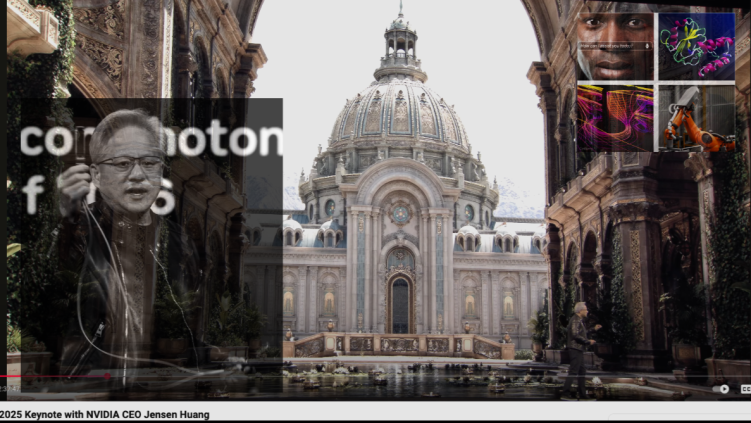
In the heart of Silicon Valley, a transformation is taking place that rivals the Industrial Revolution in its significance. At the center of this transformation stands Jensen Huang, not just as the founder and CEO of NVIDIA, but as perhaps the most important technology educator of our era.
At GTC 2025, Jensen took the stage without a teleprompter or script – a remarkable feat given the complexity of the material he was about to share with thousands of business leaders, technologists, and industry professionals. What unfolded over the next two hours was not merely a product announcement, but a masterclass in explaining how AI is fundamentally changing our world, from computing paradigms to economic structures.
From Retrieval to Generation: The Paradigm Shift
“Fundamentally changed how Computing is done,” Jensen explained, describing the transition “from a retrieval Computing model we now have a generative Computing model.”
This distinction is profound. For decades, computing has been built around retrieving pre-existing content – files, records, images – stored in advance. But the AI revolution has turned this model on its head. Now, computers don’t retrieve; they generate.
“Whereas almost everything that we did in the past was about creating content in advance storing multiple versions of it and fetching whatever version we think is appropriate at the moment of use,” Jensen explained, “now AI understands the context, understands what we’re asking, understands the meaning of our request and generates what it knows.”
This shift represents more than a technical evolution – it’s a complete reinvention of how we interact with information. Rather than searching through files or databases, we simply ask questions, and AI generates responses based on its understanding.
For business leaders without technical backgrounds, this explanation illuminates why AI isn’t just another tool but a fundamental reimagining of what computers do and how they create value.
The Three Pillars of AI Advancement
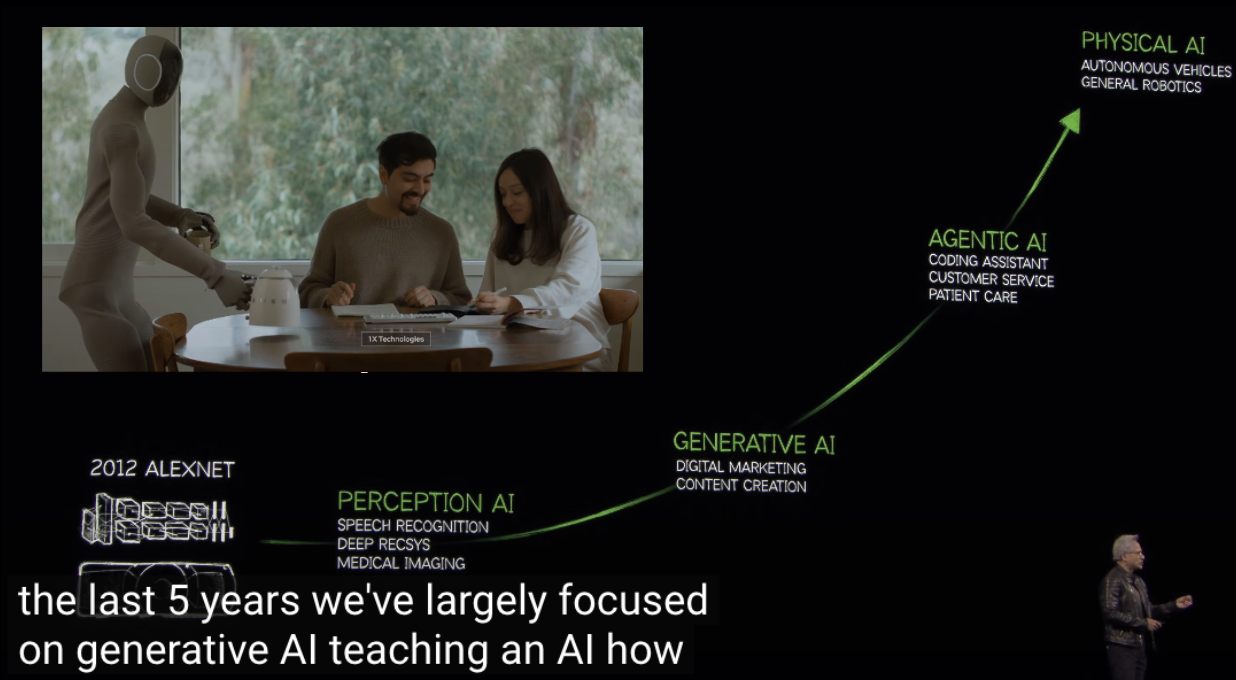
Perhaps Jensen’s greatest contribution as an educator is his ability to distill complex technological evolutions into frameworks that anyone can understand. He identified three core challenges that define each wave of AI advancement:
-
How do you solve the data problem? AI is fundamentally data-driven, needing vast amounts of digital experience to learn from.
-
How do you train the model without human intervention? Human-in-the-loop training quickly hits scaling limits.
-
How do you scale? What algorithms allow more resources to create smarter AI?
This framework helps executives understand not just what’s happening with AI, but why certain approaches are winning while others falter. It transforms AI from a mysterious black box into a comprehensible system governed by identifiable constraints.
The Birth of AI Factories
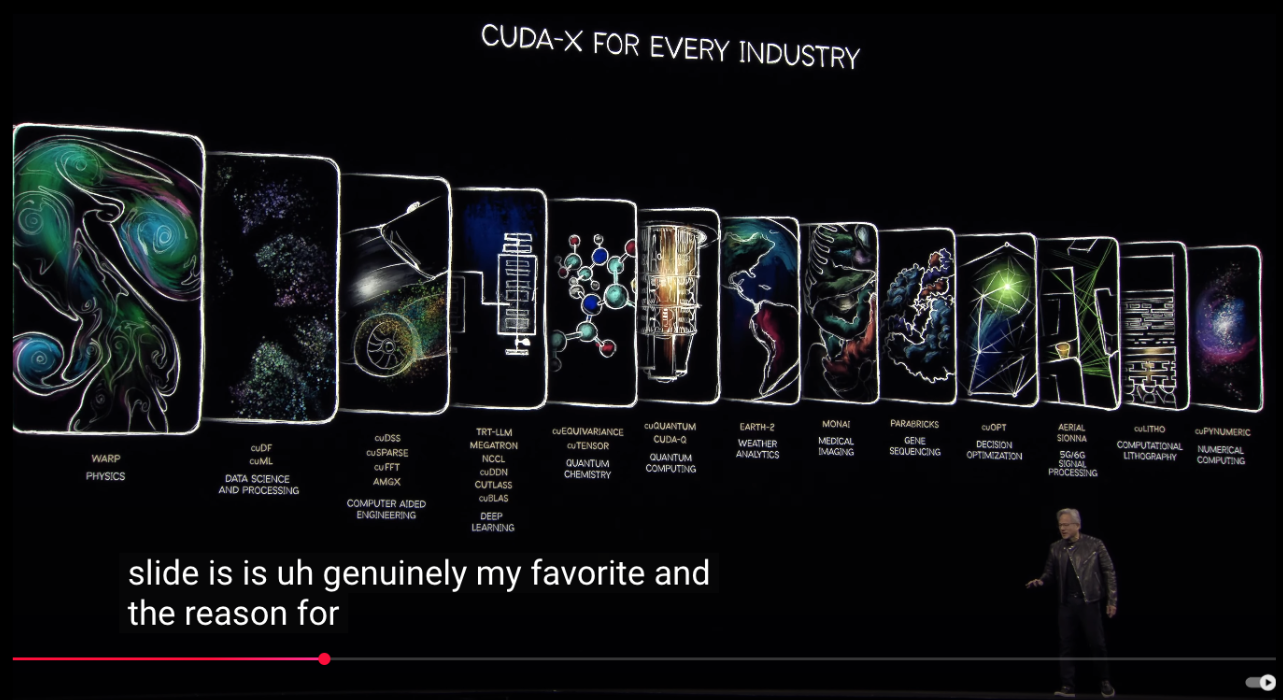
The most compelling part of Jensen’s keynote was his introduction of a new metaphor that will likely shape business thinking for decades: the AI Factory.
“I call them AI factories,” Jensen explained, “because it has one job and one job only: generating these incredible tokens that we then reconstitute into music, into words, into videos, into research, into chemicals or proteins.”
This reframing of data centers as factories producing AI outputs rather than simply housing computing power represents a profound shift in how we should think about technology infrastructure investments.
“Every industry, every company that has factories will have two factories in the future,” Jensen predicted. “The factory for what they build and the factory for the mathematics, the factory for the AI.”
For automotive companies, this means one factory builds cars and another factory builds the AI for those cars. For smart speaker companies, one factory produces hardware while another generates the intelligence that powers it.
This concept of dual production systems – physical and digital – helps business leaders conceptualize how AI fits into their existing operations and why it requires dedicated infrastructure rather than simply being bolted onto existing systems.
Understanding the Economics of AI Factories
Jensen didn’t just describe what AI factories are – he provided a framework for understanding their economics that any business leader can grasp.
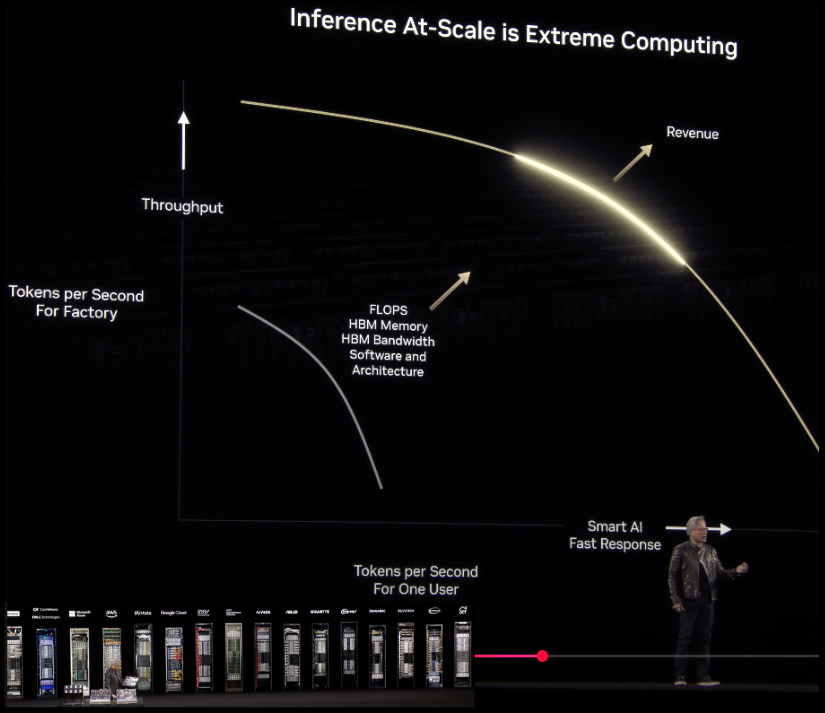
Using the metaphor of a factory producing tokens (the building blocks of AI outputs), he demonstrated the fundamental tension between quality and quantity that defines AI production economics:
“On the one hand, you would like your token rate to be as fast as possible so that you can make really smart AIs. And if you have Smart AIs, people pay you more money for it. On the other hand, the smarter the AI, the less you can make in volume.”
He illustrated this with a simple graph showing the trade-off between tokens per second per user (quality/smartness) and total tokens per second per factory (volume/throughput). This elegantly frames the economic challenge of AI: balancing customer experience against production economics.
For business leaders, this framework transforms abstract technical discussions about model size and training approaches into concrete economic trade-offs they can evaluate through familiar business lenses.
The Computing Revolution Required
Perhaps most importantly, Jensen explained why this new AI paradigm demands a fundamental rethinking of computing architecture.
“The computation requirement, the scaling law of AI is more resilient and in fact hyper accelerated,” he emphasized. “The amount of computation we need at this point as a result of agentic AI, as a result of reasoning, is easily a hundred times more than we thought we needed this time last year.”
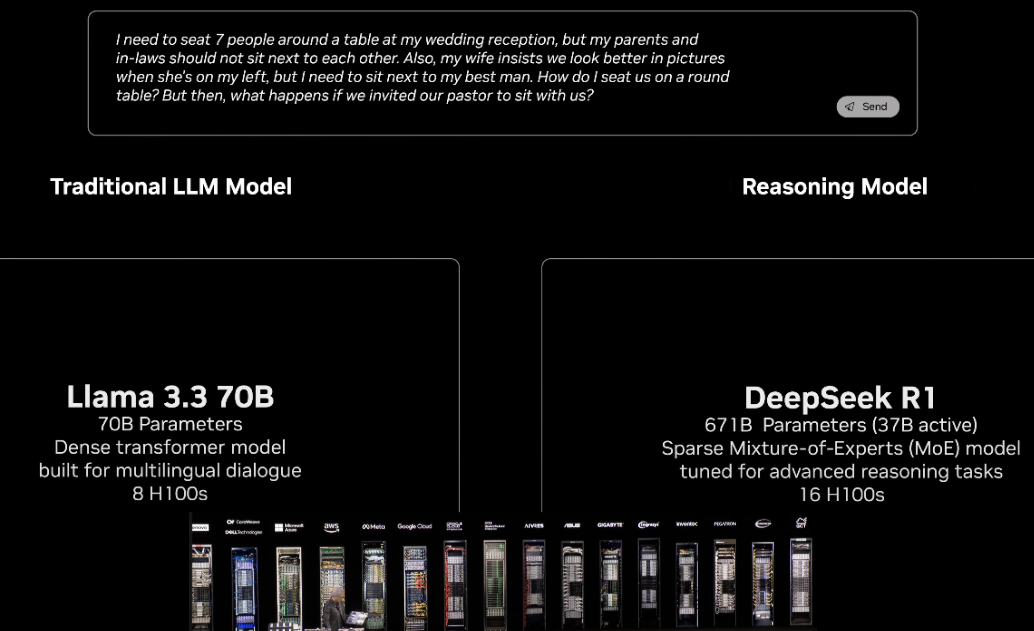
Why such a dramatic increase? Jensen walked through the evolution from simple AI models that generate a single response to modern reasoning models that break problems down step by step, evaluate multiple approaches, and check their own work.
“Instead of just generating one token or one word after next, it generates a sequence of words that represents a step of reasoning,” he explained. “The amount of tokens that’s generated as a result is substantially higher… easily a 100 times more.”
This insight helps business leaders understand why AI requires specialized infrastructure rather than simply running on traditional computing systems – the computational demands are orders of magnitude greater than previously understood.
The Road to Scale: From Hopper to Blackwell to Rubin
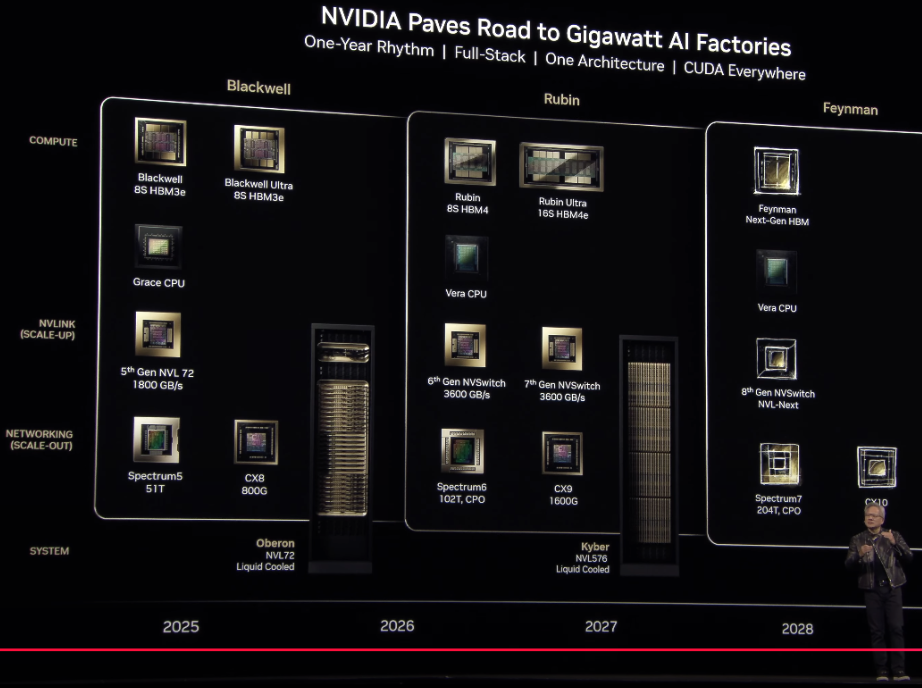
With the conceptual groundwork laid, Jensen then walked through NVIDIA’s product roadmap – not as a sales pitch, but as the technological path to enabling these AI factories.
He explained how NVIDIA’s new Blackwell architecture represents a fundamental transition in computing design, from air-cooled to liquid-cooled, from integrated systems to disaggregated ones, all enabling unprecedented scale.
“Our goal is to do scale up,” Jensen emphasized, showing how NVIDIA has created systems capable of operating as a single massive GPU across hundreds of processing units. “This is the most extreme scale up the world has ever done.”
For business leaders, this technological progression is framed not in terms of technical specifications, but in terms of economic outcomes: more computation per watt, more tokens per second, better AI quality, and ultimately better business results.
Turning Enterprise Computing Inside Out
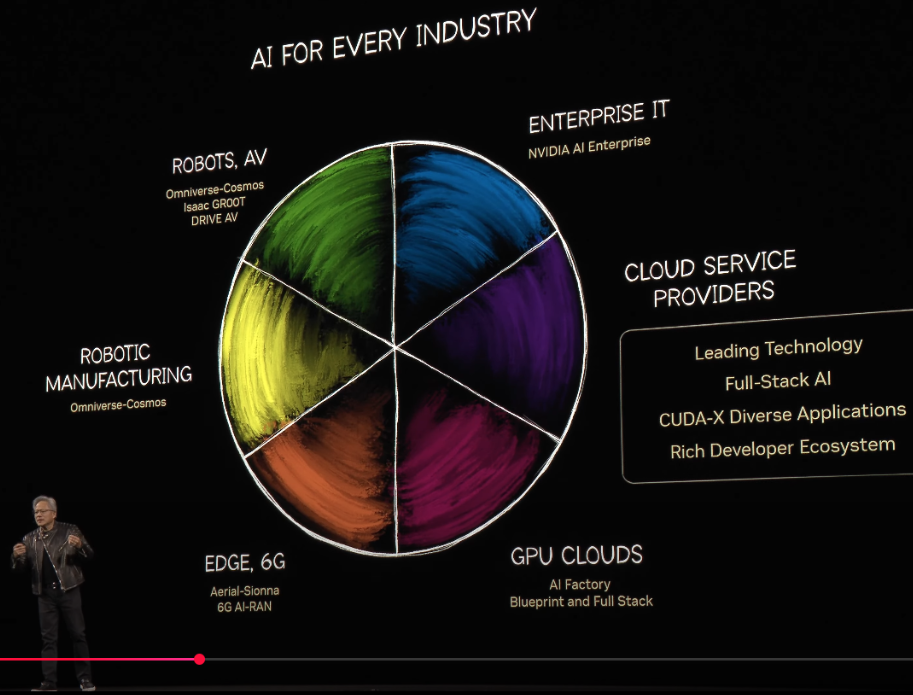
“AI will go everywhere,” Jensen declared, explaining how the AI revolution will transform enterprise computing.
He painted a vision of future enterprises where AI agents become part of the digital workforce: “There’s a billion knowledge workers in the world. There probably going to be 10 billion digital workers working with us side by side.”
This isn’t a distant future – it’s imminent: “100% of software engineers in the future, there are 30 million of them around the world, 100% of them are going to be AI assisted. I’m certain of that. 100% of NVIDIA software engineers will be AI assisted by the end of this year.”
This vision helps business leaders understand that AI isn’t simply about automation or efficiency – it’s about creating an entirely new class of digital colleagues that will work alongside human employees.
Questions Business Leaders Should Ask
As we absorb Jensen’s vision for the future of AI, several critical questions emerge for business leaders:
-
How should we think about our own “AI factory” needs? What capacity will we require to remain competitive, and how does this change our infrastructure investment planning?
-
What is our strategy for balancing AI quality against production economics? Where on Jensen’s graph of tokens per second per user versus total tokens per second should our business operate?
-
How are we preparing our organization for the integration of digital workers? What skills, processes, and cultural elements need to change?
-
What will be our company’s dual factory model? How will we integrate our traditional production systems with our AI production systems?
-
How are we thinking about energy as a constraint on our AI capabilities? As Jensen emphasized, power is becoming the ultimate limiting factor on AI production.
-
What is our timeline for adoption? Given NVIDIA’s roadmap, how should we plan our own technology transition to align with these capabilities becoming available?
-
How will our competitive landscape change as AI factories become standard business infrastructure? Who could enter our market with AI-powered advantages?
The Unbounded Future
Perhaps the most inspiring aspect of Jensen’s keynote was his ability to convey both the enormity of the current transformation and the sense that we’re still just at the beginning.
From the advances in silicon photonics that will enable multi-million GPU clusters to the physical AI bringing intelligence to robots and autonomous systems, Jensen painted a picture of a world where intelligence becomes embedded in every aspect of our physical and digital environment.
“Everything that moves will be autonomous,” he predicted, showing advances in robotics and physical AI that will transform industries from manufacturing to healthcare.
For business leaders, the message is clear: the AI revolution is not a single event but an ongoing transformation that will continue to accelerate. Those who understand it today will be positioned to lead tomorrow.
Jensen Huang: Educator in Chief
What makes Jensen Huang remarkable isn’t just his technical vision or business acumen – it’s his ability to educate across boundaries, to make the complex comprehensible without oversimplifying.
In an era of specialized knowledge and technological complexity, this ability to translate between technical and business domains is perhaps the most valuable skill a leader can possess. Jensen demonstrates that understanding technology deeply and explaining it clearly aren’t opposing skills – they’re complementary capabilities that amplify each other.
As AI continues to transform our world, we need more leaders who can bridge these domains, who can explain not just what’s happening but why it matters and how we should respond.
Jensen Huang may be building the infrastructure for the AI revolution, but perhaps his greatest contribution is showing us how to think about that revolution – not as technologists or business leaders alone, but as informed participants in a transformation that will reshape our economic and social landscape for decades to come.
Reflections for the Future
As we witness this historic transition from retrieval-based to generative computing, from traditional data centers to AI factories, a few thoughts emerge for consideration:
-
The AI revolution isn’t primarily about technology – it’s about a fundamental reimagining of how we create, process, and interact with information.
-
Leadership in this new era requires the ability to understand both technological capabilities and business implications, bridging what have traditionally been separate domains.
-
Organizations will need to develop new metrics and frameworks for evaluating their AI investments, focusing on the economics of token production rather than traditional IT performance measures.
-
The distinction between physical and digital production is blurring, with every company potentially becoming a dual-factory operation.
-
Energy and computational efficiency will become the primary constraints on AI capability, making sustainable AI a business necessity rather than just an environmental consideration.
In this landscape, the most valuable perspective may be Jensen’s educational approach – one that embraces complexity while making it accessible, that acknowledges constraints while inspiring possibilities, and that treats business and technology not as separate disciplines but as interwoven aspects of the same transformation.
The world is changing faster than most realize. Those who can understand and articulate these changes, as Jensen does, will be the ones who guide their organizations successfully through this period of unprecedented opportunity and disruption.