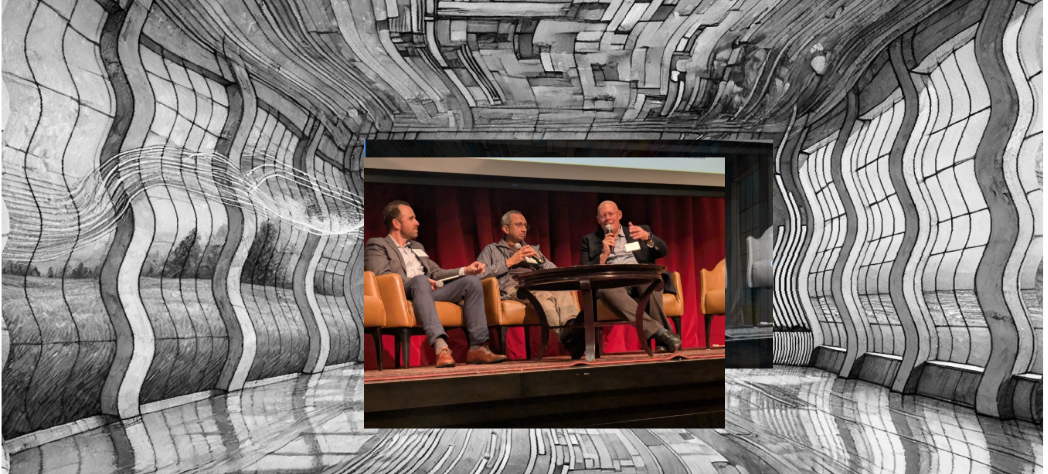
How Northeastern’s Institute for Experiential AI & Anthropic Approach AI’s Trust Paradox
Fireside Chat: When AI Innovation Meets Human Wisdom - A Dialogue on Responsible Development
At a pivotal moment in AI’s evolution, three thought leaders converged to tackle one of technology’s most pressing challenges: how to ensure AI development remains both innovative and responsible. This wasn’t just another tech talk - it was a critical dialogue about shaping AI’s future in service of humanity.
The conversation brought together distinct yet complementary perspectives:
Dr. Usama Fayyad, who leads Northeastern University’s Institute for Experiential AI, has pioneered approaches to human-centered AI development. His work at the Institute demonstrates how academic innovation can directly address real-world challenges.
Vinay Rao brings battle-tested insights from the frontlines of AI safety as Head of Trust & Safety Engineering at Anthropic, where responsible AI isn’t just a goal - it’s foundational to their approach to AI development.
James Genone, as Senior Vice Chancellor for Learning Strategy at Northeastern, provides crucial perspective on how educational institutions can prepare the next generation for an AI-augmented future while maintaining human agency at the center.
Together, they explored the delicate balance between pushing AI’s boundaries and ensuring its development serves human values and needs. Their discussion wasn’t just theoretical - it offered practical insights for organizations grappling with AI implementation while trying to maintain trust and ethical standards.

The Experiential AI Revolution
“The Institute for Experiential AI is all about human-centric AI, where humans and machines work together,” explains Dr. Usama Fayyad, Executive Director at Northeastern’s Institute for Experiential AI. “What we call ’experiential AI’ is our code word for AI with the human in the loop.”
This isn’t just theoretical posturing. The Institute has forged partnerships with organizations ranging from Bangor Savings Bank to major healthcare providers, demonstrating how human-AI collaboration can drive real-world impact. Their approach? Start narrow, think practical, and never lose sight of the human element.
The Counterintuitive Case for Smaller Models
In what might seem heretical in today’s race for larger language models, Fayyad makes a provocative case: “The pursuit of these single models that are now ‘do-it-all’ models will be proven to be the wrong thing. I personally have never come across a real application with real value that requires the model to know 80-90 languages in every field of science out there.”
Instead, he advocates for targeted solutions: “Make the scope as narrow as possible. The narrower you make it, the more likely you are to hit a level of super intelligence actually.”
The Industry Perspective: Anthropic’s Trust-First Approach
Vinay S. Rao, Head of Trust & Safety Engineering at Anthropic, offers a complementary view from the frontlines of AI development. “The story of Anthropic starts with a bunch of folks that were working at OpenAI… who decided to break away… to start a company which had safety at the center of the development of AI.”
This safety-first approach manifests in concrete ways. “There is a set of things that actually just says human in the loop. Otherwise, don’t use it,” Rao explains, particularly for “health or financial decisions or educational decisions, or anything that is high precision.”

The “Sleeping at the Wheel” Problem
Perhaps the most striking insight came from Fayyad’s warning about AI trust: “My short-hand name for this whole problem is called sleeping at the wheel, literally. You know, once you trust it, it’s driving very well… and then you wake up.”
This paradox - where system reliability leads to reduced human vigilance - represents one of responsible AI’s greatest challenges. Both speakers emphasized the critical importance of maintaining meaningful human oversight, even as systems become more capable.
Practical Lessons for Organizations
The speakers offered several key insights for organizations implementing AI:
-
Start Narrow: Focus on specific, well-defined problems rather than attempting to implement broad, general-purpose AI solutions.
-
Prioritize Human Oversight: As Rao emphasized, certain decisions require human involvement - this isn’t just best practice, it’s essential for responsible deployment.
-
Build Trust Through Experience: The Institute’s work with partners like Bangor Savings Bank demonstrates how organizations can develop AI capabilities while building internal expertise.
Looking Ahead: The Real Threat
“The biggest threat to AI to humanity is not super intelligence - we’re very far from that,” Fayyad notes. “It is complete disorientation all over the world. If you live in a world where you can no longer believe anything you read, see, hear, or experience and interact with, we’re done.”
This sobering assessment underscores why responsible AI implementation isn’t just an ethical nicety - it’s a business imperative.
The Path Forward
The convergence of academic insight and industry experience points to a clear conclusion: responsible AI implementation requires both technical sophistication and human wisdom. As organizations rush to adopt AI capabilities, the examples set by institutions like Northeastern’s Institute for Experiential AI and companies like Anthropic offer valuable blueprints for success.
“The best way to change culture,” Fayyad concludes, “is to build education and talent and awareness, and really know how that’s pragmatic.”
https://bsky.app/profile/schwentker.bsky.social/post/3lisr3f4fzs24