
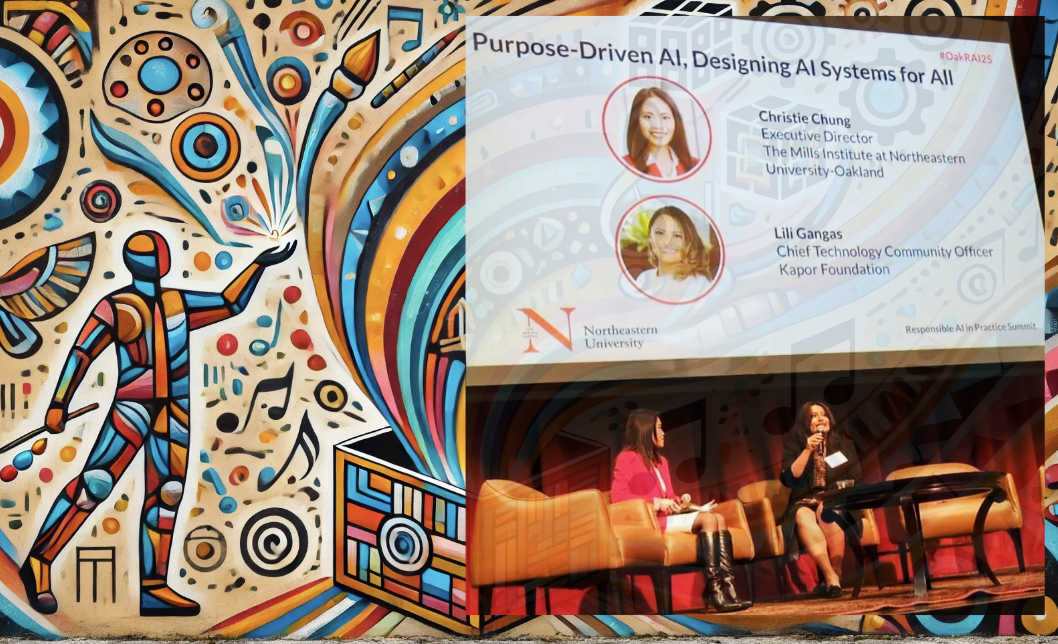
In the rapidly evolving landscape of artificial intelligence, the intersection of technology and social impact is becoming an urgent focus. In a thought-provoking discussion with Christie Chung, Ph.D., Executive Director of The Mills Institute at Northeastern University Oakland, Lili Gangas**, Chief Technology Community Officer at the Kapor Foundation**, shared a compelling vision for purpose-driven AI—one that prioritizes equity, systemic change, and inclusive innovation. Their conversation highlighted the responsibility of technologists, policymakers, and society at large in shaping a future where AI is designed not just for efficiency but for social good.
As Chung aptly posed, “AI has the power to both exacerbate biases and drive transformative change—the key question is: which path will we choose?” This fundamental challenge underscores the urgency of designing AI systems that enhance rather than harm society.
Technology & Equity: The Kapor Foundation’s Mission
Gangas’ role at the Kapor Foundation is unique, straddling multiple disciplines to drive systemic change at the intersection of technology and racial justice. The foundation’s work is rooted in:
-
Expanding Access to Technology Careers: Through investments in K-12 education, entrepreneurship, and venture capital, the foundation aims to create equitable opportunities across the tech ecosystem.
-
Closing the Digital Divide: Advocating for infrastructure improvements and policy changes that ensure communities—especially those historically marginalized—can access affordable and reliable internet.
-
Scaling Ethical AI & Workforce Models: Supporting inclusive tech policies that not only reduce harm but actively promote responsible development in emerging fields.
-
Driving Civic Engagement Through Technology: Partnering with civic organizations to ensure that digital transformation empowers, rather than excludes, communities.
The Urgency of a Multi-Disciplinary Approach
One of Gangas’ key takeaways is that the development of AI should not be left solely to technologists. Instead, it requires collaboration between social scientists, educators, investors, policymakers, and community advocates.
Chung posed a critical question: “How can we ensure that AI development includes a multi-disciplinary approach, bringing in social scientists, educators, and community voices?”
This is more than a theoretical concern—AI’s development will shape industries, economies, and the fabric of society itself. By integrating expertise from diverse fields, we can ensure that AI reflects the needs of real-world communities rather than serving the narrow interests of a select few.
Gangas describes the current moment as a “renaissance” in technology—a time of rapid innovation but also a moment of reckoning. The stakes are high, and how we navigate AI’s development today will determine whether it deepens societal inequities or drives positive transformation.
Systemic Barriers & The Need for Ethical AI
Gangas underscored that AI does not exist in a vacuum. Its deployment reflects and amplifies existing inequities, such as:
-
Historical Redlining & Digital Redlining: Just as discriminatory housing policies created systemic economic disparities, digital exclusion exacerbates inequality in access to education, healthcare, and job opportunities.
-
Bias in AI Systems: From facial recognition software with higher error rates for marginalized communities to hiring algorithms that reinforce discrimination, biased AI systems pose serious risks.
-
Corporate & Policy Responsibilities: Without deliberate intervention, AI development is often guided by profit motives rather than public interest. Gangas urges policymakers and corporate leaders to take proactive steps in shaping responsible AI frameworks.
Balancing Risks & Opportunities in AI
AI has the power to both exacerbate inequalities and drive transformative change. Gangas emphasized the need for purpose-driven AI—a framework that prioritizes community impact over unchecked technological expansion. She highlighted examples on both ends of the spectrum:
Positive Applications of AI
-
Healthcare Innovations: AI-assisted diagnostics can improve early disease detection, such as cancer screenings, providing doctors with enhanced decision-making tools.
-
STEM Education Expansion: AI-powered learning platforms are reducing barriers in STEM education by making high-quality content more accessible and scalable.
-
Ethical AI Startups: Companies are developing multi-modal AI models that integrate diverse perspectives rather than relying on singular, biased datasets.

Risks & Ethical Dilemmas
-
AI’s Environmental Cost: The massive computational power required for AI models strains energy resources and contributes to climate change.
-
Predatory Surveillance & Discrimination: AI-driven systems are often used in policing and financial services in ways that reinforce systemic biases.
-
Job Displacement: Without ethical foresight, automation could further economic disparity by disproportionately impacting vulnerable populations.
Rethinking AI Development: “Just Because We Can, Should We?”
One of the most thought-provoking takeaways from Gangas’ talk was a simple but profound question:
“Just because we can build it, should we?”
This question challenges the dominant AI narrative—one that prioritizes speed and scale over ethical responsibility. Gangas urged developers, investors, and policymakers to pause and critically assess:
-
Who benefits from this AI system?
-
Who is excluded or harmed by it?
-
What real-world consequences does this technology create?
Instead of rushing to market with unchecked innovations, she advocates for rigorous testing, transparency, and accountability in AI deployment.

Looking Ahead to 2050: An Inclusive AI Future
As we envision the world of 2050, Gangas calls for a paradigm shift in AI development—one that reflects the realities, needs, and aspirations of a changing global population. By mid-century:
-
The U.S. will have a more diverse population, with significant growth in Latino, Black, Asian, and multiracial communities.
-
The global workforce will evolve, requiring inclusive AI systems that address varied cultural, economic, and societal needs.
-
There will be an increased demand for responsible AI governance, ensuring ethical considerations remain central to technological advancement.
Gangas’ call to action is clear: we must invest in AI that serves the collective good rather than exacerbates disparities.
Conclusion: A Shared Responsibility for AI’s Future
AI is not just a technological revolution—it is a social revolution that requires active participation from all sectors of society. Whether as technologists, policymakers, educators, or community advocates, we all have a role in shaping the trajectory of AI.
Chung framed the challenge beautifully: “What message do we want to send to future generations? How will they look back on this moment and see our choices?”
The time to act is now. AI should be built with purpose, equity, and inclusivity at its core.
https://bsky.app/profile/schwentker.bsky.social/post/3liq545tric2j