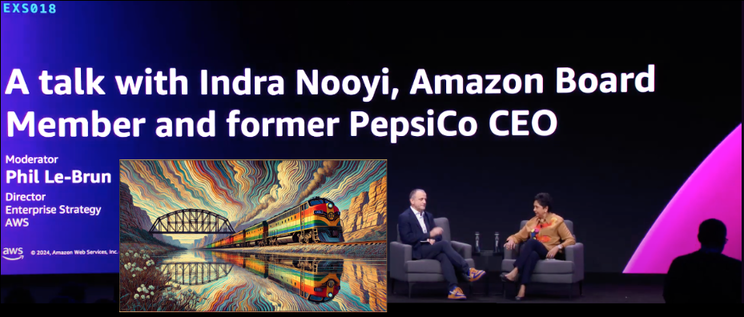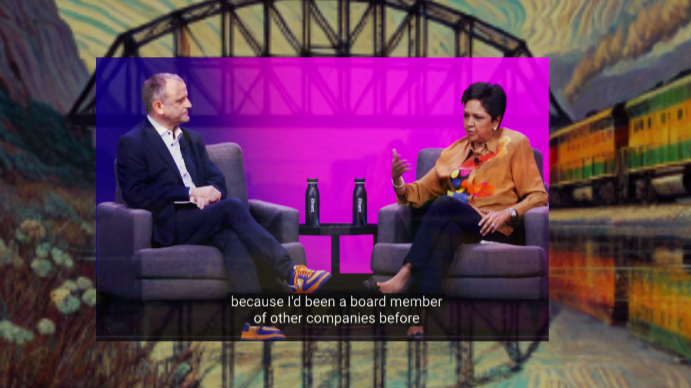
Indra Nooyi’s insights at the recent AWS fireside chat with Phil Le-Brun remind us of an imperative that echoes across boardrooms, executive retreats, and leadership academies worldwide: train, train, train. In an era where technology transforms industries faster than organizations can adapt, the urgency to elevate leadership capabilities has never been greater. As Nooyi succinctly put it,
“If the top three layers of the company don’t get trained and retrained and re-retrained on all these technological developments happening, you cannot have a conversation as to what we need to do as a company.”
It’s not just about training for the sake of knowledge. It’s about survival, transformation, and positioning organizations to thrive in a future that’s already here. This article explores the urgency of training—both the why and the how—drawing on Nooyi’s wisdom while opening the floor to creative strategies and reflections.
Leadership’s Dual Challenge: Adapt or Obsolesce
Nooyi’s call for continuous learning strikes a chord in a world where leaders must navigate a delicate balance between innovation and risk. “Not innovating is a risk by itself,” she remarked, highlighting how stagnant thinking can lead to organizational irrelevance. Yet the solution is not as simple as signing off on a suite of pilot projects. Leaders must fully immerse themselves in understanding both the opportunities and the operational realities of new technologies—a point she underscored with her anecdote about ERP implementation during her time as PepsiCo’s CFO:
“My IT team turned in three thick binders on the ‘as-is’ and ‘to-be’ architecture. They said, ‘Don’t worry, we’ve got this under control.’ But I read every page of those binders, got textbooks, hired professors, and immersed myself in the details. If I’m signing off on a multi-billion-dollar investment, I need to know more than just the headlines.”
Her example underscores an essential point: effective training doesn’t just enable leaders to “check a box.” It equips them to ask the right questions, make informed decisions, and defend long-term investments against short-term critics.
Training as a Strategic Imperative
Training, Nooyi reminds us, is not a one-and-done endeavor. It’s a continuous process. This is particularly critical in today’s landscape, where generative AI and other emerging technologies are reshaping industries in real-time. The question for leadership is no longer if but how they will upskill themselves and their organizations to harness these changes.

Nooyi’s “zoom in and zoom out” approach offers a useful framework for designing training strategies. Leaders must develop the ability to dive deeply into the details of a new technology while maintaining a 25,000-foot view of its broader implications:
“Having this insatiable curiosity to understand a business or issue in great detail, then zooming out to see the bigger picture, has been constant through my career.”
This dual focus—granular and big-picture—is precisely what training should instill in leaders. It’s not about making them technologists but about equipping them to collaborate effectively with experts, evaluate strategic opportunities, and align technology investments with business goals.
Curiosity and Humility: Foundational Traits for Learning Leaders
A recurring theme in Nooyi’s reflections is the essential role of curiosity and humility in leadership. As she pointed out, “Curious CEOs are what make successful companies. If you think you’ve arrived, you’re mistaken.” This mindset must extend across the leadership team and into the organization’s culture.
Consider these reflective questions to guide one’s thinking:
-
Is one, as a leader, modeling curiosity through their own learning journey?
-
Does their organization reward curiosity, or does it penalize experimentation?
-
How might a shift toward a learning culture reshape their company’s readiness for the future?
Nooyi’s leadership at PepsiCo, Motorola, BCG —immersing herself in everything from recipes to semiconductors to “chip” manufacturing ( think Lay’s :) —demonstrates that curiosity isn’t just an individual trait. It’s a cultural lever. Leaders who embrace continuous learning send a powerful message to their teams about the value of knowledge and adaptability.

Designing Training Plans: From Boardroom to Frontline
Training must cascade through an organization, starting at the top. Nooyi’s insights on board dynamics are instructive here. She cautioned against “stacking the board” with disconnected experts and instead advocated for shaping boards based on company needs:
“If you put too many technology people on the board, nobody’s going to understand what they’re saying. But you also need enough expertise to govern effectively.”
This principle applies to training plans as well. A phased approach can help ensure that training aligns with both organizational strategy and individual roles:
-
Phase 1: Leadership Immersion – Engage the C-suite and board in foundational training, ensuring they understand the strategic implications of emerging technologies.
-
Phase 2: Functional Upskilling – Tailor training programs to the specific needs of functional leaders and their teams.
-
Phase 3: Frontline Enablement – Empower employees with tools and knowledge to apply new skills directly to their roles.
The Risk of Standing Still
As Nooyi aptly noted, “Risk is no longer static; it changes all the time.” In this context, training becomes not just a safeguard against disruption but a catalyst for innovation. By equipping employees at all levels with the skills to navigate change, organizations can transform training into a competitive advantage.

A critical aspect of this is fostering a collaborative relationship between technologists and business leaders. Nooyi’s advice is clear: “Make sure the CTO speaks the language of business, not the language of technology.” Training programs that facilitate cross-disciplinary dialogue can help bridge this gap, ensuring that technology-driven initiatives are both strategic and actionable.
Inspiration, Not Dictation: A Call to Reflect
Nooyi’s reflections leave us with an open invitation to think deeply about the role of training in our organizations. In considering her words, one may ask oneself:
-
What is the next frontier of learning for their leadership team?
-
How can training become a platform for fostering innovation and resilience?
-
What risks are they taking by not investing in the continuous development of their people?
The urgency is clear, but the solutions are theirs to co-create. As Nooyi’s career demonstrates, the best leaders don’t dictate. They inspire, question, and create space for creativity to emerge. If one is looking for a starting point, her words on transformation—delivered with vivid conviction at AWS’s fireside chat—are an excellent guide.
“Paint an optimistic picture of what the company could be after the transformation. At the same time, paint a picture of what it will be if we don’t transform. But do it with vivid, emotional, committed storytelling.”
The future is coming fast. Will their organization be ready? Training—train, train, train—might just be the key to unlocking one’s potential.
Source: AWS Fireside Chat with Indra Nooyi, available on YouTube.
https://www.youtube.com/watch?v=eP25p_oO60w
Dec 19, 2024