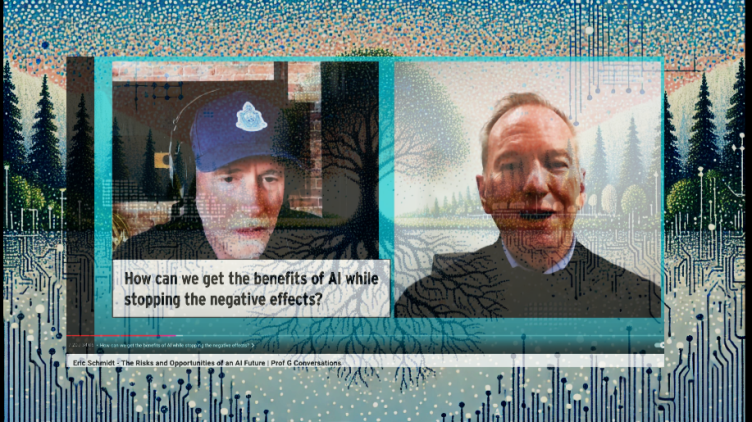
In a recent conversation with Scott Galloway and Eric Schmidt, former CEO of Google and co-author of Genesis: Artificial Intelligence, Hope, and the Human Spirit, unpacked a series of provocative questions about the future of AI and its intersection with society. Schmidt, alongside his co-author Henry Kissinger, offers a reflection on AI’s rapid evolution, its profound potential, and the dangers that lie in its unchecked spread.
The book, which delves into the societal structures disrupted by AI, raises an urgent question: Are we ready for AI’s impact? “The world is not ready for this,” Schmidt shared. He argues that many of the discussions surrounding AI overlook critical aspects of its societal consequences—whether in terms of trust, power, economics, or even the effects on children. “There are so many examples…that are relatively poorly explored,” he notes, emphasizing that while the promise of AI is vast, the readiness to manage these systems remains far behind.
As the conversation progressed, the existential threats of AI were discussed in a stark light. Sentience, misinformation, inequality, and loneliness were all framed as potential risks of a technology that is evolving at a pace too fast for most societies to keep up. While Schmidt acknowledges the overwhelming good AI could bring—advancements in healthcare, climate change, and scientific discovery—he also warns of its darker possibilities. He is particularly concerned about its potential misuse in biological warfare and cyberattacks, with AI systems powerful enough to orchestrate attacks on a scale never before seen. These concerns are compounded by what he describes as the “evil” possibilities of AI in the wrong hands.
One of the more troubling aspects of AI’s evolution, according to Schmidt, lies in its potential to amplify loneliness. The rise of AI-driven virtual relationships, such as AI girlfriends, could exacerbate the isolation already felt by many, particularly young men.

“The biggest threat in the U.S. right now is loneliness,” Schmidt remarked. This loneliness, he argues, can lead to radicalization, misogyny, and social withdrawal. These AI-driven relationships, he believes, could accelerate the disintegration of real-world relationships, further isolating individuals and breeding deeper social divides.
Schmidt’s reflections take a turn toward the ethical implications of AI’s reach. The conversation turns to free speech, with Schmidt articulating a clear boundary: “I am strongly in favor of free speech for every human. I am not in favor of free speech for computers.” This distinction between human speech and algorithmic behavior raises critical questions about who, or what, controls AI’s actions. Schmidt advocates for a world where algorithms are held accountable for their actions, especially when those actions harm individuals. He suggests that, much like previous technological inventions such as cars, AI systems must be regulated with appropriate guardrails to mitigate risks.
The conversation naturally shifts toward the pressing question of regulation. Schmidt, who was instrumental in navigating the regulatory landscape for big tech, is cautious about how AI will be treated by lawmakers. “For the next four years, there’ll be very little regulation,” he predicts, a reflection of the industry’s tendency to resist oversight. However, Schmidt is quick to point out that companies will still face legal liability in cases of harm. This, he suggests, may be the only catalyst for change—a calamity that sparks the realization that regulations are urgently needed.

When it comes to global cooperation on AI, Schmidt raises another thought-provoking question. He considers the idea of international treaties to prevent AI weaponization and to manage its global proliferation. “Should the U.S. and China work together on AI security to solve a big part of the global threat?” he asks. Schmidt reflects on the potential for collaboration between these two superpowers, despite the deep political divides that currently exist. “We’re not best friends, but we have to learn how to coexist,” he observes, acknowledging the complexity of international relations in the context of AI security. The idea of building a cooperative framework that balances national interests with global security remains a topic of fierce debate, one that Schmidt believes will require careful, sustained effort.
At the heart of this conversation lies a question: Can society balance the incredible benefits of AI with the serious risks it poses? Schmidt’s view is one of cautious optimism, underscored by the urgency of thoughtful regulation and international cooperation. “I think most reasonable people would say, okay, some sort of regulation that keeps these things in check makes sense,” he concludes, though the path to achieving this is anything but clear.
The future of AI remains uncertain, and its trajectory will depend largely on how we choose to regulate, govern, and collaborate on its use. As Schmidt warns, the time to act is now—before the technology outpaces our ability to control it.

The source of the interview is Eric Schmidt on AI’s Dangers and Opportunities with Scott, discussing Schmidt’s book Genesis: Artificial Intelligence, Hope, and the Human Spirit. The interview is available on YouTube: Watch here.