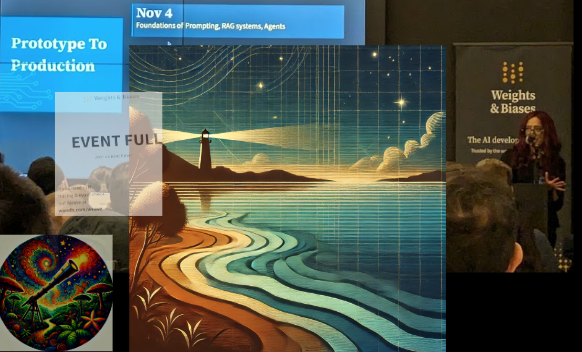
As organizations embrace the transformative potential of Generative AI, many are eager to shift from early experimentation to scalable, production-ready applications. The recent Weights & Biases GenAI Master Class: From Prototypes to Production laid out a roadmap for this journey, blending technical insights and strategic guidance to help teams navigate the transition, lead by Lavanya Shukla. 🌉🚀
📝 Highlights from the Master Class
🔧 Building a Production Mindset One of the most powerful takeaways was the importance of adopting a “production mindset.” Moving from development to deployment can be challenging due to scaling and operational hurdles. By focusing on robust experimentation early on, teams can anticipate real-world demands and prepare for a smoother journey to production. 🌱
🔍 Experimentation as a Core Principle A standout strategy was hands-on experimentation through variable tweaking in Python notebooks. This method allows teams to explore how different parameters (like temperature and prompt structure) influence model behavior. Through experimentation, teams gain a deeper understanding of model strengths and limitations, ultimately leading to better performance in production. 🎛️
🤖 Enhancing Contextual Understanding with Transformers The session explored the inner workings of Transformer models, highlighting how attention mechanisms empower models to grasp context across vast datasets. This architecture is especially game-changing for NLP applications, enabling models to understand and predict complex patterns and relationships. 📚✨
⚖️ Overcoming Challenges in Model Evaluation Transitioning to production requires a solid evaluation framework. Non-deterministic outputs and model reliability are common challenges. The Master Class shared strategies for setting up comprehensive evaluation metrics to assess accuracy, relevance, and responsiveness, ensuring consistent model performance once deployed. 🔄
✏️ Prompt Engineering and Context Management Good prompt engineering is an art! Structured prompts lead to better, more predictable outputs. The session covered essentials like using delimiters and crafting examples, guiding models toward optimized and clear responses. 🎯
📈 Scaling with Retrospective Attention The session also highlighted how modern transformers (e.g., GPT-4) use retrospective attention to manage larger context windows, overcoming scaling limits of earlier models. This enables longer, complex interactions—ideal for applications like customer support or extensive document analysis. 📜💬
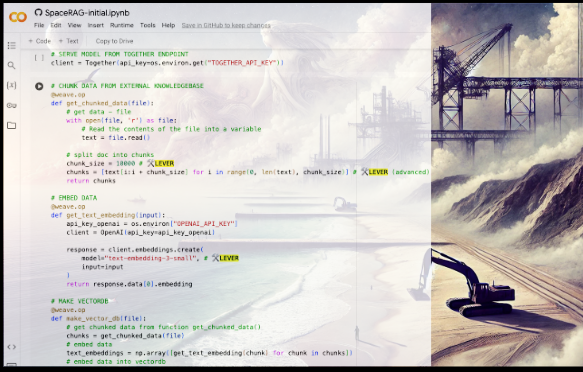
🌐 Reflecting on the Path Forward: How Organizations May Evolve with W&B 🔍🌟
The master class illuminated the incredible potential for organizations to grow through thoughtful adoption of tools like Weights & Biases. This empowers GenAI to drive meaningful impact across key sectors—from finance 💸 and healthcare 🏥 to education 📘 and creative industries 🎨. As companies continue to explore these technologies, essential questions guide this transformative journey:
For Technical Teams: How can data-driven experimentation reduce risk while enhancing GenAI’s adaptability across diverse applications?
-
(a) By fine-tuning model prompts and parameters to meet industry-specific needs 🛠️.
-
(b) Through continuous iteration and performance tracking 📊 on W&B dashboards, creating a dynamic feedback loop for improvement 🔄.
For Executives: What steps can leaders take to build a GenAI roadmap that aligns with strategic objectives and sustains performance at scale?
-
(a) By focusing on high-impact use cases and deploying scalable, secure infrastructure 🔐.
-
(b) By fostering a production-ready mindset from early prototyping through to deployment 🏗️.
For Broader Stakeholders: How can cross-functional teams collaborate effectively to maximize GenAI’s potential in ways that add real value?
-
(a) By establishing shared metrics and accessible dashboards across teams, encouraging alignment 📈.
-
(b) By setting regular checkpoints to ensure technical progress aligns with broader organizational goals 🎯.
With Weights & Biases as a core component, organizations are poised not only to deploy GenAI solutions but to continuously improve, adapting to the evolving demands of production environments. 🧩✨ The Master Class highlighted a journey of progressive growth, where the blend of experimentation, rigorous evaluation, and adaptive system design fosters a resilient and scalable AI foundation. 🏆
As we move forward, the possibilities are boundless: a future where GenAI integrates seamlessly across sectors, powering both innovation and responsible AI deployment. This vision isn’t a distant aspiration but a path unfolding for those ready to embrace the next era of intelligent, scalable technology. 🌍🚀