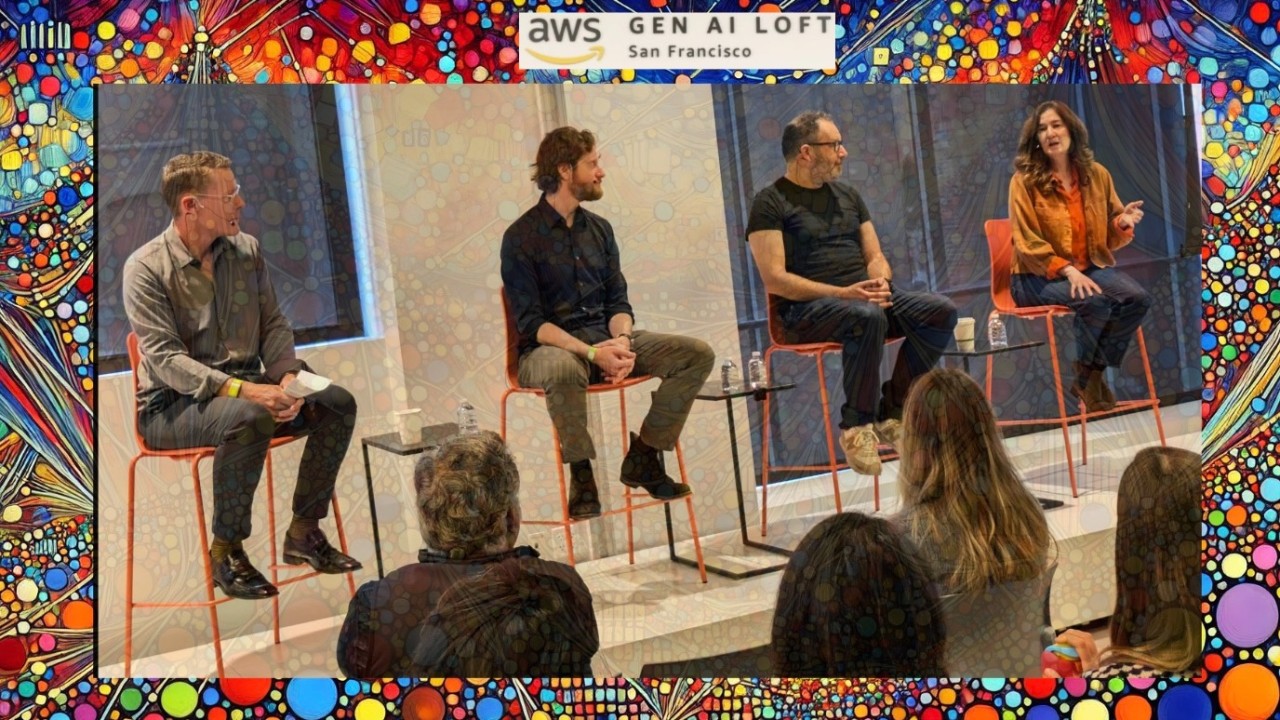
The field of generative AI is advancing at an unprecedented pace, and enterprises are taking note. At a recent panel hosted at the AWS GenAI Loft in San Francisco, experts from Glean, AWS, and Anthropic convened to discuss how companies can harness the transformative power of AI while ensuring data security, scalability, and responsible use. With representatives from Cisco, SAP, Samsung, and other major organizations in attendance, the event provided a rich exchange of ideas on the evolving role of AI in enterprise.
Setting the Stage: Who’s Who on the Panel
The panel featured notable leaders in AI: Tamar Yehoshua, President of Product & Technology at Glean; Adam Seligman, VP of Developer Experience at Amazon Web Services (AWS); Michael Gerstenhaber, VP of Product at Anthropic; and moderator Matt Kixmoeller, Glean CMO. Each brought distinct insights into enterprise AI—from operational efficiency and workflow automation to security and ethical considerations.
AWS Bedrock: A Secure Foundation for Enterprise AI
Adam Seligman from AWS introduced the discussion by explaining how AWS Bedrock is designed to provide enterprise-ready security, ensuring the integrity of generative AI applications. In a landscape where companies must innovate quickly, AWS has prioritized an environment where developers can deploy AI models without compromising on security.
“AWS operates Bedrock with the same principles as any other compute environment,” Adam emphasized. “With fine-grained permission controls, logging, and serverless environments, our customers can trust that their data and AI models are secure as they scale AI solutions globally.”
Adam highlighted AWS’s commitment to making generative AI as accessible and reliable as possible, even as companies grapple with complex data privacy and compliance demands. “Our focus is on supporting enterprise AI with the infrastructure that makes it secure, agile, and effective,” he added.
Glean’s Single-Tenant Approach and Agentic Workflows: Empowering Enterprise Control
Following AWS’s security overview, Tamar Yehoshua expanded on Glean’s unique commitment to data privacy through its single-tenant architecture. While many Software-as-a-Service (SaaS) providers operate on a multi-tenant basis—hosting multiple clients’ data in a shared environment—Glean has opted for a single-tenant approach, giving each client its dedicated infrastructure to host and manage its data.
“For enterprise customers, particularly those handling highly sensitive information, a single-tenant setup provides unparalleled control and peace of mind,” Tamar explained. “We recognized early on that organizations wouldn’t feel comfortable giving all their data to a multi-tenant SaaS model, so we prioritized single-tenancy to let companies retain full control over their environments.”
Glean’s architecture not only bolsters security but also facilitates customized agentic workflows that adapt to unique organizational needs. Tamar elaborated on how Glean’s design enables AI-driven “agentic” workflows, where multiple steps in an automation process can be chained together securely, each step adhering to strict permissioning and data access protocols.
“Each step in our agentic workflows respects the same permissions and data controls as any other individual action in the system,” Tamar noted. “This way, companies can chain automated tasks together without compromising data integrity or security, ensuring that only authorized users can access specific information at each stage.”
For large organizations managing complex, multi-level permissions, this capability is critical. The agentic workflows allow AI to perform a series of actions, such as pulling data from various sources, summarizing reports, and flagging key insights, all while ensuring that security protocols are upheld at each step. Tamar pointed out that this adaptability enables Glean’s clients to streamline internal processes while maintaining a high level of trust and security.
Evaluating AI Quality with Glean’s AI Evaluator
In addition to its single-tenant architecture and agentic workflows, Glean has taken proactive steps to maintain high standards in AI quality through tools like its AI Evaluator. Tamar Yehoshua highlighted this commitment, explaining how Glean uses large language models (LLMs) to assess specific parts of its codebase and ensure its AI systems align with enterprise-level requirements.
“We use LLM elements to evaluate aspects of our code,” Tamar shared, “and we documented this approach in a blog post a few months ago titled AI Evaluator. It’s an excellent resource for understanding the rigorous standards we apply to Glean Assistant to ensure it meets the demands of modern enterprises.”
(Post here: glean.com/blog/glean-ai-evaluator)
This layer of quality control enhances Glean’s ability to provide AI solutions that not only perform well but also remain trustworthy for users across diverse and sensitive enterprise environments.
Responsible AI and the “Hallucination” Challenge: Anthropic’s Perspective
Anthropic’s Michael Gerstenhaber expanded on AI safety, a cornerstone of responsible AI deployment. He pointed to a unique challenge in generative AI: “hallucinations,” where AI models generate information that appears credible but lacks factual grounding. For Anthropic, responsible AI goes beyond error reduction, emphasizing transparency, user trust, and alignment with ethical standards.
“Responsible AI isn’t just about avoiding mistakes,” Michael explained. “It’s about ensuring that AI operates within an ethical framework. Enterprises increasingly prioritize transparency and reliability in their AI systems, especially when it comes to handling sensitive data.”
Anthropic’s approach includes both advanced model training and human-in-the-loop evaluations, which enable users to verify information accuracy by accessing primary sources within the AI output itself. This practice helps mitigate hallucinations, enhancing trust in AI-driven decisions.
Innovation through AI: Glean’s “Promptathon” Approach to Workflow Transformation
Towards the end of the panel, Tamar Yehoshua from Glean shared an innovative approach Glean has used to accelerate AI adoption and creative problem-solving within its teams. Through “Promptathons”—internal events inspired by hackathons—Glean’s employees collaborate across departments to design AI prompts that streamline workflows and tackle complex tasks.
“Even in an AI-first company like Glean,” Tamar reflected, “we’ve found that empowering employees to experiment with AI prompts brings to life new efficiencies in document management, customer support, and interdepartmental communication.”
In one example, Tamar described how a finance team member, with the guidance of an engineer, created an automated process for tracking sales bonuses. Such initiatives exemplify how Glean encourages every team member to view AI as a tool for creative problem-solving and process optimization.
Tamar emphasized that while Glean’s Promptathon culture may appear straightforward, the impact is profound: “By giving employees the time, tools, and expertise to explore AI, we’re not only fostering innovation but also making AI accessible and practical for everyone.”

Audience Q&A: Security, Scalability, and Usability in Focus
As the session moved to Q&A, the audience—representing major tech players like Cisco, SAP, and Samsung—posed questions on integrating AI securely, scaling AI in sensitive workflows, and balancing efficiency with data privacy. Both Tamar and Adam shared their insights on balancing the technological possibilities of generative AI with enterprise-level security.
One question from a Cisco representative concerned data security, a top priority in AI deployments. Tamar reiterated that Glean’s single-tenant architecture allows clients to retain control over their data, addressing privacy concerns directly. “With AWS and Bedrock, we’re able to deliver an enterprise-grade AI solution that combines scalability with uncompromising security,” she explained.
Key Takeaways: AI as a Strategic Partner for Innovation and Integrity
The panel offered an insightful perspective on the future of AI in enterprise environments, blending technical innovation with ethical and security standards. Glean’s Promptathon approach to fostering AI innovation serves as a replicable model, encouraging organizations to build an AI-literate workforce that can collaborate across functions and unlock new efficiencies.
The event prompted a compelling question in my mind as generative AI continues to reshape industries:
What practices will ensure that AI-driven innovation aligns with an organization’s values, balancing agility with integrity and security?