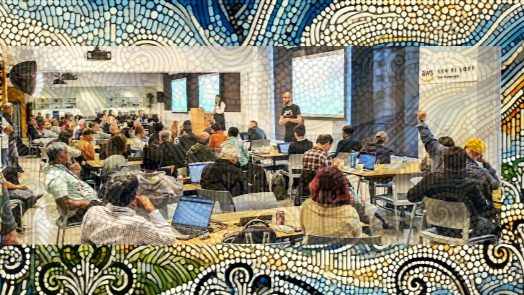
Generative AI continues to transform industries, and at Amazon Web Services (AWS) Gen AI Developer Day, Margaret (Maggie) Vo, Head of Technical Education and Enablement at Anthropic, provided an insightful exploration into the latest breakthrough—Claude 3.5. This technical session was not just a showcase of capabilities; it was a masterclass in how enterprises can leverage Claude 3.5 to unlock new levels of efficiency and innovation using AWS infrastructure. Great hosting by all the AWS Gen AI Loft San Francisco event and production team and AWS Sr Dev Rel Mike Chambers.
Claude 3.5: Beyond the Basics
Claude 3.5 represents a significant leap forward in AI reasoning and interaction. Maggie guided attendees through the core strengths of Claude 3.5, highlighting its advanced reasoning capabilities that set it apart from earlier versions. These capabilities allow enterprises to move beyond simple language generation to create sophisticated AI agents capable of nuanced decision-making, enabling truly transformative automation across a variety of domains.
“Our core goal has always been to ensure safe AI development while also pushing the frontiers and building really powerful AI models,” Maggie explained, emphasizing the importance of balancing safety and innovation. She added, “We’ve been able to accomplish these goals by releasing a series of frontier models at an astronomical pace—everything from Anthropic Claude 1 to Claude 3.5 within about a year and a half.”
The presentation underscored how Claude 3.5 integrates seamlessly with Amazon Bedrock, providing a powerful infrastructure for generative AI workflows. This combination enables scalable deployment of AI solutions, from prototype to production, without the burden of complex system integrations. For both AI practitioners and enterprise architects, the key message was clear: Claude 3.5 is not just a tool but an ecosystem enabler.

Retrieval-Augmented Generation (RAG) and Best Practices
A central focus of Maggie’s session was on Retrieval-Augmented Generation (RAG)—a methodology that combines generative AI with powerful retrieval mechanisms to deliver highly relevant and contextual outputs. Claude 3.5 excels in leveraging RAG to enhance responses, particularly in enterprise environments where precision is critical.
Maggie shared empirical evaluations and case studies demonstrating how Claude 3.5 can be optimized within AWS to advance RAG applications. These examples illustrated best practices for integrating AI with existing enterprise data systems, using Claude 3.5’s capabilities to refine the quality and context of generated content. “The most important evals are always the ones you do for yourself,” Maggie stated, underscoring the value of real-world testing. “Always build joint evals whenever a new model comes about; test it against your old eval suite to know most effectively what a model is good for in your use case.”
Prompt Engineering: Unlocking Full Potential
Prompt engineering is at the heart of extracting value from AI models, and Maggie provided actionable insights into crafting effective prompts for Claude 3.5. The session covered advanced techniques for structuring prompts that not only elicit detailed responses but also guide the AI towards making better inferences and decisions. By exploring prompt iterations and examples, Maggie illustrated how different phrasing strategies impact the quality of AI outputs, a critical factor for optimizing workflows.
One key takeaway was the importance of iterative prompt development. “Examples are perhaps the most single powerful tool you could use to improve the prompt,” Maggie noted, emphasizing that providing examples for the AI to follow can drastically improve output consistency. Whether refining customer service automation or enhancing research capabilities, the process of developing prompts that work well with Claude 3.5 is both an art and a science. This iterative process ensures that the AI can be directed to produce outputs that align closely with organizational goals.
Considerations for Exploring AI Potential:
-
How can enterprises leverage advanced reasoning capabilities in Claude 3.5 to make strategic decisions that were traditionally human-driven?
-
In what ways can prompt engineering techniques be systematically implemented across teams to maintain consistent and high-quality AI outputs?
-
What specific scenarios might benefit most from using Retrieval-Augmented Generation, especially when combined with the scalability of AWS?
-
How might corporate leaders harness Claude 3.5 to not just automate, but innovate within their processes?
Harnessing Claude 3.5 on AWS
Deploying Claude 3.5 on AWS via Amazon Bedrock opens a world of possibilities for scaling AI across the enterprise. Maggie walked attendees through the practicalities of integrating Claude 3.5 into AWS environments, emphasizing ease of use, scalability, and the powerful support that Bedrock offers for handling foundation models. This enables businesses to quickly transition from experimentation to real-world deployment, a critical capability for staying ahead in fast-paced industries.
The discussion also touched upon optimizing agent behaviors within Claude 3.5—how to create workflows that intelligently harness RAG and the generative power of the model to anticipate user needs and provide proactive support. “Claude has been trained specifically to understand complex structures like XML tags, which makes it very efficient at parsing and generating structured outputs,” Maggie said, highlighting the technical depth and specificity that enterprises can leverage. For AI practitioners, this session served as a guide to not just adopting Claude 3.5, but doing so in a way that maximizes the strategic value of generative AI within their specific AWS context.
Global Implications and Ethical Considerations
A subtle but critical theme was the global impact of deploying powerful AI models like Claude 3.5. Maggie hinted at considerations for regional deployments, such as adapting the model to align with data regulations and cultural norms in markets like Japan, Brazil, and the European Union. The ability of Claude 3.5 to be customized for different regulatory environments means enterprises can deploy it with confidence in compliance and ethical governance.
For leaders, this raises questions about how AI can be ethically integrated into diverse geographies and how enterprises can lead in establishing global best practices for AI usage. The conversation is no longer just about technological capability but also about governance and responsible deployment.
Questions for Corporate Strategy:
-
How can boards navigate the regulatory complexities of deploying advanced AI like Claude 3.5 in regions with strict data privacy laws?
-
In what ways can generative AI serve as both a catalyst for growth and a guardian of ethical standards in rapidly changing global markets?
-
How do the capabilities of Claude 3.5 reshape the balance between automation and strategic human oversight in leadership roles?
Final Thoughts
Maggie Vo’s presentation on Claude 3.5 at AWS Gen AI Developer Day was a comprehensive look at the forefront of generative AI technology. It offered a vision of what’s possible when advanced reasoning and scalable infrastructure meet. For enterprises ready to innovate, the tools are available—the challenge now is to use them effectively, with a balance of creativity, caution, and strategic foresight.
As businesses and organizations around the globe consider their next steps in Generative AI adoption, the insights shared during this session act as both a roadmap and a call to action. The path forward involves not just deploying AI, but deeply integrating it to transform how decisions are made, how operations are run, and ultimately, how value is created in the modern enterprise.