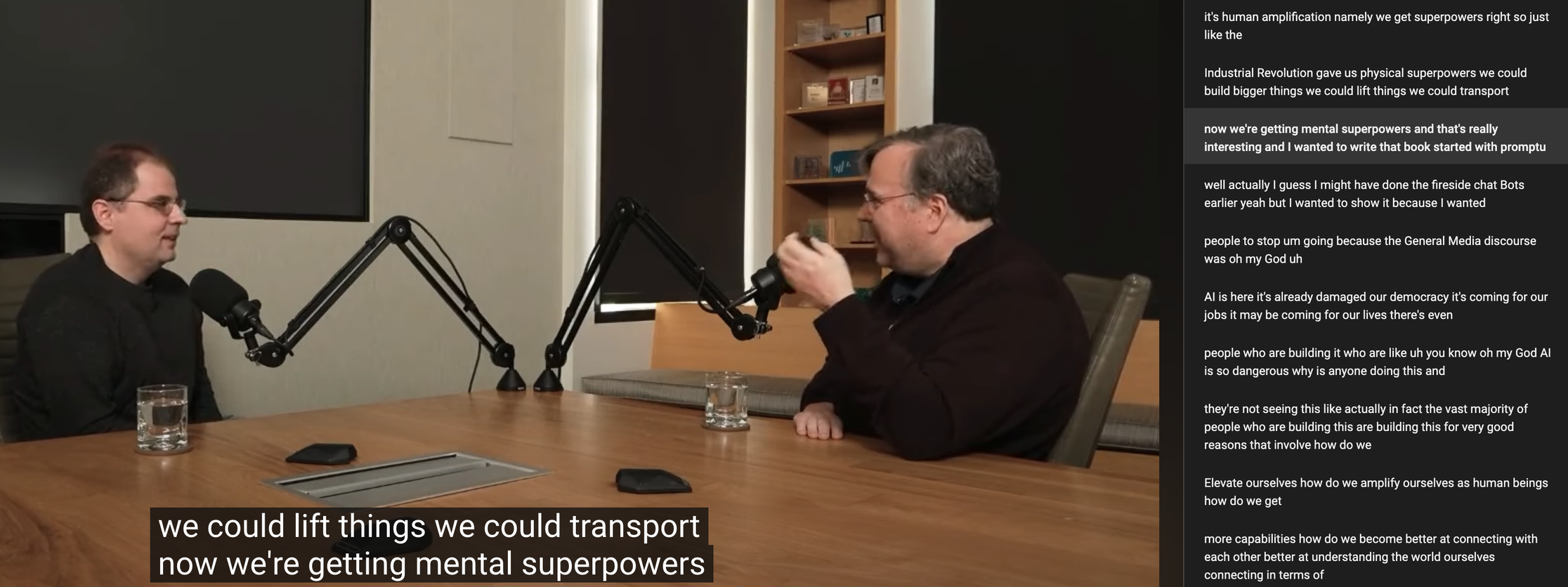
Summarizing Interview - Aleksander Madry, OpenAI Technical Staff
https://www.youtube.com/watch?v=hRbCWAODPOI
August 2, 2024
The rapid advancement of AI technology presents both opportunities and challenges. As AI becomes more integrated into various aspects of life, how can companies ensure that these technologies are used innovatively and ethically? What measures can be taken to navigate potential pitfalls and enhance human connections rather than causing harm?
Reid Hoffman, Co-founder of Inflection AI, Co-founder and executive chairman of LinkedIn, and Founding investor and former board member at OpenAI, has been at the forefront of addressing these questions. His vision and initiatives provide valuable insights into the responsible and transformative use of AI.
Human Amplification: Mental Superpowers
Hoffman often emphasizes the concept of human amplification through AI. He draws a parallel to the Industrial Revolution, which granted humanity physical superpowers—enabling us to build bigger structures, lift heavier objects, and transport goods across vast distances. Similarly, AI endows us with mental superpowers, enhancing our cognitive capabilities beyond natural human limits.
Hoffman explains, “We are now back in the game because, as opposed to programming, we’re programming learning machines.” This shift from traditional programming to creating machines that can learn and adapt is revolutionary. These learning machines can perform tasks and solve problems that were previously thought to be the exclusive domain of human intelligence.

The Equation of Pi: EQ + IQ
One of Hoffman’s key contributions to the AI discourse is the concept of “Pi,” which is the chatbot from his company, Inflection AI. Pi represents the combination of Emotional Quotient (EQ) and Intelligence Quotient (IQ). Hoffman believes that true human amplification involves not just intellectual enhancement but also emotional intelligence. As he states, “If you’re talking about human amplification, we’re not just IQ beings. We have lots of other modalities, emotions being a very significant one of them.”
This holistic approach to AI ensures that as we enhance our cognitive abilities, we do not lose sight of the emotional and ethical dimensions that make us human. The integration of EQ with IQ in AI systems, as exemplified by Pi, can lead to more empathetic and effective human-AI interactions.
SuperAgency: Redefining Human Agency
Hoffman’s upcoming book, SuperAgency, explores how technology, and AI in particular, redefines our notion of agency as human beings. He posits that while AI increases our agency by providing superpowers, it also changes the nature of that agency. This change requires us to rethink our roles and responsibilities in a world where AI is an integral part of our daily lives.
He emphasizes the importance of using AI to become better versions of ourselves—more intelligent, wise, and compassionate. “We want to be learning how to be better versions of ourselves, how to be intelligent, wise, compassionate, how to be engaging with other human beings,” Hoffman asserts.
The Duality of Innovation: Ship and Shipwreck
Hoffman often references the philosopher Paul Virilio, who stated, “When you invent the ship, you invent the shipwreck.” This aphorism highlights the dual nature of technological innovation. While new technologies bring unprecedented benefits, they also introduce new risks and challenges.
Hoffman expands on this idea by pointing out that with the invention of the ship, we not only created the possibility of shipwrecks but also the entire shipping civilization. This perspective encourages us to embrace innovation while being mindful of the potential downsides, ensuring that we build systems that can manage and mitigate these risks.
A Good Theory of Human Good
At the core of Hoffman’s vision for AI is the development of a comprehensive theory of human good. This theory should guide the creation and implementation of AI technologies to ensure they elevate the human condition. Hoffman advocates for AI that increases our capabilities, deepens our understanding of the world and each other, and fosters a more peaceful and compassionate society.
Hoffman believes that we should design AI to amplify human goodness. This involves creating systems that encourage positive human traits and behaviors, such as empathy, collaboration, and ethical decision-making. “We need an explicit theory about how do we help make human beings better,” he insists.
Inclusive Innovation: A Global Perspective
Hoffman stresses the importance of ensuring that the benefits of AI are inclusive and accessible to all. This means not only catering to markets that can afford high-end AI solutions but also addressing the needs of the Global South and other underrepresented communities.
1. Inclusive Benefits
When developing AI applications, such as medical assistants, it’s crucial to create versions that serve both affluent markets and those with fewer resources. Hoffman emphasizes, “If you make a medical assistant, don’t just provision it to people who might be able to pay you much more money than people in the Global South. Figure out how to do a version that also helps the Global South, even though the Global South may be poorer than a first-world market.”
2. Engagement and Dialogue
Effective AI development requires engaging with and understanding the needs and concerns of diverse communities. Hoffman advises, “Engage in conversations with these communities. Don’t just say, ‘Hey, we’re going to build it, and you’re going to like it.’ Instead, ask them, ‘What are your concerns? What are your needs?’ One of the things that a lot of Western academics and others don’t realize is that their top concern is ‘don’t leave me out.’ It’s not necessarily that they need you to build it in Spanish or French, but rather, they don’t want to be excluded.”
3. Supporting Startups and Entrepreneurs
To foster inclusive innovation, it’s essential to support startups and entrepreneurs in various regions. Hoffman highlights the importance of leveraging local talent to improve AI products and services. “Enable startups and entrepreneurs in these areas. There’s a lot of technological talent that can help make AI products, services, and technologies much better. Let’s make sure that the development loop is inclusive.”
The Ethical Use of AI
Ethics is a central theme in Hoffman’s approach to AI. He believes that AI should be developed and used in ways that align with ethical principles and enhance human welfare. This includes addressing potential risks and ensuring that AI systems are transparent, accountable, and fair.
Hoffman is critical of approaches that focus solely on the risks of AI without considering its potential benefits. He argues that a balanced perspective is necessary to harness the full potential of AI while mitigating its dangers. “We don’t want to kill the future that could be a doctor on every smartphone, a tutor on every smartphone for people of any age, anywhere in the world, massive elevation of humanity.”
The Role of AI in Healthcare
One of the most promising applications of AI is in the field of healthcare. Hoffman envisions a future where AI can provide accessible and affordable medical advice to billions of people around the world. “Billions and billions of people around the world who do not have access to a doctor can suddenly have an AI that’s trained for them that they can go, ‘Oh, my kid’s got dysentery and I don’t know what to do.’ And the AI could say, ‘Well, try some different water.’ We want those AIs. Those AIs are buildable today. We want them.”
By focusing on practical applications that address critical needs, AI can significantly improve global health outcomes and reduce disparities in healthcare access.
The Future of AI: Collaboration and Competition
Hoffman acknowledges that the development of AI involves both collaboration and competition. While competition drives innovation and excellence, collaboration is essential for addressing common challenges and ensuring that AI benefits humanity as a whole.
He emphasizes the importance of fostering a cooperative environment among AI developers, researchers, and policymakers. This includes sharing best practices, establishing common standards, and working together to address ethical and safety concerns.
Navigating Geopolitical Dynamics
AI development is also influenced by geopolitical dynamics, with different countries striving to lead in AI technology. Hoffman believes that democratic societies with strong ethical frameworks should play a leading role in AI development. He argues that the values and principles upheld by these societies are crucial for ensuring that AI is used for the common good.
He highlights the importance of international cooperation and dialogue to navigate the competitive landscape of AI. By working together, countries can develop AI technologies that respect human rights, promote social justice, and enhance global welfare.
The Path Forward: Optimism and Responsibility
Hoffman remains optimistic about the future of AI, but he also recognizes the need for responsible development and deployment. He believes that by embracing a balanced approach that considers both risks and benefits, we can create AI systems that transform society for the better.
He encourages leaders, developers, and policymakers to focus on the positive potential of AI while actively addressing its challenges. This involves not only technical innovation but also ethical leadership and a commitment to the broader social good.
Conclusion
Reid Hoffman’s vision for AI is one of human amplification, ethical innovation, and inclusive progress. By integrating emotional intelligence with cognitive enhancement, redefining human agency, and fostering global collaboration, he envisions a future where AI empowers individuals and communities to achieve their full potential.
As we navigate the complexities of AI development, Hoffman’s insights provide a roadmap for ensuring that AI technologies are used to create a more intelligent, compassionate, and equitable world. His emphasis on human collaboration, ethical considerations, and inclusive benefits underscores the importance of a holistic approach to AI—one that amplifies our humanity and elevates our collective well-being.
In this transformative journey, we must remember Hoffman’s guiding principle: “We want to be learning how to be better versions of ourselves, how to be intelligent, wise, compassionate, how to be engaging with other human beings.” By adhering to this principle, we can harness the power of AI to build a brighter future for all.