youtube.com/watch?v=_bn9Ek6_F8U&t=1725s
Summarizing highlights:
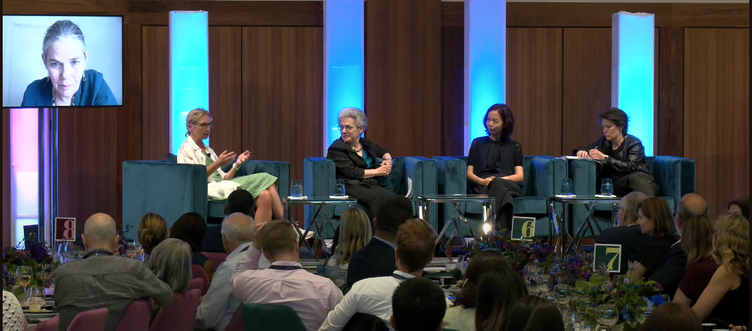
On a memorable evening at Stanford University, the Human-Centered AI (HAI) Institute celebrated its fifth anniversary by honoring the trailblazing women who have significantly contributed to the field of AI. The “Godmothers of AI” panel featured esteemed AI pioneers: Fei-Fei Li, Barbara Grosz, Corinna Cortes, and Daphne Koller. The discussion traversed the evolution of AI, the importance of interdisciplinary collaboration, and the ongoing challenges and opportunities in the field.
Fei-Fei Li: The Evolution and Ethical Imperative of AI
Fei-Fei Li opened the discussion by reflecting on the rapid advancement of AI technology over the past decade. She highlighted the convergence of computing power, neural network algorithms, and big data as pivotal to AI’s progress.
“AI amplifies who we are and it amplifies the best of us and the worst of us.” - Fei-Fei Li
Li emphasized the ethical responsibility of guiding AI development to benefit humanity. Her insights underscored the dual nature of AI as both a tool for incredible innovation and a potential amplifier of societal flaws.
Barbara Grosz: Pioneering Empirical Studies and Ethical AI
Barbara Grosz shared her journey and contributions to natural language processing and human-computer interaction. She recounted her pioneering work on designing empirical studies to understand human-computer dialogues.
“One of my first contributions was to design empirical studies to learn how people actually might talk to a computer system.” - Barbara Grosz
Grosz stressed the importance of integrating ethical considerations into AI development, a practice she has championed through her work in embedded ethics courses at Harvard and beyond.
Corinna Cortes: The Power of Interdisciplinary Collaboration
Corinna Cortes, known for her work in machine learning, emphasized the significance of interdisciplinary collaboration in tackling complex global challenges. She highlighted the interconnectedness of health, economy, and climate change.
“Understanding how all these factors they play together for our health and our economy, and not leaving the global South behind.” - Corinna Cortes
Cortes also advised future AI practitioners on the value of building strong support networks.
“Get yourself a study group or have a tight net of people.” - Corinna Cortes

Daphne Koller: Setting Ambitious Goals in AI Research
Daphne Koller, with her extensive background in both academia and industry, spoke about the transformative potential of AI in solving hard scientific and societal problems. She encouraged young researchers to aim high.
“Set your SES higher than you think is feasible because even if you don’t make it, you’ll aim higher than if you aim low.” - Daphne Koller
Audience Engagement: Addressing Gender Bias and Celebrating Impact
The panel also addressed questions from the audience, tackling issues of gender bias and the recognition of impactful work in AI. The speakers collectively emphasized the importance of continuous efforts to address bias and promote diversity in the field.
When asked about what kind of award they would create beyond profit-driven metrics, the panelists highlighted the value of meaningful contributions.
“I would give an award for the work that makes the greatest impact in making the world a better place.” - Panel Response
Conclusion: A Call to Action
The “Godmothers of AI” panel was a powerful reminder of the strides women have made in AI and the challenges that remain. It underscored the importance of ethical considerations, interdisciplinary collaboration, and setting ambitious goals. As we look to the future, it is crucial to continue fostering an inclusive and innovative environment in AI research and development.
This event not only celebrated the achievements of these remarkable women but also is inspirational for the next generation of AI practitioners to pursue their passions fearlessly and make a positive impact on the world.